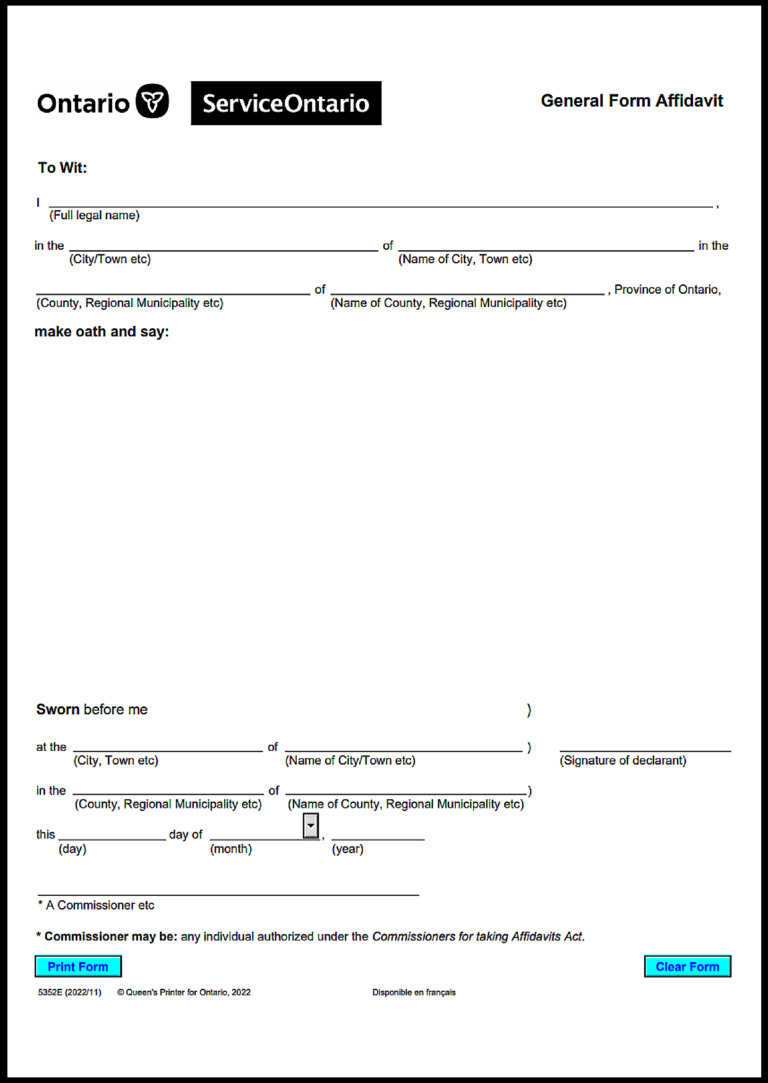
British Columbia Affidavit of Residence (Free Template & Guide)
British Columbia Affidavit of Residence is a legal document used to confirm where you live through a sworn statement. It is often required when regular address proof is not enough or not available.
In simple terms, an affidavit of residence is a written statement where you confirm your address under oath. This means you are legally saying the information is true.
I’ve seen many people in British Columbia run into delays with schools, banks, and immigration files because their affidavit was missing proper sworn details or was not signed correctly before a commissioner. When you are already stressed and trying to prove where you live, even a small mistake in this document can cause authorities to question the credibility of the information provided.
For example, a student may need this for school admission if they don’t have a utility bill in their name. A bank may ask for it during KYC verification. It can also be used in immigration, tenancy disputes, or government applications.
Under British Columbia law, this document is important because it is treated as legal evidence. That means authorities can rely on it when making decisions.
Last Updated: September 2026
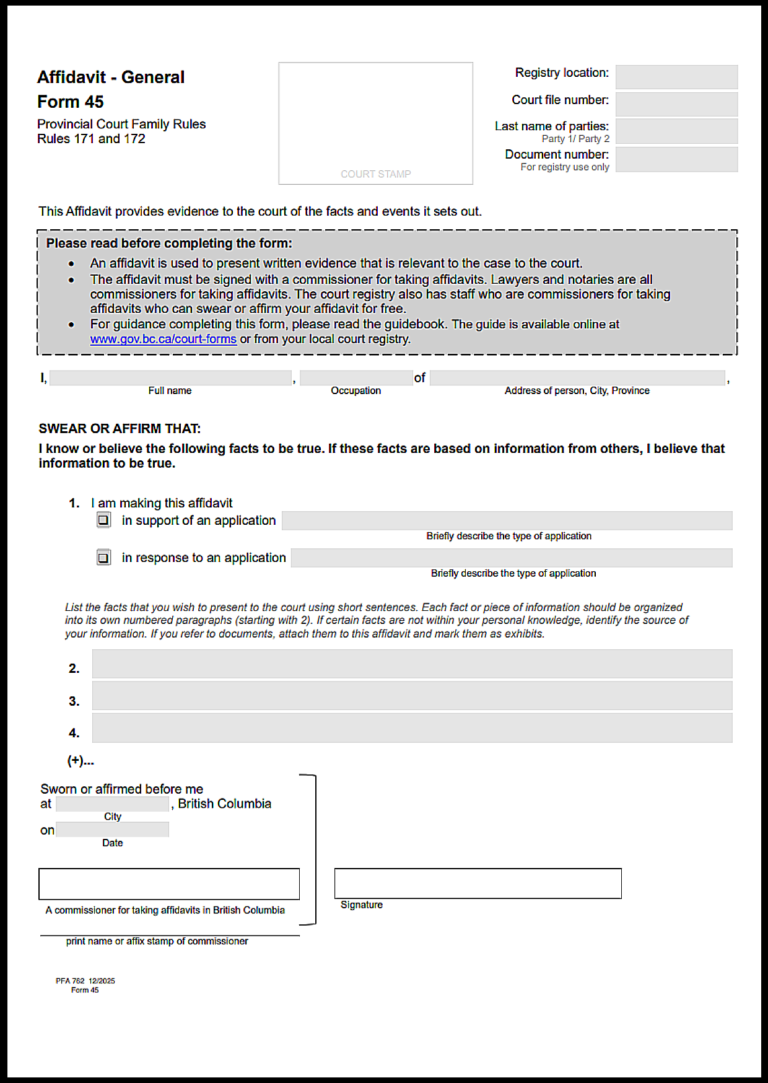
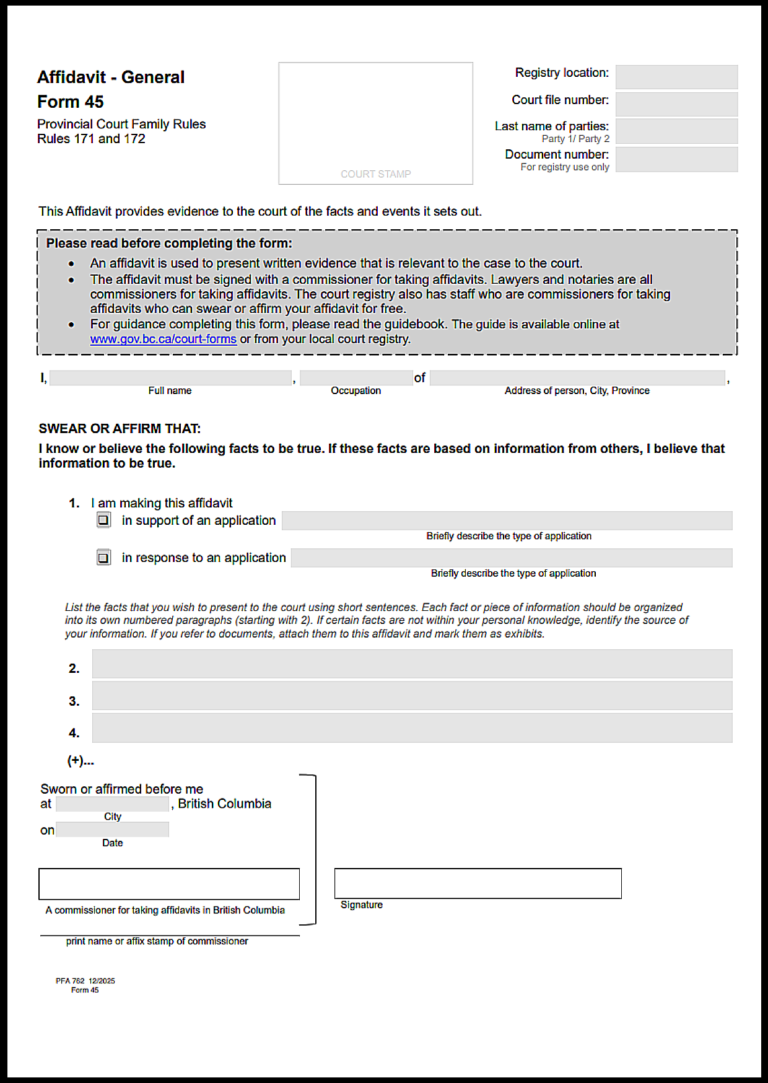
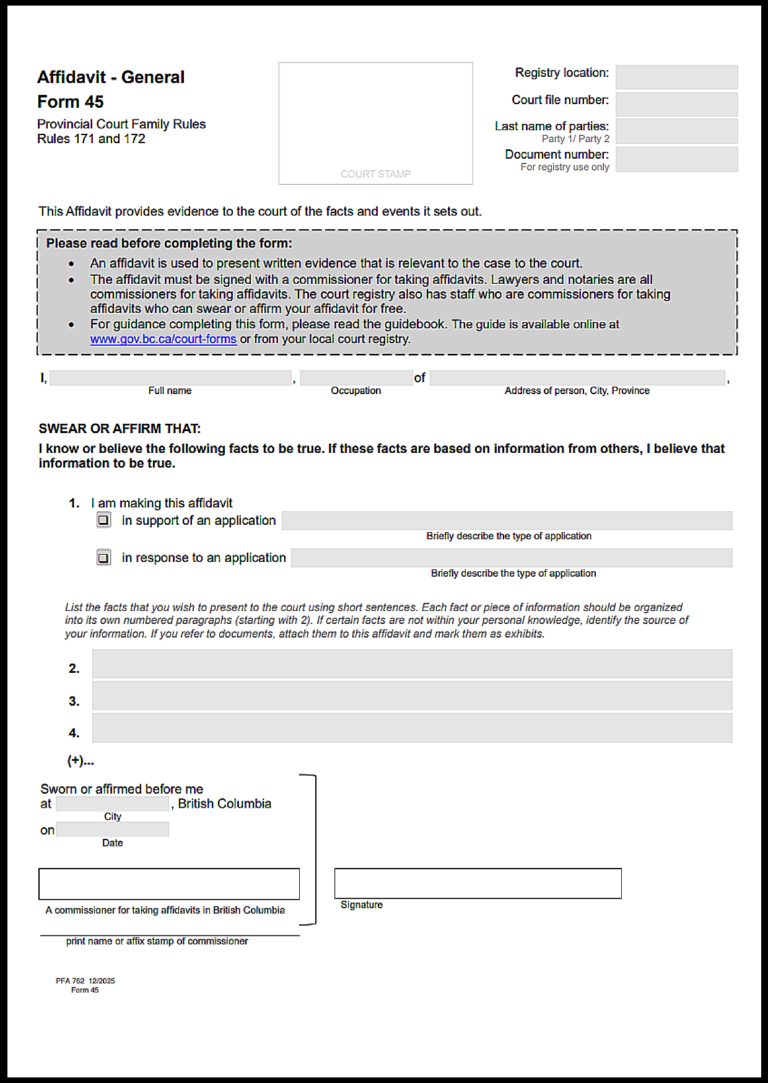
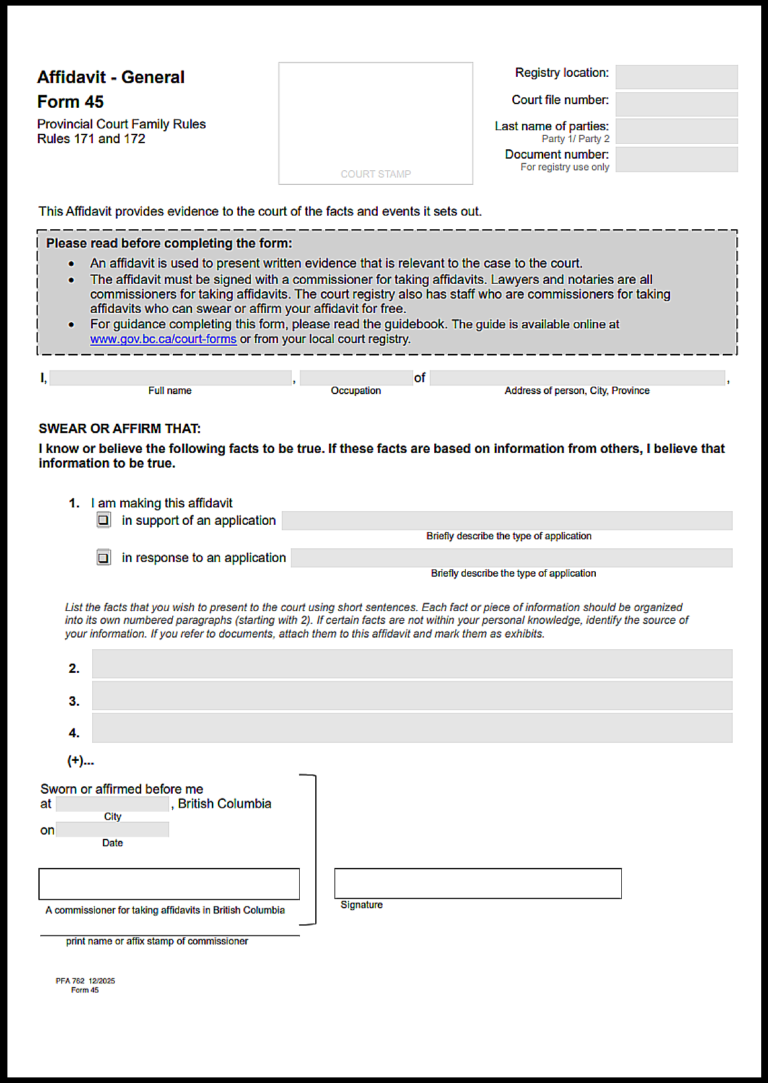
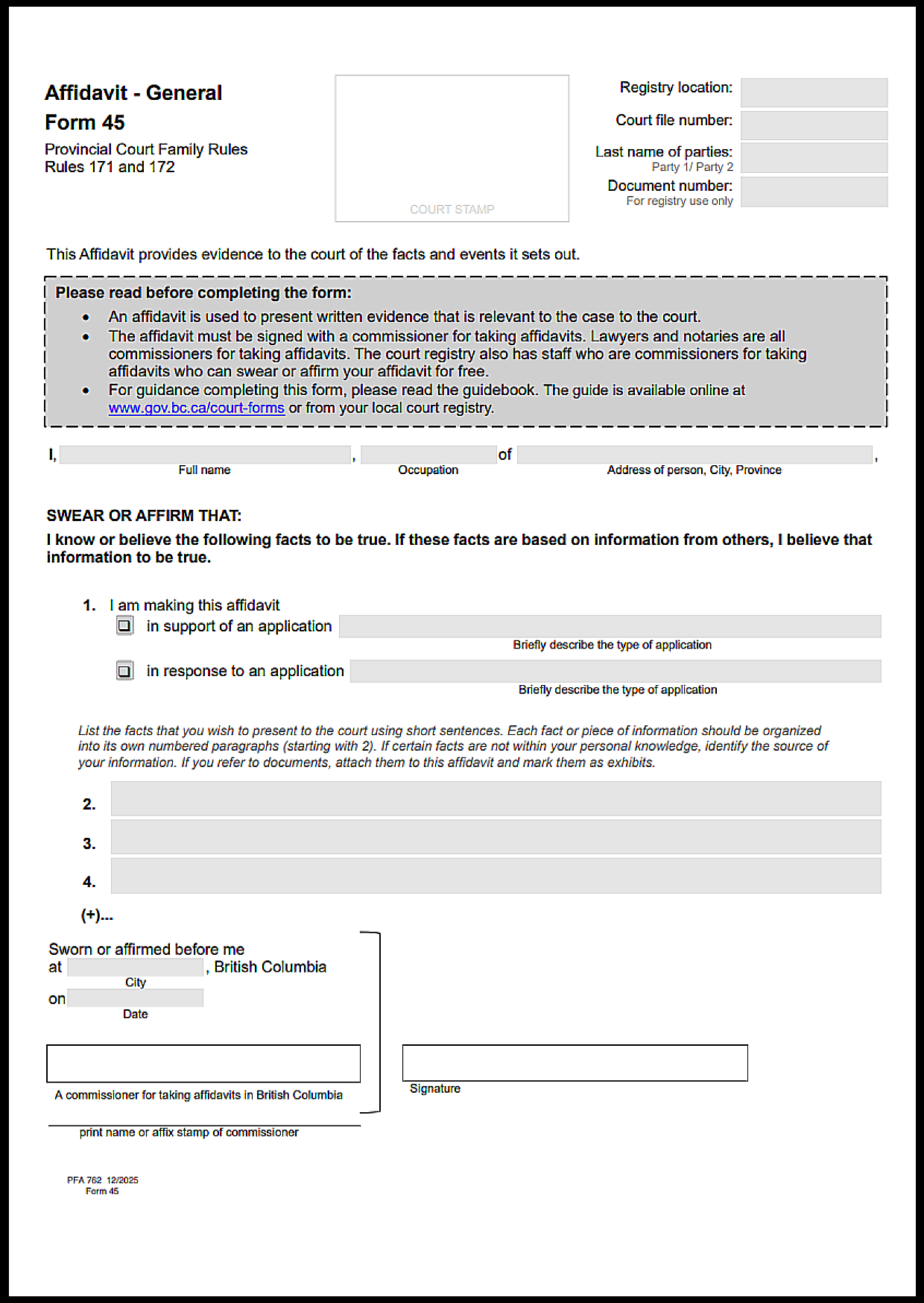
Free British Columbia Affidavit of Residence Template
Below is a clean and simple template you can copy and use. Make sure you fill it correctly and sign it in front of an authorized official.
British Columbia Affidavit Laws, Witness Rules, and Filing Requirements
| Topic / Issue | British Columbia Legal Rule | Governing Statute |
|---|---|---|
| Governing legislation | Affidavits in British Columbia are governed by the Evidence Act and, when used in court, the applicable court rules. A federal proceeding may also be subject to federal legislation and the rules of the relevant federal court or tribunal. | Evidence Act, RSBC 1996, c. 124; Supreme Court Civil Rules; Provincial Court Family Rules; Canada Evidence Act, R.S.C., 1985, c. C-5 |
| Remote commissioning | British Columbia’s court rules permit affidavits to be sworn or affirmed by video conference in specified circumstances. The applicable court rule requires prescribed wording confirming the video-conference process. | Supreme Court Civil Rules, Rule 22-2; Supreme Court Family Rules |
| Who signs the affidavit | The person making the affidavit must swear or affirm it and sign it, while the person before whom it is sworn or affirmed completes the required statement. | Supreme Court Civil Rules, Rule 22-2 |
| Witness requirement | An affidavit must be sworn or affirmed before a person authorized to take affidavits, such as an authorized commissioner, practising lawyer, or notary public. | Evidence Act; applicable court rules |
| Authorized persons | Persons authorized to take affidavits in British Columbia include practising lawyers, notaries public, judges, certain registrars, and other persons authorized under the Evidence Act. | Evidence Act, ss. 56–60 |
| Disqualified witnesses | The person taking the affidavit must be legally authorized to do so and must follow the applicable professional and procedural requirements. | Evidence Act; applicable professional and court rules |
| Age and capacity | The Evidence Act does not impose a general requirement that every affidavit deponent be 19. The person making the affidavit must be capable of making the statement and must understand the oath or solemn affirmation. | Evidence Act; applicable rules |
| Mental capacity | The person making the affidavit must understand the statement being made and the oath or solemn affirmation being administered. | Evidence Act and applicable court rules |
| Filing deadlines | There is no universal deadline for making an affidavit. Any deadline depends on the court rule, order, legislation, or administrative process for which the affidavit is required. | Applicable process |
| Required jurat clause | A court affidavit must contain the jurat or statement required by the applicable court rules, including the required details about when and where it was sworn or affirmed. | Supreme Court Civil Rules, Rule 22-2 |
| Commissioner identification | The commissioner must complete the required jurat or statement and provide the identification required by the applicable court form or rule. | Supreme Court Civil Rules, Rule 22-2 |
| Virtual commissioning wording | For a Supreme Court affidavit sworn or affirmed by video conference, the affidavit must include the statement required by Rule 22-2(6.1) confirming the video-conference process. | Supreme Court Civil Rules, Rule 22-2(6.1) |
| Court filing use | An affidavit used in a BC court proceeding must comply with the rules and filing requirements of that court and proceeding. Provincial Court family proceedings have their own forms and requirements. | Supreme Court Civil Rules; Provincial Court Family Rules |
| Real estate or tax filing | Some land, tax, or administrative processes may require an affidavit or statutory declaration, but the filing requirement depends on the particular transaction or program. | Process-specific legislation and government requirements |
| Private-use affidavits | An affidavit prepared for a private or administrative purpose is not automatically filed with a government office; filing depends on the organization or process requesting it. | Process-specific |
| Improper jurat | Missing or incorrect commissioner details can create an irregularity and may require correction or cause the document to be questioned, but a defect does not automatically prevent an affidavit from being received in evidence. | Evidence Act, s. 67; applicable court rules |
| Failure of presence | The affidavit must be sworn or affirmed before an authorized person in accordance with the applicable rules, which may permit attendance by video conference. | Supreme Court Civil Rules, Rule 22-2(6.1) |
| Hearsay restrictions | In Supreme Court civil proceedings, Rule 22-2 limits affidavit evidence. Statements based on information and belief are permitted in the circumstances set out in Rule 22-2(13), including where the source is identified. | Supreme Court Civil Rules, Rule 22-2 |
| Lawyers as commissioners | Practising lawyers in British Columbia are authorized to act as commissioners for taking affidavits under the Evidence Act. | Evidence Act, s. 60 |
| Seal requirements | The applicable court form or rule governs the commissioner’s required identification or stamp; a physical embossed seal should not be presented as a universal requirement. | Applicable court rules and forms |
Do not treat an affidavit as already sworn simply because you signed it at home. It must be properly sworn or affirmed before an authorized person for the intended use. For BC Supreme Court affidavits completed by video conference, Rule 22-2(6.1) also requires specific wording confirming the video-conference process.
Hearsay can matter when an affidavit is used in court. In Supreme Court civil proceedings, Rule 22-2 limits affidavit evidence and sets out when information-and-belief statements may be used. Procedural defects should also be addressed carefully rather than assumed to make the affidavit automatically invalid.
To avoid these problems, download the free British Columbia Affidavit of Residence template and complete it carefully before having it sworn or affirmed.
An affidavit of residence is commonly used to confirm a person’s address for legal, financial, or administrative purposes. To understand how sworn declarations are generally structured, you can review the complete affidavit guide for Canada together with the British Columbia sworn affidavit template used for formal declarations.
What Is an Affidavit of Residence in British Columbia?
An affidavit of residence is a sworn or affirmed statement about where you live. It can provide formal evidence of residence, but whether it is accepted and what weight it receives depends on the purpose and proceeding.
Many people confuse it with proof of address. Here is the difference:
| Type | Meaning | Example |
| Proof of Address | Regular document showing your address |
Utility bill, bank statement
|
| Affidavit of Residence | Sworn or affirmed statement confirming your address |
Affidavit made before an authorized person
|
In a particular situation, an organization may ask for an affidavit when:
- You don’t have documents in your name
- Your existing documents are outdated
- The organization requires a formal sworn statement
Under British Columbia law, an affidavit can be used as evidence when the applicable process permits it. Knowingly making a false statement under oath or solemn affirmation, with intent to mislead, can constitute perjury where the circumstances covered by section 131 of the Criminal Code are met.
Supporting legal verification documents may also be required depending on the situation involved. Some individuals may need an affidavit of identity form, while others may need instructions for notarizing an affidavit in British Columbia before submission.
When You Need an Affidavit of Residence
This document can be used in different administrative, financial, or legal situations. Common examples include:
- School or college admission
A student living with relatives may be asked for a residence affidavit if ordinary address records are unavailable. - Immigration or visa documentation
An immigration authority may request a sworn statement as part of a particular application. - Banking or financial verification
A financial institution may request additional address documentation or a sworn statement where its normal verification documents are insufficient. - Tenant or landlord disputes
An affidavit may help provide evidence about where a person lives in a legal proceeding. - Government applications
A government program may request evidence of residence as part of its own eligibility or identification process.
In each case, the affidavit is only useful if the receiving organization or legal process permits it.
This type of document is sometimes requested alongside tenancy paperwork or other housing records to verify residency information during legal or rental-related processes.
Key Details Required in This Affidavit
Deponent (Person Making Statement)
- Full legal name
- Current address
Residence Information
- Exact full address
- How long you have lived there
Purpose of Affidavit
- Clear reason for making the affidavit
Supporting Documents
- Utility bills
- Lease agreement
- Government ID
Supporting documents are not universally required. Include them when the recipient or applicable proceeding asks for them or when they help support the facts stated in the affidavit.
Commissioner for Oaths Section
- Signature of official
- Required commissioner identification or stamp
These details should be accurate and consistent with any supporting documents you attach.
Oath vs Affirmation (Important Difference)
When signing an affidavit, you may make an oath or a solemn affirmation.
- Oath → A solemn form of commitment used when making the sworn statement
- Affirmation → A solemn affirmation that can be used instead of an oath
Under British Columbia law, a solemn affirmation has the same force and effect as an oath.
You may use the form of oath or affirmation that is appropriate for you and permitted by the applicable procedure.
How to Fill an Affidavit of Residence (Step-by-Step)
Step 1: Add Your Personal Details
Write your full legal name and current address clearly. Use the name and details required by the organization or proceeding receiving the affidavit.
Step 2: Write Correct Address Information
Include the full address with city and province. Make sure the information is accurate and consistent with any supporting documents you provide.
Step 3: Clearly State the Purpose
Explain why you are making the affidavit. Keep it simple and specific.
Step 4: Attach Supporting Proof (if needed)
Add copies of documents like:
- Utility bill
- Lease agreement
- ID card
Only attach documents that are relevant or requested for the intended use.
Step 5: Sign in Front of a Commissioner
Do not sign the affidavit at home and present it as already sworn. The affidavit must be properly sworn or affirmed before an authorized person for the intended use.
The exact procedure can differ where video-conference commissioning is permitted under the applicable court rules.
Who Can Witness the Affidavit in BC?
An affidavit must be sworn or affirmed before an authorized person. This can include:
- Commissioner for Oaths
- Notary Public
- Practising lawyer
- Other persons authorized under the Evidence Act
The person before whom you make the affidavit must have the authority required for your particular purpose. You should not sign the document and treat it as sworn without completing that process.
Legal Rules in British Columbia You Should Know
Under British Columbia law and the applicable court rules, affidavits must meet the requirements of the process in which they are being used.
- Must be sworn or affirmed before an authorized person
- Must contain truthful information
- Must follow the applicable form and content requirements
- Supporting documents should be accurate and consistent with the statements they support
Knowingly making a false statement under oath or solemn affirmation, with intent to mislead, can constitute perjury where the circumstances covered by section 131 of the Criminal Code are met.
| Rule | Why It Matters |
| Swear or affirm before an authorized person |
Completes the affidavit process
|
| Provide truthful information |
Reduces the risk of legal consequences
|
| Use consistent supporting documents |
Helps the recipient verify the information
|
| Follow the applicable format |
Helps meet court or organizational requirements
|
Common Mistakes That Make Affidavits Invalid
Many affidavit problems are caused by simple errors:
- Signing before meeting the commissioner
- Incorrect or incomplete address
- No clear purpose when one is required
- Missing signature or required date
- Providing false or unsupported information
Errors can cause an affidavit to be questioned, returned, or require correction, depending on how and where it will be used. An irregularity does not automatically prevent an affidavit from being received in evidence.
When an Affidavit of Residence May Be Rejected
A recipient or court may question, return, or refuse to rely on an affidavit if:
- The address information cannot be adequately verified
- Supporting documents conflict with the statement
- The affidavit was not properly sworn or affirmed
- Required information or formatting is missing
- The document is unclear or unreadable
Before submitting, check the requirements of the particular court, government agency, school, bank, or other organization requesting the affidavit.
Affidavit vs Proof of Address
An affidavit and ordinary proof of address serve different purposes. An affidavit is a sworn or affirmed statement, while proof of address is usually an existing document such as a bill or account statement.
| Feature | Affidavit of Residence |
Proof of Address
|
| Type | Sworn or affirmed statement |
Regular document
|
| Legal Value | Sworn evidence when the applicable process permits it |
Ordinary documentary verification
|
| Requirement | Must be properly sworn or affirmed for use as an affidavit |
Usually no oath or commissioner required
|
| Use Case | Legal, administrative, or special verification |
Everyday identity or address verification
|
Institutions may prefer ordinary proof of address where it is sufficient. An affidavit may be requested when additional formal evidence is needed.
FAQs
Is an affidavit of residence legally valid in BC?
A properly sworn or affirmed affidavit can be a valid sworn statement, but whether an affidavit of residence will be accepted depends on the requirements of the court, authority, or organization receiving it.
Can I write it myself?
Yes. You can generally draft your own affidavit, but it must be properly sworn or affirmed before a person authorized to take affidavits for the intended use.
Do I need a lawyer?
A lawyer is not generally required simply to prepare an affidavit. Professional advice may still be useful where the affidavit will be used in a court proceeding or complex legal matter.
How much does it cost to notarize?
Fees vary by provider and by the service requested. Check the current fee charged by the commissioner or notary you plan to use.
Can I use it for immigration or banking?
It may be accepted when the relevant immigration authority or financial institution permits an affidavit for that purpose, but you should follow that organization’s specific document requirements.
Legal Disclaimer: This article provides general legal information about affidavits in British Columbia and is not legal advice. Requirements can differ depending on the court, government agency, financial institution, or other organization requesting the affidavit.