Is Bill of Sale Required Manitoba? (Know Legal Rules)
Is Bill of Sale Required Manitoba? In most private sale situations, Manitoba law does not require a written bill of sale for every item. However, having one is strongly recommended because it helps prove ownership, payment, and the terms of the sale if problems happen later.
A bill of sale is a simple document that records a transaction between a buyer and seller. In Manitoba, people commonly use it for cars, trucks, trailers, boats, farm equipment, electronics, furniture, and other valuable personal property. Vehicle sales are handled differently from ordinary private sales. Under Manitoba law, vehicle ownership transfers must go through Manitoba Public Insurance (MPI), and certain ownership documents are required during registration.
Even when a written bill of sale is not legally mandatory, keeping one protects both the buyer and seller. It creates a clear record of payment, ownership transfer, and the condition of the item at the time of sale. This article explains Manitoba bill of sale rules, vehicle transfer requirements, “As-Is” clauses, taxes, and common legal mistakes buyers and sellers should avoid.
Last Updated: October 2026
Is a Bill of Sale Legally Required in Manitoba? Registration, Tax & Ownership Rules
| Topic / Issue | Manitoba Legal Rule | Governing Statute |
|---|---|---|
| Bill of sale requirement for private transfers | For a private vehicle sale, MPI requires the buyer and seller to complete a written bill of sale and the Transfer of Ownership (TOD) document. Requirements for other assets depend on the transaction and any applicable registration process. | The Drivers and Vehicles Act, C.C.S.M. c. D104; MPI Registration Standards |
| Tax collection authority | MPI collects Retail Sales Tax during qualifying private transfer registrations. | The Retail Sales Tax Act, C.C.S.M. c. R130 |
| Federal vessel ownership proof | Licensed boat transfers require proof of ownership documentation. | Canada Shipping Act, 2001, S.C. 2001, c. 26; Small Vessel Regulations (SOR/2010-91) |
| Digital and copied documents | Do not assume that a photocopy or digital scan will be accepted for every transaction. Confirm the document format required by MPI or the relevant licensing authority for the specific transfer. | MPI Document Processing Policy |
| Dealership purchase exemption | For a new vehicle or trailer purchased from a dealer, the dealer’s sales and ownership documents may differ from the paperwork used for a private sale. Confirm the documents required for the particular registration with MPI or an Autopac agent. | The Drivers and Vehicles Act, C.C.S.M. c. D104 |
| Family gift transfers | A qualifying family gift may be eligible for a Retail Sales Tax exemption, but eligibility and supporting-document requirements depend on the relationship and transaction. Confirm the current MPI and Manitoba Finance requirements before registering the vehicle. | The Retail Sales Tax Act, C.C.S.M. c. R130 |
| Required transaction date | The exact sale date should appear clearly on the document. | MPI and Transport Canada processing requirements |
| Purchase price disclosure | The final purchase price or gift/trade arrangement should be stated explicitly. | MPI and Transport Canada processing requirements |
| Required buyer and seller details | Bills of sale should contain legal names, addresses, and signatures of all parties. | MPI and Transport Canada processing requirements |
| Vehicle information requirements | For a vehicle bill of sale, MPI says to include the vehicle’s year, make, model, serial number, and agreed selling price. Include other identifying details, such as odometer information, where applicable and required for the transaction. | The Drivers and Vehicles Act, C.C.S.M. c. D104 |
| Boat information requirements | Boat sales should include HIN and Pleasure Craft Licence information where applicable. | Canada Shipping Act, 2001; Small Vessel Regulations |
| Dual-document registration rule | For a private vehicle sale, MPI requires both a written bill of sale and the signed Transfer of Ownership (TOD) document. Confirm the applicable paperwork separately for a trailer or other registrable property. | The Drivers and Vehicles Act, C.C.S.M. c. D104 |
| Seven-day transfer grace period | Do not rely on a general seven-day grace period without checking the specific circumstances. Before driving a newly purchased vehicle, confirm the applicable registration, insurance, and temporary operating-permit requirements with MPI or an Autopac agent. | The Drivers and Vehicles Act, C.C.S.M. c. D104 |
| Registration denial without bill of sale | If the bill of sale or other required ownership documents are missing or incomplete, MPI may be unable to complete the registration until the issue is resolved. Ask MPI what alternative proof, if any, is accepted for the specific transaction. | MPI registration procedures |
| Estate transfer restriction | Estate-related transfers may require documents showing the representative’s authority and the basis for the transfer. The exact paperwork depends on the property and circumstances, so confirm the requirements with MPI or the relevant authority before proceeding. | Manitoba probate and property law principles |
| Altered sale price risk | Changes to the agreed purchase price should be acknowledged by both parties and documented clearly. An unexplained alteration may create a dispute about the terms of the sale or prompt questions during registration or tax processing. | Manitoba common law contract principles |
| Manitoba TOD enforcement | For a private vehicle sale, MPI requires the completed Transfer of Ownership (TOD) document as part of the registration process. If the original document is unavailable, contact MPI to confirm whether any alternative process is available. | The Drivers and Vehicles Act, C.C.S.M. c. D104 |
| Real-time tax valuation review | For certain motor vehicle and off-road vehicle acquisitions, Manitoba’s Retail Sales Tax Act may require the taxable value to be based on the greater of the purchase price and average wholesale price. A qualifying appraisal may be considered where the statutory conditions are met. | MPI valuation and tax assessment procedures |
For a boat transaction, record identifying information such as the hull identification number (HIN), where applicable, and any Pleasure Craft Licence number. Federal licensing and proof-of-ownership requirements depend on whether the boat must be licensed and on the type of transfer. Check Transport Canada’s current instructions when transferring a Canadian Pleasure Craft Licence. See buying or selling a boat privately in Manitoba.
A written bill of sale is useful evidence of a private transaction, but the documents required depend on the property being sold. For a private vehicle sale, MPI says the buyer and seller need to complete both a written bill of sale and the Transfer of Ownership (TOD) document. Boat owners should separately check whether federal Pleasure Craft Licence or other proof-of-ownership requirements apply. Do not assume the vehicle process applies to every trailer or boat.
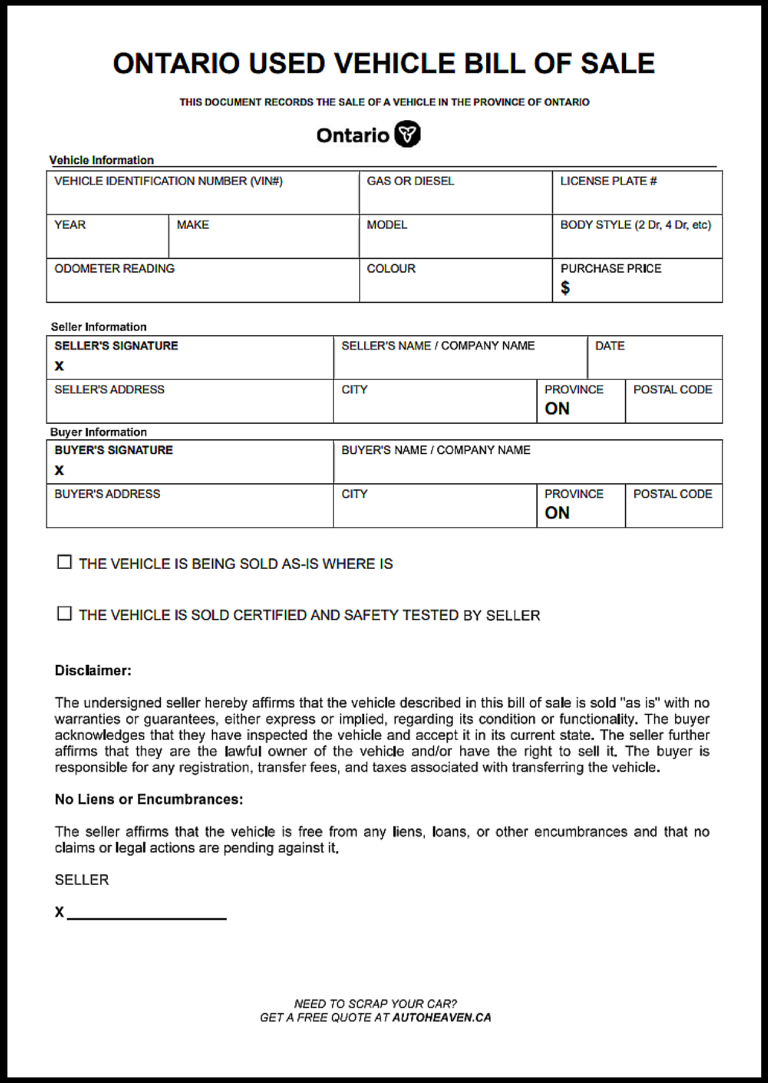
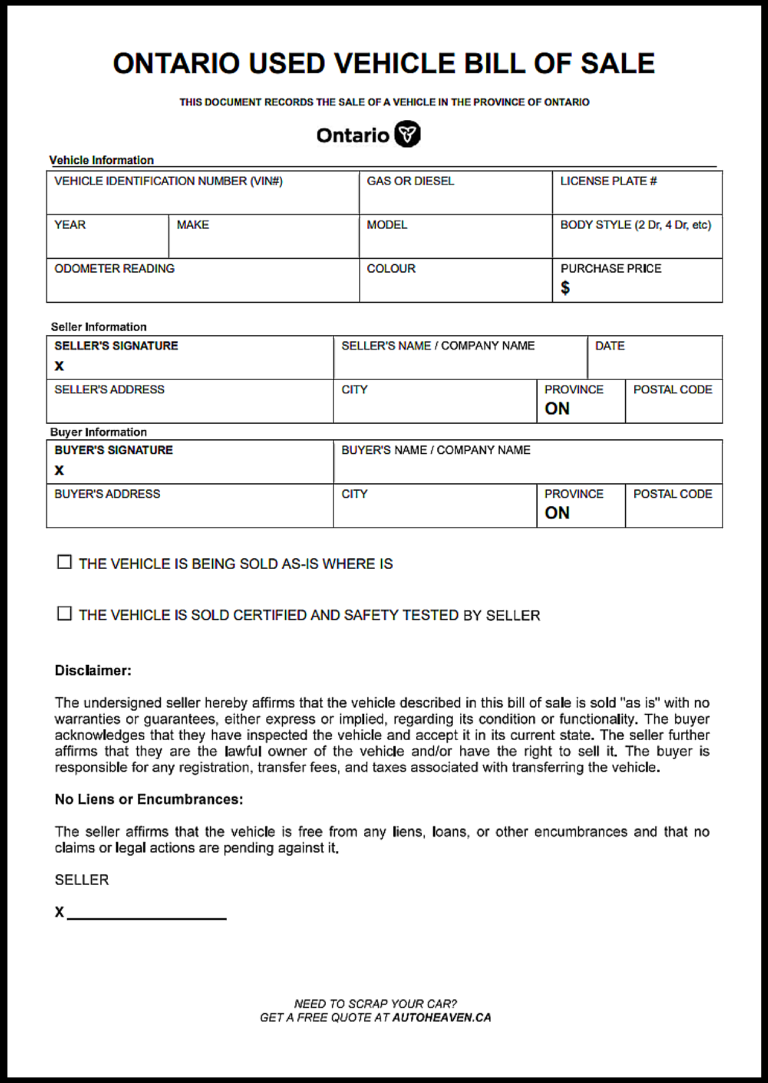
Tax valuation can affect the amount payable when a vehicle is registered. Under section 2.2 of Manitoba’s Retail Sales Tax Act, the taxable value of certain motor vehicle and off-road vehicle acquisitions may be the greater of the purchase price and average wholesale price. The Act provides for market value in qualifying circumstances where an appraisal supports a lower value because of severe damage or excessive use. Complete the paperwork accurately, keep signed copies, and confirm the applicable requirements with MPI before registration. The free Manitoba Bill of Sale template below can help record the transaction details.
Is a Bill of Sale Legally Required in Manitoba?
For General Personal Property Sales
Under Manitoba law, a written bill of sale is not legally required for every private sale.
In many situations, verbal agreements can still be legally valid under common contract principles. For example, if someone privately sells a used couch, refrigerator, or lawn tool, the agreement may still be enforceable even without paperwork.
However, verbal agreements often create problems later if the parties disagree about:
-
The sale price
-
Ownership
-
Payment status
-
The condition of the item
That is why most buyers and sellers still prefer written proof.
A bill of sale is especially helpful when selling:
-
Used electronics
-
Appliances
-
Farm equipment
-
Expensive personal property
Without written records, proving ownership later can become difficult.
For Vehicle Sales in Manitoba
Vehicle sales follow stricter legal rules.
For a private vehicle sale, the buyer and seller must complete the transfer paperwork required by Manitoba Public Insurance (MPI). The seller provides the Transfer of Ownership (TOD) document, found on the back of the vehicle registration card, and both parties should complete a written bill of sale.
MPI also commonly requests a bill of sale for:
-
Ownership verification
-
Tax assessment
-
Registration processing
In practice, most private vehicle sales in Manitoba include both:
-
A signed TOD
-
A bill of sale
Why Most Buyers and Sellers Still Use One
Even when not legally required, a Manitoba bill of sale provides important protection.
It helps provide:
-
Proof of payment
-
Proof of ownership transfer
-
Tax documentation
-
Protection against future disputes
-
Evidence for insurance claims
-
Fraud protection
For sellers, it can help prove the exact date they gave up ownership. For buyers, it helps show the item was legally purchased.
Manitoba Laws That Affect Bills of Sale
The Sale of Goods Act
The Sale of Goods Act applies to many private sales in Manitoba.
Under Manitoba law, sellers are generally expected to provide “quiet possession.” This means the buyer should be able to use the property without another person later claiming ownership rights.
The law also protects buyers against undisclosed liens or encumbrances. For example, if a financed trailer still has unpaid debt attached to it, the buyer could face legal complications later.
Section 56 of Manitoba’s Sale of Goods Act says certain rights, duties, or liabilities implied by law may be excluded or varied by express agreement, subject to the law that applies to the transaction. Sellers sometimes use wording such as:
“Sold As-Is, Where-Is.”
The effect of this wording depends on the agreement and applicable law. It does not automatically protect a seller from fraud, misrepresentation, or obligations that cannot legally be excluded.
The Drivers and Vehicles Act
Vehicle sales involve additional registration requirements under Manitoba law and MPI procedures. For a private sale, the buyer and seller should complete the Transfer of Ownership (TOD) document and a written bill of sale. MPI says the bill of sale should describe the vehicle’s year, make, model, serial number, and agreed selling price. Check the vehicle’s identifying number against the registration paperwork, and ask MPI about any additional inspection, registration, or licensing requirements that apply to the vehicle and buyer.
The Personal Property Security Act (PPSA)
The PPSA mainly affects financed property.
If a vehicle, trailer, or equipment still has financing attached to it, the lender may hold a registered security interest.
This creates risks for buyers because unpaid loans can sometimes remain connected to the property even after a sale.
Before buying expensive property, many buyers perform a PPSA search to check for:
-
Outstanding loans
-
Registered liens
-
Existing security interests
Before preparing transfer paperwork, buyers may also benefit from reviewing the difference between ownership records and a bill of sale in Manitoba together with the step-by-step guide for writing a Manitoba bill of sale to ensure all required transaction details are included.
What Should Be Included in a Manitoba Bill of Sale?
Buyer and Seller Information
A proper bill of sale should clearly identify both parties.
Include:
-
Full legal names
-
Addresses
-
Contact details
Using incomplete names or nicknames can create confusion later.
Description of the Item
The description should clearly identify the property being sold.
Important details may include:
-
Make and model
-
Year
-
Colour
-
Serial number
-
VIN for vehicles
A vague description can create ownership disputes later.
Sale Price and Payment Details
The document should clearly state:
-
Exact purchase price
-
Deposit amount
-
Payment method
-
Whether payment was completed in full
Accurate sale pricing is especially important for vehicle tax purposes in Manitoba.
Date of Sale
The sale date matters for:
-
Ownership disputes
-
Tax records
-
Insurance issues
-
Liability questions
For vehicles, it may help prove when responsibility transferred from seller to buyer.
Signatures
Both parties should sign the bill of sale.
An ordinary private bill of sale does not generally need to be witnessed as part of MPI’s routine vehicle-sale process. Confirm any additional signing or witnessing requirements that may apply to a special transaction or separate document.
Still, signed documents provide much stronger legal evidence than unsigned agreements.
Vehicle Bill of Sale Rules in Manitoba
Odometer Disclosure Requirements
Vehicle sellers in Manitoba must disclose mileage information.
The standard wording commonly used is:
“I/We certify that the odometer reading is [Mileage] and to the best of my/our knowledge it reflects the actual distance the vehicle has been driven.”
Incorrect mileage statements can create serious legal disputes later.
VIN Verification Rules
The Vehicle Identification Number (VIN) is one of the most important parts of a vehicle sale.
Buyers should confirm:
-
The VIN matches the registration
-
The VIN plate appears genuine
-
The VIN has not been altered or damaged
Selling a vehicle with a tampered VIN is illegal in Manitoba.
Transfer of Ownership Through MPI
Vehicle ownership transfers must be completed through MPI.
The process commonly includes:
| Requirement | Purpose |
| Transfer of Ownership Document (TOD) |
Records the vehicle ownership transfer
|
| Bill of sale |
Confirms the transaction details and agreed purchase price
|
| Registration paperwork |
Registers the vehicle in the buyer’s name
|
| Retail Sales Tax payment |
Required for most private vehicle sales unless an exemption applies
|
When registering a privately purchased vehicle in Manitoba, the buyer generally pays the applicable 7% Retail Sales Tax (RST), unless an exemption applies. Under section 2.2(5) of Manitoba’s Retail Sales Tax Act, the fair value of certain motor vehicle and off-road vehicle acquisitions is the greater of the purchase price and average wholesale price, subject to statutory exceptions. The Act defines average wholesale price by reference to a method authorized by the Minister or an estimate made by the Director; do not assume a particular commercial valuation guide applies in every case.
For motorcycles and other off-road vehicles, check with MPI or an Autopac agent how the applicable average wholesale price is determined for the specific vehicle. Avoid assuming that one named valuation guide is always used.
If the purchase price is below the applicable average wholesale price, tax may be calculated using the higher value. The Act allows market value to be considered in qualifying circumstances where an approved appraisal report supports a lower value because of severe damage or excessive use. Confirm the required appraisal form and process with MPI before registration.
Can You Register a Vehicle Without a Bill of Sale?
Sometimes MPI may accept alternative proof of purchase, but a bill of sale is commonly expected during private vehicle transfers.
Without one, buyers may face:
-
Registration delays
-
Extra document requests
-
Ownership verification problems
-
Tax assessment issues
Using a signed bill of sale is usually the safest approach.
“As-Is” Sales in Manitoba Explained
What “Sold As-Is, Where-Is” Means
An “as-is” sale records that the buyer is accepting property in its current condition, and the seller may be seeking to limit certain implied terms where the law allows. Under section 56 of Manitoba’s Sale of Goods Act, some implied rights and obligations may be excluded or varied by express agreement. However, the effect of an “as-is” clause depends on the transaction and any applicable consumer-protection rules. It does not excuse fraud or misrepresentation. See selling property in its current condition without warranties. For a sale by a business to a consumer, check the applicable provisions of Manitoba’s Consumer Protection Act before relying on such wording.
What Sellers Still Cannot Hide
An “As-Is” clause does not protect dishonest behaviour.
Sellers still cannot legally hide:
-
Fraud
-
Known serious defects intentionally concealed
-
VIN tampering
-
False ownership claims
-
Misleading statements
If a seller knowingly lies, legal action may still happen despite an “As-Is” clause.
Common Private Sale Problems
Many private sale disputes happen because buyers skip important checks before purchasing.
Common problems include:
-
Hidden liens
-
Odometer fraud
-
Mechanical defects
-
Ownership disputes
-
Missing paperwork
Good documentation helps reduce these risks.
Mistakes Buyers and Sellers Commonly Make
Using Incomplete Information
Even one missing detail can create registration or ownership problems later.
Common mistakes include:
-
Missing VIN numbers
-
Missing signatures
-
Incorrect names
-
Wrong purchase price
Always review paperwork carefully before signing.
Forgetting to Check for Liens
Some buyers assume the seller fully owns the property.
That assumption can become expensive if unpaid financing still exists.
A PPSA search can help reveal loans attached to:
-
Vehicles
-
Farm equipment
-
Trailers
-
Business assets
Underreporting the Sale Price
Some buyers and sellers may be tempted to report a purchase price that is lower than the amount actually paid. The bill of sale should state the true transaction price. Under section 2.2(5) of Manitoba’s Retail Sales Tax Act, the taxable value of certain motor vehicle and off-road vehicle acquisitions may be the greater of the purchase price and average wholesale price. A lower market value may be considered in qualifying circumstances if an approved appraisal report supports it because of severe damage or excessive use. Ask MPI or an Autopac agent which evidence is required; do not assume a particular book or appraisal report will automatically determine the tax.
Not Keeping Copies
Both parties should keep signed copies permanently.
Old bills of sale often become important years later during:
-
Insurance claims
-
Tax audits
-
Ownership disputes
-
Civil lawsuits
Digital scans are also useful backup records.
How to Properly Complete a Manitoba Bill of Sale
Step 1 — Gather Ownership Information
Before preparing the document, collect:
-
Registration paperwork
-
Serial numbers
-
VIN information
-
Government identification
This helps reduce mistakes during the transaction.
Step 2 — Write Accurate Sale Details
Carefully record:
-
Correct legal names
-
Exact purchase price
-
Payment details
-
Item condition
Avoid vague descriptions whenever possible.
Step 3 — Add Special Clauses if Needed
Some sales require additional terms.
Examples include:
-
“As-Is” wording
-
Deposit conditions
-
Payment schedules
-
Delivery arrangements
Clear wording helps prevent misunderstandings later.
Step 4 — Sign and Exchange Copies
Both parties should sign the document at the same time whenever possible.
Paper copies are still commonly used, but digital copies can also help with long-term record keeping.
Each party should immediately receive a signed copy.
Do Bills of Sale Need To Be Notarized in Manitoba?
General Rule
A routine private vehicle bill of sale in Manitoba is not generally required to be notarized under MPI’s ordinary sale process. The buyer and seller should complete and sign the written bill of sale and the required Transfer of Ownership (TOD) document. If a document is missing or the transaction involves an estate or other special circumstances, ask MPI or the relevant authority what additional proof is required.
Situations Where Extra Verification May Help
Although notarization is not generally required for a routine private vehicle bill of sale, additional verification or supporting documents may be needed in situations such as:
-
High-value equipment sales
-
Business asset transfers
-
Estate-related transactions
-
Cross-border transactions
Some parties choose notarization simply for stronger legal evidence.
Frequently Asked Questions
Is a handwritten bill of sale legal in Manitoba?
A handwritten bill of sale may be useful for a private sale if it clearly identifies the buyer and seller, describes the item, records the agreed price, and is signed by both parties. For a vehicle, make sure it also contains the details MPI requires and is accompanied by the required transfer paperwork.
Can I sell a car in Manitoba without a bill of sale?
For a private vehicle sale, MPI says the buyer and seller should complete both a written bill of sale and the Transfer of Ownership (TOD) document. Contact MPI if either document is missing and ask what options are available for your circumstances.
Does a bill of sale prove ownership?
It helps prove ownership transfer, but ownership may also depend on registration records and supporting documents.
What if the buyer never registers the vehicle?
This can create liability concerns for the seller. Sellers should keep copies of all signed transfer documents to help prove the sale date.
Can a bill of sale protect me from future disputes?
Yes. A properly written bill of sale can help provide evidence about payment, ownership transfer, item condition, and agreed terms.
Do trailers require a bill of sale in Manitoba?
Many trailer sales use a bill of sale, especially when transferring trailer ownership in Manitoba requires registration or tax documentation.
Is a witness required for a Manitoba bill of sale?
A witness is not generally part of MPI’s routine private vehicle-sale paperwork. However, a separate document or special transaction may have its own signing requirements, so confirm those requirements where applicable.