Free British Columbia Medical Power of Attorney (Template & Guide)
Many people searching for a British Columbia Medical Power of Attorney are actually trying to solve a different problem: making sure someone they trust can make health care decisions if they’re no longer able to speak for themselves. In BC, that authority is usually created through a Representation Agreement rather than the financial planning documents many people assume will cover medical issues, which is why the witnessing and signing rules under the Representation Agreement Act matter so much.
I’ve seen families arrive at a hospital carrying an Enduring Power of Attorney, only to discover that it doesn’t give them the authority they thought it did when urgent treatment decisions have to be made. Those situations often start with a generic Canadian template that ignores how British Columbia separates financial authority from personal and health care decision-making.
This page explains how these documents work in BC, when a Representation Agreement may be needed, and the execution requirements people often overlook until it’s too late.
Free British Columbia Medical Power of Attorney Template
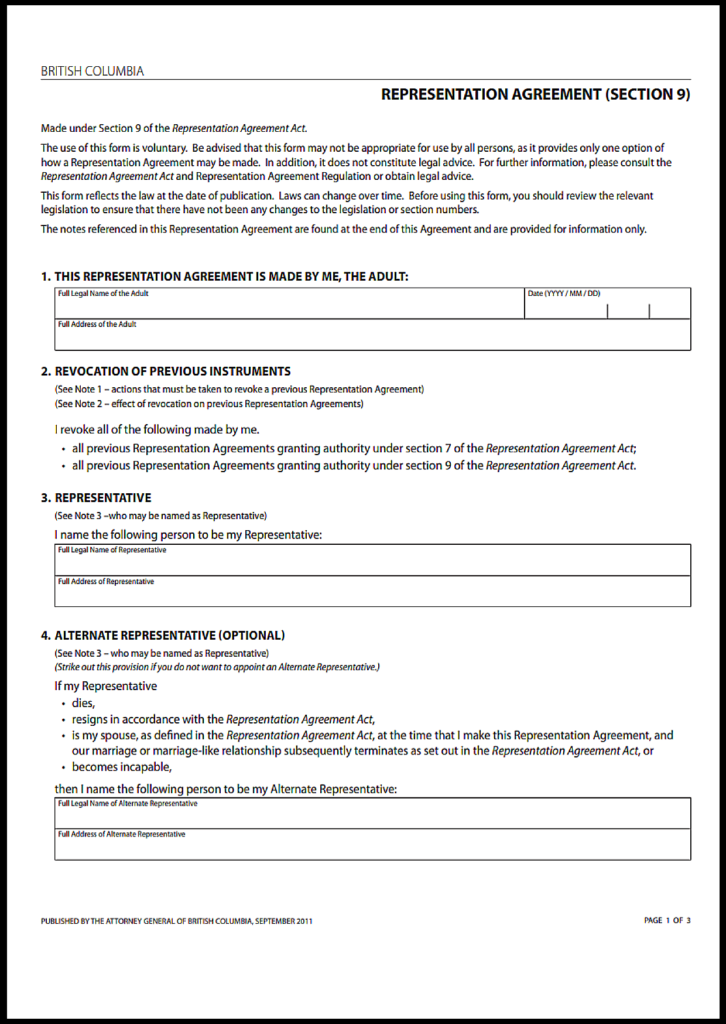
In British Columbia, a Medical Power of Attorney is commonly created through a Representation Agreement. Below is a clean, ready-to-use template you can copy and fill out.
British Columbia Representation Agreement Laws You Should Know
| Topic / Issue | British Columbia Legal Rule | Governing Statute |
|---|---|---|
| Correct Legal Document Name | In British Columbia, healthcare and personal care authority is created through a Representation Agreement, not a traditional Medical Power of Attorney. | Representation Agreement Act, RSBC 1996, c. 405 |
| Governing Health Consent Law | The default substitute decision-maker hierarchy applies if no agreement exists. | Health Care (Consent) and Care Facility (Admission) Act, RSBC 1996, c. 181 |
| Who Can Sign | The adult must be at least 19 years old, or a court-authorized person may sign. | Representation Agreement Act, s. 13 |
| Witness Requirements | Two witnesses must be present at the same time, or one witness is allowed only if that witness is a BC lawyer or BC notary. | Representation Agreement Act, s. 13 |
| Disqualified Witnesses | The representative, or their spouse, child, parent, or employee, generally cannot act as a witness. | Representation Agreement Act, s. 13 |
| Notarization Rule | Notarization is not required if two valid witnesses sign, but it is required when only one witness is used. | Representation Agreement Act, s. 13 |
| Capacity Requirement | Section 7 agreements use a lower standard of capacity than Section 9 agreements. | Representation Agreement Act, s. 8 and s. 9 |
| Expiry Rules | The agreement stays valid until revoked, death of the adult, or inability of the representative to act. | Representation Agreement Act, s. 29 |
| Mandatory Certificates | Required certificates for representatives and witnesses must be completed and attached. | Representation Agreement Regulation, B.C. Reg. 468/2003, Forms 1–4 |
| Section 7 Financial Authority | A Section 7 agreement must clearly state if it includes routine management of financial affairs. | Representation Agreement Act, s. 7 |
| Registration Requirement | No government filing or registration is legally required for validity. | Representation Agreement Act |
| Voluntary Registry | Many residents voluntarily register documents with the Nidus Personal Planning Registry. | Representation Agreement Act |
| Invalid Witnessing Consequence | A document signed with only one witness who is not a BC lawyer or notary is invalid. | Representation Agreement Act, s. 13 |
| Limits on Section 7 Authority | Section 7 agreements cannot authorize certain major healthcare decisions unless Section 9 requirements are met. | Representation Agreement Act, s. 9 |
| Missing Certificates Problem | Failure to attach the required certificates may cause healthcare providers to reject the agreement. | Representation Agreement Regulation, Forms 1–4 |
| Unique BC Capacity Standard | BC allows some adults with limited decision-making ability to create a Section 7 agreement based on a trusting relationship with the representative. | Representation Agreement Act, s. 8 |
| Unique BC Terminology | BC uses the Representation Agreement system instead of terms like Personal Directive or Power of Attorney for Personal Care. | Representation Agreement Act |
One of the most important rules in British Columbia is that a Medical Power of Attorney is actually called a Representation Agreement. Many people use the wrong document by mistake and later discover it does not properly cover healthcare decisions. Another major rule involves witnesses. In BC, using only one witness is allowed only when that person is a lawyer or BC notary. If this rule is ignored, the document can become invalid at the exact moment it is needed most.
The Section 7 and Section 9 distinction is also unique to BC. Section 7 agreements allow adults with lower mental capacity to still appoint someone they trust. This helps families protect vulnerable adults without immediately going to court. However, Section 7 agreements have limits and may not cover serious end-of-life decisions unless Section 9 requirements are properly followed.
Missing the required certificates can also create real problems because hospitals or care providers may refuse to rely on the document during emergencies. To avoid delays, confusion, or invalid paperwork, download the free British Columbia Medical Power of Attorney template and complete it correctly.
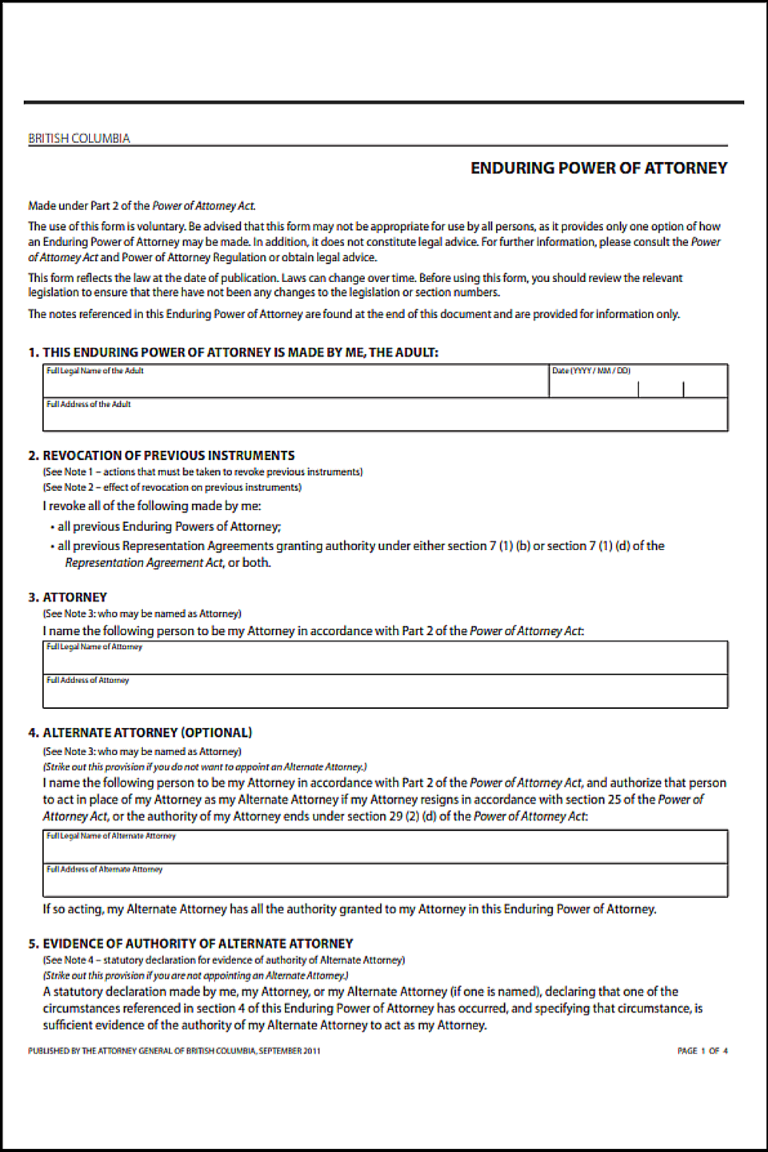
A medical power of attorney allows someone you trust to make healthcare decisions on your behalf if you become unable to communicate your wishes. To understand how these legal authority documents fit into broader planning arrangements, you can review the main estate planning documents guide together with the power of attorney in British Columbia.
What Is a Medical Power of Attorney in British Columbia?
A Medical Power of Attorney in BC allows you to choose someone to make healthcare and personal care decisions for you if you are unable to do so.
Under British Columbia law, this is done through a Representation Agreement.
It covers:
- Medical treatment decisions
- Personal care (like living arrangements or daily care)
It does not cover financial matters.
Example:
If someone has a serious accident and is unconscious, their representative can:
- Talk to doctors
- Approve treatments
- Decide on care options
Without this document, doctors may need to rely on family members or even court processes.
When Should You Create One? (Real-Life Situations)
In most estate planning situations, it’s best to prepare this document early—not during a crisis.
You should consider creating one if:
- You are planning surgery or have a medical condition
- You have aging parents and want to plan ahead
- You live alone or don’t have close family nearby
- You travel often or have a risky job
Real-life example:
A young professional living alone in Vancouver had no Representation Agreement. After an accident, doctors struggled to decide who should make decisions. This caused delays and stress for everyone involved.
Having this document avoids such problems.
Healthcare planning often involves several related legal forms depending on the type of medical or personal care instructions being prepared. Some individuals also create a living will template, while others prepare an advance care directive in British Columbia to document treatment preferences and long-term healthcare decisions.
How It Works in BC (Legal Overview Made Simple)
British Columbia has clear rules for Representation Agreements.
Who can make one?
- You must be at least 19 years old
- You must understand what the agreement does
Who can act as a representative?
- A trusted adult (friend, family member, or partner)
- Someone willing to follow your wishes
Witness requirements:
- Usually 2 witnesses
- Witnesses cannot be your representative or their spouse
When it becomes active:
- Immediately, or
- Only when you become incapable
Section 7 vs Section 9 Agreements
| Type | What It Covers | When Used |
| Section 7 | Basic routine care decisions |
For individuals with limited capacity
|
| Section 9 | Full healthcare and personal care decisions |
Most common for full planning
|
Section 9 agreements are more detailed and are typically used for full medical decision-making.
People organizing broader financial and estate planning records may also benefit from reviewing the British Columbia power of attorney template or a financial power of attorney document for managing property and financial responsibilities.
Key Parts of a Strong Medical POA in BC
Choosing the Right Representative
Pick someone you trust deeply. This person must:
- Communicate clearly with doctors
- Stay calm in stressful situations
- Respect your wishes, even if they disagree
Always name a backup representative in case your first choice is unavailable.
Defining Healthcare Powers Clearly
Be clear about what your representative can do:
- Approve or refuse treatments
- Choose care facilities
- Access your medical records
Clear wording reduces confusion later.
Adding Personal Care Instructions
This is where you guide your future care:
- Where you prefer to live
- Daily routines and comfort needs
- Cultural or religious practices
These details help your representative make better decisions.
End-of-Life Decisions
This is one of the most important parts.
You can include:
- Life support preferences
- Pain management choices
- Do-not-resuscitate (DNR) wishes
Being specific here prevents family conflict and ensures your wishes are followed.
Medical POA vs Other BC Legal Documents
Many people confuse different estate planning documents. Here’s a simple comparison:
| Document | Covers | Purpose |
| Medical POA (Representation Agreement) | Health + personal care |
Decision-making authority
|
| Financial Power of Attorney | Money and property |
Financial decisions
|
| Living Will | Wishes only |
Guidance, not legally binding
|
| Advance Directive | Specific healthcare instructions |
Direct instructions to doctors
|
Each document serves a different role. In most cases, you need more than one for full protection.
How to Fill Out the BC Medical POA Template (Step-by-Step)
Filling out the template is simple if you follow these steps.
Step 1: Add personal details
Write your full legal name, address, and date of birth.
Step 2: Choose your representative
Pick someone you trust and include full contact details.
Step 3: Define powers
Clearly state what decisions they can make.
Step 4: Add instructions
Include personal care and medical preferences.
Step 5: Sign with witnesses
You must sign while mentally capable, with proper witnesses present.
Step 6: Share copies
Give copies to:
- Your doctor
- Family members
- Your representative
This ensures the document can be used when needed.
Legal Rules You Must Follow in British Columbia
Under British Columbia law, individuals are legally required to follow strict rules for validity.
- You must sign while mentally capable
- Witnesses must meet legal requirements
- Your representative must act honestly and in your best interest
A document can be refused if:
- It is not properly signed
- Witness rules are broken
- There is evidence of pressure or fraud
These rules protect you from misuse.
Common Mistakes That Can Cause Problems
Many people make avoidable mistakes when creating this document.
- Choosing someone unreliable
- Not being clear about medical wishes
- Forgetting to update after major life changes
- Missing proper signatures or witnesses
- Not informing family or doctors
Even one mistake can make the document invalid or cause delays.
Risks of Not Having a Medical Power of Attorney
If you don’t have this document, serious problems can arise.
- Family members may disagree on decisions
- Medical treatment may be delayed
- A court may appoint someone you would not choose
- You lose control over your care
In real situations, this can create stress, conflict, and legal complications.
Can a Medical Power of Attorney Be Changed or Cancelled?
Yes. You can change or cancel it at any time while you are mentally capable.
To revoke it:
- Create a written revocation
- Inform your representative and healthcare providers
You should update your document if:
- You get married or divorced
- Your representative is no longer suitable
- Your health situation changes
Keeping it current is just as important as creating it.
FAQs
Is a Medical Power of Attorney the same as a Representation Agreement in BC?
Yes. In British Columbia, a Medical Power of Attorney is typically called a Representation Agreement.
Do I need a lawyer in British Columbia?
Not always. Many people create this document on their own. However, a lawyer can help if your situation is complex.
Can family override my representative?
Usually no. If the document is valid, your representative has legal authority to make decisions.
Does it cover financial decisions?
No. You need a separate Financial Power of Attorney for money and property matters.
Where should I keep the document?
Keep it in a safe place and share copies with:
- Your representative
- Your doctor
- Close family members
This ensures it can be accessed quickly in an emergency.