British Columbia Prenuptial Agreement (Free Template & Guide)
A British Columbia Prenuptial Agreement is often searched right after an engagement, a second marriage discussion, or a conversation about protecting a business, inheritance, or property that one person is bringing into the relationship. What catches many couples off guard is that the strongest challenge to a marriage agreement usually isn’t the wording itself — it’s incomplete financial disclosure before the document is signed, something the courts can scrutinise closely under the Family Law Act.
I’ve seen situations where an agreement looked settled for years, only for a dispute in the British Columbia Supreme Court to focus on assets that were never fully disclosed during the negotiation stage. That’s one reason generic Canadian templates frequently miss the mark in BC, where fairness, disclosure, and the circumstances surrounding the signing matter just as much as the final terms. Below you’ll find what a BC prenup can cover, how it should be signed, and the issues that commonly lead to challenges later on.
Last Updated: September 2026
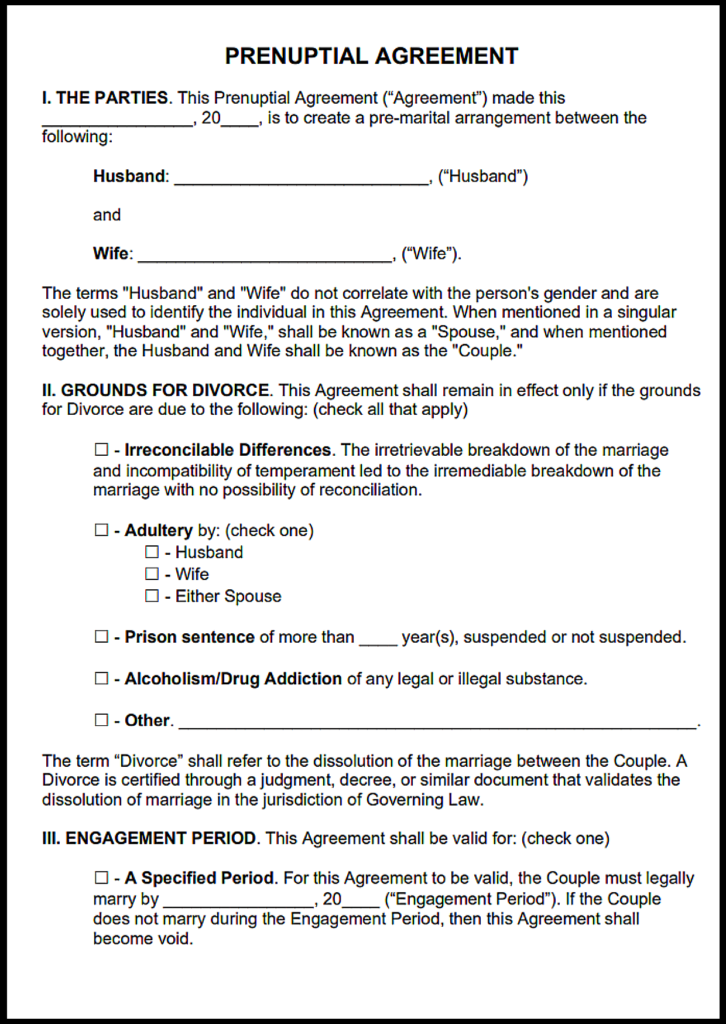
Free British Columbia Prenuptial Agreement Template
You can copy, edit, and customize this template based on your situation. Keep it clear and accurate.
British Columbia Prenuptial Agreement Laws, Court Challenges, and Property Rules
| Topic / Issue | British Columbia Legal Rule | Governing Statute |
|---|---|---|
| Primary provincial legislation | Prenuptial agreements in British Columbia are mainly governed by provincial family property and support laws. | Family Law Act, SBC 2011, c. 25 |
| Federal legislation | Divorce and some spousal support matters fall under federal law. | Divorce Act, RSC 1985, c. 3 (2nd Supp.) |
| Nature of law | Property, debt, and support rules are mainly provincial, while divorce and some support matters are federal. | Family Law Act, SBC 2011, c. 25 and Divorce Act, RSC 1985, c. 3 (2nd Supp.) |
| Effective date of Family Law Act | The Family Law Act replaced the Family Relations Act on March 18, 2013. | Family Law Act, SBC 2011, c. 25 |
| 2023 amendments | Amendments effective January 15, 2024 added rules related to companion animals (pets). | Family Law Act, SBC 2011, c. 25 |
| Who can sign | “Spouses” can make agreements under the Family Law Act, including married couples and couples in a marriage-like relationship who meet the statutory definition of spouse. | FLA s. 3 & s. 92 |
| Witness requirements | A written property or debt agreement must be signed by each spouse and witnessed by at least one other person. The same witness may witness both signatures. | FLA s. 93(1) |
| Notarization requirement | Notarization itself is not a separate statutory requirement for a property or debt agreement, but the required witnessing formalities must be followed. | FLA s. 93(1) |
| Age requirement | The general age of majority in British Columbia is 19. | Age of Majority Act, s. 1 |
| Mental capacity | A court may set aside or replace an agreement where a spouse did not understand the nature or consequences of the agreement. | FLA s. 93(3)(c) |
| Time limits for signing | The Family Law Act permits spouses to make a property or debt agreement, but there is no need to describe the rule as a general “no deadline” rule. The timing and circumstances of signing can matter if enforceability is later challenged. | FLA s. 92 & s. 93 |
| Mandatory wording | British Columbia does not prescribe a single mandatory statutory form or script for a marriage agreement. | Family Law Act |
| Disclosure acknowledgment | Financial disclosure is important because failure to disclose significant property, debts, or other relevant information can be a ground for setting aside or replacing an agreement. A written acknowledgment of disclosure may be useful evidence, but is not itself the statutory requirement. | FLA s. 93(3)(a) |
| Independent legal advice acknowledgment | Independent legal advice can help demonstrate informed consent and reduce disputes, but the Family Law Act does not make a separate acknowledgment of legal advice a universal validity requirement. | FLA s. 93 |
| Filing requirement | An agreement can be binding whether or not it has been filed with a court. Separate registration requirements can apply where the agreement involves interests in land. | Family Law Act, s. 6 |
| Land transfer exception | If the agreement requires a transfer of a freehold interest in land, the applicable land-title transfer requirements must be followed, including the required transfer documentation. | Land Title Act and Land Title Office BC procedures |
| Failure to disclose assets or debts | Courts may set aside or replace an agreement if a spouse failed to disclose significant property, debts, or other information relevant to the negotiation. | FLA s. 93(3)(a) |
| Improper advantage | Courts may set aside or replace an agreement if one spouse took improper advantage of the other spouse’s vulnerability, including vulnerability relating to age, education, literacy, physical or mental condition, emotional dependence, or other circumstances. | FLA s. 93(3)(b) |
| Lack of understanding | Courts may set aside or replace an agreement if a spouse did not understand the nature or consequences of the agreement. | FLA s. 93(3)(c) |
| Significant unfairness test | For a property agreement, the court may set it aside or replace it if it is significantly unfair, taking the statutory factors into account, including the length of time since the agreement was made, the spouses’ intention to achieve certainty, and the degree to which they relied on the agreement. | FLA s. 93(5) |
| Common-law spouse inclusion | A person may qualify as a spouse under the Family Law Act after living with another person in a marriage-like relationship for at least 2 years, subject to the statutory rules and exceptions. | Family Law Act, s. 3 |
| Excluded property regime | Property acquired before the relationship, certain inheritances, gifts and other property listed in s. 85 may qualify as excluded property. The treatment of excluded property and any later division is governed by the statutory rules and exceptions. | Family Law Act, s. 85 & s. 96 |
One of the important BC rules is the statutory significant-unfairness test. For a property agreement, the court can consider factors including the time since the agreement was made, the spouses’ intention to achieve certainty, and the degree to which they relied on its terms. The test is more specific than simply asking whether the agreement later produced an unfair result.
BC also has a specific excluded-property regime. Property acquired before the relationship, inheritances and certain gifts can qualify as excluded property under s. 85. The treatment of excluded property and any possible division later depends on the statutory rules, so couples with homes, investments or business interests should not assume that every increase in value is automatically divided equally.
Financial disclosure deserves attention before the agreement is signed. The Family Law Act allows the court to set aside or replace certain agreements where a spouse failed to disclose significant property, debts or other information relevant to the negotiation. That is why an accurate financial schedule and careful review of the agreement can matter as much as the wording itself.
Download the free British Columbia Prenuptial Agreement template to create a clearer and stronger financial plan before marriage.
A prenuptial agreement helps couples outline financial responsibilities, property ownership, and asset protection arrangements before marriage. To understand how these legal agreements fit into broader family and estate planning matters, you can review the main estate planning documents guide together with the British Columbia cohabitation agreement template, which is commonly used by unmarried couples managing shared finances and property.
What Is a Prenuptial Agreement in British Columbia?
In British Columbia, a prenuptial agreement is commonly used as a marriage agreement to set financial terms before marriage. The Family Law Act permits spouses to make agreements concerning property and debt, and separate statutory provisions address spousal support.
It mainly deals with financial matters such as:
- Property division
- Debt responsibility
- Spousal support
A marriage agreement should not be treated as controlling parenting arrangements. Parenting decisions are governed by the child’s best interests and the applicable family-law rules.
Example:
If one partner owns a house before marriage, the prenup can set out how that property and any related financial interests are intended to be treated, subject to the Family Law Act and any later court review.
When Should You Consider a Prenup?
A BC marriage agreement can be useful whenever the couple wants to establish financial rules before marriage. The issues may include existing property, business interests, debt, inheritances or how property and support will be handled if the relationship ends.
You should consider it if:
- You are entering a second marriage
- You already own property, savings, or investments
- One partner has significant debt
- Your family is contributing financially (like gifting money)
- You expect to receive an inheritance
Real-life scenario:
A person receives family land from parents. Without a prenup, the treatment of that property and any later claim involving it will depend on BC’s excluded-property and family-property rules. A marriage agreement can clearly establish the couple’s intended treatment of the asset, subject to the Family Law Act.
Marriage and long-term financial planning often involve several related legal documents depending on the couple’s circumstances. Some individuals also prepare a British Columbia will template to protect inheritance wishes, while others create a power of attorney document for future financial and legal decision-making responsibilities.
What Can Be Included in a BC Prenuptial Agreement?
Property and Asset Division
Under British Columbia law, property can include:
- Family property
- Excluded property, including certain property owned before the relationship or received by gift or inheritance
A marriage agreement can establish how the spouses intend property and debt to be divided, subject to the Family Law Act and the court’s power to review certain agreements.
Spousal Support Terms
You can:
- Limit support
- Set specific payment terms
- Waive support
However, agreements about spousal support are subject to their own statutory requirements and court-review provisions. A support term should therefore be drafted carefully rather than treated as automatically enforceable simply because both spouses signed it.
Debt Protection
The agreement can state:
- Who pays which debts
- How particular liabilities are treated
- Protection from partner’s loans or liabilities, where legally effective
Business and Investments
If one partner owns a business:
- Ownership can remain separate
- Future income rules can be defined
- The agreement can address how business interests and related property are treated
Inheritance and Gifts
You can address:
- Family property
- Gifts from parents
- Future inheritance
These provisions should be drafted consistently with BC’s statutory rules concerning excluded property and family property.
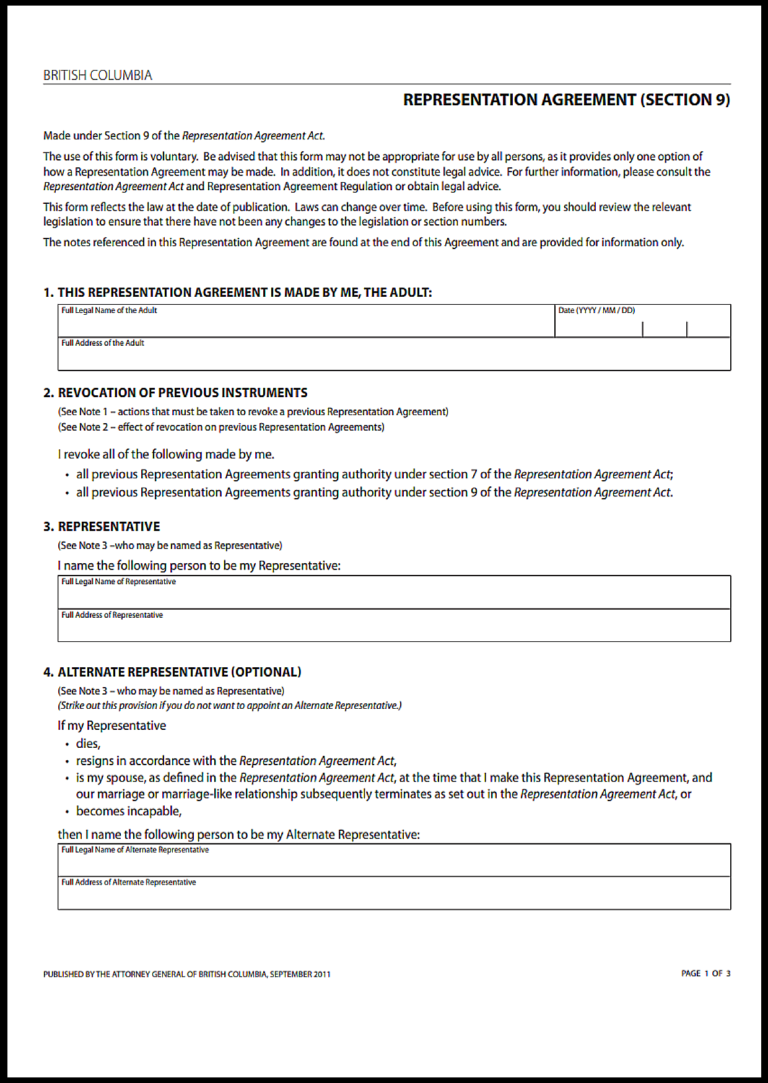
Couples reviewing property division and financial obligations may also benefit from reading the British Columbia separation agreement guide to better understand how assets and responsibilities may be handled if the relationship later ends.
Legal Rules for Prenuptial Agreements in British Columbia
The Family Law Act provides specific rules for agreements dealing with property, debt and spousal support, including rules about witnessing and circumstances in which the court may set an agreement aside.
| Requirement | Explanation |
| Written Agreement |
A property or debt agreement must be in writing.
|
| Signed by Both Parties |
Each spouse must sign the written agreement.
|
| Witness Required |
Each spouse’s signature must be witnessed by at least one other person for a property or debt agreement.
|
| Financial Disclosure |
Significant property, debts and other relevant information should be disclosed because nondisclosure can be a statutory ground for challenging the agreement.
|
The enforceability of an agreement depends on the applicable statutory requirements and the circumstances in which it was negotiated and signed. For property agreements, the Family Law Act specifically addresses disclosure, vulnerability, understanding and significant unfairness rather than applying a simple rule that every agreement must merely be “fair and transparent.”
How to Make Your Prenup Valid and Enforceable
To reduce the risk of later disputes, deal with disclosure, signing, legal advice and the wording of the agreement carefully before the marriage.
- Be fully honest about all finances
- Avoid signing under pressure or close to the wedding date
- Each partner should consider getting independent legal advice
- Use clear and simple language
- Keep signed copies safe (physical and digital)
- Make sure the required witnessing formalities are completed
A well-prepared prenup can reduce the chance of legal disputes later, although no agreement can guarantee that a court will never review its terms.
Common Mistakes That Can Make a Prenup Invalid
The most serious problems are usually connected to disclosure, understanding, vulnerability, signing formalities or terms that later become subject to a statutory challenge.
- Hiding assets or debts
- One-sided or unfair terms
- Not getting legal advice
- Signing under emotional pressure
- Using generic templates without editing
- Failing to complete required signing and witnessing formalities
A mistake does not automatically mean that a court will reject the entire agreement. The legal effect depends on the nature of the problem and the applicable provisions of the Family Law Act.
What Happens If You Don’t Have a Prenup in BC?
Without a marriage agreement, the applicable BC family-law rules generally determine property, debt and support rights, subject to the statutory exceptions and circumstances that apply.
| Situation |
Result Under BC Law
|
| Property division |
Family property is generally divided equally, subject to statutory exceptions or possible unequal-division orders.
|
| Debt sharing |
Family debt is generally shared equally, subject to the Family Law Act and applicable exceptions.
|
| Business assets |
Business interests may form part of family property or require valuation, depending on the circumstances.
|
| Spousal support |
One spouse may have an obligation to pay spousal support if the statutory requirements are met.
|
Example:
Without a prenup, a business started during marriage could form part of the family-property analysis and may require valuation or another financial adjustment depending on the circumstances.
Can a Prenuptial Agreement Be Challenged in Court?
Yes, courts in British Columbia can review a marriage agreement where the statutory requirements for doing so are met.
Common reasons include:
- Lack of financial disclosure
- Improper advantage of a spouse’s vulnerability
- Lack of understanding of the agreement or its consequences
- Significant unfairness in circumstances covered by the Family Law Act
- Other applicable contractual grounds
A judge may:
- Set aside the agreement
- Replace or modify the agreement where the statute permits
- Enforce some provisions while setting aside others, depending on the circumstances
The outcome depends on the specific agreement, the evidence and the statutory provisions that apply.
Prenuptial vs Cohabitation Agreement
Both agreements are similar but used in different situations.
| Feature | Prenuptial Agreement |
Cohabitation Agreement
|
| When used | Before marriage |
For couples living together
|
| Legal status | Can operate as a marriage agreement between spouses |
Can establish financial and property terms for spouses in a marriage-like relationship
|
| Purpose | Establish financial and property rights before marriage |
Define financial and property rights during cohabitation and, where applicable, after separation
|
Both are governed under British Columbia law, although the applicable statutory rules depend on the subject matter of the agreement and the parties’ legal status.
Step-by-Step: How to Fill Out the Template
Follow this simple process to complete your prenup correctly.
Step 1: Add personal and marriage details
Write full legal names and planned wedding date.
Step 2: List all assets and debts
Include:
- Property
- Savings
- Loans
- Investments
Step 3: Decide division rules
Clearly state what happens in case of separation.
Step 4: Add support and special clauses
Include spousal support, business ownership, or inheritance protection.
Step 5: Sign with a witness
For a property or debt agreement, each party must sign the written agreement and the signatures must be witnessed by at least one other person.
Step 6: Consult a lawyer
This step is strongly recommended to help each party understand the agreement and avoid future problems.
FAQs About British Columbia Prenuptial Agreements
Is a prenup legally binding in BC?
A marriage agreement can be legally binding when the applicable Family Law Act requirements are satisfied. For property and debt agreements, the agreement must be in writing and signed by the spouses with the required witnessing. Courts can still review certain agreements under the statutory challenge provisions.
Can we write our own prenup without a lawyer?
The parties can prepare their own agreement, but independent legal advice can be valuable. It can help each spouse understand the agreement and identify issues before signing. The absence of legal advice is not, by itself, an automatic ground for setting aside every agreement.
How much does a prenup cost in BC?
Costs vary depending on the complexity of the agreement, the assets and debts involved, the amount of financial disclosure required, and whether each party obtains independent legal advice. There is no single standard cost for every BC marriage agreement.
Can a prenup include child custody terms?
A marriage agreement should not be relied on to predetermine parenting arrangements. Parenting decisions are governed by the child’s best interests and the applicable family-law rules at the time the issue arises.
Can we change a prenup after marriage?
Yes. Spouses can enter into a later agreement addressing property, debt or support, provided the applicable legal requirements are satisfied. Depending on the circumstances, such an agreement may be described as a postnuptial agreement.