How to Write Bill of Sale British Columbia (Step by Step Guide)
How to Write Bill of Sale British Columbia is something every buyer or seller should understand before doing a private deal. A bill of sale is a simple document, but if written wrong, it can create serious legal and financial problems.
In real life, I’ve seen people lose money just because they didn’t write clear details. For example, a buyer purchased a used car privately, but the bill of sale had no VIN. Later, ownership became disputed, and registration was delayed.
I’ve also seen ICBC registration issues happen in British Columbia because people copied incomplete bill of sale forms from the internet without understanding what information must legally match the vehicle records. When someone is already stressed about buying or selling privately for the first time, even one missing detail can turn a simple transaction into weeks of problems.
Last Updated: August 2026
In this article, you’ll learn:
- How to write a bill of sale step by step
- What details are legally important in British Columbia

Table of Contents
ToggleBritish Columbia Bill of Sale Laws You Should Know Before Signing
| Topic / Issue | [British Columbia] Legal Rule | Governing Statute |
|---|---|---|
| Governing legislation | General bills of sale are primarily contractual documents. The Sale of Goods Act applies to contracts for the sale of goods, while other laws may apply depending on the property involved. | Sale of Goods Act [RSBC 1996] c. 410 |
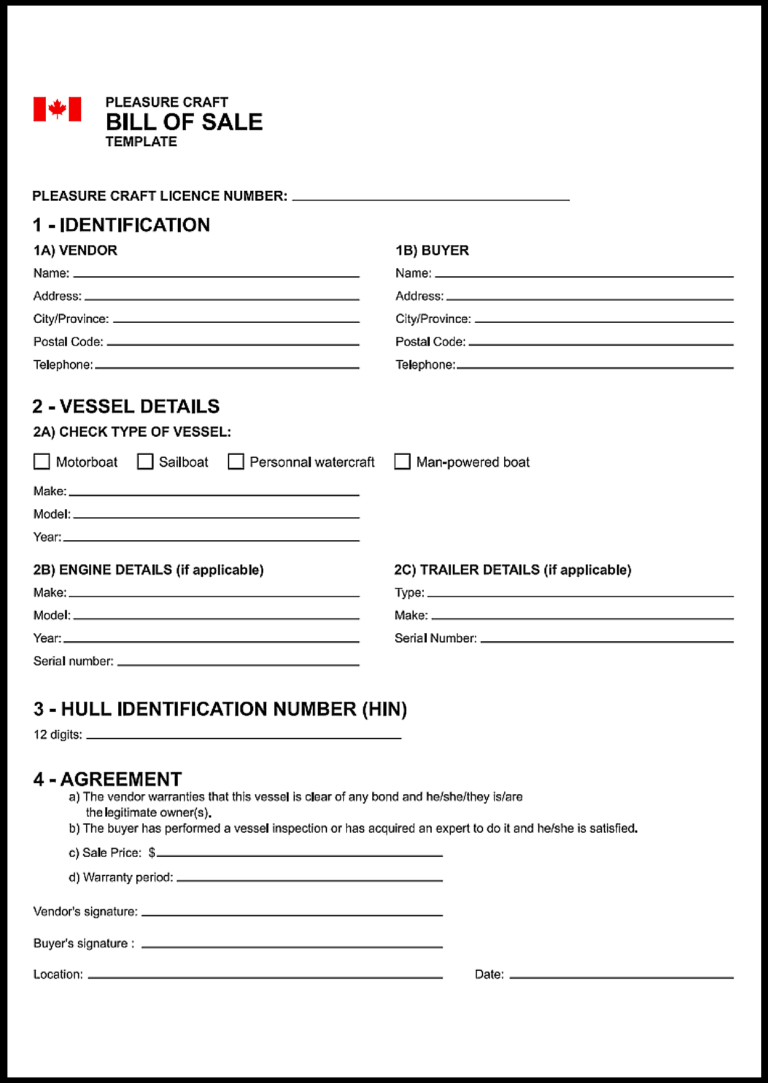
| Federal marine vessel rule | Certain registered marine vessels are subject to federal registration and transfer requirements. | Canada Shipping Act, 2001 |
| Who can sign | A contract of sale may be made in writing or orally, but having both buyer and seller sign a bill of sale creates clearer evidence of the agreed transaction. | Sale of Goods Act, ss. 6–8 |
| Witness requirements | The Sale of Goods Act does not prescribe a general witness-signature requirement for an ordinary bill of sale. | Sale of Goods Act |
| Notarization | The Sale of Goods Act does not impose a general notarization requirement for an ordinary private bill of sale. | Sale of Goods Act |
| Age and mental capacity | Capacity to buy and sell is governed by the general law concerning contractual and property capacity. | Sale of Goods Act, s. 7 |
| Time limit for disputes | The basic limitation period for a court proceeding is generally 2 years from the day the claim is discovered, subject to the Limitation Act and its exceptions. A separate 6-year period applies to claims not otherwise specifically provided for. | Limitation Act, ss. 6 and 3(5) |
| Seller’s right to sell | In a contract of sale, the seller generally gives an implied condition that the seller has the right to sell the goods, unless the circumstances show a different intention. | Sale of Goods Act, s. 16 |
| Quiet possession | Unless the circumstances show a different intention, the buyer has an implied warranty of quiet possession of the goods. | Sale of Goods Act, s. 16 |
| Vehicle transfer requirement | Vehicle transfers require the transferor and transferee to sign the notice of transfer in the form required by ICBC, and the transferee must deliver it to ICBC within 10 days with the required fees and taxes. | Motor Vehicle Act, s. 17 |
| Filing requirement | Most ordinary bills of sale are private transaction documents and do not require separate government filing. Vehicle ownership transfers have separate ICBC registration requirements. | Motor Vehicle Act |
| Conditional bill of sale | If the seller retains a security interest in the goods until payment is completed, registration may be used to perfect the security interest under the Personal Property Security Act. | Personal Property Security Act, s. 25 |
| Vehicle ownership registration | A purchaser must complete the required ICBC ownership-transfer and registration process after acquiring a registered vehicle. | Motor Vehicle Act |
| Minor signing issue | Capacity involving a person under 19 is governed by the applicable general law; the Sale of Goods Act does not impose a blanket rule that every contract signed by a person under 19 is unenforceable. | Sale of Goods Act, s. 7; applicable capacity law |
| Unclear item description | The goods should be identified clearly enough to establish what was sold. An unclear description can create interpretation and proof problems. | Sale of Goods Act, ss. 8, 17; contract law |
| Illegal sale purpose | An agreement involving an illegal purpose or prohibited transaction may be unenforceable under applicable law. | Common law principles of illegality |
| BC age of majority difference | British Columbia’s general age of majority is 19, but contractual capacity is governed by the applicable law and the particular transaction. | Age of Majority Act; Sale of Goods Act, s. 7 |
| PST on private vehicle sales | PST on qualifying vehicle purchases is generally 12%, and for many private vehicle transactions the taxable value is based on the greater of the purchase price and average wholesale value, subject to applicable exceptions. | Provincial Sales Tax Act; BC government PST guidance |
| No separate Bills of Sale Act | Ordinary bills of sale are generally governed through contract and applicable property, sale-of-goods, vehicle, and secured-transactions legislation rather than a standalone general Bills of Sale Act. | Applicable BC legislation |
British Columbia’s general age of majority is 19, but that does not mean every contract involving a person under 19 is automatically invalid. The Sale of Goods Act states that capacity to buy and sell is governed by the general law concerning capacity to contract and to transfer or acquire property.
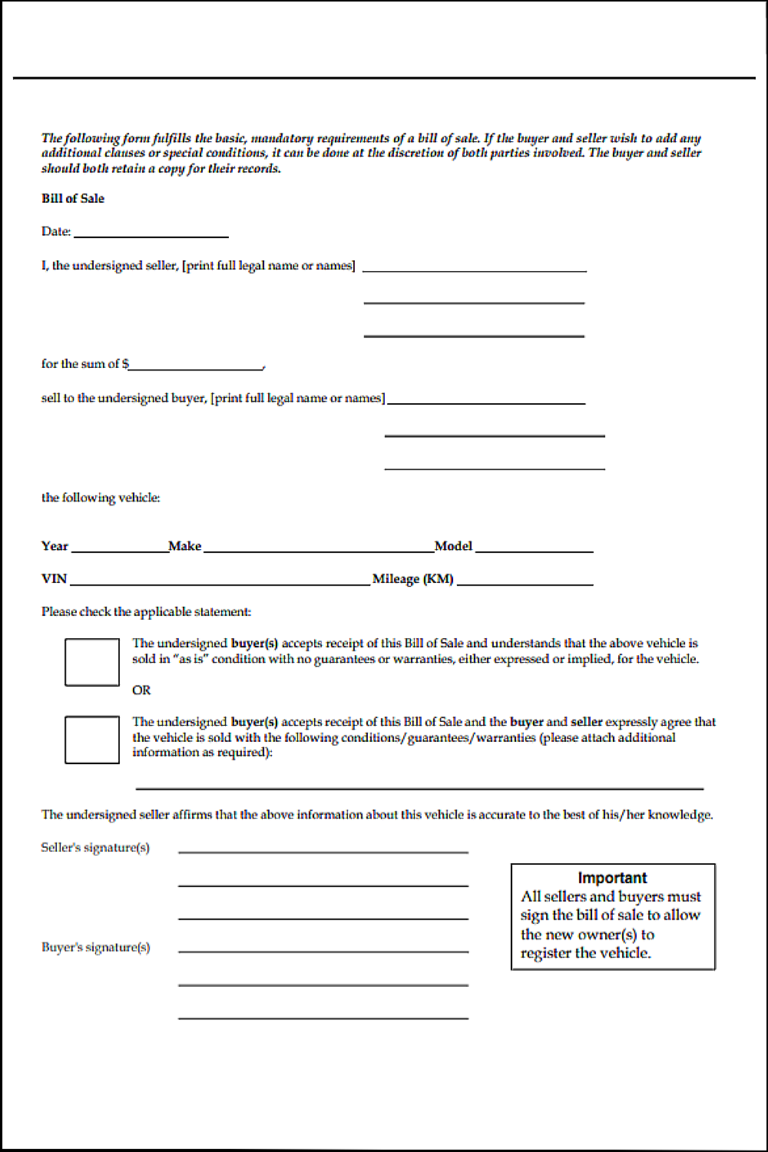
Accurate item descriptions are also important. For vehicles, information such as the VIN, make, model, year, and sale price should be recorded carefully. For other property, a serial number, brand, model, or other identifying information can help establish exactly what changed hands.
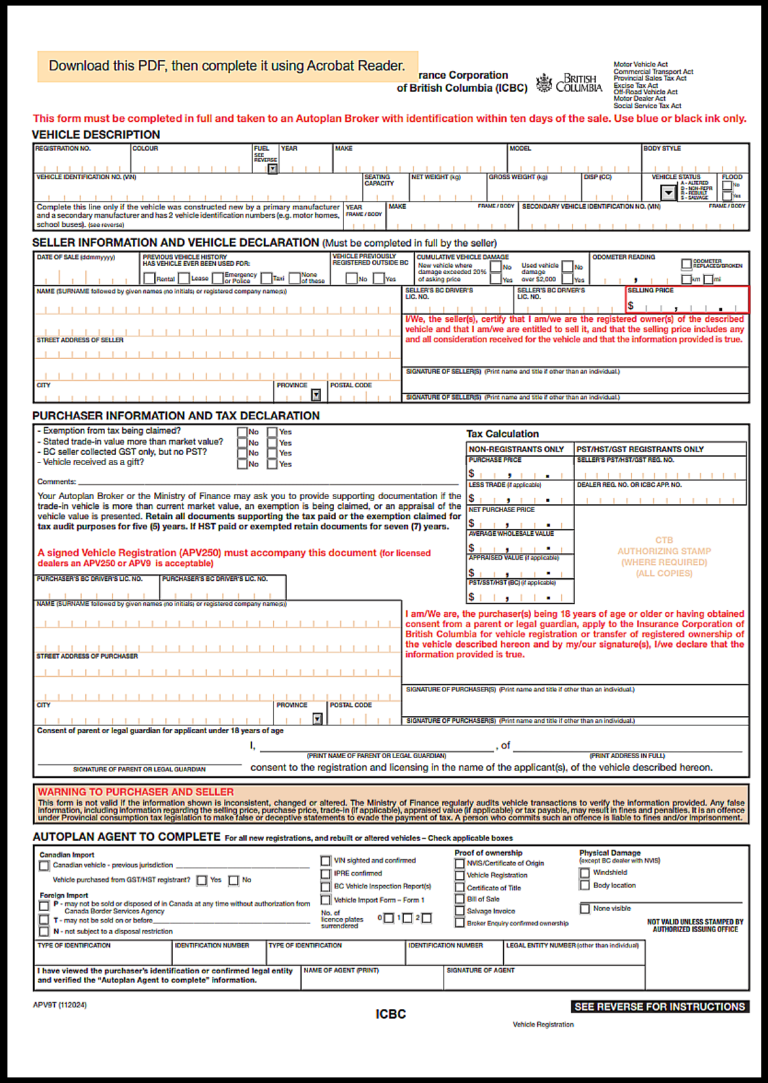
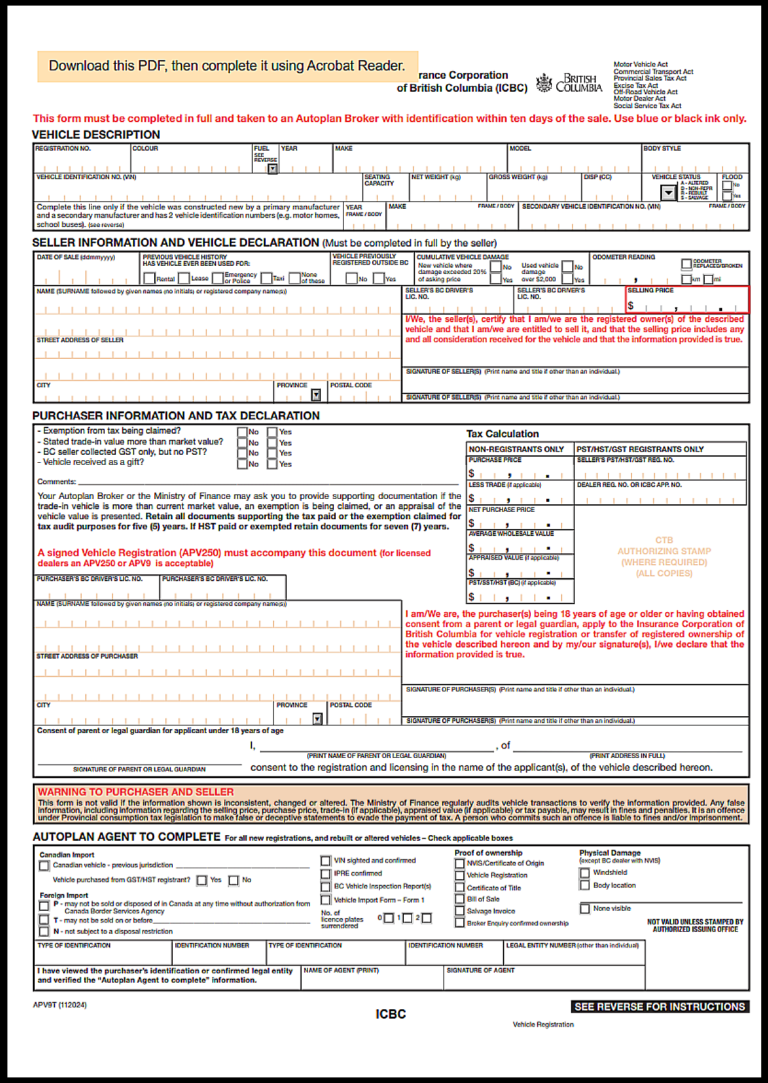
For vehicle transactions, a bill of sale is only part of the paperwork. Under the Motor Vehicle Act, the transferor and transferee must sign the required transfer notice, and the transferee must deliver it to ICBC within 10 days. ICBC’s APV9T Transfer/Tax Form records the vehicle information, sale date, selling price, and signatures.
PST can also matter in private vehicle transactions. BC’s current rules generally impose 12% PST on vehicles, and for many private sales the taxable value is based on the greater of the purchase price and average wholesale value, with specific appraisal and vehicle exceptions.
Before creating this type of ownership document, sellers should understand the bill of sale requirements in British Columbia before drafting the document.
What Is a Bill of Sale and Why It Matters in BC
A bill of sale is a written record of a transaction. It can show:
- Who sold the item
- Who bought it
- What was sold
- The price and date
For private sales, this written record can help establish what the parties agreed to and what consideration was paid.
Why it matters
In many private sale situations:
- There is no dealership invoice
- There may be no other detailed written record
- Disputes can happen later
A bill of sale can therefore be useful evidence if a disagreement develops about payment, ownership, condition, or the terms of the transaction.
Common situations where it’s used
- Private vehicle sales
- Selling furniture or appliances
- Online marketplace deals (Facebook, Craigslist, etc.)
Without a written record, proving the exact terms of the transaction can become more difficult.
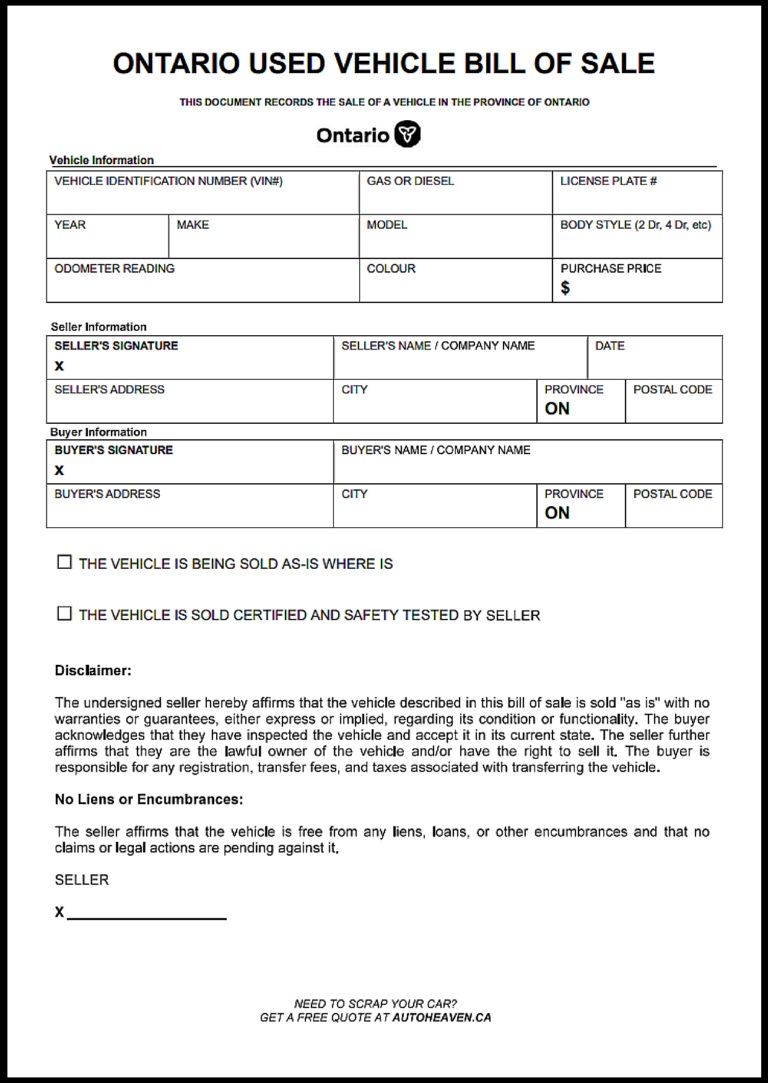
Different transactions may require more specialized forms depending on the asset being sold. Vehicle purchases often involve a vehicle bill of sale template, while personal automobile transfers commonly rely on a car ownership transfer document.
When You Need to Write a Bill of Sale in British Columbia
You should consider using a bill of sale in most private transactions, especially when the item has significant value or there is no separate invoice.
Most common cases
- Private sales between individuals
- High-value items like cars, bikes, or machinery
- When no store receipt or invoice exists
- When documenting a vehicle transaction with ICBC
- When future disputes are possible
Here’s a quick overview:
| Situation | Bill of Sale Needed? | Why |
| Private car sale | Strongly recommended and commonly used |
Provides a written record of the vehicle transaction and supports ownership/registration documentation
|
| Selling used furniture | Recommended |
Proof of payment and transaction terms
|
| Gift transfer | Optional depending on the circumstances |
Documents the transfer even when no purchase price is paid
|
| Dealership purchase | Usually not necessary as a separate private bill of sale |
Dealer invoice and required transfer documents generally provide the transaction record
|
When parties want additional protection during a private sale, they may also include an as-is bill of sale agreement to clarify the condition of the item being transferred.
Key Details You Must Include (Step-by-Step Guide)
Buyer and Seller Information
Always use the parties’ full legal names and useful contact details.
Avoid:
- Nicknames
- Short forms
- Missing identifying information
This makes it easier to establish who entered into the transaction if a dispute occurs.
Accurate Description of the Item
This is one of the most important parts.
For vehicles:
- Make
- Model
- Year
- VIN
For other items:
- Serial numbers
- Brand
- Key features
Important: The description should be specific enough to identify the goods that were sold. Under the Sale of Goods Act, goods sold by description must correspond with that description.
Sale Price and Payment Terms
Always write the exact amount.
Include:
- Total price
- Payment method (cash, transfer, etc.)
- Whether any deposit was paid
Avoid writing “approximate” or unclear amounts.
Date of Sale
The date is important for documenting:
- The transaction
- Payment
- Delivery
- Vehicle transfer and tax records
For vehicles, make sure the sale date and vehicle information are consistent across the bill of sale and ICBC transfer documents.
Condition and “As Is” Clause
“As is” means the buyer agrees to purchase the item in the condition described or observed at the time of sale.
An “as is” clause can help document the parties’ agreement about the condition of used goods, but it does not automatically protect a seller from every claim. Misrepresentation, undisclosed issues, statutory protections, and the actual wording of the agreement can still matter.
Always describe the condition honestly and clearly.
Signatures of Both Parties
A bill of sale is much stronger as a transaction record when both parties sign it.
- Both buyer and seller should sign
- A witness is not generally required under the Sale of Goods Act for an ordinary bill of sale
How to Write a Bill of Sale (Simple Step-by-Step Process)
Follow this simple process:
Step 1: Start with date and names
Write full legal names and useful contact details.
Step 2: Add item details
Be specific and accurate.
Step 3: Include price and payment method
Mention the full amount and how it was paid.
Step 4: Add legal statements
Confirm the seller’s right to sell the item and disclose any known liens or encumbrances that are relevant to the transaction.
Step 5: Review everything
Check spelling, numbers, VINs, serial numbers, price, and dates.
Step 6: Sign and keep copies
Both parties should keep a signed copy.
Special Rules for Vehicle Bill of Sale in British Columbia
Vehicle sales have additional transfer and registration requirements.
Important rules
- Vehicle information should match the registration records
- VIN should be checked carefully
- Odometer information should be recorded where appropriate
- The required ICBC transfer paperwork must be completed
- The purchaser must complete the ownership-transfer process within 10 days
Tip: Keep the bill of sale with the other transfer documents. ICBC’s APV9T form records the seller, purchaser, vehicle, date of sale, selling price, and signatures.
Taxes and Fees You Should Know (BC Context)
In British Columbia, private vehicle sales can be subject to PST.
Key points
- PST is collected or administered through the applicable ICBC transaction process
- For many private vehicle purchases, tax is calculated using the greater of the purchase price and average wholesale value
- The average wholesale value is generally determined using Canadian Black Book
- A lower declared price does not necessarily reduce the taxable value
| Factor |
How It Affects Tax
|
| Sale price |
May be the taxable value if it is the applicable higher amount
|
| Average wholesale value |
May be used when it exceeds the purchase price
|
| Vehicle condition |
An appraisal may affect the taxable value where the applicable rules allow it
|
Important: Record the actual purchase price accurately. Do not put a false amount on the bill of sale or transfer paperwork.
Common Mistakes to Avoid When Writing a Bill of Sale
Many problems can be prevented by checking the basic transaction details before signing.
Avoid these:
- Missing VIN or serial number
- Incorrect names or addresses
- Unclear condition description
- Unclear payment details
- Not keeping a signed copy
A poorly prepared bill of sale may make it harder to prove what the parties actually agreed to.
Legal Risks of Not Having a Proper Bill of Sale
Skipping a written transaction record can create practical problems.
Possible problems
- Ownership disputes
- Payment disagreements
- Trouble documenting a vehicle transaction
- Disputes about condition or warranties
- Difficulty proving the agreed terms
Real example:
A buyer purchases a used bike and later claims that the seller promised it was in a particular condition. If there is no written bill of sale or clear description of the condition, the parties may have difficulty proving what was agreed.
Buyer vs Seller Responsibilities in BC
Both parties should take reasonable steps to document the transaction accurately.
Seller responsibilities
- Disclose known material defects honestly
- Provide correct ownership details
- Disclose known liens or encumbrances where relevant
Buyer responsibilities
- Check the item carefully
- Verify details, especially the VIN for vehicles
- Confirm payment and transfer records
- Keep copies of the transaction documents
Shared responsibility
- Make sure the document is complete
- Sign and keep copies
- Agree on all important terms clearly
FAQs
Is a bill of sale legally required in British Columbia?
A separate bill of sale is not required for every type of private sale. Vehicle transfers have specific ICBC and Motor Vehicle Act requirements, and a bill of sale can be important supporting documentation. ICBC also identifies a signed and dated bill of sale as acceptable ownership evidence in certain registration situations.
Can I write a bill of sale myself?
Yes. A bill of sale can generally be prepared privately. Include enough information to identify the parties, the goods, the price, the date, payment terms, and any important condition or other agreed terms.
Does it need to be notarized in BC?
The Sale of Goods Act does not impose a general notarization requirement for an ordinary private bill of sale. Specific transactions may have their own documentation or authentication requirements.
What happens if I lose my bill of sale?
You may have more difficulty proving the transaction, payment, or terms that were agreed. Keep a signed copy and retain related transfer, registration, payment, and tax records.
Is a handwritten bill of sale valid?
A contract of sale may be made in writing or orally under the Sale of Goods Act, subject to that Act and other applicable law. A handwritten bill of sale can therefore serve as a useful written record when it accurately identifies the parties, goods, price, date, and agreed terms.