Alberta Cohabitation Agreement Template (Free Guide)
Alberta Cohabitation Agreement is a simple legal document that helps couples living together decide how money, property, and responsibilities will be handled. In Alberta, many couples choose to live together without marriage, but under Alberta law, these relationships (called Adult Interdependent Partners) can still create legal rights and obligations.
This is why more couples now prefer to set clear rules early. I’ve seen many couples in Alberta assume that living together automatically protects both partners fairly, only to face stressful property and debt disputes after a breakup. I usually tell clients that putting expectations in writing early is much easier and far less expensive than trying to sort things out once emotions and finances become complicated.
A cohabitation agreement gives clarity and avoids confusion later. It protects what you already own and helps prevent future disputes.
It can help you protect any property you owned before living together, avoid expensive legal disputes in the future, and clearly set how expenses and responsibilities will be shared. It also allows you to plan in advance what will happen if you and your partner decide to separate.
Last updated: August 2026
Table of Contents
ToggleFree Alberta Cohabitation Agreement Template
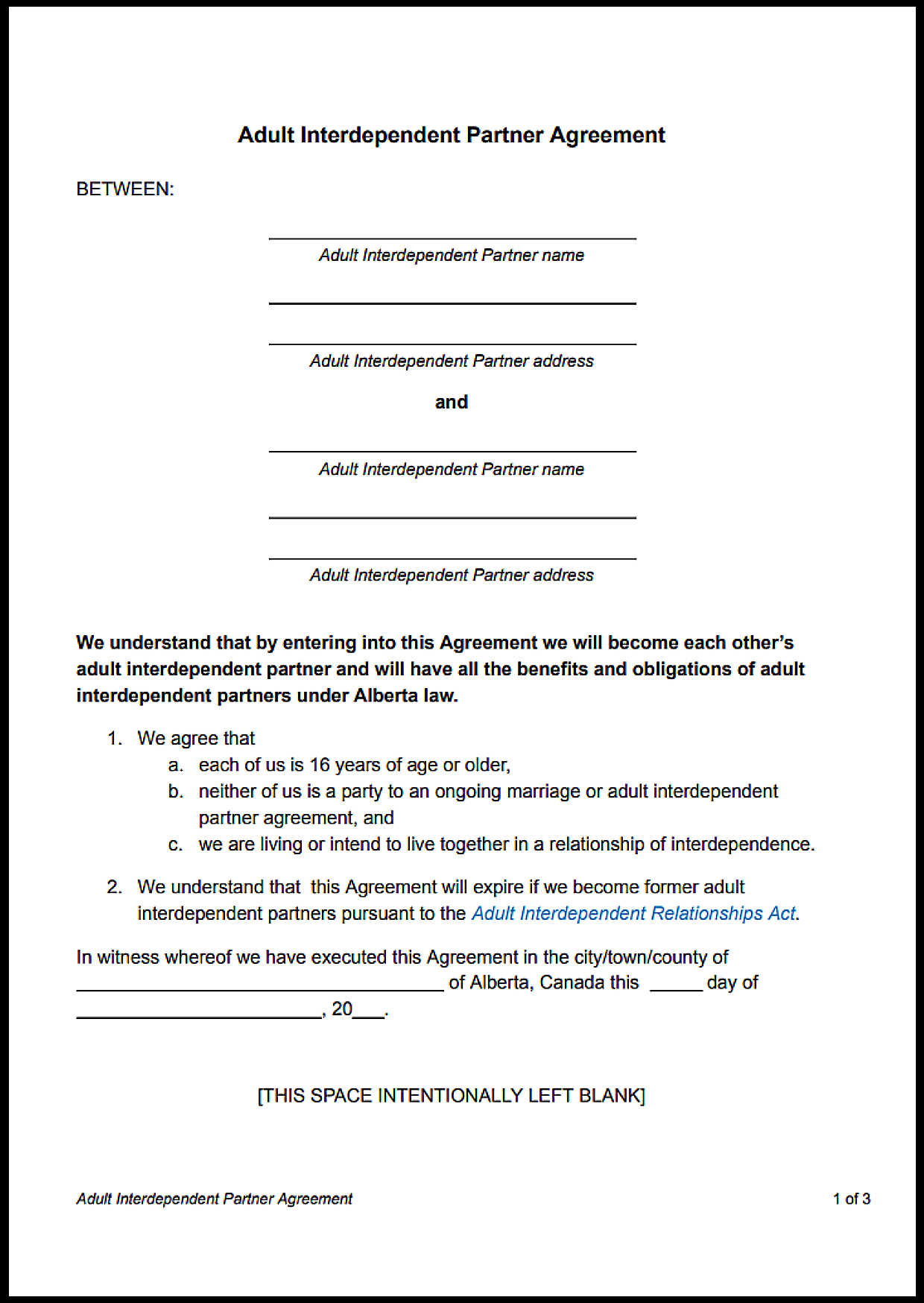
Below is a simple, ready-to-use template you can customize based on your situation. Always review it carefully before signing.
Alberta Cohabitation Agreement Laws Couples Often Overlook
| Topic / Issue | Alberta Legal Rule | Governing Statute |
|---|---|---|
| Main governing legislation | In Alberta, cohabitation agreements dealing with property can be governed by the Family Property Act, while adult interdependent partner status is governed by the Adult Interdependent Relationships Act. | Family Property Act, RSA 2000, c F-4.7; Adult Interdependent Relationships Act, SA 2002, c A-4.5 |
| Federal jurisdiction | The Divorce Act is federal legislation dealing with divorce and related matters for married spouses; Alberta’s provincial legislation governs property agreements between Alberta spouses and adult interdependent partners. | Federal Divorce Act / Alberta family-property legislation |
| 2020 legal amendment | Alberta’s property-division rules for adult interdependent partners changed effective January 1, 2020, bringing qualifying unmarried partners within the Family Property Act property-division regime. | Family Property Act amendments |
| Who can sign | Two people who are living together or intend to live together in a relationship of interdependence may enter into an adult interdependent partner agreement, subject to the statutory restrictions. | Adult Interdependent Relationships Act, s. 7 |
| Witness requirement | For a property agreement governed by section 37, each party must make the required written acknowledgement before a lawyer other than the lawyer acting for the other party. | Family Property Act, s. 38(1) |
| Notarization rule | Section 38 does not impose a separate notarization requirement; the required acknowledgement must instead be made before a qualifying lawyer. | Family Property Act, s. 38(1) |
| Age and legal capacity | For an adult interdependent partner agreement, a person under 18 must be at least 16 and have the prior written consent of their guardian or guardians; other statutory eligibility requirements also apply. | Adult Interdependent Relationships Act, s. 7(2) |
| Property claim deadline | An application for a family property order by a former adult interdependent partner is generally subject to a two-year limitation period under section 6.1, measured from when the applicant knew or ought to have known they had become a former adult interdependent partner. | Family Property Act, s. 6.1 |
| Required acknowledgment | Each party must acknowledge in writing that they are aware of the nature and effect of the agreement. | Family Property Act, s. 38 |
| Waiver acknowledgment | Each party must acknowledge the possible future property claims they may have under the Family Property Act and state an intention to give up those claims to the extent necessary to give effect to the agreement. | Family Property Act, s. 38 |
| Voluntary execution requirement | Each party must acknowledge that they are executing the agreement freely and voluntarily, without compulsion by the other party. | Family Property Act, s. 38 |
| Independent legal advice requirement | Each party’s required acknowledgement must be made before a lawyer other than the lawyer acting for the other party. | Family Property Act, s. 38 |
| Filing status | A property agreement under sections 37–38 is generally a private agreement; the Act does not impose a general registration requirement for the agreement itself. | Family Property Act, ss. 37–38 |
| Real estate exception | If the agreement is accompanied by an actual transfer of an interest in land, the transfer may require separate registration through Alberta’s land-titles system. | Alberta land-titles legislation and procedures |
| Invalid without separate lawyers | A property agreement that does not satisfy the formal requirements of section 38 may be unenforceable under the Family Property Act. | Family Property Act, ss. 37–38 |
| Invalid for hidden assets | Incomplete or misleading financial disclosure can create serious enforceability issues, so both parties should make full and accurate financial disclosure before signing. | Contract and family-law principles |
| Invalid due to unfair pressure | An agreement may face enforceability problems where the required voluntary-execution requirements were not satisfied, including where a party was compelled to sign. | Family Property Act, s. 38 |
| Alberta-specific AIP system | Alberta legislation uses the statutory terms “adult interdependent partner” and “adult interdependent relationship”; “common-law spouse” is not the statutory term used in the Act. | Adult Interdependent Relationships Act |
| Alberta’s strict lawyer rule | For a property agreement governed by section 37 of Alberta’s Family Property Act, each party must make the required acknowledgement before a lawyer other than the lawyer acting for the other party. | Family Property Act, s. 38 |
One of the biggest surprises for many Alberta couples is that a cohabitation agreement dealing with property requires the statutory formalities in section 38 if the parties want the property provisions to be enforceable under the Family Property Act. Each party must make the required written acknowledgement before a lawyer other than the lawyer acting for the other party. Alberta’s rules therefore require more than simply having both partners sign a document.
Another important rule is Alberta’s unique “Adult Interdependent Partner” system. Alberta law can recognize unmarried partners as adult interdependent partners after living together in a relationship of interdependence for at least 3 continuous years, where there is a child of the relationship, or through an adult interdependent partner agreement. This becomes very important when homes, savings, or debts are involved.
Financial disclosure also matters in practice. Incomplete or misleading information about major assets or debts can create serious enforceability issues, even though full financial disclosure is not itself listed as one of the three written acknowledgements in section 38. Both partners should therefore provide accurate financial information before signing. The same care is needed where someone is pressured to sign or does not understand the agreement’s effect.
What Is a Cohabitation Agreement in Alberta?
A cohabitation agreement is a written contract between two people living together. In Alberta, two people may become adult interdependent partners after living together in a relationship of interdependence for at least 3 continuous years, where there is a child of the relationship, or by entering into an adult interdependent partner agreement. This status can give them legal rights and obligations in areas covered by Alberta law.
Many people assume “common-law” means no legal rules apply—but that’s not true. Unmarried partners who meet Alberta’s adult interdependent partner requirements can have statutory rights and obligations, including in property and support matters.
Key differences:
- Married couples are subject to Alberta’s rules for spouses, including the Family Property Act.
- Unmarried partners who qualify as adult interdependent partners can also have statutory rights and obligations.
- A cohabitation agreement can establish different rules for property and financial matters covered by the agreement.
This is especially useful when one partner has more assets or financial risk.
A cohabitation agreement defines financial responsibilities between partners living together. It is often used before creating a formal will in Alberta, especially when shared assets are involved.
When Should You Make a Cohabitation Agreement?
You don’t have to wait until a dispute is brewing to make an agreement. In Alberta, it is sensible to deal with property ownership and financial expectations before they become difficult to separate from the relationship itself.
You should consider making one:
- Before moving in together
- Shortly after starting to live together
- When buying a home together
- When one partner has significant savings, property, or debt
In practice, many couples only think about it during conflict—but by then, it’s harder to agree on terms.
Key Clauses You Should Include
Property and Asset Division
Property wording deserves particular attention because Alberta’s Family Property Act can apply to qualifying adult interdependent partners. The agreement should identify existing property and explain how property acquired later will be treated.
You should clearly mention:
- Property owned before living together
- Joint property (house, car, investments)
- How future assets will be shared
Without clear terms, disputes can arise about ownership and division when the relationship ends.
Debt Responsibility
Debt deserves its own section rather than being buried in a general expenses clause. Spell out which debts belong to one partner, which are jointly incurred, and how any joint borrowing will be handled between the partners.
Include:
- Personal debts (student loans, credit cards)
- Shared debts (mortgage, joint loans)
- Responsibility for repayment
Clear terms can help prevent one partner from being unfairly burdened between the parties.
Living Expenses and Contributions
Put the everyday money arrangements in writing. For example, the agreement can explain how mortgage payments, utilities, insurance, groceries and other recurring expenses will be divided between the partners.
Common arrangements include:
- Equal sharing (50/50)
- Income-based contributions
- One partner covering specific expenses
This agreement is commonly linked with documents like a prenup agreement or a separation contract, helping manage legal expectations throughout a relationship.
Support Obligations
Alberta law provides for adult interdependent partner support in appropriate circumstances, so support should be addressed carefully and reviewed by separate lawyers.
You can:
- Agree to provide support
- Address support obligations in the agreement where legally permitted
Courts may review support-related terms where applicable, so clarity and proper legal review are important.
Separation Terms
It is also worth deciding in advance what happens if the relationship ends. A clear agreement can identify how jointly owned property will be dealt with and what process the partners will follow when they separate.
You should define:
- Who keeps which assets
- Who stays in the home
- How shared property will be divided
This can reduce emotional and financial stress later.
Is a Cohabitation Agreement Legally Valid in Alberta?
Yes, under Alberta law, cohabitation agreements are legally recognized. But a property agreement intended to operate under sections 37–38 of the Family Property Act must satisfy the applicable statutory requirements.
For a property agreement to be enforceable under sections 37–38:
- It must be a written agreement
- Each party must make the required written acknowledgements
- Each party must acknowledge the nature and effect of the agreement
- Each party must acknowledge possible future property claims and the intention to give up those claims to the extent necessary to give effect to the agreement
- Each party must acknowledge that the agreement is being executed freely and voluntarily
- Each party must make the required acknowledgement before a lawyer other than the lawyer acting for the other party
Full and accurate financial disclosure is also important in practice because incomplete or misleading information can create serious enforceability issues.
For a property agreement intended to be enforceable under sections 37–38 of the Family Property Act, the required lawyer acknowledgements are legally necessary; each party must complete the statutory acknowledgement before a lawyer other than the lawyer acting for the other party.
Alberta Laws That Affect Cohabitation Agreements
Alberta’s adult interdependent relationship rules determine whether an unmarried couple qualifies as adult interdependent partners, while the Family Property Act governs property division for qualifying partners. Support and estate consequences can arise under other Alberta legislation, so the applicable rule depends on the issue.
Without an agreement:
- Property disputes may go to court
- The applicable Alberta legal rules will govern the parties’ rights
- Outcomes may not match your expectations
With an agreement:
- A properly enforceable written agreement can establish different rules for the ownership and division of property covered by the agreement
- The parties can set out how specified assets, debts, expenses and responsibilities will be handled
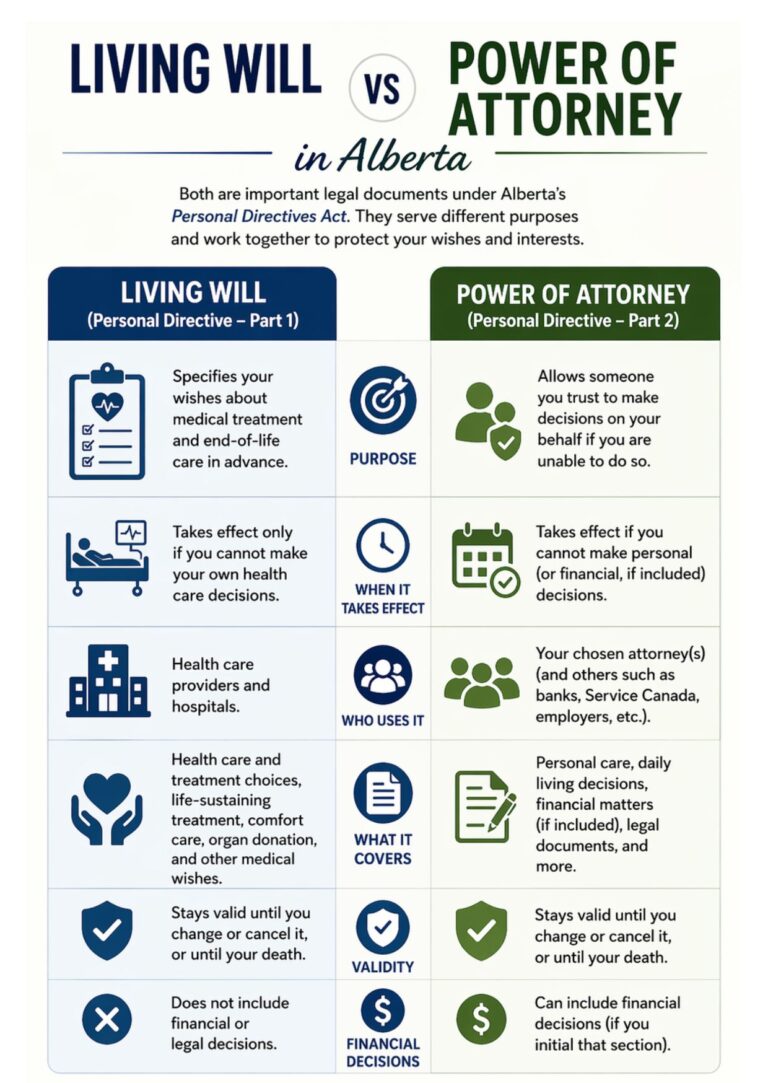
This is why agreements can be useful as part of broader estate planning, along with documents like a will or power of attorney.
Common Mistakes to Avoid
Many agreements can create problems because of simple mistakes.
Avoid these common issues:
- Not providing accurate information about assets and debts
- Using unclear or vague language
- Copying templates without customizing them
- Skipping the required legal review
- Not updating the agreement after major life changes (like buying a house or having a child)
A poorly prepared agreement may face enforceability challenges.
Real-Life Example (Simple Scenario)
Imagine one partner owns a house before the relationship of interdependence begins. Alberta’s Family Property Act contains rules for property brought into the relationship, including exemptions and the treatment of later increases in value. The agreement should therefore state clearly how the home and any later contributions will be treated.
With a cohabitation agreement:
- The agreement can clearly state how the original owner’s interest is to be treated
- Contributions (like rent or bills) can be clearly defined
- The parties can reduce uncertainty about what they intend to happen during separation
Without clear terms, disputes can lead to lengthy and expensive legal proceedings.
Cohabitation Agreement vs Prenuptial Agreement
These agreements are similar but used in different situations.
| Feature | Cohabitation Agreement | Prenuptial Agreement |
| When used | Before or during living together | Before marriage |
| Applies to | Unmarried couples, including qualifying adult interdependent partners | Couples planning to marry |
| Purpose | Set financial and property rules | Address property and financial matters in anticipation of marriage |
| Changes after marriage | The parties should review the agreement and confirm whether it is intended to continue after marriage | Intended to operate in relation to the marriage |
If a couple later marries, the parties should review the agreement and confirm whether it is intended to continue after marriage; section 37(2) addresses agreements made before marriage and their enforceability after marriage.
How to Create a Cohabitation Agreement (Step-by-Step)
Creating an agreement is straightforward if done carefully.
Step-by-step process:
- List all assets and debts
- Decide how finances will be handled
- Draft the agreement
- Review it together
- Have each party complete the required legal acknowledgement before a lawyer other than the lawyer acting for the other party
- Sign and store it safely
This process helps both partners understand the terms and complete the applicable Alberta formalities.
What Happens If You Don’t Have One?
Without an enforceable property agreement, the parties remain subject to the applicable Alberta property rules. For qualifying adult interdependent partners, the Family Property Act provides the framework for dividing property when the relationship ends.
Possible risks include:
- Property disputes
- Financial loss
- Court involvement
- Unclear ownership of assets
In many situations, couples only realize the importance of an agreement after separation—when changing the arrangements can be much more difficult.
Frequently Asked Questions
Is a cohabitation agreement the same as common-law marriage?
No. A cohabitation agreement is a contract, while adult interdependent partner status is a legal relationship defined under Alberta law. Alberta does not use “common-law marriage” as the statutory term for this relationship.
Can we write it ourselves in Alberta?
You can prepare the wording yourself, but a document dealing with property must still satisfy the formal requirements of sections 37–38 if you want those provisions to be enforceable under the Family Property Act.
Do we need a lawyer for it to be valid?
For a property agreement intended to be enforceable under sections 37–38 of the Family Property Act, the required lawyer acknowledgements are legally necessary. Each party must make the acknowledgement before a lawyer other than the lawyer acting for the other party.
Can we change the agreement later?
Yes, the parties can replace or amend their agreement. If the amended terms are intended to govern property under the Family Property Act, the applicable formal requirements should be followed again.
What if one partner refuses to sign?
Then there is no mutually agreed cohabitation agreement. In that case, the applicable Alberta laws will continue to govern the parties’ rights and obligations.