Affidavit format Canada: Download Free PDF & Word Template
Affidavit format Canada is one of the most searched legal topics because people often need a simple, correct format they can actually use. In this guide, I’ll show you exactly how affidavits work in Ontario, give you a ready-to-use template, and explain the legal rules in plain English. If you’re a student, applying for immigration, filing something in court, or just need a sworn statement—this guide is written for you.
One important thing to know: format matters a lot. I’ve seen people in Ontario have affidavits rejected simply because they signed them before meeting a commissioner or used the wrong format for the court or agency involved. When someone is already stressed about immigration, family matters, or court deadlines, that small mistake can create delays they never expected.
Even if your information is correct, a badly formatted affidavit can be rejected or treated as invalid. The good news? Once you understand the structure, it’s actually very simple.
Last Updated: September 2026
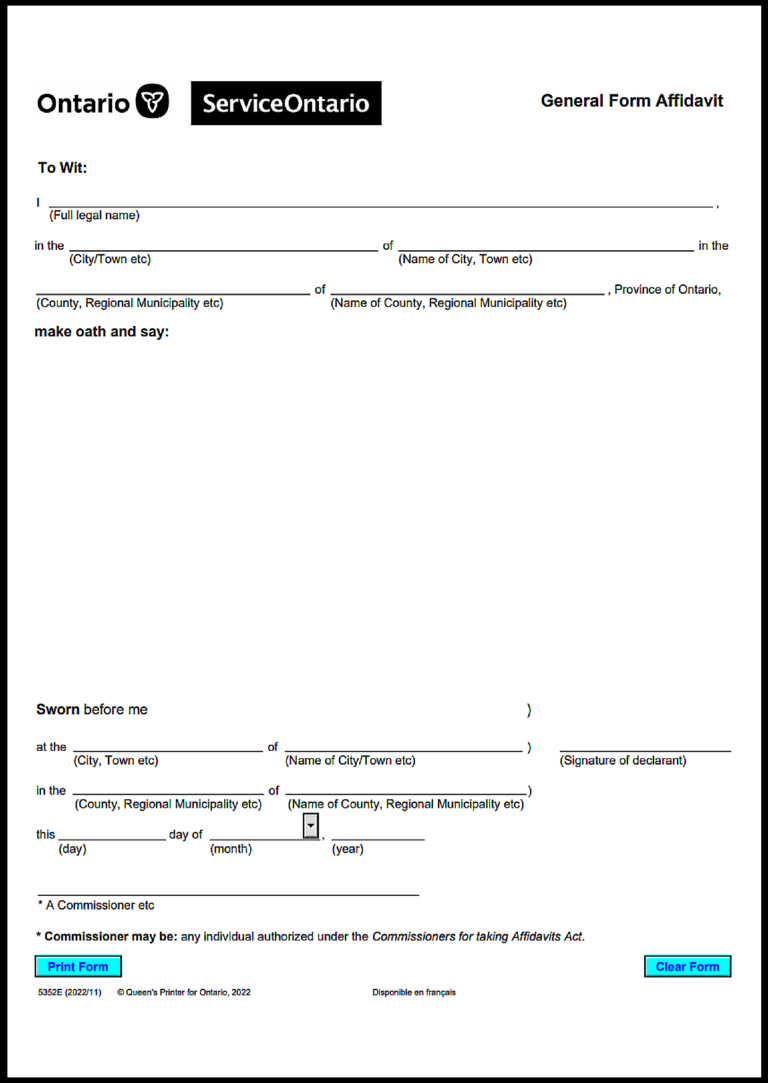
Free Affidavit Template Ontario
Below is a clean, standard affidavit format used in Ontario. You can copy, edit, and use it.
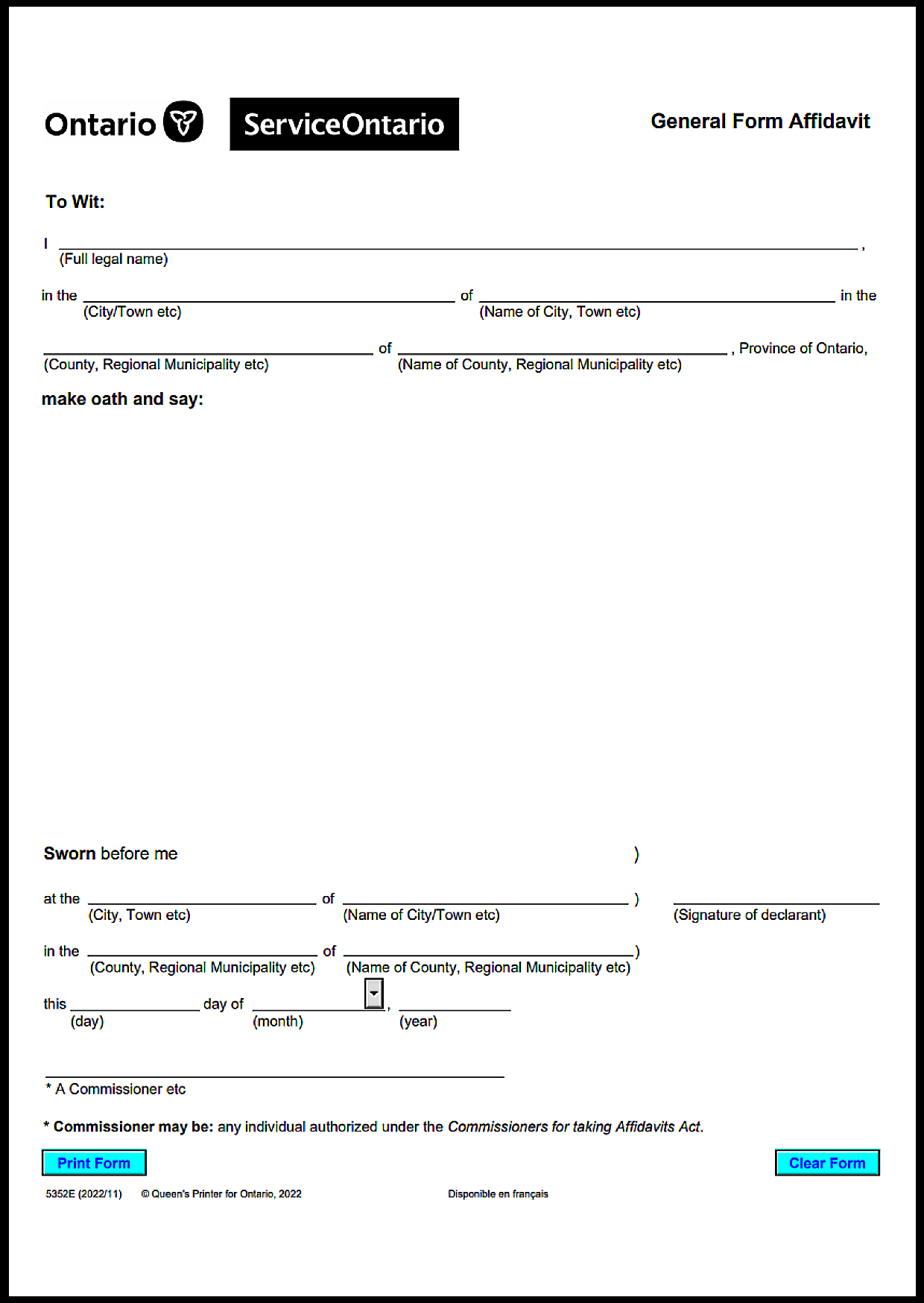
You can use “Sworn” if you follow a religious oath, or “Affirmed” if not.
Always remember:
- Do not sign before meeting the commissioner
- Signature must be done in front of an authorized person
Ontario Affidavit Format Rules, Court Filing Standards & Legal Requirements
| Topic / Issue | Ontario Legal Rule | Governing Statute |
|---|---|---|
| Provincial affidavit laws | For Ontario court proceedings, affidavit formatting and procedure are governed by the applicable court rules, including the Rules of Civil Procedure, while oath and affirmation requirements are governed by the Commissioners for Taking Affidavits Act and other applicable law. | Rules of Civil Procedure, R.R.O. 1990, Reg. 194 |
| Evidence rules | Ontario evidence law applies to affidavits in appropriate circumstances, including rules concerning oaths, affirmations and competency, alongside the applicable court and commissioning rules. | Evidence Act, R.S.O. 1990, c. E.23 |
| Commissioner rules | The Commissioners for Taking Affidavits Act governs who may administer oaths and take affidavits in Ontario. | Commissioners for Taking Affidavits Act, R.S.O. 1990, c. C.17 |
| Federal affidavit use | Federal requirements may apply when an affidavit is used in an immigration, federal court or other federal proceeding, and the applicable legislation, court rules or agency requirements should be checked for the specific matter. | Canada Evidence Act, R.S.C. 1985, c. E-10 |
| Virtual commissioning | Ontario permits remote administration of oaths and declarations where the conditions in O. Reg. 431/20 are met, including real-time audiovisual communication, identity confirmation, a modified jurat or declaration stating the required locations, and reasonable precautions to ensure the deponent understands what is being signed. | Commissioners for Taking Affidavits Act, R.S.O. 1990, c. C.17; O. Reg. 431/20 |
| Electronic filing | Ontario permits electronic filing of documents through authorized court filing systems where the applicable Rules of Civil Procedure and portal requirements permit it. | Rules of Civil Procedure and applicable electronic filing procedures |
| Who can sign | For an affidavit used in a proceeding, the Rules of Civil Procedure generally require the affidavit to state facts within the deponent’s personal knowledge, subject to rules permitting other evidence in specified circumstances. | Rules of Civil Procedure, Rule 4.06 |
| Witness requirement | An affidavit must be sworn or affirmed before a person authorized by law to administer oaths or affirmations, such as an appropriate commissioner or notary. | Commissioners for Taking Affidavits Act |
| Notarization/commissioning | An Ontario affidavit must be sworn or affirmed before a person authorized to administer oaths or affirmations; depending on the circumstances, this may include a Commissioner for Taking Affidavits or a Notary Public. | Commissioners for Taking Affidavits Act |
| Age and mental capacity | Ontario law provides that a person of any age is presumed competent to give evidence, while the person administering an oath or affirmation must comply with the applicable requirements for taking it. | Evidence Act, s. 18(1) |
| Motion deadlines | For a motion made on notice, the notice of motion generally must be served at least seven days before the hearing, subject to exceptions in the Rules or a court order. Ontario’s time-computation rule generally excludes the day the first event occurs and includes the day the second event occurs. | Rules of Civil Procedure, including Rule 37.07 and Rule 3.01 |
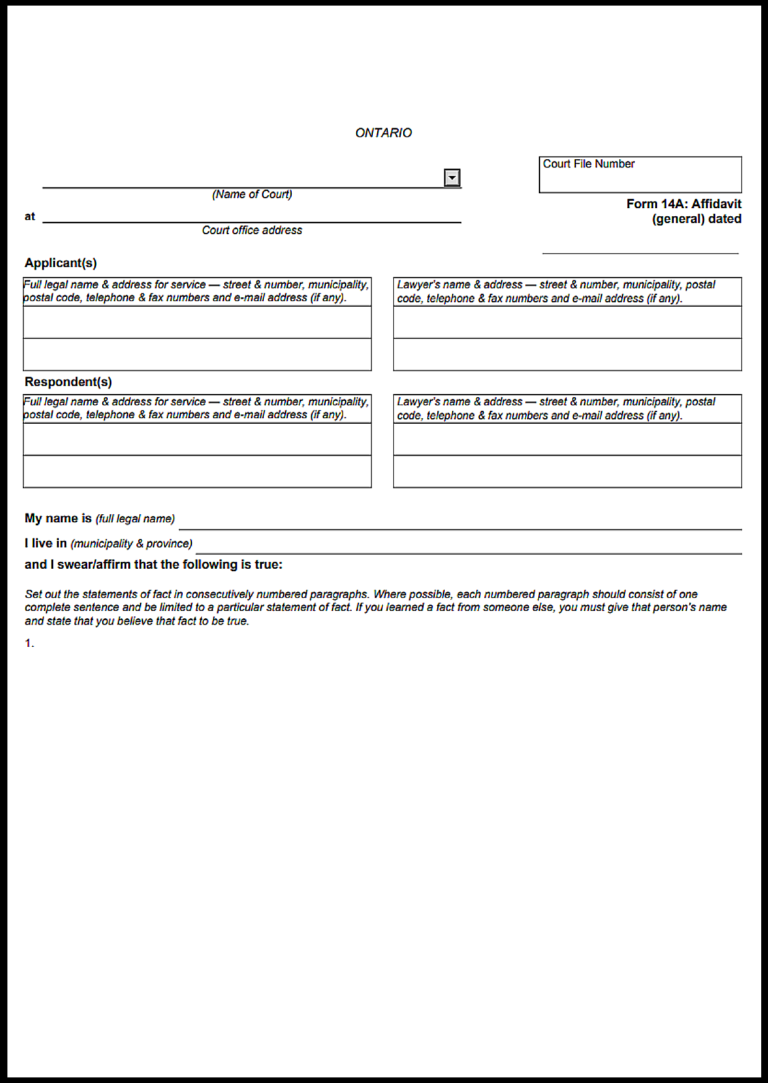
| Mandatory Ontario court format | For proceedings governed by Ontario’s Rules of Civil Procedure, Rule 4.06 requires affidavits to be in Form 4D, subject to applicable exceptions and other court-specific requirements. In Small Claims Court, Form 15B is an affidavit form, while Form 15A is the notice of motion. Tribunal requirements vary by tribunal and proceeding. | Rules of Civil Procedure, Form 4D; Rules of the Small Claims Court, O. Reg. 258/98 |
| Mandatory jurat wording | The jurat must comply with the applicable Ontario commissioning requirements, including any additional information required for a remotely administered oath or affirmation. | Applicable Ontario affidavit and commissioning requirements |
| Virtual commissioning wording | A remotely commissioned affidavit must use the modified jurat required by O. Reg. 431/20, including the information required by the regulation about the remote administration and the locations of the participants. | O. Reg. 431/20 |
| Information and belief statements | For an affidavit used on a motion, information-and-belief statements may be included where permitted by Rule 39.01 and the affidavit specifies the source of the information and the fact of the belief. | Rules of Civil Procedure, Rule 39.01(4) |
| Court filing requirement | Where an affidavit is required to be filed in an Ontario court proceeding, it must be filed using the procedure and within the time required by the applicable court rules and filing system. | Applicable Ontario court rules and procedures |
| Electronic court filing | Ontario courts provide electronic filing and submission systems for eligible documents and proceedings, but the applicable portal and filing procedure depend on the court and proceeding. | Applicable Ontario court rules and electronic filing procedures |
| Non-litigation affidavits | A non-litigation affidavit is submitted according to the requirements of the person, organization, government body or other authority requesting it. | Requirements of the receiving authority |
| Presence requirement | An oath or declaration is normally taken in the physical presence of the person administering it, but Ontario permits remote administration where the conditions in O. Reg. 431/20 are satisfied. | Commissioners for Taking Affidavits Act, s. 9; O. Reg. 431/20 |
| Trial affidavit knowledge rule | Affidavits are generally confined to facts within the deponent’s personal knowledge or other evidence the deponent could give as a witness, subject to applicable exceptions. | Rules of Civil Procedure, Rule 4.06(2) |
| Exhibit marking requirement | An exhibit referred to in an affidavit must be marked as an exhibit by the person taking the affidavit and handled in accordance with Rule 4.06(3). | Rules of Civil Procedure, Rule 4.06(3) |
| Ontario remote commissioning system | Ontario permits remote administration of oaths and declarations subject to the procedural safeguards in O. Reg. 431/20, as amended effective March 1, 2026. | O. Reg. 431/20 |
| Ontario standardized forms | For proceedings governed by Ontario’s Rules of Civil Procedure, Rule 4.06 requires affidavits to be in Form 4D, subject to applicable exceptions and other court-specific requirements. | Rules of Civil Procedure, Rule 4.06 |
| Expert affidavit requirement | Where expert evidence is governed by Rule 53.03, the applicable expert-witness requirements, including the required acknowledgment and other prescribed information, must be followed. | Rule 53.03 |
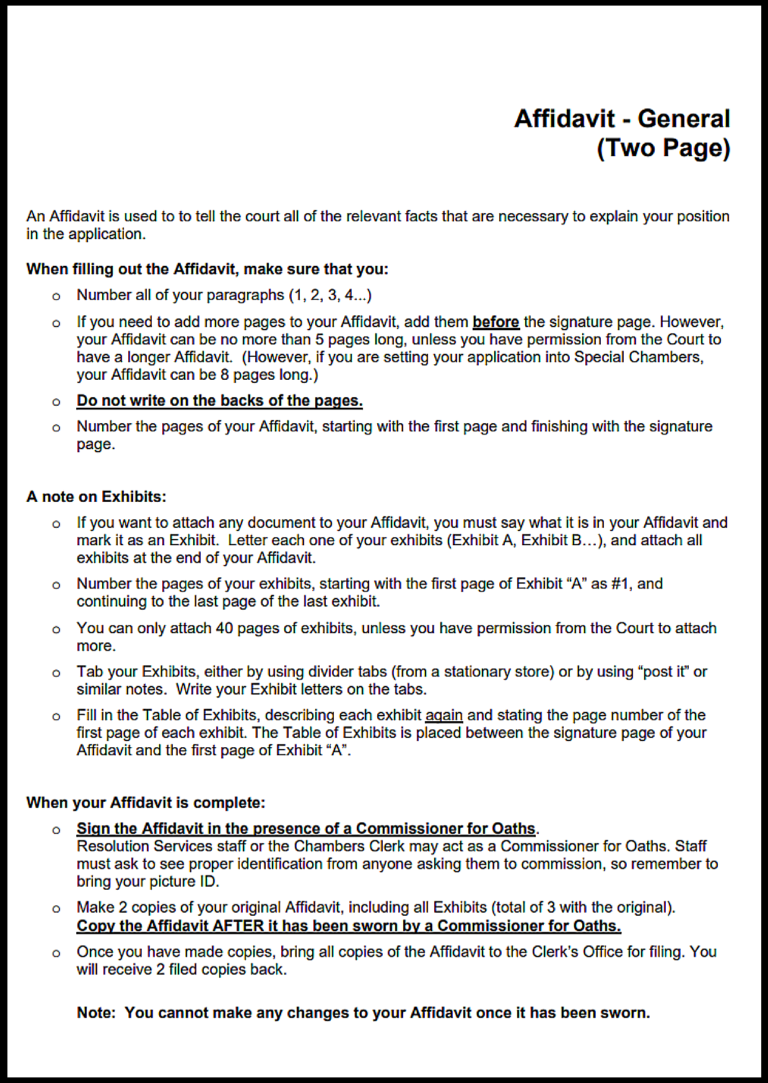
One of the most important Ontario affidavit rules is that the document must comply with the requirements applicable to the proceeding. For civil proceedings governed by the Rules of Civil Procedure, Rule 4.06 generally requires an affidavit to be in Form 4D, expressed in the first person, divided into consecutively numbered paragraphs and signed and sworn or affirmed before an authorized person. Exhibits referred to in the affidavit must also be handled according to Rule 4.06(3).
Another important Ontario rule involves virtual commissioning. Ontario permits remote administration of oaths and declarations when the conditions in O. Reg. 431/20 are satisfied. These include real-time communication, identity confirmation, a modified jurat or declaration containing the required information, and reasonable precautions to ensure that the deponent understands what is being signed.
These rules matter in real life because affidavits are used in court proceedings and may also be requested by immigration authorities, organizations and other government or legal bodies. Technical mistakes can cause filing or processing problems. Before using a template, check the requirements of the particular court or authority receiving your affidavit.
Understanding Affidavit Format in Canada
An affidavit is a written statement made under oath or affirmation.
But many people confuse two things:
- What to write (content)
- How to write (format)
Simple explanation
- Content = your facts
- Format = structure of the document
The basic purpose of an affidavit is similar across Canada, but the required form and procedure are not uniform. Ontario has its own court rules and commissioning requirements, so an affidavit prepared for an Ontario proceeding should be checked against the rules of the particular Ontario court or receiving authority.
Understanding the correct affidavit format is important when preparing a document for a specific proceeding or organization. For Ontario-specific applications, you can refer to the affidavit template hub, which provides province-focused guidance.
When Do You Need an Affidavit?
Affidavits may be required when a court or another authority needs evidence in sworn or affirmed form. You do not need to be a lawyer to prepare an affidavit, but the requirements depend on why the affidavit is being requested.
Common situations include:
- Court matters (family disputes, civil cases)
- Immigration applications
- Identity verification
- Business or legal documents
For example, if you need to prove your address, you may need an affidavit of residence Ontario.
Sometimes, people also use it for identity proof—see affidavit of identity Canada for that.
Key Parts of a Valid Affidavit (Ontario)
Let’s break it down in a simple way. For an affidavit governed by Ontario’s Rules of Civil Procedure, the required structure includes several important parts.
Title Section
The document should clearly identify that it is an “AFFIDAVIT” where the applicable form or procedure requires that designation.
Deponent Information
This means your details. Write:
- Full legal name
- City and province
- Other identifying information required by the applicable form or proceeding
Statement of Facts
This is the main part. Write your facts like this:
- Use numbers (1, 2, 3…)
- Keep each paragraph focused on a particular fact
- Only write what is true
Avoid unsupported opinions or arguments. An affidavit should generally contain facts within the deponent’s personal knowledge, subject to applicable exceptions.
Oath or Affirmation
This confirms that:
- You are making the statement under oath or affirmation
- You understand what you are signing
Signature Section
This is where many practical mistakes happen.
- You sign
- The authorized person administering the oath or affirmation completes the required commissioning portion
- The required date and location information is included
Do not sign the affidavit in advance if the applicable commissioning procedure requires you to sign in the presence of the person administering the oath or affirmation.
This format applies to multiple document types, including an Ontario sworn affidavit and specialized forms like an affidavit of identity. You can also compare usage differences in the affidavit vs statutory declaration guide.
Ontario Legal Rules
Under Ontario law, affidavits must follow the rules that apply to the particular proceeding or purpose.
Instead of making it complicated, here’s a simple breakdown:
- Must be sworn or affirmed before:
- A Commissioner for Taking Affidavits
- A Notary Public
- Another person authorized by law to administer oaths or affirmations
- Must be:
- Made voluntarily
- Truthful and accurate to the best of the deponent’s knowledge and as required by the applicable rules
- False information can lead to:
- Legal consequences
- Evidentiary or procedural consequences
- Potential criminal consequences where the conduct meets the requirements of an offence such as perjury
In simple words: Never lie in an affidavit.
How to Fill an Affidavit (Step-by-Step)
If you’re doing it for the first time, follow this simple process.
Step 1: Add your details
Write your full name and other required identifying information properly.
Step 2: Write your facts
Keep it clear and simple:
- One factual point per paragraph where practical
- Use numbered paragraphs
- Avoid unnecessary background or argument
Step 3: Avoid emotional language
Do not write:
- “I feel…”
- “I think…”
Instead, explain the facts that you personally know or identify the permitted source of information where the applicable rules allow information-and-belief evidence.
Step 4: Keep signature blank
Do not sign at home if the applicable commissioning procedure requires you to sign before the person administering the oath or affirmation.
Step 5: Visit a commissioner
The person administering the oath or affirmation may:
- Verify your identity
- Watch you sign or administer the oath or affirmation as required
- Complete the jurat or declaration and any required stamp or record
You can read more in how to get affidavit Ontario.
Affidavit vs Statutory Declaration
Many beginners get confused here, so this table will help:
| Feature | Affidavit |
Statutory Declaration
|
| Oath or affirmation | Usually made under an oath or affirmation |
Made by declaration under the applicable statutory procedure
|
| Used For | Commonly used as sworn or affirmed evidence where required |
Used where a statute, authority or recipient accepts a statutory declaration
|
| Signed Before | A person authorized to administer oaths or affirmations |
An authorized person under the applicable law
|
| Legal Role | Commonly used as evidence in court and other legal proceedings |
Used for purposes authorized by the applicable statute or receiving authority
|
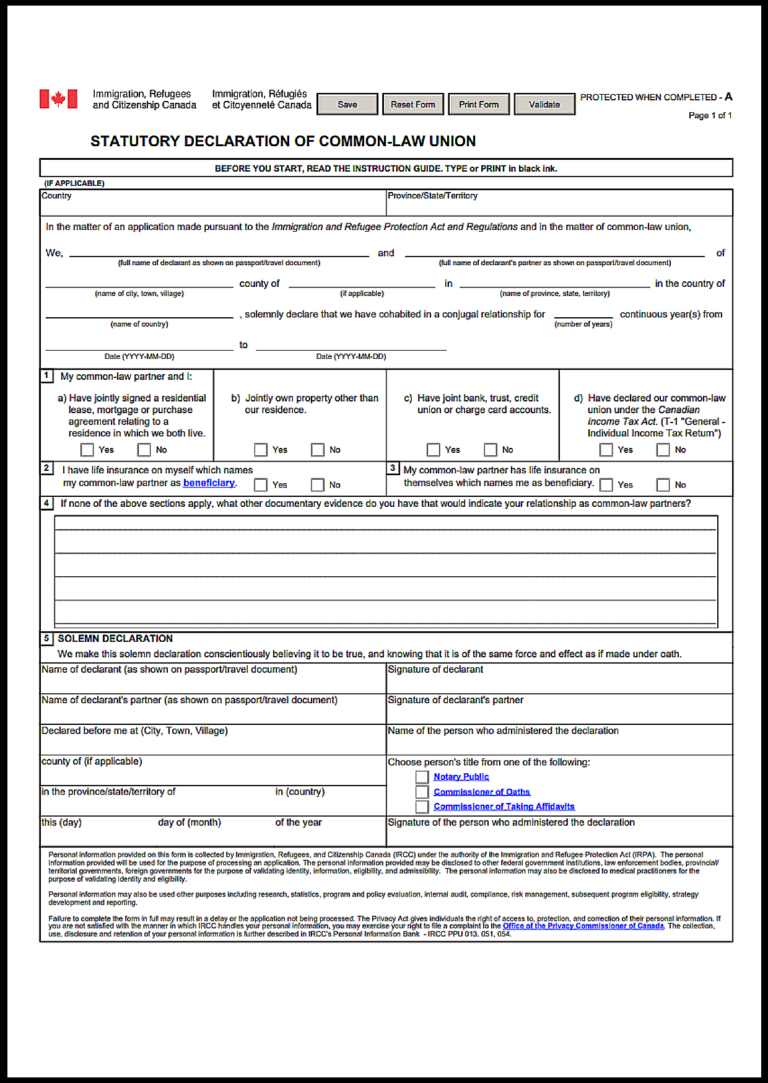
If your matter is not for court, you can also use statutory declaration Canada where the receiving authority accepts or requires one.
Common Mistakes to Avoid
Some mistakes can cause filing or processing problems. These are very common:
- Signing before meeting the person administering the oath or affirmation
- Writing false or exaggerated facts
- Using unclear language
- Missing required date or location information
- Not following the applicable court or authority’s format
Tip: Always check your document once before signing and confirm that the receiving court or organization has no additional requirements.
Do You Need Notary or Commissioner?
In many cases, an affidavit must be sworn or affirmed before a person authorized to administer oaths or affirmations.
Instead of long explanation, here is a quick comparison:
| Role | Commissioner of Oaths | Notary Public |
| Work | May administer oaths and take affidavits where authorized |
May perform notarization and other functions authorized by law
|
| Cost | Fees vary by provider and circumstances |
Fees vary by provider and circumstances
|
| Use | Commonly used for affidavits and other documents requiring an oath |
May be required or preferred where notarization is specifically requested
|
The correct choice depends on what the receiving court, government body, organization or other authority requires.
Can You Use Same Format Across Canada?
The basic concept of an affidavit is similar across Canada, but the required form, jurat, commissioning rules and court procedures can differ by province, territory and proceeding.
The structure stays broadly similar, but important differences may include:
- Province or territory
- Court rules
- Prescribed forms
- Jurat or declaration wording
- Commissioning requirements
- Filing procedures
For example:
- Ontario → Ontario court rules and forms may apply
- Alberta → Alberta legislation and court rules may apply
So always adjust the affidavit based on where and why you are submitting it.
FAQs About Affidavit Format Canada
Is handwritten affidavit valid?
A handwritten affidavit may be acceptable in some circumstances, but whether it can be used depends on the receiving court, organization or authority and any applicable form or filing requirements.
Can I make my own format?
For proceedings governed by Ontario’s Rules of Civil Procedure, Rule 4.06 requires an affidavit to be in Form 4D and to comply with the rule’s requirements. In Small Claims Court, the applicable affidavit form depends on the proceeding; for example, Form 15B is an affidavit form used for motions. A court may require corrections or may refuse a non-compliant document, so the applicable court rules and forms should be checked before filing.
Is notary required in Ontario?
A notary is not automatically required for every Ontario affidavit. An affidavit may be sworn or affirmed before a Commissioner for Taking Affidavits or another person authorized to administer oaths or affirmations.
If an affidavit or other document is intended for use outside Canada, the requirements of the destination country or receiving authority should be checked. Ontario’s Official Documents Services handles authentication and apostille services for eligible Ontario documents. Documents commissioned by a Commissioner for Taking Affidavits are not eligible for authentication through Ontario’s process, while certain documents notarized by an Ontario notary may be eligible depending on the document and destination requirements.
Can affidavit be used for immigration?
An affidavit may be used as supporting evidence in some immigration matters, but the specific application requirements should be checked with the applicable immigration authority.
What if affidavit is false?
Knowingly making a false statement under oath or solemn affirmation with intent to mislead can constitute perjury under section 131 of the Criminal Code, in addition to any consequences the false evidence may have in the underlying proceeding.
Final Thoughts
Affidavit format may look difficult at first, but it becomes much easier when you separate the document’s content from its commissioning and filing requirements.
Just remember:
- Follow the correct structure
- Write only true and supportable facts
- Sign and swear or affirm the affidavit according to the applicable commissioning requirements
Following the applicable Ontario form, commissioning and filing requirements can help avoid procedural problems, but whether an affidavit is accepted ultimately depends on the requirements of the court or authority receiving it.