Free Ontario Freelance Contract Template (Legal & Customizable)
Ontario Freelance Contract is the first thing you should have in place before starting any freelance project. It protects your work, your payment, and your peace of mind.
If you’re a freelancer or hiring one, a freelance contract is simply a written agreement that explains what work will be done, how much will be paid, and when everything will happen.
Why does it matter? Because without it, things can go wrong fast. Payments get delayed, clients ask for extra work, or disputes happen.
I’ve seen Ontario freelancers lose weeks of work because the scope was never clearly written down or the payment terms were too vague to enforce properly. In Ontario, even a simple freelance contract can make a major difference when a client suddenly disputes invoices, ownership of the work, or project deadlines.
Last Updated: September 2026
Free Ontario Freelance Contract Template
Here’s a simple, ready-to-use template you can copy, edit, and sign.
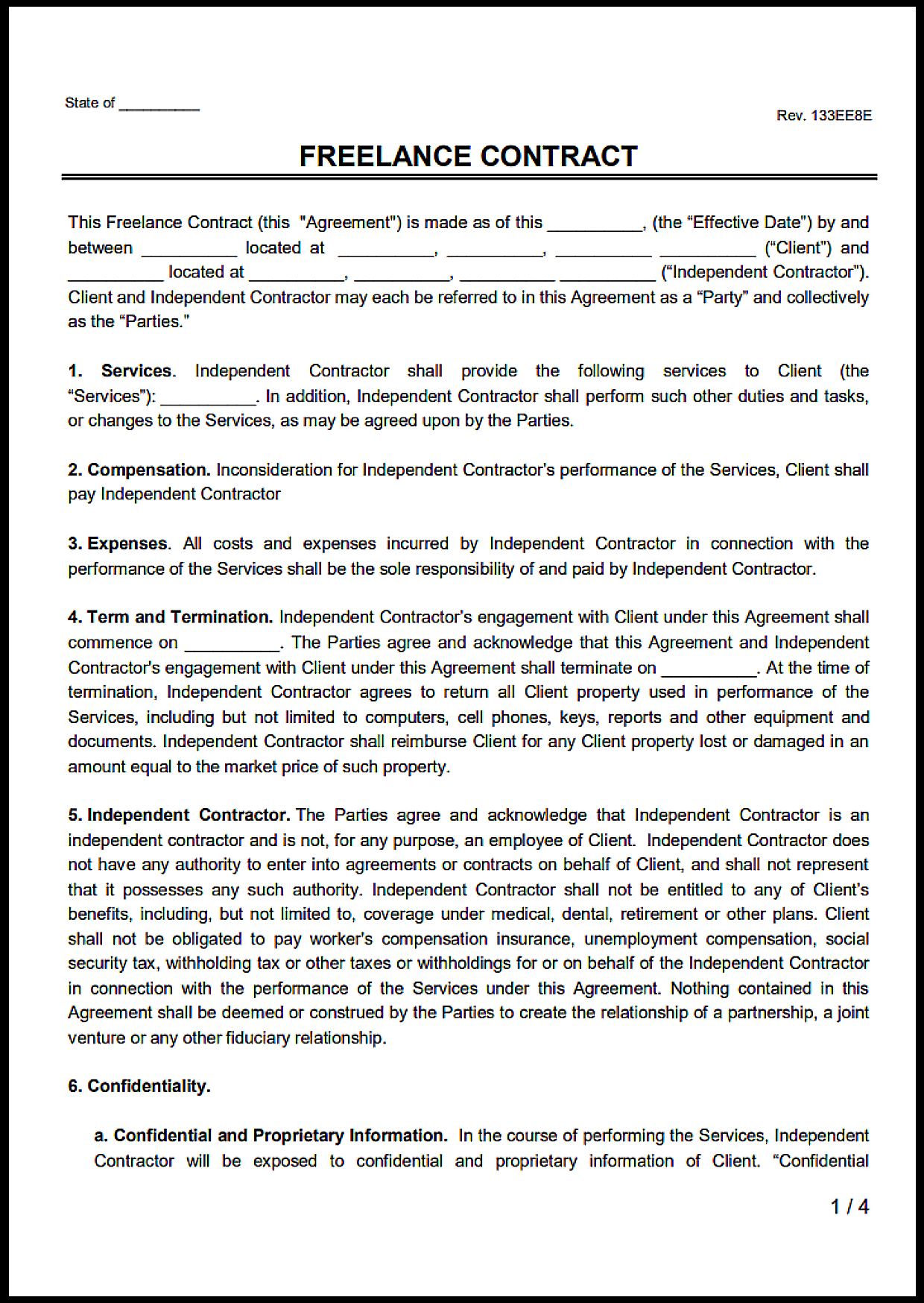
Tip: Always customize it based on your project.
Ontario Freelance Contract Laws, Worker Classification & Legal Requirements
| Topic / Issue | Ontario Legal Rule | Governing Statute |
|---|---|---|
| Governing legislation | Ontario freelance contracts are generally governed by contract-law principles, while employment-status, tax, consumer, copyright, and other statutory rules may apply depending on the relationship and transaction. | Ontario Common Law; Employment Standards Act, 2000; applicable federal legislation |
| Scope of jurisdiction | Ontario law may govern the contract and applicable provincial employment standards, while federal rules govern income tax, CPP, and EI matters. Worker classification depends on the actual working relationship. | Employment Standards Act, 2000; Income Tax Act; Canada Pension Plan; Employment Insurance Act |
| Recent legal amendments | Ontario’s Working for Workers Four Act, 2024 introduced and amended employment-related rules, including requirements for certain publicly advertised job postings; these rules generally concern employers and employees rather than freelancers as a separate legal category. | Working for Workers Four Act, 2024 (Bill 149) |
| Legal signatories | An individual may sign personally, while a corporation generally acts through a person who has authority to bind the corporation. | Ontario Common Law; Business Corporations Act |
| Witness requirement | Ordinary freelance contracts generally do not require a witness, although witnessing a signature can provide additional evidence about execution. | Ontario Common Law |
| Notarization | Standard freelance contracts generally do not require notarization. | Ontario Common Law |
| Age requirement | Ontario’s age of majority is 18. A person who is 18 or older is presumed to be capable of entering into a contract under the Substitute Decisions Act, 1992; contracts involving minors can raise additional common-law rules and should not be treated as automatically void. | Age of Majority and Accountability Act; Substitute Decisions Act, 1992 |
| Mental capacity | A person who is 18 or older is presumed to be capable of entering into a contract, although capacity can become an issue where there are reasonable grounds to believe the person is incapable. | Substitute Decisions Act, 1992 |
| Time limit to sue | The basic limitation period for many contract claims is two years from when the claim is discovered, subject to exceptions and other limitation rules under Ontario’s Limitations Act, 2002. | Limitations Act, 2002, ss. 4–5 |
| General contract language | Ontario freelance contracts generally follow common-law contract principles and do not have one mandatory set of wording for ordinary agreements. Specific transactions may have additional statutory requirements. | Ontario Common Law; applicable legislation |
| Digital platform worker disclosures | For workers covered by Ontario’s Digital Platform Workers’ Rights Act, 2022, a digital-platform operator must provide specified written information within 24 hours after the individual receives access to the platform, including information about how pay is calculated and tips. | Digital Platform Workers’ Rights Act, 2022, s. 7 |
| Consumer home-service notice | Certain consumer service agreements may be subject to Ontario’s direct-agreement requirements, including statutory cancellation rights. Whether those rules apply depends on whether the transaction meets the Consumer Protection Act, 2002 definition of a direct agreement. | Consumer Protection Act, 2002 |
| Filing requirement | Freelance agreements are generally private contracts and are not filed with the government. | N/A |
| Business name registration | A freelancer carrying on business under a name that must be registered under Ontario’s Business Names Act generally needs to register that business name through the Ontario Business Registry. | Business Names Act |
| Misclassification risk | Calling someone a freelancer or independent contractor does not by itself determine their legal status. Worker classification depends on the actual working relationship and the applicable legal test. | Employment Standards Act, 2000; applicable federal rules |
| Restrictive Covenants & Non-Competes | Section 67.2 of the ESA prohibits employers from entering into non-compete agreements with employees, subject to statutory exceptions. A restrictive covenant in a genuine commercial or independent-contractor relationship is not automatically governed by that employee prohibition and must instead be assessed under the applicable common-law rules. | Employment Standards Act, 2000, s. 67.2; Ontario Common Law |
| Jurisdiction clause importance | A choice-of-law and forum clause can help identify the law and courts the parties intend to use, although its effect depends on the contract, applicable legislation, and conflict-of-laws rules. | Ontario Common Law |
| Ontario non-compete difference | Ontario’s Employment Standards Act, 2000 prohibits employers from entering into non-compete agreements with employees, subject to statutory exceptions. That employee-specific rule should not be presented as a general ban on commercial non-competes. | Employment Standards Act, 2000, s. 67.2 |
| Electronic monitoring difference | The ESA’s electronic-monitoring policy requirement applies to qualifying employers and their employees. It should not be presented as a standalone test for whether a freelancer is legally an employee. | Employment Standards Act, 2000, s. 41.1.1 |
One of the biggest legal risks in Ontario freelance contracts is worker misclassification. Calling someone a “freelancer” does not settle the question. The actual working relationship matters, including factors such as control, tools and equipment, financial risk, subcontracting, investment, management, and opportunity for profit.
Ontario’s statutory non-compete prohibition under the Employment Standards Act, 2000 applies to employee relationships, subject to statutory exceptions. A restrictive covenant in a genuine commercial or independent-contractor relationship is a different legal question and may be assessed under common-law rules.
Another important issue involves digital platform workers, such as certain app-based delivery or ride-share workers. Ontario’s Digital Platform Workers’ Rights Act, 2022 provides specific protections and written-information requirements for workers covered by that legislation. Those rules should not be treated as requirements for every ordinary freelancer.
These rules matter in real life because poorly written freelance agreements can lead to payment disputes, employee reclassification claims, unenforceable clauses, and costly legal problems later. Use the free Ontario Freelance Contract template below as a starting point and customize it for the actual relationship and project.
What Is an Ontario Freelance Contract (and Why You Need One)
An Ontario freelance contract is a legal agreement between a client and a freelancer that clearly sets out the terms of work.
Under Ontario law, a contract may be written, verbal, or implied, although certain transactions are subject to additional legal requirements.
- An offer (the work proposed)
- Acceptance (both parties agree)
- Consideration (something of value, usually payment)
Other issues can also affect enforceability, including intention to create legal relations, capacity, certainty, legality, misrepresentation, and any statutory requirements that apply to the particular transaction.
Freelance Contract vs Employment Agreement
- A freelance contract = an agreement intended for an independent business relationship, subject to the actual facts of the relationship
- An employment contract = an agreement governing an employer-employee relationship, including applicable statutory employment standards
This difference matters because it can affect taxes, liability, employment standards, and other legal rights and obligations.
Why You Should Always Use One
In real life, problems usually come from:
- Clients asking for “just one more change” (scope creep)
- Late or missing payments
- Confusion about deadlines
A written contract will not stop every disagreement. It does, however, give both sides a clear record of the agreed scope, payment terms, deadlines, and responsibilities.
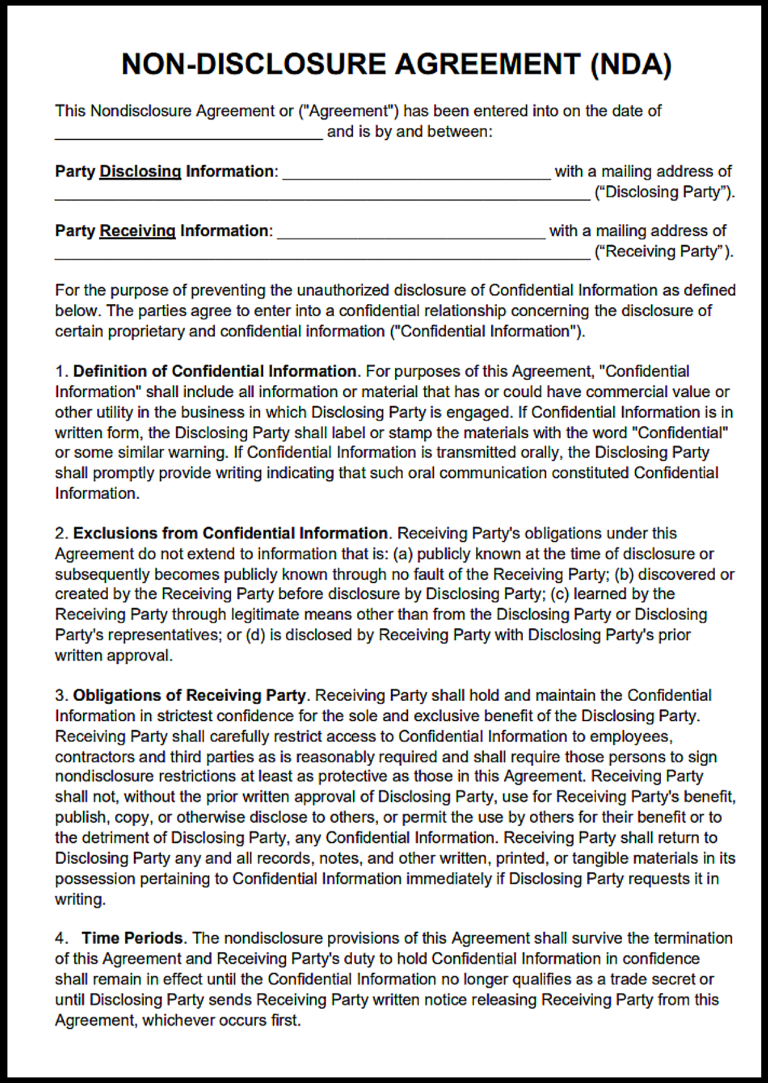
Freelancers working with sensitive client data should also refer to the [Ontario NDA template] to understand how confidentiality terms are properly included.
When Should You Use a Freelance Contract?
A written contract is useful for every freelance project, but it becomes especially important when the work involves recurring payments, intellectual property, confidential information, deadlines, or substantial project value.
Common situations:
- Starting a new client project
- One-time gigs (logo design, blog writing)
- Ongoing monthly work
- Remote or international clients
- Working with friends or referrals
Even if the project feels “informal,” a contract keeps the agreed terms clear and professional.
Example use cases:
- Graphic design
- Content writing
- Website development
- Social media management
Key Clauses Every Ontario Freelance Contract Must Include
These are the most important parts of your agreement.
Scope of Work
Clearly explain:
- What you will do
- What you will NOT do
This helps avoid confusion and extra unpaid work.
Payment Terms & Late Fees
Include:
- Fixed price or hourly rate
- Payment deadlines
- Late payment penalties
Set out how invoices will be issued, when payment is due, and what happens if an invoice remains unpaid. If interest is charged, make sure the rate and calculation method comply with applicable law.
Deadlines & Deliverables
Set:
- Start and end dates
- Milestones (if needed)
This keeps both sides accountable and gives the parties a clear way to measure project progress.
Intellectual Property Rights
Very important in Canada.
Expressly define:
- Copyright Ownership: Clearly state whether copyright in the deliverables is assigned to the client, licensed to the client, or retained by the freelancer. If the parties want ownership to transfer only after payment, the contract should expressly say so.
- Moral Rights Waiver: Under the federal Copyright Act, moral rights cannot be assigned, but they may be waived in whole or in part. If the parties intend the freelancer to waive moral rights, the agreement should clearly address that waiver separately from the copyright assignment.
Without clear intellectual-property wording, ownership and permitted uses of the work can become unclear.
Independent Contractor Clause
This records the parties’ intended relationship.
It may state:
- You are intended to operate as an independent contractor
- You handle your own applicable taxes and business expenses
However, the wording alone does not prevent a worker from being classified as an employee if the actual relationship has the characteristics of employment.
Termination Clause
Explain:
- How either party can end the agreement
- Notice period required
- What happens to outstanding payments and unfinished work
This gives both sides a clear exit plan.
Confidentiality Clause
Protects:
- Business ideas
- Client data
- Private information
Especially important for sensitive projects.
This agreement is commonly connected with an [independent contractor format] and may also align with a [service agreement structure] for clearly defining project scope.
Is a Freelance Contract Legally Valid in Ontario?
Yes—if it satisfies the legal requirements that apply to the particular agreement.
Under Ontario law:
- Contracts can be written, verbal, or implied
- Some transactions have specific statutory requirements
- Written contracts are generally much easier to prove
Why Written Contracts Are Safer
With a written agreement:
- You have clear evidence
- You reduce misunderstandings
- You can more easily establish what the parties agreed to
Verbal agreements can still be valid—but proving the exact terms can be much harder if a dispute happens.
Common Mistakes Freelancers Make (And How to Avoid Them)
The problems usually start with a few missing details. Before signing, check the scope, payment schedule, intellectual-property terms, termination wording, and the way changes to the project will be approved.
- Not defining scope clearly → Leads to extra unpaid work
- No payment schedule → Causes delays or disputes
- Ignoring IP ownership → Creates uncertainty about rights to the work
- Using generic templates → May leave important terms unsuitable for the particular Ontario transaction
- Not documenting the agreement clearly → Can make the agreed terms harder to prove and enforce
Simple rule: Put important freelance terms in writing so the agreed scope, payment, deadlines, and rights are easier to prove.
Freelance vs Independent Contractor vs Employee
The labels can be confusing because “freelancer” and “independent contractor” are not separate legal tests. What matters is the actual working relationship and the applicable legal rules.
| Type | Typical Relationship | Benefits | Tax Responsibility | Legal Status |
| Freelancer | May operate independently, but status depends on the actual relationship | Usually no employee benefits | Depends on legal status | Fact-specific |
| Independent Contractor | Provides services as an independent business relationship | Usually no employee benefits | Generally responsible for own business tax obligations | Fact-specific |
| Employee | Works in an employment relationship under the employer’s direction and control | Employment standards may apply | Employer generally handles required payroll deductions | Employee |
The Canada Revenue Agency (CRA) considers the total working relationship, including:
- Level of control
- Ownership of tools and equipment
- Ability to subcontract or hire assistants
- Financial risk
- Responsibility for investment and management
- Chance of profit or loss
Misclassification can result in tax and employment consequences, so the contract should accurately reflect the relationship rather than simply using an “independent contractor” label.
Tax and Payment Considerations for Ontario Freelancers
For Ontario freelancers, the tax side is separate from the contract itself. Keep these points in mind:
- You must report applicable freelance income to the CRA
- You may need to register for and charge GST/HST if your taxable supplies exceed the applicable $30,000 small-supplier threshold
- Keep invoices and payment records
A contract helps establish:
- Your income
- Your business relationship
- Your payment terms
Keep the contract together with invoices and other business records so you can show how the amounts were earned and what the client agreed to pay.
What Happens If a Client Doesn’t Pay?
Here’s what you can do:
- Follow up professionally
- Refer to your contract terms
- Send a formal demand letter
- File a claim in the Ontario Small Claims Court if the claim falls within its $50,000 monetary jurisdiction. Effective October 1, 2025, claims for money or personal property valued at $50,000 or less can generally be brought in Small Claims Court. Claims above that amount generally proceed in the Superior Court of Justice.
Without a contract, proving the agreed terms can become much harder.
With one, you have written proof of:
- The agreement
- The payment terms
- The client’s obligation
How to Fill Out the Freelance Contract (Step-by-Step)
Start by filling in the legal names of the parties, then work through the commercial details in the same order the project will happen.
- Add full names and contact details
- Describe services in plain English
- Set payment terms carefully
- Include realistic deadlines
- Review everything before signing
- Keep a signed copy (digital or printed)
Small mistakes here can lead to big problems later, especially when important project terms are left unclear.
Frequently Asked Questions
Do I need a freelance contract in Ontario?
A freelance contract is not generally required for every freelance arrangement, but it is strongly recommended. It helps document the scope of work, payment terms, deadlines, intellectual-property rights, and responsibilities of both parties.
Can I write my own freelance agreement?
Yes. You can draft your own freelance agreement, but validity does not depend simply on including a checklist of terms. The agreement still has to satisfy the legal requirements that apply to the particular transaction.
Is a digital signature valid in Ontario?
Yes, electronic signatures are generally recognized under Ontario’s Electronic Commerce Act, 2000, although the Act excludes certain documents and transactions. The specific document should therefore be checked before relying on an electronic signature.
What if there is no written contract?
You may still have a valid agreement without a written contract. However, proving the exact terms can become more difficult if a dispute happens.
Can I reuse the same contract for all clients?
Yes, you can use a base template for multiple clients. Just customize it for each project, including the parties, scope, payment terms, deadlines, intellectual-property provisions, confidentiality obligations, and termination terms.