General Bill of Sale Ontario Template | Free PDF
A General Bill of Sale Ontario is often the only written record proving that ownership of personal property changed hands, and under Ontario’s Sale of Goods Act, when ownership passes depends largely on what the parties intended and recorded in their agreement. I’ve seen private sale disputes reach the Ontario Superior Court of Justice because a Bill of Sale described an item too vaguely, forcing the court to rely on text messages and other evidence to determine what had actually been sold.
That’s where many generic Canadian templates fall short—they leave out the detailed descriptions, serial numbers, or transaction information that later become critical if a disagreement arises. Whether you’re selling tools, equipment, furniture, a trailer, or another valuable item, using an Ontario-specific Bill of Sale can make it much easier to demonstrate exactly what was transferred. Below you’ll find a free Ontario General Bill of Sale template, when to use it, and the information commonly included before signing.
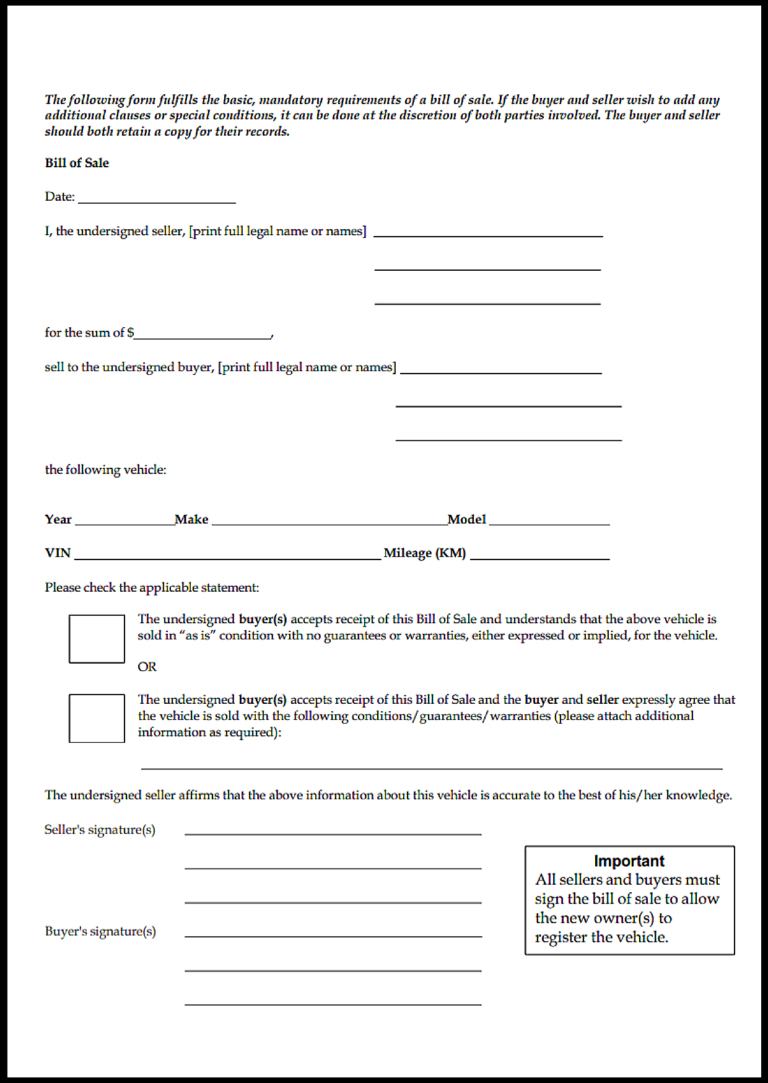
Free General Bill of Sale Ontario Template You Can Use
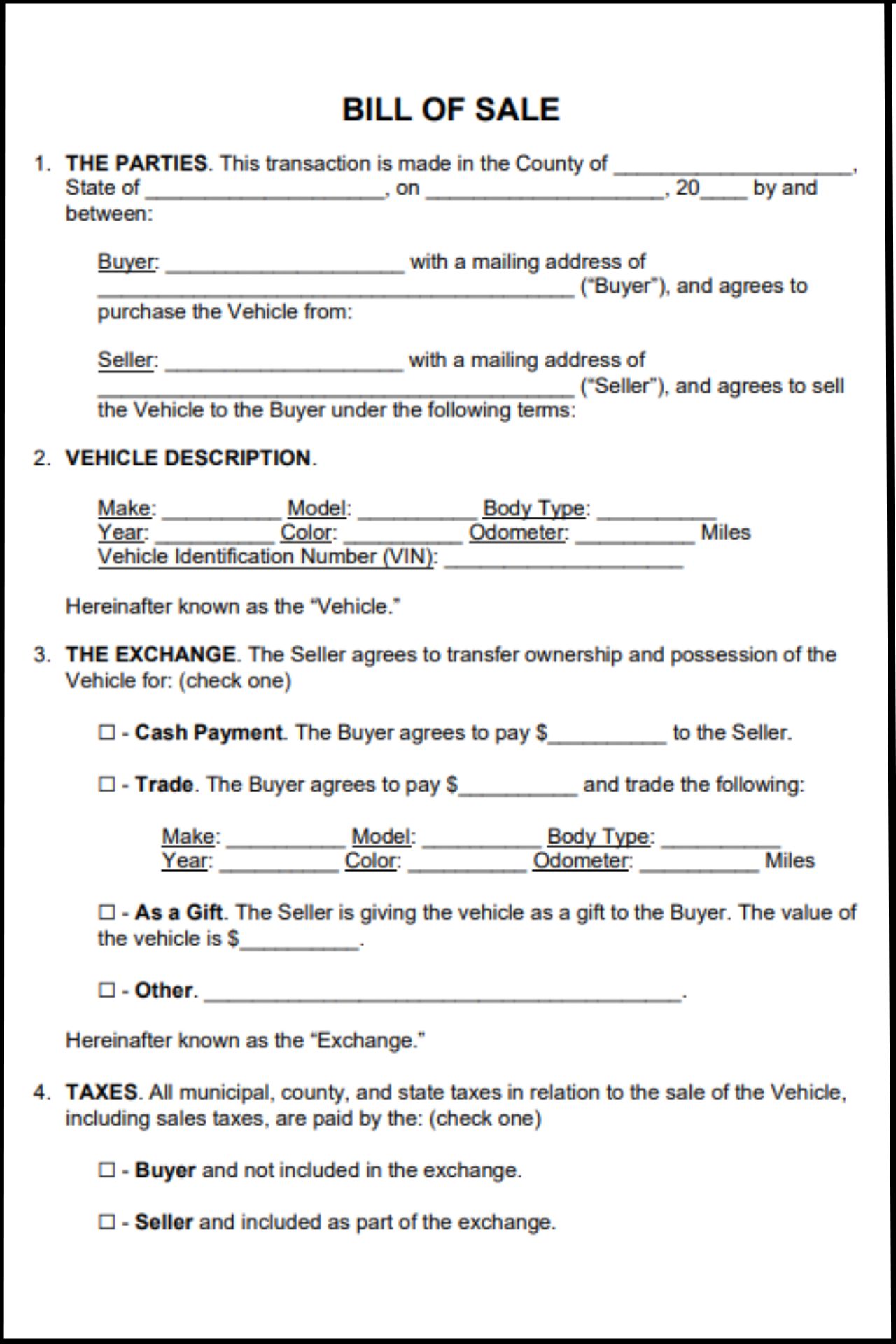
Key Clauses in a General Bill of Sale — What Each One Actually Does
A General Bill of Sale is only useful when the important terms are clearly recorded. Ontario does not require a specific government form or mandatory wording for a general personal property Bill of Sale, so the details included in the agreement become especially important when questions arise later.
For example, if someone sells a used piece of machinery in Ottawa and the buyer later claims that certain attachments were included in the deal, the written description of the goods may determine whether those items were actually part of the sale. A detailed agreement reduces uncertainty and creates a clearer record of the transaction.
The Sale of Goods Clause
The sale of goods clause identifies exactly what property is being transferred from the seller to the buyer. This section should not rely on broad descriptions that could apply to multiple items.
A strong description usually includes:
- Make and model of the item
- Serial number or identifying number where available
- Colour, condition, or distinguishing features
- Included accessories or attachments
- Any known defects disclosed before sale
Under Ontario’s Sale of Goods Act, a seller must have the right to sell the goods being transferred. Section 22 reflects the principle that a buyer cannot receive better title than the seller actually has. This means a person who sells stolen property or an item they do not legally own cannot create ownership rights simply by signing a Bill of Sale.
The limitation is that a Bill of Sale cannot fix a problem with ownership that existed before the agreement. If the seller had no legal title to transfer, the document alone does not change that.
The Purchase Price Clause
The purchase price clause records how much the buyer agreed to pay and how payment will occur. This may seem straightforward, but unclear payment terms often create disagreements after a sale.
For example, a seller in Mississauga may accept partial payment for equipment with the remaining amount due later. If the Bill of Sale does not explain the payment arrangement, the parties may disagree about whether ownership transferred immediately or only after full payment.
Under the Sale of Goods Act, delivery of goods and payment of the price are generally concurrent conditions unless the parties agree otherwise. Recording the payment schedule directly in the agreement avoids confusion about what each person expected.
A Bill of Sale should clearly state:
- Total purchase price
- Payment method
- Date payment is due
- Whether any amount remains outstanding
The document should also reflect the real arrangement. A Bill of Sale that says “paid in full” when money is still owing can create unnecessary problems if a dispute develops.
The “As Is” Condition Clause
An “as is” clause explains the condition in which the item is being sold. In many private sales, buyers inspect the item before purchase and accept its condition at the time of sale.
For example, someone selling used tools privately may include an “as is, where is” clause because the buyer has examined the equipment and agreed to purchase it in its current condition.
However, this clause has limits. A private seller may use clear wording to address the condition of the goods, but a business selling to a consumer cannot use an “as is” clause to remove consumer protections provided under Ontario’s Consumer Protection Act, 2002, S.O. 2002, c. 30, Sched. A.
This distinction matters because the same wording can have different effects depending on whether the transaction is between two private individuals or between a business and a consumer. A free general bill of sale Canada template often misses this difference and applies the same clause to every situation.
The Ownership and Title Clause
The ownership and title clause confirms that the seller has the legal right to sell the property being transferred. This is one of the most important sections because a Bill of Sale cannot transfer ownership that the seller does not actually possess.
For example, a buyer purchasing used construction equipment from a private seller in Hamilton may assume the seller owns the equipment outright. If a lender later claims there is an unpaid security interest attached to that equipment, the buyer may discover that the written agreement did not address existing claims or liens.
Under Ontario’s Sale of Goods Act, R.S.O. 1990, c. S.1, section 22 reflects the principle that a seller cannot provide better title than they have. A buyer who receives stolen goods or property sold without proper ownership rights may not obtain valid ownership simply because payment was made and a Bill of Sale was signed.
A strong ownership clause should confirm:
- The seller owns the goods being sold
- The seller has authority to transfer ownership
- Any known liens or claims have been disclosed
- The buyer understands any disclosed restrictions
The limitation is that a seller’s statement of ownership does not replace proper checks for higher-value items. Equipment, vehicles, and financed property may require additional searches before completing the transaction.
Is a General Bill of Sale Enforceable in Ontario Without a Lawyer?
A General Bill of Sale does not need to be prepared by a lawyer to be effective in Ontario. It is a private contract between the people involved in the transaction, and Ontario law does not require a general personal property Bill of Sale to be witnessed, notarized, or commissioned.
For example, two neighbours selling a used lawn tractor can prepare and sign their own agreement without attending a lawyer’s office. The document should still clearly record the item, price, payment terms, and ownership information.
A common misconception is that a document must be notarized to have legal effect. That is not required for a standard Bill of Sale. However, notarization may become relevant for other documents or specific circumstances outside a basic personal property transaction.
If a dispute arises, the written agreement becomes important evidence of what the parties agreed to. Under the Limitations Act, 2002, S.O. 2002, c. 24, Sched. B, section 4, a claim for breach of contract is generally subject to a two-year limitation period from when the claim is discovered.
What Are the Buyer’s and Seller’s Obligations Under a Bill of Sale?
A Bill of Sale creates clear expectations for both sides of the transaction. The seller is responsible for transferring the agreed goods, while the buyer is responsible for paying the agreed purchase price according to the terms recorded in the agreement.
Under the Sale of Goods Act, R.S.O. 1990, c. S.1, section 27, delivery of goods and payment of the price are generally treated as concurrent conditions unless the parties have agreed otherwise.
In practice, problems often happen when the parties rely on verbal promises instead of documenting the arrangement. For example, a buyer purchasing photography equipment in Toronto may believe payment includes additional lenses and accessories, while the seller believes only the camera body was included.
A clear Bill of Sale should address:
- What items are included
- When payment is due
- When ownership transfers
- Whether any defects were disclosed
- Whether any claims or liens exist
The agreement does not remove all risks. If the seller does not own the goods or failed to disclose important information, the buyer may still have legal remedies depending on the circumstances.
What Happens If One Side Breaches the Bill of Sale?
A breach occurs when one person fails to follow the terms they agreed to in the Bill of Sale. The consequences depend on what happened and the evidence available.
Common examples include:
- The buyer fails to provide payment
- The seller does not deliver the agreed item
- The item description does not match what was sold
- The seller transfers property they did not legally own
A frequent issue involves sellers attempting to sell goods that belong to someone else. Under the Sale of Goods Act, section 22, the buyer does not receive better ownership rights than the seller had.
Another issue involves capacity to contract. Under Ontario law, a person must generally be at least 18 years old to enter into a fully binding agreement for non-necessary goods. A contract involving a minor and non-essential items may be affected by the rules under the Age of Majority and Accountability Act, R.S.O. 1990, c. A.7, section 1.
The limitation is that every dispute depends on the facts. The wording of the Bill of Sale, communication between the parties, and evidence of payment can all affect the outcome.
When Do You Need More Than a General Bill of Sale?
A General Bill of Sale is designed for ordinary personal property transactions. Some situations require additional documents or registration.
For example, if a seller allows a buyer to pay over time while keeping an interest in the property until payment is complete, additional steps may be required. A security interest may need to be registered through Ontario’s Personal Property Security Registration (PPSR) system.
A General Bill of Sale is not intended to replace specialized documents for:
- Motor vehicles
- Real estate
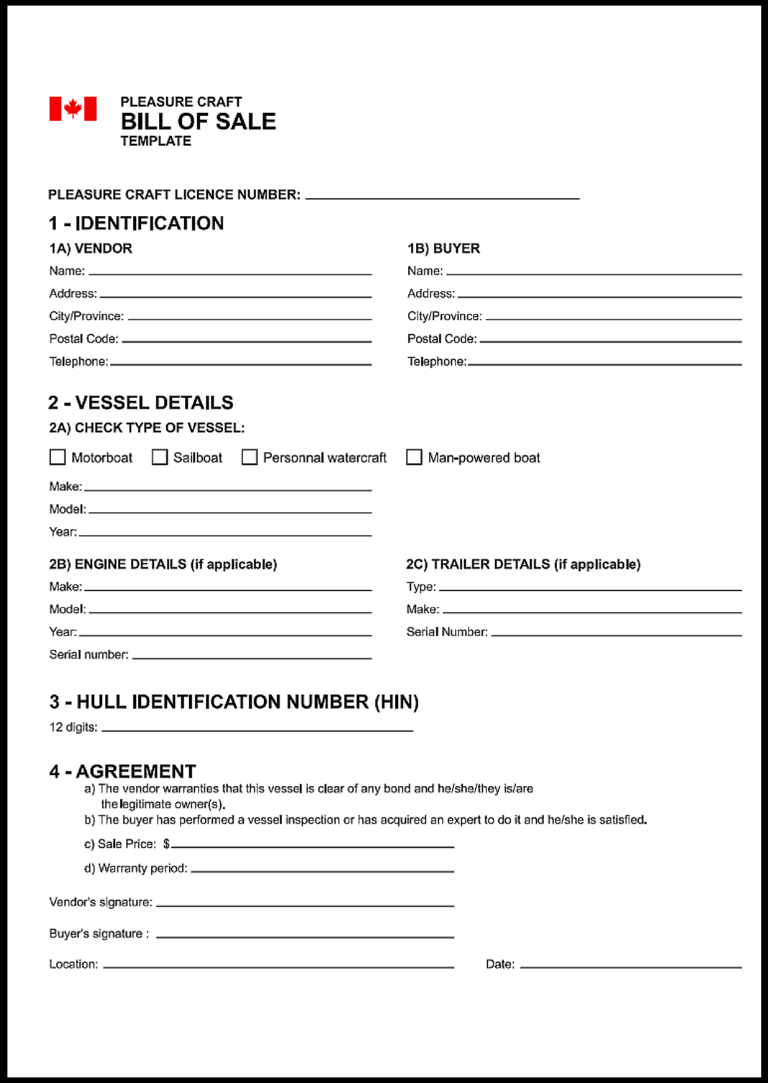
- boats
- Financing arrangements
- Transactions involving registered security interests
Someone buying expensive equipment with instalment payments should consider whether PPSR registration is needed rather than relying only on a signed agreement.
Summary of Applicable Laws
| Topic | Ontario Rule | Governing Statute |
|---|---|---|
| Seller ownership | Seller must have the legal right to sell the goods | Sale of Goods Act, R.S.O. 1990, c. S.1, s. 22 |
| Delivery and payment | Delivery and payment are concurrent unless agreed otherwise | Sale of Goods Act, R.S.O. 1990, c. S.1, s. 27 |
| Contract capacity | Generally requires age of majority for non-necessary goods | Age of Majority and Accountability Act, R.S.O. 1990, c. A.7, s. 1 |
| Consumer transactions | Businesses cannot remove consumer protections using improper clauses | Consumer Protection Act, 2002, S.O. 2002, c. 30, Sched. A, ss. 7(1), 9(1) |
| Contract claims | Two-year limitation period for most breach claims | Limitations Act, 2002, S.O. 2002, c. 24, Sched. B, s. 4 |
Private Sale vs. Business Sale — Why the Bill of Sale Rules Change
A private sale between two individuals is treated differently from a business selling goods to a consumer.
For example, someone selling a used dining table privately through an online marketplace is generally dealing under ordinary contract principles and the Sale of Goods Act. A retail business selling equipment to a customer may also have obligations under Ontario’s Consumer Protection Act, 2002.
The difference matters because businesses cannot use contract wording to remove consumer rights that Ontario legislation protects. A clause that may be acceptable in a private transaction may not have the same effect in a consumer purchase.
While the new Consumer Protection Act, 2023 has been passed into law to streamline disclosure rules and double administrative penalties, it remains awaiting official proclamation as the provincial government finalizes the supporting regulations. Until it is officially proclaimed into force, the Consumer Protection Act, 2002 continues to serve as the active statutory framework protecting Ontario consumers from unfair business practices and non-waivable contract limitations.
Common Mistakes That Make a Bill of Sale Unenforceable
Most problems with Bills of Sale come from incomplete information rather than complicated legal issues.
Common mistakes include:
- Using a vague description such as “equipment” without identifying details
- Selling property the seller does not actually own
- Leaving out payment details
- Failing to disclose known liens or claims
- Using an “as is” clause incorrectly in a business-to-consumer transaction
- Treating a general Bill of Sale as a replacement for specialized documents
One common example involves a used trailer sale where the Bill of Sale only records the price and names of the parties. If ownership is later questioned, the lack of identifying details can make it difficult to prove what was transferred.
A properly completed document should match the actual transaction rather than relying on a generic form created for another province.
Myth-Busting: Does a Bill of Sale Need to Be Notarized to Be Legal in Ontario?
No. A general Bill of Sale in Ontario does not require notarization or a witness signature simply because it records a private sale.
The document operates as a written contract between the buyer and seller. The important issue is whether the agreement accurately records the transaction and whether the people signing it have the legal capacity to enter into the contract.
A notary or lawyer may be useful in specific situations, especially where additional verification is needed, but notarization is not a standard requirement for a general personal property Bill of Sale.
Frequently Asked Questions
Do I need a Bill of Sale for a private sale in Ontario?
Ontario does not require a universal government Bill of Sale form for general personal property sales. However, having a written agreement helps prove what was sold, the price paid, and the terms agreed upon.
Is a handwritten Bill of Sale legal in Ontario?
A handwritten Bill of Sale may still record a valid agreement if it clearly identifies the transaction and the parties involved. The important issue is the content of the agreement, not whether it was typed or handwritten.
Can I sell something “as is” in Ontario?
Private sellers can use clear “as is” wording to describe the condition of goods. However, businesses selling to consumers cannot use this type of clause to remove statutory consumer protections.
What happens if the item I bought turns out to be stolen?
A buyer generally cannot receive better title than the seller had. If the seller did not legally own the property, the Bill of Sale may not create valid ownership rights.
Does a Bill of Sale need to be witnessed?
No general witness requirement applies to an Ontario General Bill of Sale for personal property.
How long can someone sue me after a Bill of Sale is signed?
A claim for breach of contract is generally subject to a two-year limitation period under the Limitations Act, 2002, starting from when the claim is discovered.