Free Manitoba Separation Agreement | PDF & WORD Template
Free Manitoba Separation Agreement Template
This Manitoba Separation Agreement template is designed for general educational use. High-conflict separations, business ownership, hidden assets, pensions, or homestead waivers should be reviewed carefully.
Manitoba Separation Agreement Legal Traps and Statutory Limits Most People Miss
| Topic / Issue | Manitoba Legal Rule | Governing Statute |
|---|---|---|
| Governing Legal Framework | Separation agreements are governed by both provincial and federal law depending on marital status and legal issue. | The Family Law Act, C.C.S.M. c. F20; The Family Property Act, C.C.S.M. c. F25; The Homesteads Act, C.C.S.M. c. H80; Divorce Act, R.S.C. 1985, c. 3 (2nd Supp.) |
| Who Can Legally Sign | Married spouses or qualifying common-law partners (3 years cohabitation or registration; 1 year with a child for support). | The Family Property Act, C.C.S.M. c. F25, s. 1(1); The Family Law Act, C.C.S.M. c. F20, s. 1 |
| Witness Requirements | No strict statutory rule, but common law requires signing before an independent adult witness for enforceability. | No statutory requirement — governed by common law principles |
| Homestead Rights Waiver | Waiving rights to the family home requires a separate formal acknowledgment before a Commissioner or Notary. | The Homesteads Act, C.C.S.M. c. H80, s. 9(1) & s. 9(4) |
| Age Requirement | Both parties must be at least 18 years old. | The Age of Majority Act, C.C.S.M. c. A7, s. 1 |
| Property Division Deadlines | Married spouses must file within 60 days after divorce; common-law partners have 3 years from separation. | The Family Property Act, C.C.S.M. c. F25, s. 19(1) & s. 19(2) |
| Opting Out of Property Division | Agreement must clearly state that The Family Property Act does not apply. | The Family Property Act, C.C.S.M. c. F25, s. 5(2) |
| Filing Requirement | Separation agreements are private and do not require filing unless enforcement is needed. | No statutory requirement — governed by common law principles |
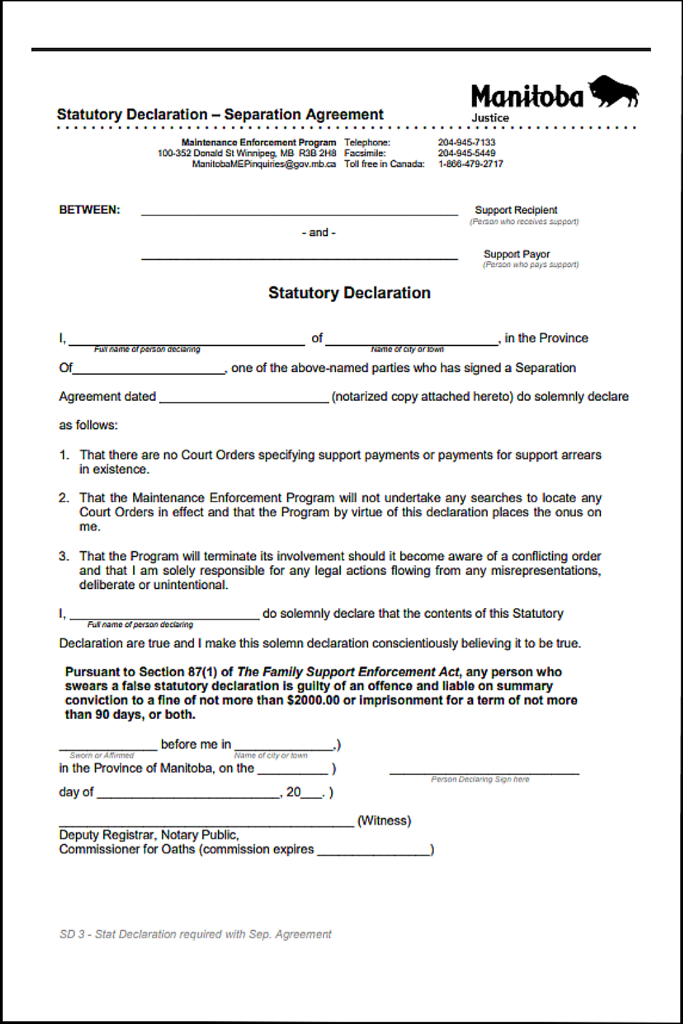
| Support Enforcement Filing | Enforceable child or spousal support provisions within a written separation agreement can be registered directly with the Maintenance Enforcement Program (MEP) for automatic tracking or administrative enforcement without needing a prior court order. | The Family Support Enforcement Act, C.C.S.M. c. F26 |
| Real Estate Transfers | Property transfers require separate land title registration documents. | The Real Property Act, C.C.S.M. c. R30 |
| CPP Credit Splitting | Parties cannot waive CPP division; any clause attempting to do so is void. | Canada Pension Plan, R.S.C. 1985, c. C-8, s. 55.2 |
| Child Support Limits | Child support cannot be waived or reduced below legal guidelines. | The Family Law Act, C.C.S.M. c. F20, s. 3 & s. 57–59; Divorce Act, s. 26.1 |
One of the biggest surprises in Manitoba is how many things you cannot contract out of, no matter how cooperative the separation feels. People often assume they can waive child support or pension division to “keep things simple,” but the law does not allow that. Child support belongs to the child, not the parent, and CPP credits are split by federal law whether you agree or not. Another major trap is the homestead rule — you cannot just sign away rights to the family home inside the agreement itself. It requires a completely separate, formal acknowledgment in front of a Commissioner or Notary, and missing that step can invalidate the entire clause.
These rules matter because separation agreements are only as strong as their weakest clause. I have seen agreements fall apart years later when someone tried to enforce terms that were never legally valid in the first place. That can mean court battles, financial loss, or having to renegotiate everything from scratch. Use the proper Manitoba Separation Agreement template and make sure your terms actually hold up when tested.
Separation vs Divorce in Manitoba — Big Difference, Bigger Mistakes
A separation agreement is not the same as a divorce judgment.
Separation Agreement:
- Private contract
- Can happen immediately
- Covers parenting, support, property
Divorce Judgment:
- Court order
- Legally ends marriage
- Federal legal implications
Common-Law Breakup Differences
Common-law partners still face serious property and support issues, but timelines and rights may differ.
Why Separation Date Matters Financially
Your separation date can affect:
- Property valuation
- Debt allocation
- Support calculations
- Equalization deadlines
Getting this wrong can create major legal problems.
Property Division Rules Manitoba Couples Often Miss
Family Home (Homestead) Protections
The family home is not “just another asset.”
Under Manitoba law, homestead protections may give non-titled spouses or common-law partners strong legal rights.
Equalization Under The Family Property Act
For many spouses, Manitoba law assumes family property sharing unless validly altered.
Pensions and Retirement Accounts
Pensions are commonly overlooked.
Retirement assets often require valuation and proper legal handling.
Business Ownership Issues
Private businesses, corporations, and self-employment income can complicate separation heavily.
Hidden Debt Problems
Debt matters too.
Families should clearly identify:
- Credit cards
- Tax debt
- Lines of credit
- Joint loans
What Cannot Simply Be “Signed Away”
Some rights—especially child support and certain pension or homestead protections—may override private wording.
Parenting Plans That Hold Up Better in Manitoba
Decision-Making Responsibility
Who makes major decisions about:
- Education
- Healthcare
- Religion
- Activities
Parenting Schedules
Specificity prevents disputes.
Holiday and School Planning
Missed holiday language is one of the most common conflict triggers.
Relocation Clauses
Parents should clearly address moving risks.
Child-Focused Drafting Mistakes
Parents cannot simply prioritize convenience over child welfare.
Best Interests of the Child Standard
Under Manitoba law, courts focus on the child—not parental preference.
Child Support and Spousal Support Realities
Federal Child Support Guidelines
Child support is generally the child’s legal right under Canada’s Divorce Act.
Section 7 Expenses
These may include:
- Childcare
- Medical costs
- Education
- Activities
Income Disclosure Obligations
Support agreements fail often when income is hidden.
Spousal Support Waiver Risks
Waivers without fairness or disclosure can be challenged later.
Review Clauses After Job Loss or Remarriage
Smart agreements anticipate life changes.
Financial Disclosure — The Clause That Prevents Future Court Battles
Financial transparency is one of the most important protections in any Manitoba separation agreement.
Essential Disclosure Areas
- Bank accounts
- Tax returns
- Real estate values
- Pensions
- Business interests
- Debts
What Happens When Someone Hides Assets
Hidden assets can trigger:
- Agreement invalidation
- Support recalculation
- Court sanctions
- Credibility damage
Legal Risks That Can Invalidate a Separation Agreement
Duress or Pressure
Pressure can destroy enforceability.
Missing Disclosure
Incomplete disclosure is a major red flag.
Unfair Support Waivers
Courts may intervene.
Improper Witnessing
Poor execution creates future disputes.
No Independent Legal Advice
While not always mandatory, separate legal advice often protects enforceability.
Parenting Terms Against Child’s Best Interests
These clauses may be struck.
DIY Separation Agreement Risks
Using U.S. Templates
Foreign templates often ignore Manitoba law entirely.
Ignoring Manitoba Homestead Law
This is a major mistake.
Vague Parenting Clauses
Ambiguity causes litigation.
Pension Omissions
Frequently overlooked.
Tax Consequences
Support and asset transfers can create tax surprises.
Future Enforcement Headaches
Poor drafting now often means court later.
Mediation, Arbitration, or Court — Which Path Fits?
Mediation Advantages
- Lower conflict
- Lower cost
- Better co-parenting outcomes
Arbitration Clauses
Can offer structured private resolution.
Court Enforcement
Sometimes necessary for:
- High conflict
- Hidden assets
- Abuse
- Urgent parenting orders
Emergency Orders
Immediate legal protection may be necessary in some family situations.
Manitoba Separation Agreement Risk Comparison
| Issue | Lower Risk Approach |
Higher Risk Approach
|
| Parenting Plan | Specific schedule |
Vague verbal promises
|
| Financial Disclosure | Full disclosure |
Partial or hidden assets
|
| Homestead Rights | Proper legal acknowledgment | Informal waiver |
| Support Terms | Guideline-based |
Unrealistic private caps
|
| Legal Advice | Separate counsel |
One-sided drafting
|
Updating a Separation Agreement
Life changes. Agreements should too.
Common Review Triggers
- New jobs
- Relocation
- New partners
- Children aging
- Property sales
- Divorce proceedings
Common Manitoba Separation Disputes
Home Possession Fights
Child Relocation
Hidden Income
Pension Valuation
Support Arrears
Many disputes happen not because couples separated—but because terms were unclear.
FAQs
Is a separation agreement legally binding in Manitoba?
Yes, if properly drafted, executed, and fair.
Do common-law couples need one?
Often yes, especially with property, children, or support issues.
Can we write our own separation agreement?
Yes, but DIY errors can create serious legal and financial consequences.
Does it need to be notarized?
Usually not, unless certain rights like homestead waivers require specific acknowledgment.
Can child support be waived?
Not in a way that violates legal child rights.