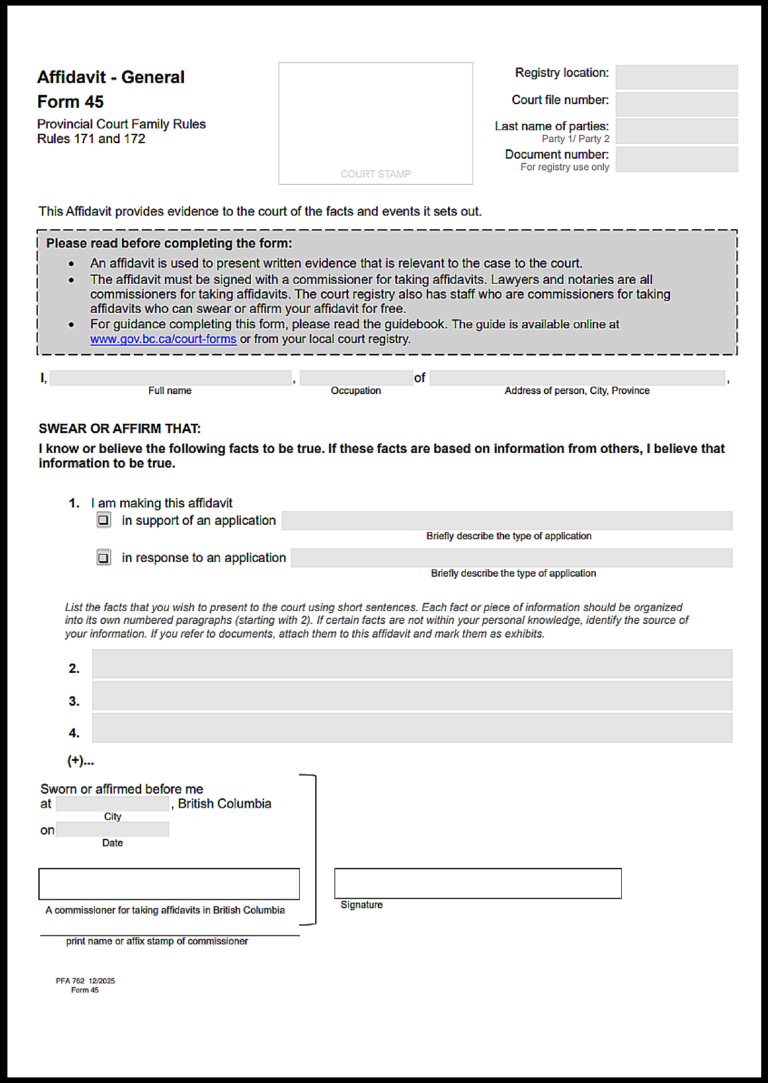
Manitoba Sworn Affidavit (Free PDF & Word Template)
A Manitoba Sworn Affidavit usually becomes necessary after something has already gone off track — probate paperwork stalls, a court motion needs sworn facts, service must be proven, or a legal name or identity issue suddenly requires more than a verbal explanation.
I’ve sat with Winnipeg clients who brought in handwritten statements for Court of King’s Bench matters, honestly thinking a signed note would do the job, only to discover Manitoba’s Evidence Act and Court of King’s Bench Rules require affidavits to be properly sworn before a Commissioner for Oaths, Notary Public, or other authorized official. Manitoba also has province-specific technical rules, including strict jurat wording and court formatting under Rule 4.07, that people often miss until their paperwork is challenged. Estate representatives, landlords, small business owners, family court applicants, and anyone handling land or procedural legal issues here regularly need sworn affidavits that meet Manitoba’s exact standards.
When a Manitoba affidavit is done wrong, the consequences are rarely minor — rejected filings, delayed probate, adjourned hearings, or evidence problems that cost real time and money. I once worked with a Brandon client who had to completely redo a sworn debt affidavit because he signed it before meeting the commissioner, which sounds small until it delays everything. Use the correct Manitoba Sworn Affidavit template before filing anything serious.
Last Updated: November 2026
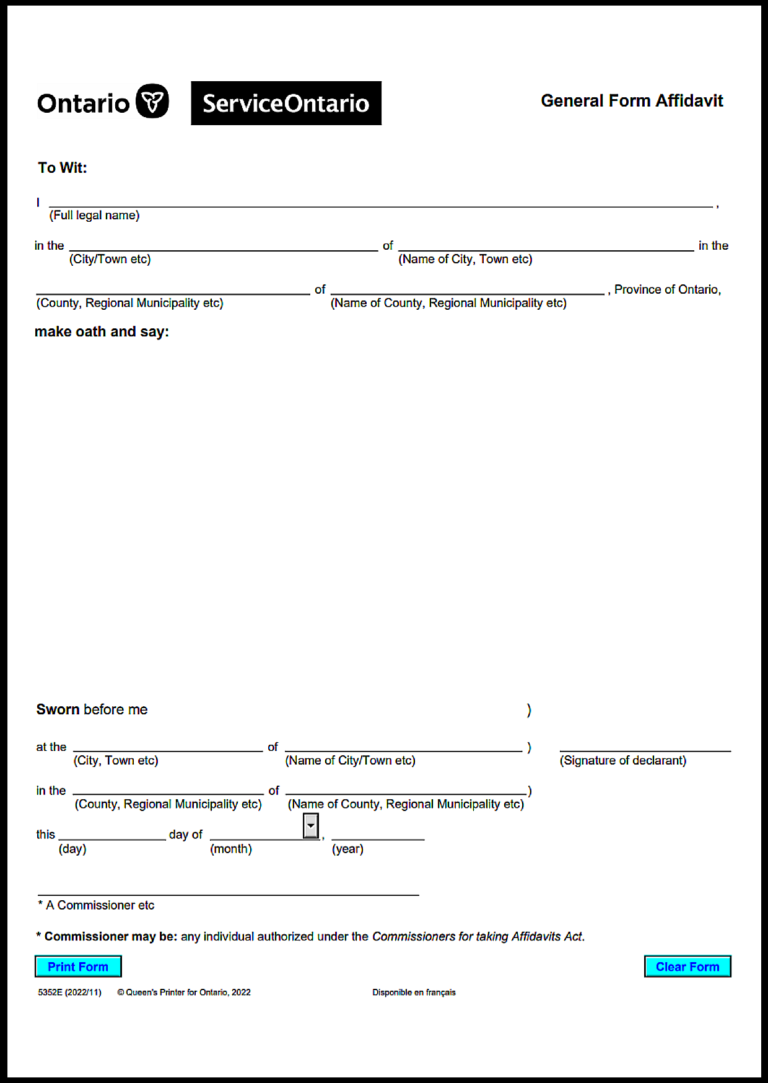
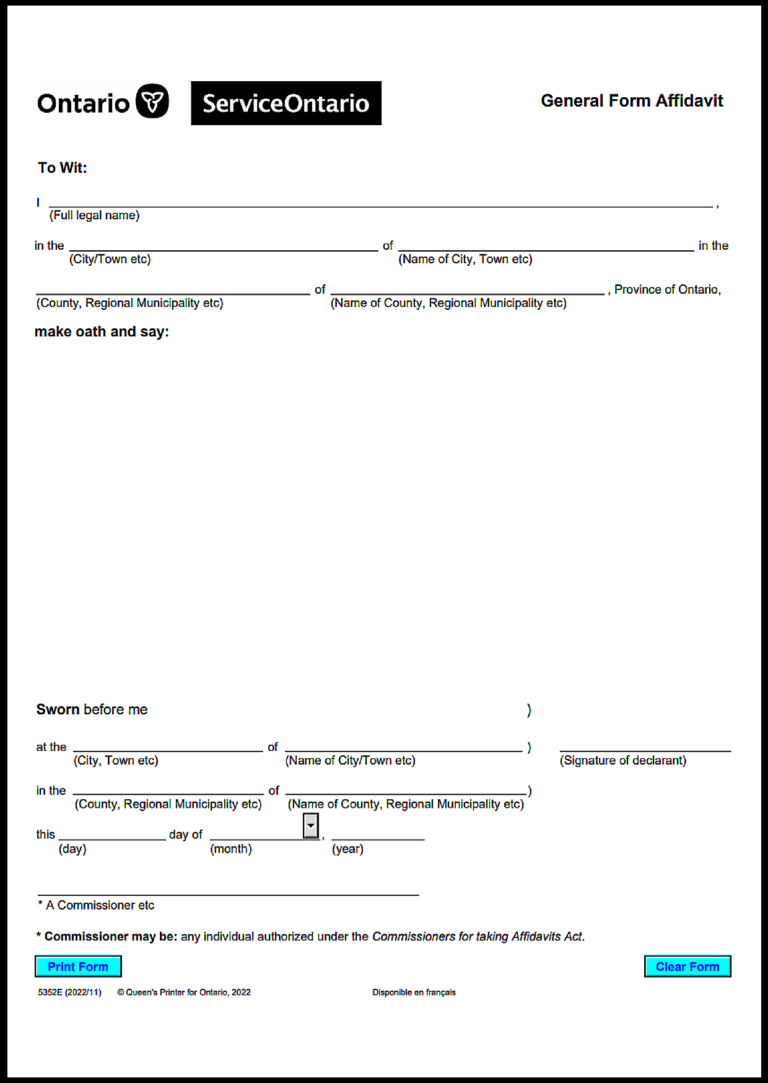
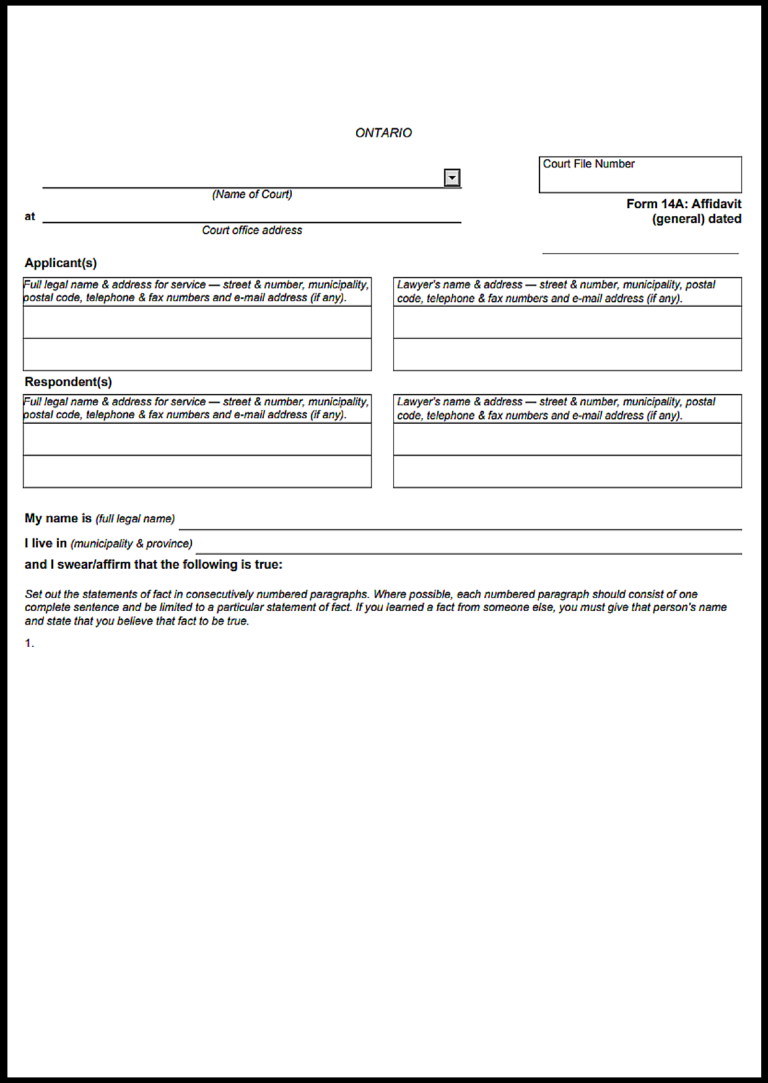
Free Manitoba Sworn Affidavit Template
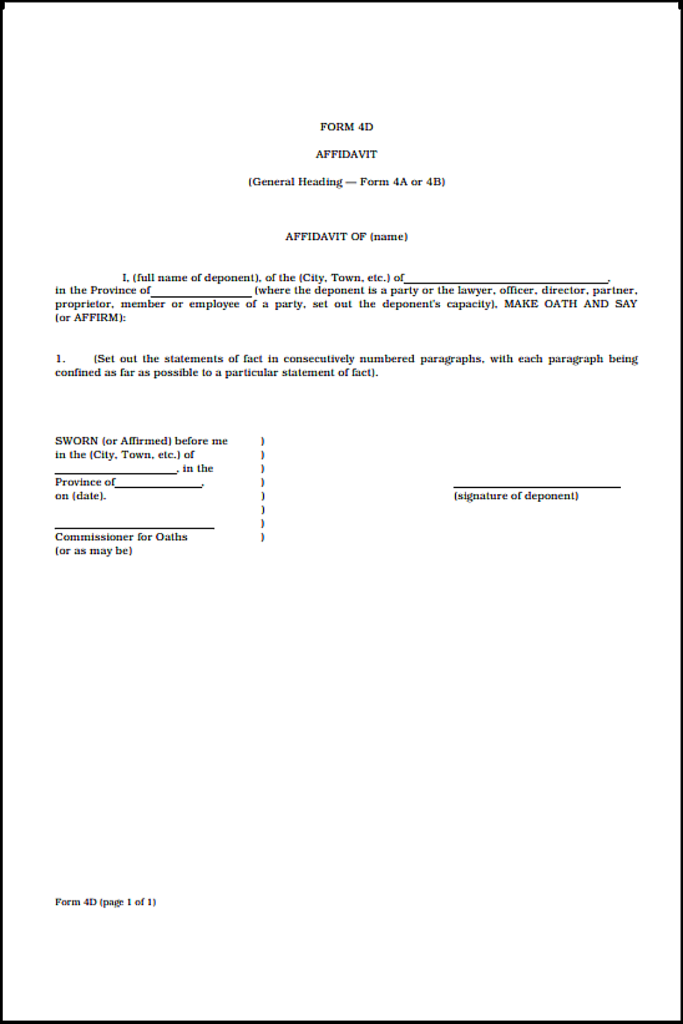
This general Manitoba sworn affidavit template is designed for broad factual use. It may support court, administrative, or private legal needs unless a specialized form is required.
Manitoba Sworn Affidavit Compliance: Province-Specific Rules That Actually Control Acceptance
| Topic / Issue | Manitoba Legal Rule | Governing Statute |
|---|---|---|
| Governing Provincial Law | Manitoba affidavits, oaths, affirmations and authorized officials are primarily governed by one provincial statute, subject to applicable court rules and other legislation. | The Manitoba Evidence Act, C.C.S.M. c. E150 |
| Court Procedure Rules | Affidavits used in Court of King’s Bench proceedings must comply with Rule 4.07. Rule 39.01 governs affidavit evidence on motions and applications. | Court of King’s Bench Rules, M.R. 553/88 |
| Federal Proceedings | Affidavits used in federal proceedings may also be subject to applicable federal legislation and the procedural rules of the particular federal court or tribunal. | Canada Evidence Act, R.S.C. 1985, c. C-5 |
| False Statements / Perjury | Knowingly making a false statement under oath in circumstances covered by the Criminal Code may constitute perjury. | Criminal Code, R.S.C. 1985, c. C-46, ss. 131–132 |
| Who Can Sign | The deponent must sign and swear or affirm the affidavit before an authorized person. For Court of King’s Bench proceedings, the affidavit must generally contain facts within the deponent’s personal knowledge or other evidence the person could give as a witness, subject to exceptions. | The Manitoba Evidence Act, s. 64; Court of King’s Bench Rules, rr. 4.07(1)–(2) |
| Authorized Official | Section 62(1) identifies authorized officials, including Commissioners for Oaths, Justices of the Peace, judges, lawyers entitled to practise in Manitoba and Manitoba-appointed Notaries Public. | The Manitoba Evidence Act, s. 62(1) |
| Witness Requirements | The legislation requires the authorized official to administer the oath or affirmation and complete the jurat. It does not impose a general requirement for an additional independent witness. | The Manitoba Evidence Act, ss. 62 and 64 |
| Commissioner Identification | The official must designate their office below their signature on the jurat. A Commissioner whose commission expires under the Act must also record the commission’s expiry date on the document. These are separate requirements under sections 62(2) and 74(1). | The Manitoba Evidence Act, ss. 62(2), 74(1) |
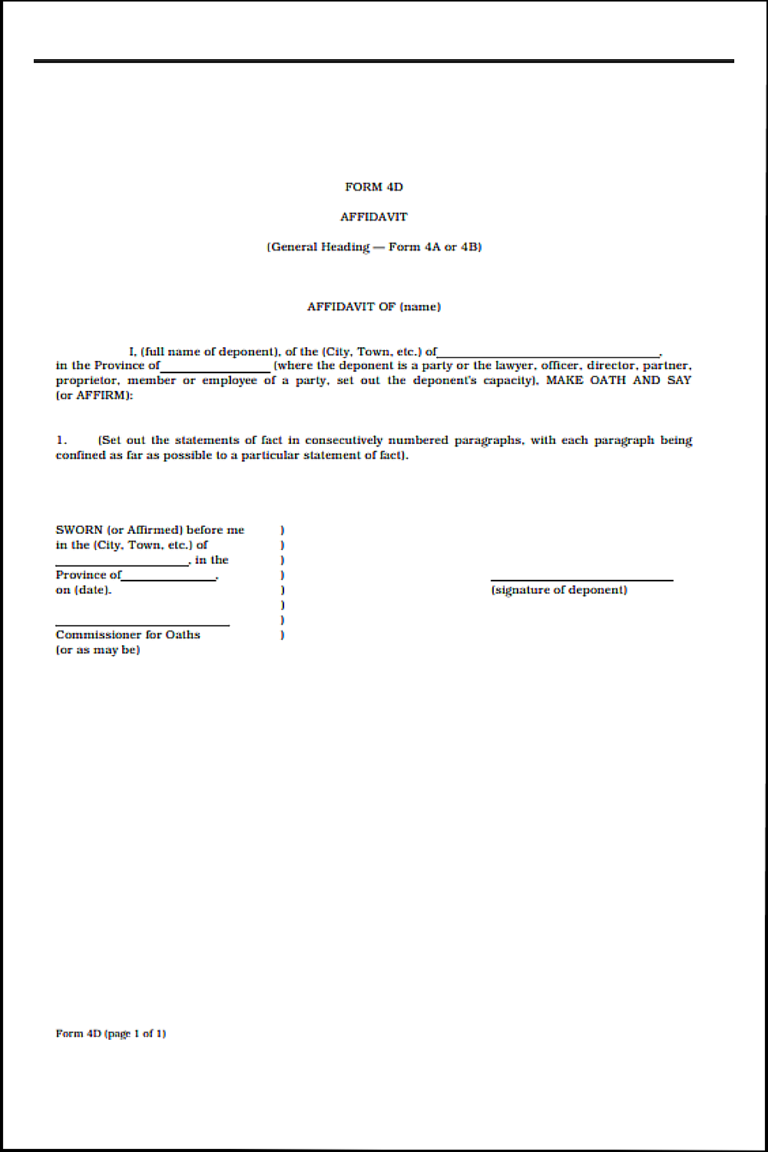
| Court Formatting | Court of King’s Bench affidavit forms require 14-point font, numbered pages, numbered or lettered exhibit tabs, and secure binding. Rule 4.01 also requires double spacing and an approximately 40 mm left margin for court documents. | Court of King’s Bench Rules, rr. 4.01 and 4.07; official Form 4D guidance |
| Remote Signing | Remote commissioning is permitted by videoconference under section 64.1 of The Manitoba Evidence Act and the eight-step procedure in the Remote Commissioning Regulation. | The Manitoba Evidence Act, s. 64.1; M.R. 78/2021 |
| Mandatory Jurat | Court of King’s Bench affidavits must follow Form 4D. The jurat must accurately record the place and date of commissioning. Remote commissioning requires additional wording under M.R. 78/2021. | Court of King’s Bench Rules, r. 4.07(1); The Manitoba Evidence Act, s. 64(3); M.R. 78/2021, s. 6 |
| Affirmation Language | Section 64(2) provides the wording, or wording to the same effect, for an affidavit sworn under oath or affirmed solemnly. | The Manitoba Evidence Act, s. 64(2) |
| Exhibit Certification | The person taking the affidavit must mark each exhibit. Rule 4.07(3) also addresses whether exhibits are attached, produced to the deponent, filed and served. | Court of King’s Bench Rules, r. 4.07(3) |
| Un-initialled Alterations | Interlineations, erasures and other alterations must be initialled by the person taking the affidavit. Otherwise, the affidavit cannot be used without the permission of the presiding judge or officer. | Court of King’s Bench Rules, r. 4.07(9) |
| Land Registration Use | Manitoba’s legislation authorizes certain land titles officials to administer affidavits. Land-related documents must also satisfy the applicable land registration requirements. | The Manitoba Evidence Act, s. 62(1)(g); The Real Property Act |
| Court Filing | Court affidavits must be filed with the appropriate court office in accordance with the applicable court rules, filing procedures and any specific court directions. | Court of King’s Bench Rules, rr. 4.05 and 39.01 |
The distinction between the statutory requirements and court-specific formatting rules matters. For example, section 62(2) of The Manitoba Evidence Act requires an authorized official to identify their office below their signature. Separately, sections 74(1) and 79(1) deal with recording the expiry date of certain Commissioners’ and Notaries’ commissions. These requirements should not be confused or treated as one rule.
Province of Manitoba+1
For Court of King’s Bench filings, the official Form 4D guidance specifies 14-point font, numbered pages, numbered or lettered exhibit tabs and secure binding. Rule 4.01 also addresses double spacing and margins. These are court-document requirements, not universal formatting rules for every private affidavit in Manitoba.
Province of Manitoba+1
Manitoba also permits remote commissioning, but a video call alone is not enough. The authorized official must follow the procedure in M.R. 78/2021, including identity verification, observing the signing, checking the original document and completing the required jurat.
Province of Manitoba+1
These requirements become particularly important when an affidavit supports a court application, probate matter or land transaction. A missing jurat detail, improperly handled exhibit or unauthorized alteration can create avoidable problems. Before using an affidavit, check the requirements of the particular proceeding or organization receiving it. Download the free Manitoba Sworn Affidavit template as a starting point, and confirm that it meets the requirements of your intended use.
Optional Exhibit Certificate
An exhibit referred to in an affidavit must be identified and marked by the person taking the affidavit. The following is an illustrative certificate, not a universally prescribed wording that must be copied exactly:
“This is Exhibit ‘A’ referred to in the affidavit of [Name] sworn (or affirmed) before me this [Date].”
The certificate should identify the affidavit and exhibit clearly. Under Rule 4.07(3) of the Court of King’s Bench Rules, the person taking the affidavit marks the exhibit. If the exhibit is described as attached, it must be attached to and filed with the affidavit. If it is produced and shown to the deponent instead, the rule provides a different handling procedure. A copy of a documentary exhibit must generally be served with the affidavit unless doing so is impractical.
Province of Manitoba+1
Manitoba Formatting Rules People Miss
If you are preparing an affidavit for a Manitoba Court of King’s Bench proceeding, pay attention to its prescribed format.
The official Form 4D guidance identifies these requirements:
-
Use 14-point font.
-
Number every page.
-
Separate exhibits using numbered or lettered tabs.
-
Secure the affidavit and exhibits by stapling or binding them so that nothing becomes loose or separated.
-
Use double spacing and an approximately 40 mm left margin.
-
Print on one side of good-quality letter-size paper when using a printed document.
Rule 4.07(1) also requires a Court of King’s Bench affidavit to use Form 4D, be written in the first person, identify the deponent and use consecutively numbered paragraphs dealing, as far as possible, with individual facts.
These formatting instructions should not automatically be applied to every affidavit intended for private or administrative use. Always check the receiving organization’s requirements.
Province of Manitoba+1
Remote Swearing Rules
Manitoba permits remote commissioning by videoconference under section 64.1 of The Manitoba Evidence Act and the Remote Commissioning Regulation, M.R. 78/2021.
The regulation establishes an eight-step procedure:
-
Establish a live audio and visual connection so both parties can see and hear each other.
-
Verify the deponent’s identity using current government-issued photo identification or two permitted alternative forms of identification.
-
Confirm that the deponent understands the oath, affirmation or declaration and is acting voluntarily.
-
Obtain a physical or electronic copy of the document and inspect every page of the original held by the deponent.
-
Hear the oath or affirmation and observe the deponent signing the original.
-
Verify the signature immediately after it is made.
-
Receive the original and compare it with the copy previously held by the authorized official.
-
Sign and date the original and provide a written statement identifying how the deponent established their identity.
The regulation also requires the jurat to indicate that commissioning took place by videoconference. It provides an example of the wording that may be used. A properly completed remote commissioning is deemed to have taken place in Manitoba.
Remote commissioning has been available under this regulation since October 1, 2021.
Province of Manitoba+2
Sworn vs Affirmed in Manitoba — What’s the Real Difference?
Religious Oath Option
A sworn affidavit involves the deponent taking an oath to confirm that the contents are true. Section 64(2) of The Manitoba Evidence Act provides an example of the wording:
“I, A.B., swear that the contents of this affidavit made and subscribed by me are true. So help me God.”
The legislation allows wording to the same effect. The deponent should understand the oath before taking it.
Secular Affirmation Option
An affirmation provides a non-religious alternative to an oath. The deponent solemnly and sincerely affirms that the contents of the affidavit are true.
Section 64(2) provides this example:
“I, A.B., do solemnly and sincerely affirm that the contents of this affidavit made and subscribed by me are true.”
You do not need to make a religious oath if you prefer to affirm the truth of your statement.
Province of Manitoba
Same Legal Force
Both methods are legally recognized under Manitoba’s evidence legislation. The important distinction is the form of the undertaking, not whether one method creates a stronger affidavit.
Choose the oath or affirmation that reflects your preference, and make sure the wording in the jurat matches the method actually used.
Which Wording Belongs in Your Affidavit
Use the oath wording if you choose to swear an affidavit. Use the affirmation wording if you choose to affirm it.
The authorized official must administer the oath or affirmation and complete the jurat accurately. Under section 64(3), the jurat must state the actual place and date on which the affidavit was made. Remote commissioning has additional jurat requirements under M.R. 78/2021.
Province of Manitoba+1
Common Wording Mistakes
Check the following before completing your affidavit:
-
Mixing oath and affirmation language.
-
Leaving out the place of commissioning.
-
Recording an incorrect date.
-
Failing to identify the authorized official’s office below their signature.
-
Using an ordinary in-person jurat for a remote commissioning.
The wording must accurately reflect what happened when the affidavit was sworn or affirmed. Do not sign a completed jurat before the commissioning appointment.
Commissioner for Oaths vs Notary Public vs Justice of the Peace
Choosing the right official depends on the document’s purpose and where it will be used. Manitoba law recognizes several categories of people who can administer oaths and affirmations.
Who Can Legally Witness in Manitoba
Section 62(1) of The Manitoba Evidence Act identifies several authorized persons, including:
-
A Commissioner for Oaths.
-
A Notary Public appointed for Manitoba.
-
A Justice of the Peace in Manitoba.
-
A judge of a Manitoba court.
-
An associate judge or the Registrar or a deputy registrar of the Court of King’s Bench.
-
A Manitoba lawyer entitled to practise in the province.
The legislation also identifies other authorized officials, including certain land titles officials, municipal officials and RCMP members.
Not every person who can witness a signature is automatically authorized to administer an affidavit. Confirm the official’s legal authority before arranging the appointment.
Province of Manitoba
When a Notary May Be Better
A Notary Public may be appropriate when an affidavit or certified document is intended for use outside Manitoba or internationally.
For example, a receiving organization in another country may request notarization, a notarial seal or additional authentication.
Manitoba’s legislation also recognizes certain affidavits administered outside the province under section 63. However, acceptance by a foreign authority depends on that authority’s requirements. Do not assume that a Manitoba commission or notarial seal automatically satisfies every international requirement.
Province of Manitoba
Court vs Private Administrative Use
Many ordinary provincial affidavit requirements can be met by a Commissioner for Oaths authorized under Manitoba law.
However, the receiving organization may impose additional requirements. A court proceeding, land registration transaction, insurance claim or banking matter may involve different forms and supporting documents.
For Court of King’s Bench proceedings, Rule 4.07 and Form 4D provide the relevant starting point. For private administrative use, check the organization’s own instructions before arranging commissioning.
Remote Commissioning Limitations
Not every affidavit is suitable for remote commissioning.
Manitoba’s Remote Commissioning Regulation authorizes specified officials to administer oaths, affirmations and declarations without being physically present with the deponent, but only through the prescribed videoconference procedure.
The official must verify identity, observe the signing and complete the required documentation. If the receiving organization has additional requirements, those must also be considered.
Province of Manitoba+1
Common Signing-Day Mistakes
Avoid these problems when attending an appointment:
-
Signing the affidavit before the authorized official instructs you to do so.
-
Failing to bring acceptable identification.
-
Bringing incomplete or missing exhibits.
-
Using an incorrect jurat.
-
Making changes after the affidavit has been sworn or affirmed.
If you notice an error, raise it before the oath or affirmation is administered. This is generally easier than correcting a completed affidavit.
How To Complete a Manitoba Sworn Affidavit Properly
Use Fact-Only Language
Write your affidavit in clear, direct language. Explain what happened, when it happened and what you personally observed.
For Court of King’s Bench proceedings, Rule 4.07(2) generally limits affidavit contents to facts within the deponent’s personal knowledge or other evidence the deponent could give as a witness, subject to exceptions in the rules.
Avoid turning the affidavit into a legal argument. A judge should be able to identify the relevant facts without having to separate them from unnecessary opinions.
Province of Manitoba
Avoid Hearsay Unless Allowed
Second-hand information is not automatically acceptable in every affidavit.
However, Manitoba’s Court of King’s Bench Rules recognize specific exceptions. Under Rule 39.01(4), an affidavit used on a motion may include statements based on information and belief if the source of the information and the fact that the deponent believes it are identified.
Rule 39.01(5) also permits information-and-belief statements about non-contentious facts in affidavits used on applications, provided the source and belief are specified.
These exceptions have limits. If you are relying on someone else’s statement, identify where the information came from rather than presenting it as something you personally witnessed.
Province of Manitoba
Number Each Paragraph
Use consecutive paragraph numbers when preparing a Court of King’s Bench affidavit.
Rule 4.07(1) requires numbered paragraphs, with each paragraph confined as far as possible to a particular statement of fact.
For example, separate the date of an event, the people involved and the actions taken into clearly organized paragraphs. This makes it easier for the court and other parties to refer to specific evidence.
Attach and Mark Exhibits Correctly
If your affidavit refers to supporting documents, identify each exhibit clearly.
For Court of King’s Bench proceedings, Rule 4.07(3) requires the person taking the affidavit to mark the exhibits. The rule distinguishes between documents attached to the affidavit and documents produced and shown to the deponent.
Where a documentary exhibit is attached, it must be attached and filed with the affidavit. A copy must generally be served with the affidavit unless service is impractical.
Do not assume that simply attaching a document makes it a properly certified exhibit.
Province of Manitoba
Sign Only in Official Presence
For an ordinary in-person affidavit, section 64(1) of The Manitoba Evidence Act requires the deponent to take the oath, affirmation or declaration in the presence of the authorized official.
The official must satisfy themselves that the signature is genuine and administer the oath or affirmation before signing the jurat.
Remote commissioning is a separate process. It is permitted only when the statutory and regulatory videoconference requirements are followed.
Province of Manitoba+1
Correcting Mistakes Before Swearing
Review the affidavit before the appointment. Check names, dates, paragraph numbers, attachments and the wording of the jurat.
If you identify an error, correct it before swearing or affirming the document.
For Court of King’s Bench affidavits, Rule 4.07(9) requires interlineations, erasures and other alterations to be initialled by the person taking the affidavit. An alteration that has not been initialled cannot be used without the permission of the presiding judge or officer.
Do not independently change a sworn affidavit and assume the correction will automatically be accepted.
Province of Manitoba
Court Rejection Risks and Filing Problems
Wrong Font Size
A 12-point document may not meet the formatting requirements for a Court of King’s Bench affidavit.
The official Form 4D guidance specifies 14-point font, numbered pages, exhibit tabs and secure binding. Rule 4.01 also requires double spacing and an approximately 40 mm left margin.
These are important requirements when preparing court documents, but they should not be described as universal rules for every private Manitoba affidavit.
Province of Manitoba+1
Missing Commissioner Expiry
A missing commission expiry date can create a compliance problem when the authorized person’s commission is subject to an expiry requirement.
Sections 74(1) and 79(1) of The Manitoba Evidence Act deal with the expiry date that certain Commissioners for Oaths and Notaries Public must record on affidavits, declarations or certificates.
Remember that section 62(2) separately requires the official to identify their office below their signature. The expiry date and official designation are two distinct requirements.
Province of Manitoba+1
Invalid Jurat
The jurat confirms that the affidavit was properly sworn or affirmed.
Under section 64(3), the authorized official must accurately state the place and date in the jurat or attestation. Court of King’s Bench affidavits must also follow Form 4D.
Remote affidavits require the additional videoconference information specified by M.R. 78/2021, including the identity-verification statement.
Province of Manitoba+2
Post-Signature Edits
Changing an affidavit after it has been sworn or affirmed can create serious procedural problems.
Under Rule 4.07(9), alterations must be initialled by the person taking the affidavit. Without those initials, the affidavit cannot be used without permission from the presiding judge or officer.
If a substantive correction is needed, obtain appropriate guidance rather than changing the document yourself.
Improper Hearsay Statements
An affidavit that relies on information from another person should identify the source of that information where the applicable rules permit it.
Rule 39.01(4) allows information-and-belief statements in affidavits used on motions when the source and belief are specified. Rule 39.01(5) provides a narrower exception for non-contentious facts in applications.
A statement that falls outside an applicable exception may face evidentiary objections.
Province of Manitoba
Missing Exhibit Certificates
An exhibit should be marked by the person taking the affidavit.
Rule 4.07(3) governs the handling of attached exhibits and documents produced and shown to the deponent. An exhibit that is not properly identified or handled can create problems when the affidavit is filed or relied upon.
Check the exhibit references in the affidavit against the actual documents before commissioning.
False Statements, Perjury, and Real Legal Consequences
A sworn affidavit is a formal statement made under oath or affirmation. Its contents should be accurate and complete.
Criminal Code Penalties
Section 131 of the Criminal Code addresses perjury. It applies to knowingly making a false statement under oath or solemn affirmation, or in another legally recognized circumstance, with the intent described in that section.
Perjury is a criminal offence, and section 132 sets out its punishment. Not every mistake or inaccurate statement automatically amounts to perjury; the statutory elements must be established.
Province of Manitoba
Civil Credibility Damage
Even when an inaccurate statement does not result in criminal proceedings, it can undermine the reliability of an affidavit.
Inconsistent dates, unsupported allegations and contradictions with documentary evidence may affect how a court assesses the deponent’s evidence.
Review every factual statement before signing.
Registry Rejection
A document that does not meet the applicable filing requirements may need correction before it can proceed.
For Court of King’s Bench matters, the applicable rules include Rule 4.05 for filing documents and Rule 4.07 for affidavit requirements.
Do not assume that filing a document means every procedural or evidentiary requirement has been satisfied.
Province of Manitoba
Delayed Court Hearings
An incomplete or improperly prepared affidavit can create additional work before a hearing.
For example, an improperly marked exhibit, missing jurat information or an uninitialled alteration may require correction or a request for the court’s permission.
Rule 39.01 also establishes filing and service requirements for affidavits supporting motions and applications. For certain motions or applications made on notice that are not contested, supporting affidavits must generally be filed by 2 p.m. on the day before the hearing.
Province of Manitoba
Land Title or Probate Setbacks
An affidavit used in a land or estate matter must meet the requirements of the relevant process.
For land-related documents, Manitoba’s evidence legislation identifies certain land titles officials as authorized persons under section 62(1)(g). The document must also meet the applicable land registration requirements.
For probate matters, check the specific Court of King’s Bench probate requirements and the documents required by the Probate Division. A general affidavit template should not be assumed to satisfy every probate filing requirement.
Common Manitoba Sworn Affidavit Failure Points
| Mistake | Potential Result |
| Using 12-point font for a Court of King’s Bench affidavit |
Failure to meet the official Form 4D formatting guidance
|
| Missing or inaccurate jurat information |
Non-compliance with statutory commissioning requirements
|
| Missing commission expiry date where required |
Non-compliance with sections 74(1) or 79(1) of The Manitoba Evidence Act
|
| False statement made knowingly under oath with the required intent |
Potential perjury liability under the Criminal Code
|
| Improper exhibit marking or handling |
Exhibit-related procedural or evidentiary problems
|
| Uninitialled alterations |
The affidavit cannot be used without the presiding judge’s or officer’s permission under Rule 4.07(9)
|
| Missing numbered paragraphs |
Non-compliance with Rule 4.07(1) for Court of King’s Bench proceedings
|
| Incorrect remote commissioning procedure |
Failure to meet the requirements of M.R. 78/2021
|
Real-World Manitoba Filing Paths
Court of King’s Bench
The Manitoba Court of King’s Bench handles civil, family and probate matters, among other proceedings.
Affidavits used in its proceedings must comply with Rule 4.07 and the applicable court procedures. Rule 39.01 also governs affidavit evidence on motions and applications.
Before filing, check whether the matter requires Form 4D, supporting exhibits, particular service arrangements or additional procedural documents.
Provincial Court / Small Claims
The Manitoba Court of King’s Bench and the Manitoba Provincial Court have different jurisdictions and procedural rules.
Small Claims matters fall within the Provincial Court’s jurisdiction. Do not automatically apply the Court of King’s Bench affidavit requirements to a Provincial Court proceeding.
Check the applicable Provincial Court rules, forms and directions before preparing or filing evidence.
Teranet Manitoba Land Titles
Teranet Manitoba operates Manitoba’s land titles system.
Affidavits used in land registration matters may need to meet requirements under the applicable property legislation and land titles procedures.
The Manitoba Evidence Act identifies certain land titles officials as authorized to administer affidavits under section 62(1)(g). However, the requirements for a particular registration depend on the document and transaction involved.
Check the current land registration instructions before submitting an affidavit.
Insurance and Banking Requests
Insurance companies and financial institutions may request affidavits to verify facts, support claims or document particular transactions.
A Commissioner for Oaths may be sufficient for some requests, but the receiving organization may specify notarization or additional documentation.
Ask for the institution’s requirements before arranging the appointment.
Private Evidentiary Use
An affidavit may also be prepared for a private administrative or evidentiary purpose.
For example, it may document facts relevant to a dispute, settlement discussion or transaction. However, whether the receiving party accepts the document depends on its requirements and the applicable law.
A properly commissioned affidavit does not automatically guarantee that its contents will be admissible in every legal proceeding.
Notarization Myths vs Manitoba Reality
Not Every Affidavit Needs a Notary
Manitoba law recognizes Commissioners for Oaths and several other authorized officials. A Notary Public is not automatically required for every affidavit.
Section 62(1) of The Manitoba Evidence Act identifies the officials who may administer oaths and affirmations for use in Manitoba.
The correct choice depends on the intended use of the document and any additional requirements imposed by the receiving organization.
Province of Manitoba
Commissioner Often Sufficient
For many ordinary Manitoba affidavit requirements, a properly authorized Commissioner for Oaths can administer the oath or affirmation.
However, some organizations and transactions may request a Notary Public or additional authentication.
Check the receiving party’s instructions rather than assuming one type of commissioning will satisfy every purpose.
Witness Myths
An affidavit does not generally require a second independent witness in addition to the authorized official who administers the oath or affirmation.
The official’s role is to administer the oath or affirmation, verify the deponent’s signature and complete the jurat.
Additional requirements may apply to particular documents or transactions, so check the applicable instructions.
Digital Signatures Limitations
Electronic documents and remote commissioning are not the same thing.
Manitoba permits remote commissioning by videoconference under section 64.1 of The Manitoba Evidence Act and M.R. 78/2021. The regulation requires the authorized official to observe the signing, verify identity and complete the prescribed procedure.
Simply applying an electronic signature to a document does not establish that an affidavit has been properly sworn or affirmed.
Province of Manitoba+1
Filing vs Validity Confusion
A properly commissioned affidavit is not necessarily required to be filed publicly.
Some affidavits are prepared for private administrative purposes, while others are submitted as evidence in court proceedings or land registration transactions.
The requirements depend on the purpose of the document. If an affidavit is intended for a Manitoba court proceeding, follow the applicable court rules and filing directions.
FAQs
What is a sworn affidavit in Manitoba?
A sworn affidavit in Manitoba is a written statement of facts that a person swears or solemnly affirms to be true before an authorized official. It may be used as evidence in legal proceedings or for other purposes where an affidavit is required.
Who can sign or witness it?
Under section 62(1) of The Manitoba Evidence Act, authorized persons include Commissioners for Oaths, Manitoba-appointed Notaries Public, Justices of the Peace, judges and certain other officials.
The deponent signs the affidavit and takes the oath or affirmation before the authorized official, subject to the statutory remote commissioning procedure where applicable.
Does Manitoba require notarization?
No. Manitoba does not require every affidavit to be notarized. A Commissioner for Oaths or another person authorized under section 62(1) can administer an affidavit.
However, check whether the organization receiving the affidavit has additional requirements.
Can I swear an affidavit online?
Yes. Manitoba permits remote commissioning by videoconference under section 64.1 of The Manitoba Evidence Act and the Remote Commissioning Regulation, M.R. 78/2021.
The authorized official must follow the prescribed eight-step procedure, including identity verification, observing the signing and completing the remote jurat.
What happens if I lie?
Knowingly making a false statement under oath or solemn affirmation with the intent required by section 131 of the Criminal Code may constitute perjury.
Perjury is a serious criminal offence, but an honest mistake does not automatically establish the offence. The legal elements must be proven.