Ontario Lease Agreement Template – Download Free PDF and Word
Ontario Lease Agreement is a legal contract between a landlord and a tenant that explains the rules of renting a property in Ontario. If you’re renting for the first time or managing a property, this article will walk you through everything in a simple way.
I’ve seen many Ontario landlords and tenants run into expensive disputes simply because important lease terms were never written down clearly at the start. When people come to me after a disagreement over rent increases, deposits, or notice periods, it’s usually because they signed a lease without fully understanding Ontario’s rental rules.
In this article, you will get a free lease agreement template, a simple and clear explanation of Ontario rental rules, and an overview of different lease types so you can choose the right one. You will also find practical tips based on real-life situations to help you avoid common problems.
Last Updated: September 2026
Table of Contents
ToggleWhat is an Ontario Lease Agreement?
An Ontario lease agreement is a written contract that sets out:
- Who is renting (tenant)
- Who owns the property (landlord)
- How much rent is paid
- What rules both must follow
Under Ontario law, most residential rentals must use the standard lease form. This protects both sides and avoids confusion later.
In most rental situations, having a clear written lease prevents disputes about rent, repairs, or notice periods.
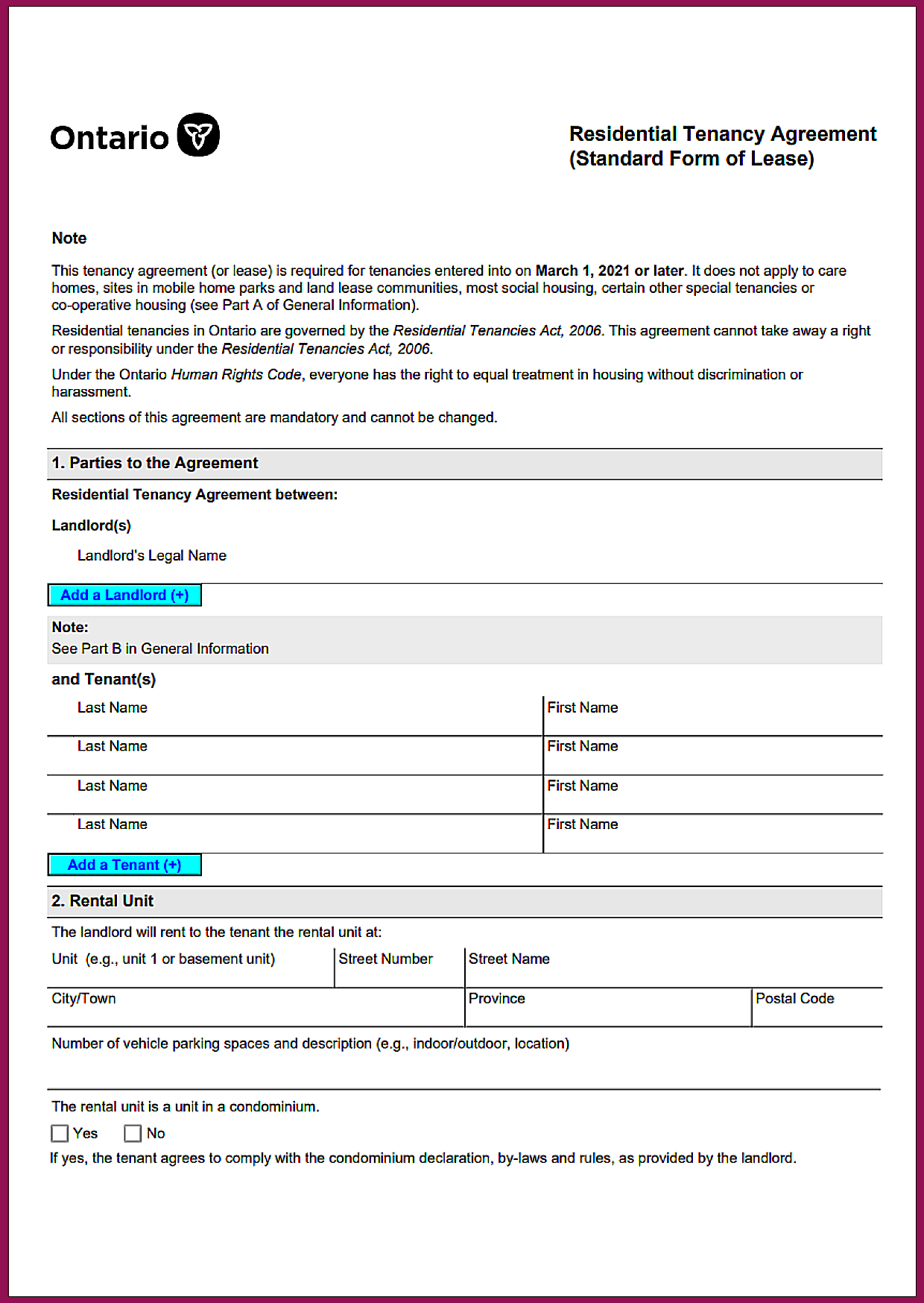
Free Ontario Lease Agreement Template
Below is a simple, general-purpose lease template you can use for most residential rentals in Ontario.
Types of Lease Agreements in Ontario
Choosing the correct document depends on the type of arrangement, and Ontario’s Residential Tenancies Act may apply differently depending on the property and tenancy.
Standard Residential Lease Agreement
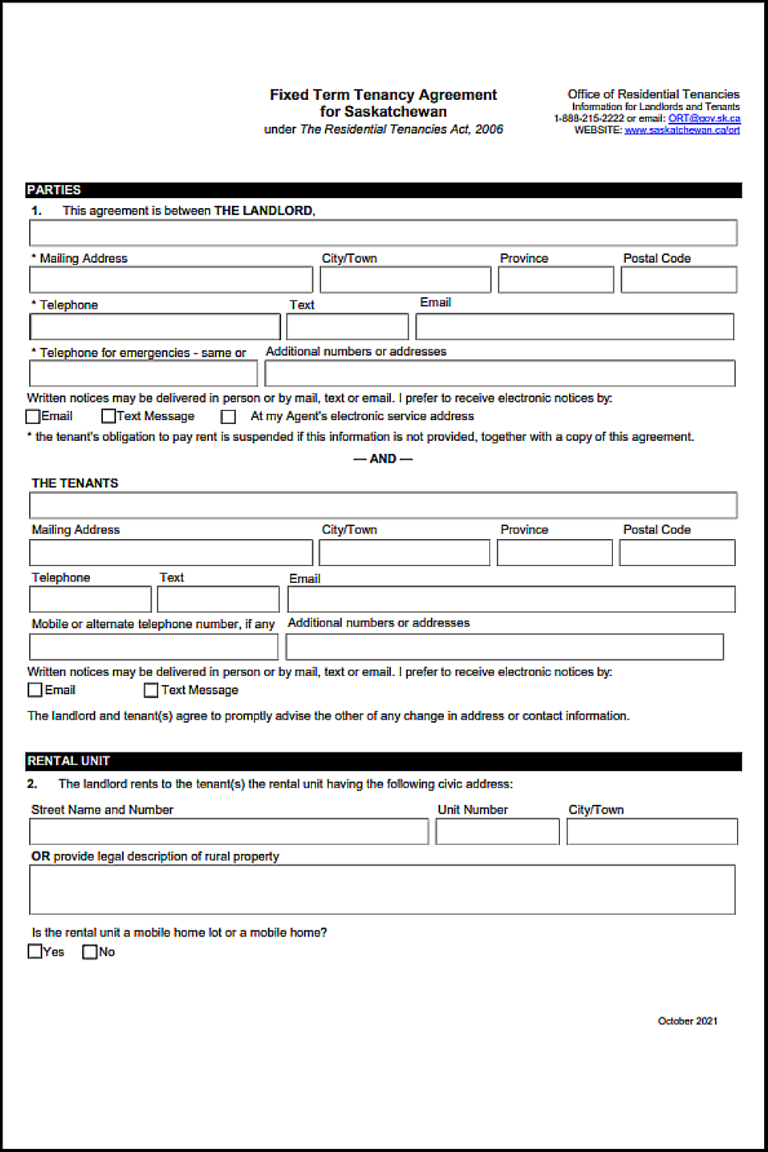
Used for houses, condos, and apartments that are covered by Ontario’s residential tenancy rules. For most covered residential tenancy agreements, the government-prescribed Standard Form of Lease is required.
Fixed-Term Lease Agreement
Establishes a specified initial term of occupancy, such as one year. Under section 38 of the Residential Tenancies Act, a fixed-term tenancy generally does not simply end because the specified term has expired. If the tenancy has not been properly terminated or renewed, it generally continues on a month-to-month basis under the same tenancy terms.
Month-to-Month Lease Agreement
A month-to-month tenancy continues from rental period to rental period. It can provide flexibility, but both landlord and tenant must still follow the Residential Tenancies Act and its termination rules.
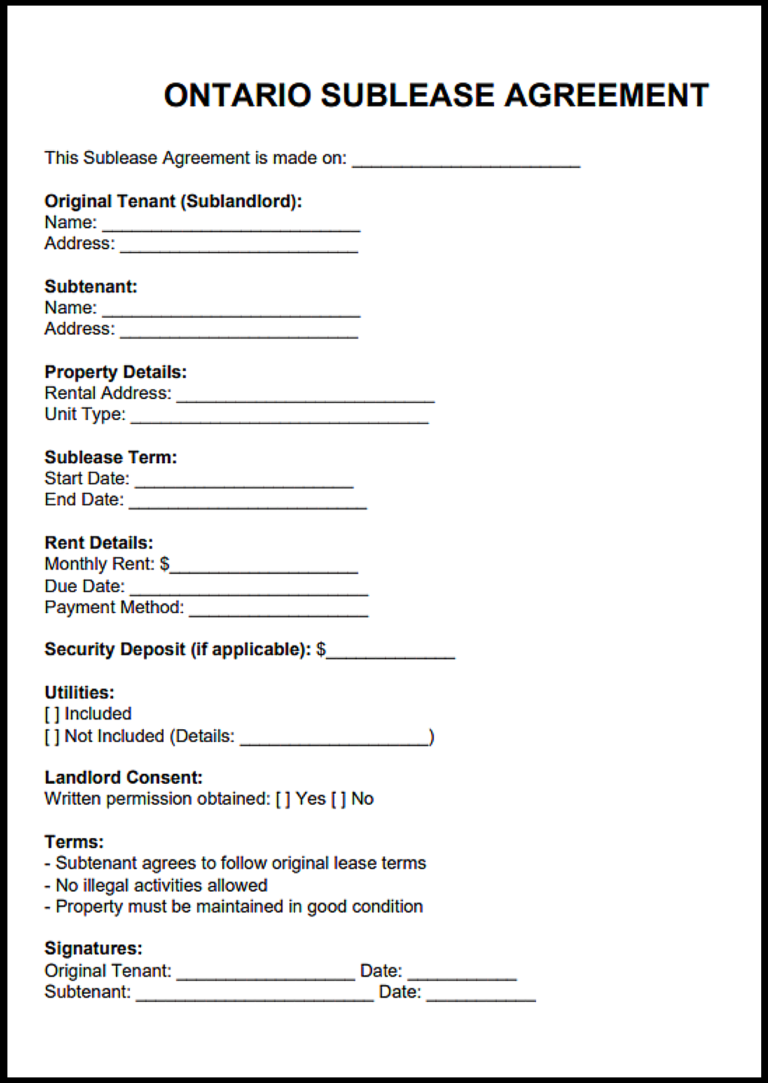
Sublease Agreement
A tenant rents the unit to another person temporarily while remaining responsible for the tenancy.
Under Ontario law, a tenant may sublet a rental unit with the landlord’s consent, but the landlord cannot arbitrarily or unreasonably withhold consent to a proposed subtenant.
Roommate Agreement
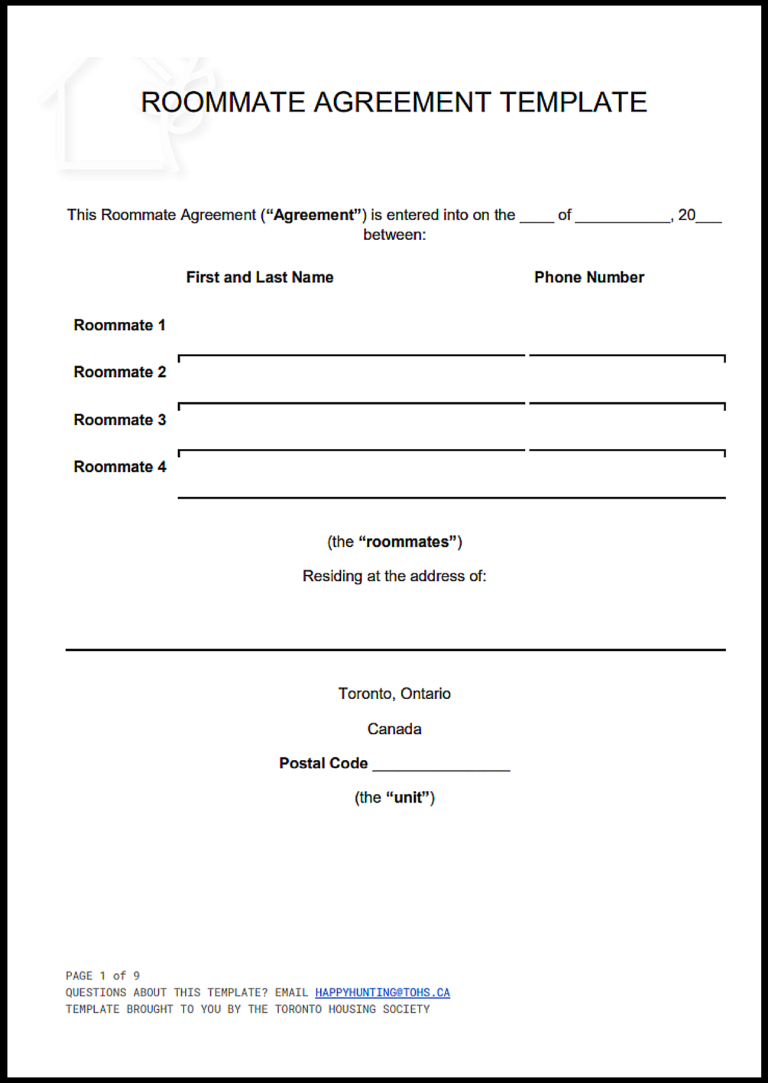
Used when tenants share a space. It can set out how rent, utilities, household responsibilities and other shared expenses will be divided.
A roommate agreement does not replace the rights and obligations created by the Residential Tenancies Act where that Act applies.
Commercial Lease Agreement
For business use, such as shops and offices. Commercial leases are governed by different legal rules and are generally not covered by Ontario’s Residential Tenancies Act.
Short-Term / Vacation Rental Agreement
For certain short-term or vacation arrangements, such as some Airbnb-style rentals. Some accommodation intended for travellers or vacationers is excluded from the Residential Tenancies Act, depending on the circumstances.
To ensure your rental arrangement complies with Ontario law, this standard Ontario lease agreement template can be supported by related documents such as a residential rental agreement format and a tenant application form in Ontario. You may also need a rent receipt template for payment records and an Ontario tenant rights guide to understand applicable protections. For drafting information, see how to write a lease agreement in Ontario.
Ontario Lease Agreement Laws, Void Clauses & Tenant Rights
| Topic / Issue | Ontario Legal Rule | Governing Statute |
|---|---|---|
| Governing Legislation | Most residential tenancies in Ontario are governed by the Residential Tenancies Act, 2006, subject to statutory exemptions. | Residential Tenancies Act, 2006 |
| Federal Applicability | Residential tenancy regulation is primarily a matter of provincial law in Ontario, although federal laws can apply to particular issues or properties. | Constitution Act, 1867 and applicable federal law |
| Recent Amendments | Ontario has enacted recent amendments affecting residential tenancies. Bill 97 includes amendments concerning matters such as air conditioning and renoviction rules, with provisions coming into force on different dates. Bill 60 also amends the Residential Tenancies Act, including notice and non-payment-of-rent procedures, with provisions taking effect in stages. | Helping Homebuyers, Protecting Tenants Act, 2023; Fighting Delays, Building Faster Act, 2025 |
| Who Can Legally Sign | A tenancy agreement is entered into by the landlord and tenant. A landlord may act through an authorized agent, and a corporation or other legal entity may be a landlord or tenant where legally applicable. | Residential Tenancies Act, 2006 |
| Witness Requirements | Ontario’s residential tenancy legislation does not generally require a witness for a residential tenancy agreement to be valid. | Residential Tenancies Act, 2006 |
| Notarization | Notarization is not generally required for an Ontario residential tenancy agreement. | Residential Tenancies Act, 2006 |
| Age Requirement | Capacity to enter into a tenancy can depend on the person’s circumstances and applicable law. A person under 18 should obtain appropriate legal advice where capacity is uncertain. | Applicable Ontario law |
| Mental Capacity | A person entering into a contract generally needs the legal capacity required to understand and enter into the agreement. Capacity questions are fact-specific. | Applicable contract and capacity law |
| Mandatory Delivery | If a written tenancy agreement is signed, the landlord must give the tenant a copy signed by both parties within 21 days after the tenant signs and gives it to the landlord. | RTA, s. 12(2) |
| Required Lease Form | Most residential tenancy agreements signed on or after April 30, 2018 must use the prescribed Standard Form of Lease, subject to statutory exemptions. | O. Reg. 9/18 |
| Mandatory Tenant Information | Section 11 requires the landlord to provide prescribed information to a tenant in the circumstances set out by the Act. It should not be described generally as a requirement to provide a separate explanation of all tenant rights and responsibilities. | RTA, s. 11 |
| Void Clauses | A provision in a tenancy agreement that is inconsistent with the Residential Tenancies Act or regulations is generally void. Specific examples include provisions prohibiting pets and provisions unlawfully restricting guests. | RTA, ss. 4 and 14 |
| Filing Status | A residential tenancy agreement does not generally need to be registered with ServiceOntario or a land registry office simply to create a residential tenancy. | N/A |
| LTB Role | A lease may be used as evidence in a Landlord and Tenant Board proceeding. It is not generally submitted to the LTB simply because a tenancy begins. | Landlord and Tenant Board |
| Failure to Use Standard Form | For a tenancy covered by the Standard Form requirement, a tenant who makes a proper written demand and does not receive the required agreement within the statutory period may withhold rent subject to the specific rules and limits in s. 12.1. | RTA, s. 12.1 |
| Illegal Deposits | A landlord cannot require a separate damage, pet or general security deposit. A lawful rent deposit is subject to statutory limits, and certain refundable key or entry-device deposits may also be permitted. | RTA, ss. 105–106; O. Reg. 516/06 |
| Inconsistent Terms | A tenancy agreement term inconsistent with the Act or regulations is generally void. The rule is broader than only maintenance or vital-service provisions. | RTA, s. 4 |
| Automatic Month-to-Month Renewal | When a fixed-term tenancy ends without a proper termination or new agreement, the tenancy generally continues on a monthly basis under s. 38. | RTA, s. 38 |
| No-Pet Clauses | A provision prohibiting animals in or about the residential complex is generally void, although other legal grounds relating to pets can still apply. | RTA, s. 14 |
One of the most important Ontario lease rules is the requirement to use the government’s Standard Form of Lease for most covered residential rentals. The Standard Form requirement has statutory exemptions, so it is more accurate to say that it applies to most residential tenancy agreements rather than every rental arrangement.
If a tenant is entitled to a Standard Form of Lease but does not receive one, the tenant can make a written demand. If the landlord does not provide the required agreement within 21 calendar days, the tenant may withhold one month’s rent, subject to the statutory conditions and limits. If the landlord subsequently complies within the applicable statutory period, the withheld rent may become payable again.
Ontario also has strict limits on deposits. A landlord may require a rent deposit subject to the statutory limit, which is generally no more than the lesser of one rent period and one month’s rent. A separate damage deposit or pet deposit cannot be required. Certain refundable deposits for keys or entry devices can be permitted under the regulations.
Another important rule is that “No Pets” provisions in residential tenancy agreements are generally void. Ontario law also prevents tenancy agreements from contracting out of rights protected by the Residential Tenancies Act.
These rules matter because disputes can arise when landlords or tenants rely on incorrect lease terms instead of the requirements of Ontario tenancy law.
Real-Life Use Cases in Ontario
Here’s how people may use different agreements:
- Renting your first apartment in Toronto → Standard lease
- Moving for a short job contract → Fixed-term lease
- Letting a friend stay temporarily → Depending on the circumstances, this may be a sublet or another occupancy arrangement
- Sharing rent with classmates → Roommate agreement
- Opening a shop → Commercial lease
- Renting for tourists → Short-term or vacation rental agreement, where applicable
The correct document depends on the legal relationship between the parties and whether the Residential Tenancies Act applies.
Key Elements of a Valid Ontario Lease Agreement
A written residential tenancy agreement should clearly record the important terms of the tenancy.
Names of Landlord and Tenant
Full legal names of the landlord and tenant should be recorded.
Rental Property Details
The complete address and unit details should be included.
Rent Amount and Payment Terms
- Monthly rent
- Due date
- Payment method
- What services or utilities are included
Lease Duration
- Fixed-term, such as one year
- Or a periodic tenancy, such as month-to-month
The legal effect of the tenancy continuing after a fixed term depends on the Residential Tenancies Act and the circumstances of the tenancy.
Deposits and Fees
Under Ontario law:
- Only a lawful rent deposit may be required, subject to statutory limits.
- Landlords cannot require a separate damage deposit.
- Pet deposits are not permitted.
- Certain refundable key or entry-device deposits may be permitted.
Maintenance and Responsibilities
Clearly define:
- Who handles repairs
- Who pays utilities
- Which services are included in the rent
- Any responsibilities that can legally be assigned to the tenant
The agreement cannot transfer legal responsibilities in a way that conflicts with the Residential Tenancies Act.
Rules and Restrictions
Include rules about:
- Pets
- Smoking
- Guests
- Parking
- Other building rules
A lease cannot simply prohibit guests or pets where Ontario law makes such restrictions void.
Signatures and Date
For a written tenancy agreement, the landlord and tenant should sign the agreement and keep copies. The legal effect of an unsigned or incomplete agreement depends on the circumstances; an unsigned document does not automatically mean that no tenancy exists.
How to Create or Complete an Ontario Lease Agreement
Follow these simple steps:
- Choose the correct lease type
- Check whether the Residential Tenancies Act applies
- Use the prescribed Standard Form where required
- Fill in tenant and landlord details
- Add property information
- Clearly define rent and duration
- Check Ontario-specific rules
- Review additional terms for consistency with the Act
- Sign and keep a copy
Tip: Always keep a signed copy. This can make it easier to establish what was agreed if a dispute happens later.
Legal Overview in Ontario
Ontario residential tenancy agreements are primarily governed by the Residential Tenancies Act, 2006, which establishes rules for residential tenancies, including tenancy agreements, rent, repairs, termination and tenant protections.
Under Ontario law:
- Prescribed Lease Form: Most residential tenancy agreements covered by the Standard Form rules must use the government-prescribed Standard Form of Lease. Certain types of housing and special tenancies are exempt.
- The Rent Control Boundary: The rent increase guideline generally applies to covered units. It does not apply to new buildings, additions and most new basement apartments first occupied for residential purposes after November 15, 2018, along with certain other exempt situations. The 2026 Ontario rent increase guideline is 2.1%.
- Air Conditioning Protections: Ontario has enacted amendments concerning tenants’ installation and use of window or portable air conditioning units. The relevant provisions have different effective dates, so landlords and tenants should check which provisions are currently in force before relying on them.
- Permissible Deposits: Landlords may require a lawful rent deposit subject to the limits in section 106. Separate damage and pet deposits are not permitted, while certain refundable key or entry-device deposits may be permitted under the regulations.
- Conflicting Terms: A tenancy agreement provision that is inconsistent with the Residential Tenancies Act or its regulations is generally void.
Commercial leases are governed by different legal rules and are generally not covered by Ontario’s Residential Tenancies Act.
If you are unsure whether a particular tenancy is covered by the Act or whether a specific provision is currently in force, check the official Ontario legislation and housing guidance.
Common Mistakes to Avoid
Many landlords and tenants make these mistakes:
- Using the wrong lease type
- Not using Ontario’s standard lease when it is required
- Missing key terms like rent date
- Adding illegal clauses, such as damage deposits
- Treating a fixed-term tenancy as automatically ending on its expiry date
- Subleasing without the landlord’s consent
- Assuming every short-term rental is governed by the Residential Tenancies Act
- Not defining roommate responsibilities
Checking the agreement against Ontario’s tenancy rules can help prevent avoidable disputes and unenforceable terms.
Choosing the Right Lease Agreement (Decision Guide)
Use this quick guide:
| Situation |
Best Lease Type
|
| Renting a full unit long-term | Standard lease |
| Want a fixed initial term |
Fixed-term lease
|
| Need a periodic tenancy |
Month-to-month tenancy
|
| Tenant leaving temporarily |
Sublease, where legally appropriate
|
| Sharing rent |
Roommate agreement
|
| Business use |
Commercial lease
|
| Short stays |
Short-term or vacation rental agreement, where applicable
|
FAQs About Ontario Lease Agreements
Is a written lease required in Ontario?
For most residential tenancy agreements covered by Ontario’s Standard Form rules, the landlord must use the prescribed written Standard Form of Lease. However, Ontario law recognizes that a tenancy can exist even when the agreement is not in writing, and statutory exemptions also exist.
Can a landlord ask for a security deposit?
Landlords cannot require a separate damage, pet or general security deposit. They may require a lawful rent deposit subject to Ontario’s statutory limits, and certain refundable key or entry-device deposits may also be permitted.
What happens if there is no lease agreement?
The Residential Tenancies Act can still apply even when there is no written lease. However, proving the agreed terms can become more difficult when important terms were not recorded in writing.
Can a lease be ended early?
A tenancy can sometimes be ended before the original fixed-term date, but the applicable rules depend on the circumstances. Ontario law provides specific termination rights and procedures for landlords and tenants, so early termination should not be assumed to be available simply because one party wants to leave.
Do roommates need a separate agreement?
A separate roommate agreement is not generally required by Ontario law. However, it can be useful for recording how roommates will divide rent, utilities, household duties and other shared expenses.
Is a verbal lease valid in Ontario?
A tenancy can exist without a written agreement. However, for most residential tenancies covered by the Standard Form rules, the landlord must provide the prescribed written lease. Written terms are also easier to establish if a dispute arises.
Legal Disclaimer
This content is only for general information. It does not replace professional legal advice. Laws can change and may be different depending on your situation.
For proper guidance, you should speak with a qualified legal professional or contact the appropriate Ontario housing authority.