Ontario Last Will and Testament Guide | Free PDF Template
Ontario Last Will and Testament is one of the most important documents you can create to protect your family and your assets. Imagine this—someone passes away without a will, and suddenly the family is left dealing with confusion, delays, and legal rules deciding who gets what. It happens more often than people think.
Under Ontario law, if you don’t have a will, your estate is divided using fixed legal rules—not your personal wishes. That’s why creating a will early gives you control, avoids disputes, and protects the people you care about.
I’ve seen families in Ontario spend months dealing with estate delays and unexpected legal costs simply because a will was never properly signed or updated after major life changes. When people try to handle this process without understanding Ontario’s estate rules, it often creates stress and conflict at the worst possible time for their loved ones.
In this article, you’ll get:
- A free Ontario will template
- Simple, step-by-step instructions
- Clear explanation of Ontario estate laws
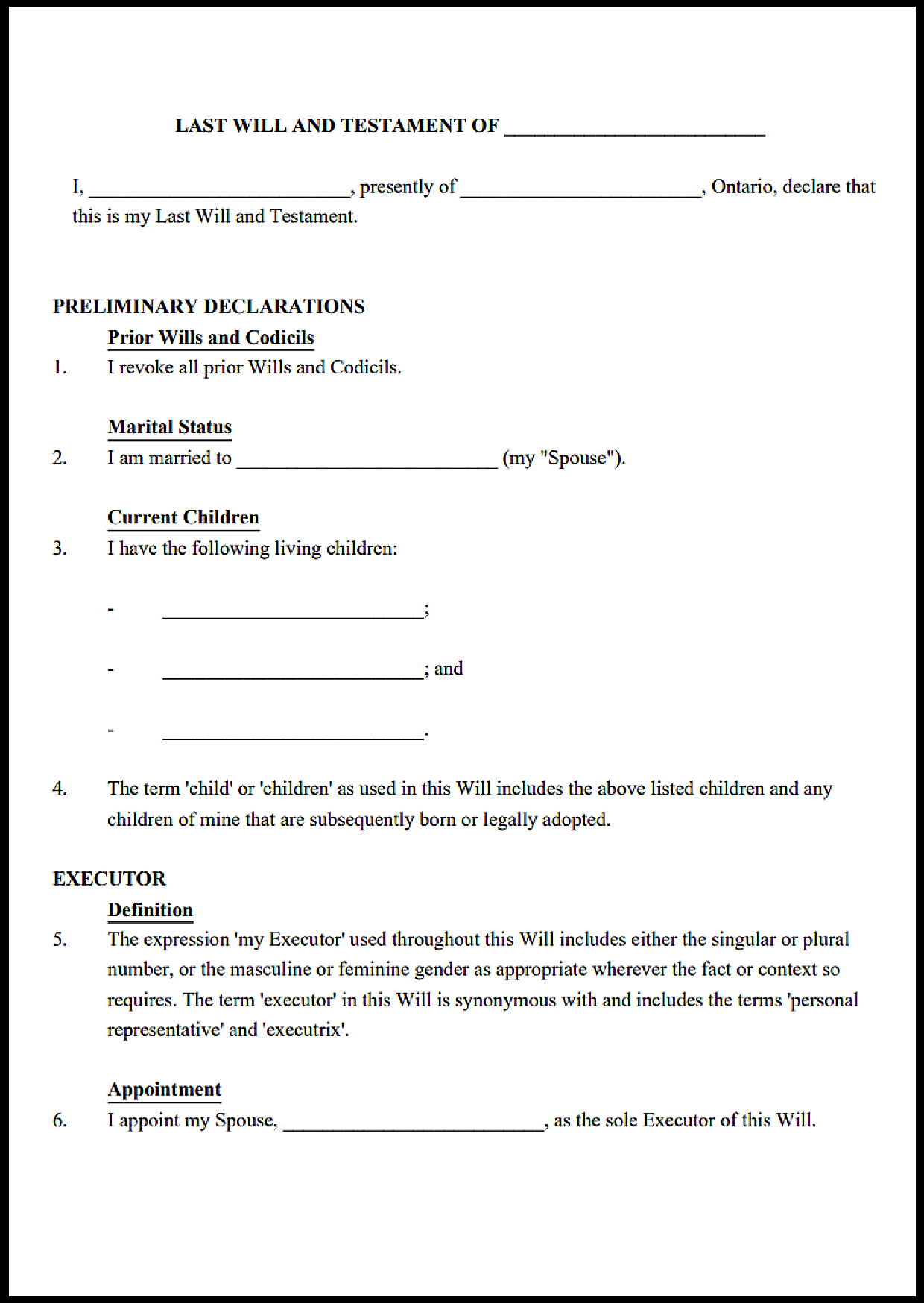
Free Ontario Last Will and Testament Template
What Is an Ontario Last Will and Testament?
A will is a legal document that explains what should happen to your assets after your death. In simple words, it tells who gets what.
Under Ontario law, your will also allows you to choose your executor and name guardians for minor children. It gives you full control over your estate.
If you don’t have a will, your estate is handled under intestacy rules. This means the government decides how your assets are divided, usually giving priority to your spouse and children. This can create delays and sometimes conflicts.
Key Parts of a Valid Will in Ontario
A valid will has several important parts, and each one plays a role in avoiding confusion.
Testator Information
The testator is the person making the will. You must be at least 18 years old and mentally capable. This means you understand what assets you own and who you want to give them to.
Executor (Estate Trustee)
The executor manages your estate after your death. This includes paying debts, handling paperwork, and distributing assets. It’s important to choose someone responsible and trustworthy.
Beneficiaries
Beneficiaries are the people or organizations who receive your assets. Always use clear names to avoid disputes later.
Asset Distribution
Your will should clearly explain how your property, money, and personal items will be distributed. You can give specific items or divide the remaining estate.
Guardian for Minor Children
If you have children under 18, naming a guardian is very important. This person will take care of your children if something happens to you.
A last will is one of the most important estate planning documents in Ontario. To understand its full role in asset distribution and legal decision-making, you should review the complete Ontario will template guide, which explains how wills are structured under provincial law. In some cases, individuals may also need to account for obligations outlined in an Ontario separation agreement when drafting their will.
Legal Requirements for a Valid Will in Ontario
To make your will legally valid, you must follow certain rules.
- The will must be in writing
- You must sign the will
- Two witnesses must be present
- Witnesses must sign in your presence
- Witnesses cannot be beneficiaries or the spouse of a beneficiary. If a beneficiary or their spouse signs as an attesting witness, the testamentary gift to them is automatically void under SLRA s. 12(1) unless the Superior Court of Justice exercises its discretion under s. 12(3) to save the bequest upon proof that no improper or undue influence occurred
There is also something called a holograph will, which is a handwritten will. It does not need witnesses, but it must be fully written and signed by you. However, it can sometimes cause legal issues if not clear.
How to Make a Will Step-by-Step (Ontario)
Creating a will becomes easier if you follow a simple process.
Step 1: List Your Assets
Start by writing down everything you own, such as property, bank accounts, and personal items.
Step 2: Choose Executor
Pick someone reliable who can handle responsibilities properly. This role is very important.
Step 3: Decide Beneficiaries
Choose who will receive your assets. It’s also smart to include backup beneficiaries.
Step 4: Write the Will
You can use the template provided above or get legal help if needed.
Step 5: Sign with Witnesses
Sign your will in front of two witnesses and make sure they sign it at the same time.
What Happens If You Die Without a Will in Ontario?
If you die without a will, your estate is divided based on Ontario’s intestacy laws. These rules follow a fixed system and do not consider your personal wishes.
- Married Spouses & The Preferential Share: A legally married surviving spouse receives a statutory preferential share of the first $350,000 of the estate (for deaths on or after March 1, 2021). If the net estate value is less than or equal to $350,000, the married spouse inherits the entire estate to the complete exclusion of any children.
- The Residue Split: If the estate exceeds $350,000, the remaining residue is divided between the married spouse and children: 50/50 if there is only one child; one-third to the spouse and two-thirds divided equally among the children if there are two or more children. Succession Law Reform Act, ss. 45, 46, 47.
- The Common-Law Spouse Trap: Unmarried common-law partners have no statutory inheritance rights under Ontario’s intestacy rules. They do not receive a preferential share and must file an adversarial dependant’s support claim under Part V of the SLRA or bring a claim for unjust enrichment within strict limitation periods.
This process often causes delays, confusion, and sometimes family disputes. It also removes your control over how your assets are distributed.
This document is often prepared alongside other agreements that define financial relationships. For example, a legal prenuptial agreement format can impact how assets are divided, while a cohabitation agreement in Ontario helps clarify property ownership for unmarried partners. These documents ensure your will reflects accurate legal responsibilities.
Common Mistakes That Make a Will Invalid
Many people make small mistakes that can make a will legally invalid. It’s important to avoid these.
- Not signing the will correctly
- Using a beneficiary as a witness
- Writing unclear or confusing instructions
- Not updating the will after life changes
- Losing the original document
Keeping your will safe and updated is just as important as creating it.
Real-Life Example
Let’s take a simple example. A married person with two children owns a house and some savings.
With a will, the house can go to the spouse, and savings can be divided equally among the children. Everything is clear and smooth.
Without a will, the estate is divided based on legal rules. This may not match personal wishes and can cause delays or disagreements.
This shows how a simple will can make a big difference.
Probate and Estate Administration in Ontario
Probate is the legal process that confirms a will is valid and allows the executor to act.
In many cases, probate is required, especially if the estate includes property or large financial accounts. The executor must apply for probate, handle debts, and distribute assets.
Ontario also charges a fee called the Estate Administration Tax based on the value of the estate.
Probate Overview Table
| Aspect | Details |
| Purpose |
Validate the will legally
|
| Required when |
Property or large assets involved
|
| Handled by | Executor |
| Cost |
Estate Administration Tax
|
Will vs Living Trust in Ontario
Both wills and living trusts are used in estate planning, but they work differently.
| Feature | Will | Living Trust |
| Takes effect | After death | During lifetime |
| Probate required | Usually yes | Often avoided |
| Complexity | Simple | More complex |
| Cost | Low | Higher |
A will is enough for most people, while trusts are used in more complex situations.
When You Should NOT Use a Basic Will Template
A simple template is not suitable for everyone. You should avoid using it if you have complex needs.
- Large estates
- Business ownership
- Blended families
- Special needs dependents
- Advanced tax planning needs
In such cases, professional legal advice is strongly recommended.
FAQs About Ontario Last Will and Testament
Final Thoughts
Creating a will is a simple step that can protect your family from stress and confusion. In most cases, even a basic will provides peace of mind and ensures your wishes are followed.
It’s always better to create a will early and review it regularly, especially after major life changes. A little planning today can save your loved ones from big problems later.