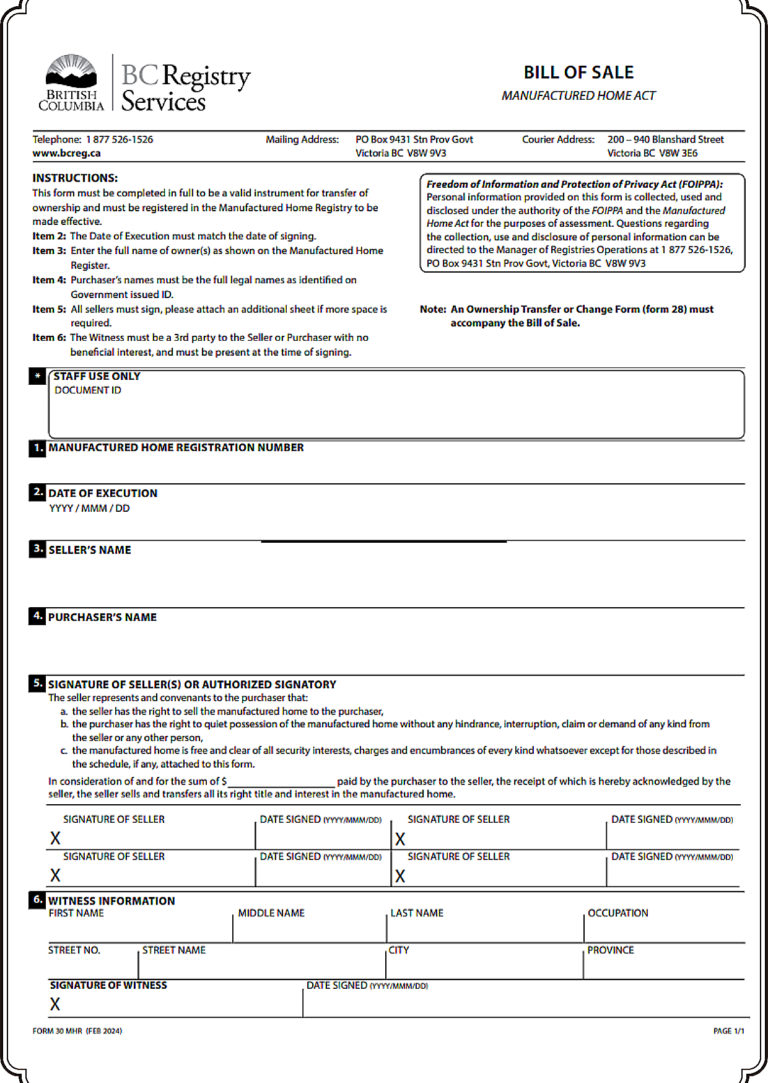
How to Write Bill of Sale Manitoba? (Step by Step Guide)
How to Write Bill of Sale Manitoba is something many buyers and sellers search for when handling private sales in Manitoba. Whether you are selling a used vehicle, trailer, electronics, furniture, or farm equipment, a properly written bill of sale helps protect both parties and creates a clear record of the transaction.
In Manitoba, rules for a bill of sale depend on what is being sold. General personal property sales are usually simple, but vehicle sales involve extra requirements through Manitoba Public Insurance (MPI). A written bill of sale can help prevent disputes, confirm ownership transfer, support tax records, and show the agreed purchase terms if problems happen later.
This guide explains Manitoba bill of sale rules, vehicle transfer requirements, VIN and lien disclosure rules, “As-Is” wording, and the most common mistakes people make during private sales.
Last Updated: October 2026

How to Properly Write a Manitoba Bill of Sale for Vehicles, Boats & Private Sales
| Topic / Issue | Manitoba Legal Rule | Governing Statute |
|---|---|---|
| Contract formation rules | Written transfers of personal property are governed under Manitoba sale contract law. | The Sale of Goods Act, R.S.M. 1987, c. S10 |
| Vehicle transfer data requirements | Manitoba requires specific ownership and registration details for vehicle transfers. | The Drivers and Vehicles Act, C.C.S.M. c. D104 |
| Federal vessel ownership compliance | Boat bills of sale must satisfy applicable federal proof-of-ownership requirements. | Canada Shipping Act, 2001; Small Vessel Regulations (SOR/2010-91) |
| Required transfer wording | The bill of sale should clearly describe the agreement and the parties’ intention to transfer the property. Manitoba law does not prescribe a single present-tense formula for every bill of sale. | The Sale of Goods Act, C.C.S.M. c. S10, s. 3 |
| Witness requirements | Witnesses are generally optional for ordinary Manitoba private sales. | No general statutory requirement for an ordinary private bill of sale |
| Price requirement | The bill of sale should record the agreed purchase price clearly. The price may be fixed by the contract, an agreed method, or the parties’ course of dealing. | The Sale of Goods Act, C.C.S.M. c. S10, ss. 3, 10 |
| Signature requirements | Both buyer and seller should sign the document for registration purposes. | The Drivers and Vehicles Act, C.C.S.M. c. D104; MPI requirements |
| Electronic signature acceptance | Do not assume every electronically signed bill of sale or TOD will be accepted for vehicle registration. Confirm the document format with MPI. | Confirm with Manitoba Public Insurance |
| Buyer and seller identification | Include the purchaser’s and seller’s names as required by MPI. Do not assume a universal requirement that both physical addresses match identification records. | MPI vehicle-registration guidance |
| Vehicle information requirements | MPI’s bill-of-sale checklist includes the purchase date, model year, make, model, serial number, purchase price, purchaser and seller names, and both parties’ signatures. | MPI vehicle-registration guidance |
| Boat information requirements | Boat bills of sale should contain Hull Identification Number (HIN) and Pleasure Craft Licence information where applicable. | Canada Shipping Act, 2001; Small Vessel Regulations |
| Motor information requirements | Boat motor packages should identify engine make, model, horsepower, and serial number where available. | Confirm applicable Transport Canada requirements |
| “As-Is” wording requirements | An “as-is” clause does not automatically remove every legal protection. Section 16 addresses implied conditions concerning quality, while section 56 addresses exclusion or variation of terms implied by law. | The Sale of Goods Act, C.C.S.M. c. S10, ss. 16, 56 |
| Date and execution requirements | Bills of sale should contain the full execution date and signatures of the parties. | MPI and applicable registration requirements |
| TOD companion requirement | For a private vehicle sale, MPI requires a written bill of sale and a signed Transfer of Ownership Document (TOD). Confirm the applicable process separately for a trailer. | MPI vehicle-registration guidance |
| Boat and trailer itemization | Boat, trailer, and motor package values should be separated clearly where relevant for registration and tax purposes. Confirm the applicable procedure with MPI. | Manitoba Retail Sales Tax Act; MPI guidance |
| Missing co-owner signatures | If property is jointly owned, confirm who has authority to sell it and whether additional owners’ signatures or consent are needed. Section 23 does not establish a universal co-owner-signature rule. | The Sale of Goods Act, C.C.S.M. c. S10, s. 23 |
| Post-signature alterations | Avoid unexplained changes after signing. If both parties agree to an amendment, record it clearly and have both parties initial or re-sign the revised document. | Practical drafting guidance |
| Vague asset descriptions | Describe the property clearly enough to identify it. Section 15 addresses sales by description; section 21 is not the general statutory rule for item descriptions. | The Sale of Goods Act, C.C.S.M. c. S10, ss. 15, 21 |
| Manitoba trailer tax valuation review | Do not assume MPI applies a particular package-pricing method without confirming the procedure for the transaction. Check applicable tax valuation rules with MPI. | Manitoba Retail Sales Tax Act; MPI guidance |
For a private vehicle sale, start with Manitoba Public Insurance’s checklist rather than a generic bill-of-sale form. The document should identify the vehicle by its model year, make, model and serial number, and record the purchase date, purchase price, purchaser and seller names, and both parties’ signatures. The buyer also needs the signed Transfer of Ownership Document and should check whether a Certificate of Inspection is required. For furniture or other personal property, use a description that clearly identifies the item.
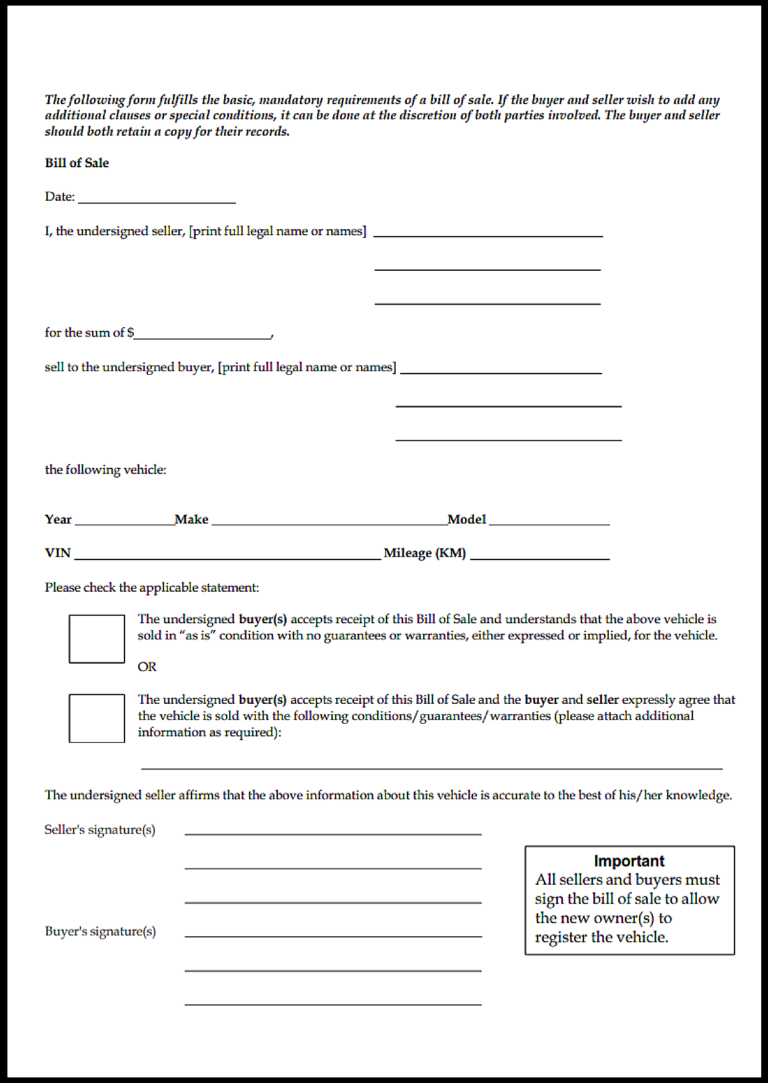
Record the actual agreed price and avoid unexplained changes after signing. For qualifying vehicle acquisitions, Manitoba’s Retail Sales Tax Act contains specific rules for determining taxable value; the applicable value is not determined simply by whether a price appears low. If the property is jointly owned, confirm who has authority to sell it and obtain any required signatures. The free Manitoba Bill of Sale template below can help you record the transaction details.
Is a Bill of Sale Legally Required in Manitoba?
Private Sales of Personal Property
Many buyers and sellers first wonder whether a bill of sale is legally required for private transactions in Manitoba before preparing their paperwork. People often buy and sell used furniture, electronics, tools, appliances, or small equipment through online marketplaces or local sales without formal paperwork.
Still, creating a bill of sale is strongly recommended. A written agreement gives both parties proof of what was sold, when the sale happened, and how much money changed hands. If disagreements happen later, the bill of sale can help prove ownership and the terms of the transaction.
Section 5 of Manitoba’s Sale of Goods Act allows a sale contract to be written, oral, partly written and oral, or implied by the parties’ conduct, subject to other applicable law. A written bill of sale provides useful evidence of the agreed terms.
Vehicle Sales Have Extra Requirements
Vehicle sales in Manitoba are different from ordinary private sales because additional registration rules apply.
When selling a vehicle, buyers normally need:
-
A properly completed bill of sale
-
The Transfer of Ownership Document (TOD)
-
Registration through Manitoba Public Insurance (MPI)
The bill of sale alone is usually not enough to complete a vehicle ownership transfer. MPI may refuse registration if required information is missing.
The TOD is the transfer portion on the back of the vehicle registration. MPI requires it as part of the paperwork for a private vehicle sale, along with a written bill of sale. Keep the TOD and bill of sale together when completing the registration process.
What Information Must Be Included in a Manitoba Bill of Sale?
Buyer and Seller Legal Names
The bill of sale should include the full legal names of both the buyer and seller. Nicknames should be avoided because they can create confusion later.
For example, using “Michael Thompson” instead of “Mike Thompson” is safer for legal and registration purposes. Names should match government-issued identification whenever possible.
This is especially important for vehicle sales because MPI may compare the information against registration records.
Sale Date and Purchase Price
Record the actual sale date and purchase price. These details help document the parties’ agreement and may be relevant to registration, insurance, or a later dispute. For qualifying vehicle acquisitions, Manitoba’s Retail Sales Tax Act sets specific rules for determining fair value; the taxable value is not based solely on whether a price appears unrealistic. Never state a false price to reduce tax, as inaccurate transaction records can create legal and tax problems.
Full Description of the Item
The item being sold should be described clearly enough to identify it without confusion.
Common examples include:
| Item Type |
Details to Include
|
| Furniture |
Brand, material, colour, dimensions
|
| Electronics |
Model number, serial number, accessories
|
| Farm equipment |
Year, make, model, serial number
|
| Trailers |
VIN, trailer size, condition
|
| Vehicles |
Year, make, model, VIN, mileage
|
For furniture, tools, electronics, and equipment, include identifying details such as the make, model, serial number, dimensions, or condition where relevant. For vehicles, use the identifying details required by MPI.
VIN or Serial Number Requirements
For a vehicle bill of sale, follow MPI’s current checklist, which includes the vehicle’s serial number along with the model year, make, model, purchase date, purchase price, purchaser and seller names, and signatures. For other property, include the VIN or serial number where one exists and is relevant to identifying the item. Check MPI’s current instructions for the particular vehicle before submitting registration paperwork.
Signatures of Both Parties
The buyer and seller should both sign the bill of sale.
Signatures help prove:
-
The parties agreed to the transaction
-
Ownership changed voluntarily
-
The terms were accepted
Witnesses are usually optional in Manitoba private sales. However, witnesses can help if the transaction involves expensive property or if disputes later arise.
“As-Is” Clause Protection
Manitoba’s Sale of Goods Act contains implied terms that may apply to a sale, including terms about the seller’s right to sell, quiet possession, and goods matching their description. Section 56 allows some terms implied by law to be excluded or varied by express agreement, course of dealing, or usage, subject to the circumstances and other applicable law. An “as-is” clause records that the buyer accepts the property in its current condition, but it does not automatically remove every legal protection or excuse fraud or misrepresentation.
Different transactions may require more specialized transfer paperwork depending on the type of asset being sold. Vehicle purchases often involve a vehicle ownership transfer form, while private automobile sales commonly use a car bill of sale template for registration and legal recordkeeping.
How to Write a Vehicle Bill of Sale in Manitoba
Information MPI Requires
Before signing, check the bill of sale against MPI’s current checklist for a privately purchased vehicle. MPI lists the purchase date, model year, make, model, serial number, purchase price, purchaser and seller names, and both parties’ signatures. Incomplete or incorrect information may delay registration.
The Transfer of Ownership Document (TOD)
Many people mistakenly believe a bill of sale automatically transfers vehicle ownership.
In Manitoba, a bill of sale alone does not complete the vehicle-registration process. For a private vehicle sale, MPI requires the signed Transfer of Ownership Document (TOD), found on the back of the registration, along with a written bill of sale. If the TOD is missing or you are unsure what format will be accepted, contact MPI or an Autopac agent before attempting registration.
Without the TOD, the buyer may not be able to register the vehicle properly.
Odometer Accuracy Rules
Do not alter or knowingly misrepresent a vehicle’s mileage. Record mileage accurately where relevant, and state clearly if the actual distance travelled is unknown or cannot be verified.
Sellers should never:
-
Roll back mileage
-
Guess inaccurate mileage
-
Misrepresent the vehicle’s true distance travelled
False mileage information can lead to disputes and may have legal consequences depending on the conduct and applicable law. If the actual distance travelled is unknown, do not guess; state that it cannot be verified.
If the seller does not know the actual mileage, that should be clearly stated.
Vehicle Liens and Outstanding Loans
Before paying for a used vehicle, buyers should check for liens.
A lien means a lender or creditor may still have a legal claim against the vehicle because of unpaid financing.
If the debt is not cleared, the vehicle could potentially be repossessed even after the buyer pays the seller.
Buyers can search the Personal Property Registry (PPR) to check for registered liens.
Section 14 of Manitoba’s Sale of Goods Act contains implied terms concerning the seller’s right to sell, the buyer’s quiet possession, and goods free from undisclosed encumbrances, subject to the Act’s wording and the circumstances of the sale. Buyers should also consider checking the Personal Property Registry for registered security interests before purchasing valuable property.
Retail Sales Tax (RST) on Vehicle Purchases
Retail Sales Tax generally applies to qualifying private vehicle purchases in Manitoba unless an exemption applies. Section 2.2(5) of the Retail Sales Tax Act sets specific valuation rules for certain motor vehicle and off-road vehicle acquisitions. In the circumstances described by that section, fair value is generally the greater of the purchase price and average wholesale price, subject to the statutory exceptions. A lower market value may be considered where the Act’s conditions are met and a qualifying appraisal supports it. Confirm the current process with MPI or an Autopac agent.
When parties want additional protection during private sales, they may also choose to use an as-is bill of sale agreement. Buyers comparing ownership paperwork may also benefit from reviewing the difference between a bill of sale and ownership documents in Manitoba before completing the transfer process.
How “As-Is” Sales Work in Manitoba
What “As-Is” Actually Means
An “as-is” clause records that the buyer agrees to accept the property in its current condition. Section 56 of Manitoba’s Sale of Goods Act allows some terms implied by law to be excluded or varied by express agreement, course of dealing, or usage, subject to the circumstances and other applicable law. The clause does not automatically remove every legal protection. Do not assume that an “as-is” clause is always effective in a private sale or automatically invalid in every dealership sale. For a consumer purchase from a business, check Manitoba’s Consumer Protection Act and the rules that apply to the particular transaction.
For example, an “As-Is” clause does not protect a seller who:
-
Sells stolen property
-
Hides a lien
-
Lies about major damage
-
Provides fake ownership information
The effect of an “as-is” clause depends on the wording of the agreement and applicable law. Buyers should inspect the property and ask questions before purchasing, while sellers should describe the item honestly and avoid misleading statements.
Situations Where Sellers Still Have Legal Duties
An “as-is” clause does not automatically resolve every legal issue. The seller should have authority to sell the property and should not make false statements about ownership, financing, or condition. A buyer concerned about a lien can search the Personal Property Registry. The legal consequences of fraud or misrepresentation depend on the facts and applicable law.
Example of Proper “As-Is” Wording
Many Manitoba private sales use wording similar to this:
“The buyer accepts the goods in ‘as is’ condition with no guarantees or warranties, express or implied.”
This helps reduce confusion and future disputes.
Common Mistakes That Cause Problems Later
Leaving Out the VIN or Serial Number
Missing VINs or serial numbers can create serious issues later.
Problems may include:
-
Registration delays
-
Ownership disputes
-
Difficulty proving identity of the property
-
Fraud concerns
Always verify the VIN directly from the vehicle before signing documents.
Using Incorrect Buyer or Seller Names
Incorrect names can create legal confusion during registration or future disputes.
This may cause:
-
MPI processing delays
-
Insurance issues
-
Contract disputes
-
Ownership challenges
Full legal names are always the safest option.
Forgetting Lien Disclosure
Undisclosed liens are one of the biggest financial risks in private vehicle sales.
If a lender still has a legal interest in the property, the buyer may risk repossession even after completing payment.
Buyers should consider checking the Personal Property Registry before purchasing expensive assets.
Writing the Wrong Sale Price
Some people intentionally understate the purchase price to reduce taxes.
This can create:
-
Tax reassessments
-
Fraud concerns
-
Insurance valuation disputes
-
Legal problems during resale
The safest approach is to record the true sale amount.
Relying Only on Verbal Agreements
Section 5 of Manitoba’s Sale of Goods Act allows a sale contract to be written, oral, partly written and oral, or implied by the parties’ conduct, subject to other applicable law. The practical difficulty with an oral agreement is evidence: the parties may later disagree about the item, price or conditions. A signed bill of sale records those details in one place. For a vehicle, it must also meet MPI’s document requirements and accompany the required transfer paperwork.
Should a Manitoba Bill of Sale Be Notarized?
When Notarization Is Usually Not Required
MPI’s ordinary vehicle-registration checklist requires a bill of sale and a signed Transfer of Ownership Document, among other applicable documents, and does not list notarization as a routine requirement for a private vehicle sale. Other transactions or receiving authorities may have additional requirements, so confirm the rules for the particular document.
Situations Where Notarization Can Help
Notarization may still be useful in some situations, including:
-
High-value equipment sales
-
Cross-province transactions
-
Commercial asset transfers
-
Dispute prevention
-
Estate-related transfers
Before paying for notarization, ask the receiving authority whether it requires notarization or whether a signed bill of sale and the other supporting documents are sufficient.
Selling to Buyers in Other Provinces
Registration requirements can differ by province. Before completing a cross-province sale, ask the destination province’s vehicle-registration authority which ownership documents and inspections it requires.
If the buyer lives outside Manitoba, both parties should confirm the destination province’s requirements before finalizing the sale.
What Happens After the Bill of Sale Is Signed?
Steps for Buyers
After a private vehicle purchase, take the bill of sale, signed TOD and any other required documents to MPI or an Autopac agent. Check whether a valid Certificate of Inspection is required, arrange registration and insurance, and retain copies of the transaction records.
Steps for Sellers
After a private vehicle sale, retain the signed bill of sale and other transaction records, keep your licence plates, and contact MPI or your Autopac agent about cancelling or changing coverage as appropriate. Confirm that payment has cleared before handing over the property, and keep copies of the signed documents.
Keeping Records for Tax and Legal Purposes
Keep the signed bill of sale with proof of payment and any related ownership documents. These records may help if the parties later disagree about the transaction or need to establish the purchase price. If the sale relates to a business or creates a tax-reporting obligation, check the Canada Revenue Agency’s record-retention rules for your circumstances rather than relying on a general retention period.
Frequently Asked Questions
Can I handwrite a Bill of Sale in Manitoba?
A handwritten bill of sale may be useful evidence of a private sale if it clearly records the parties, item, agreed price, date and signatures. For a vehicle, it must also contain the details MPI requires and be accompanied by the required transfer paperwork.
Does a Bill of Sale need witnesses?
MPI’s ordinary vehicle-registration checklist does not list a witness as a routine requirement for a private vehicle bill of sale. A different transaction or receiving authority may impose additional requirements, so confirm the rules that apply to your document.
Can I sell a vehicle without a TOD?
For a private vehicle sale, MPI requires the signed Transfer of Ownership Document (TOD) as well as a written bill of sale. If the TOD is missing, contact MPI or an Autopac agent to ask what options are available for your circumstances.
Is a Bill of Sale enough proof of ownership?
A bill of sale is evidence of the transaction, but it does not replace the vehicle-registration process. For a private vehicle purchase, the buyer must complete the applicable MPI transfer and registration requirements.
What if the vehicle still has a loan?
Buyers should consider searching Manitoba’s Personal Property Registry for registered security interests before paying. Sellers should provide accurate information about financing or liens, and the parties should confirm how any outstanding debt will be discharged before completing the sale.
Can a Bill of Sale be canceled after signing?
Whether a signed bill of sale can be rescinded or set aside depends on the facts, the contract and the applicable law. Fraud or misrepresentation may provide legal grounds for a remedy, but cancellation is not automatic; seek legal advice about a specific dispute.