Manitoba Bill of Sale Requirements (Free Template, Rules)
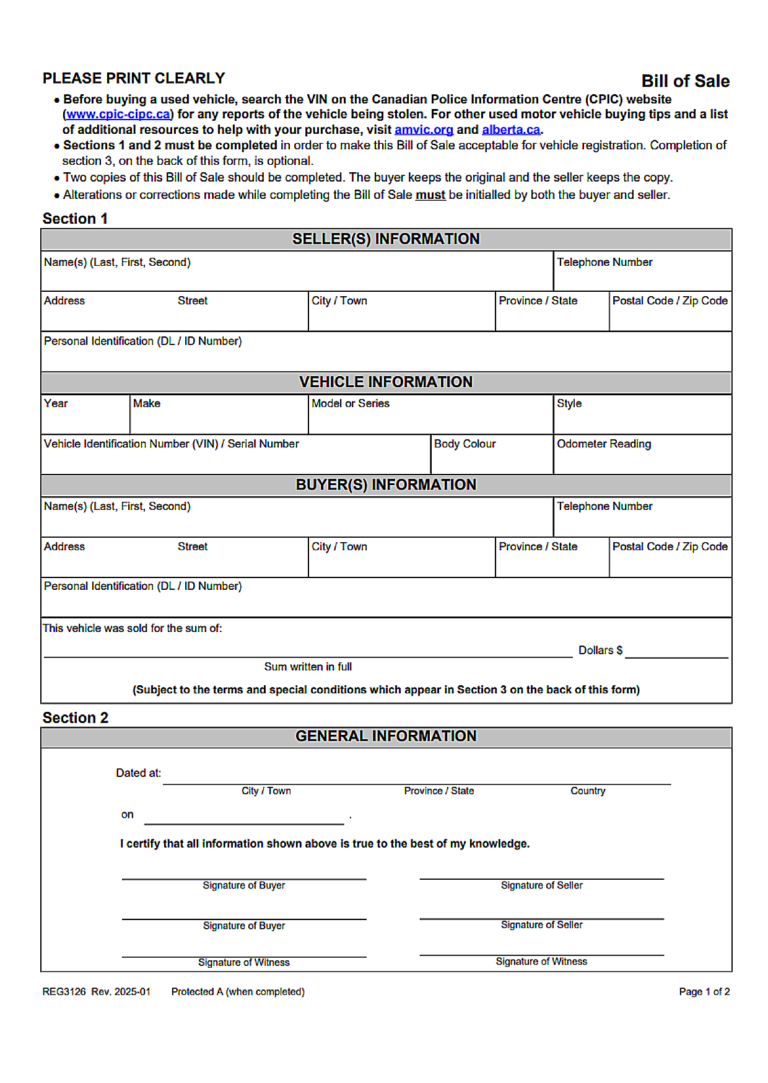
Manitoba Bill of sale requirements rules depend on what is being sold. A simple bill of sale for furniture is treated differently from a Manitoba vehicle bill of sale used for a car, truck, motorcycle, or trailer transfer.
In most private sale situations, a bill of sale works as written proof that the buyer paid for the item and the seller transferred ownership. It can help prevent disputes about payment, condition, ownership, or taxes later.
For vehicle sales, Manitoba Public Insurance (MPI) also requires specific information before ownership can be registered properly. Missing details like the VIN or signatures can delay registration or create legal problems.
A Manitoba bill of sale is commonly used for: Cars and trucks, motorcycles, trailers, boats, farm equipment, electronics, furniture, tools, and machinery.
Under Manitoba law, most private bills of sale do not need a witness or notary to be valid. However, written documents are strongly recommended because verbal agreements are difficult to prove if problems happen later.
Last Updated: October 2026
Manitoba Bill of Sale Requirements Template
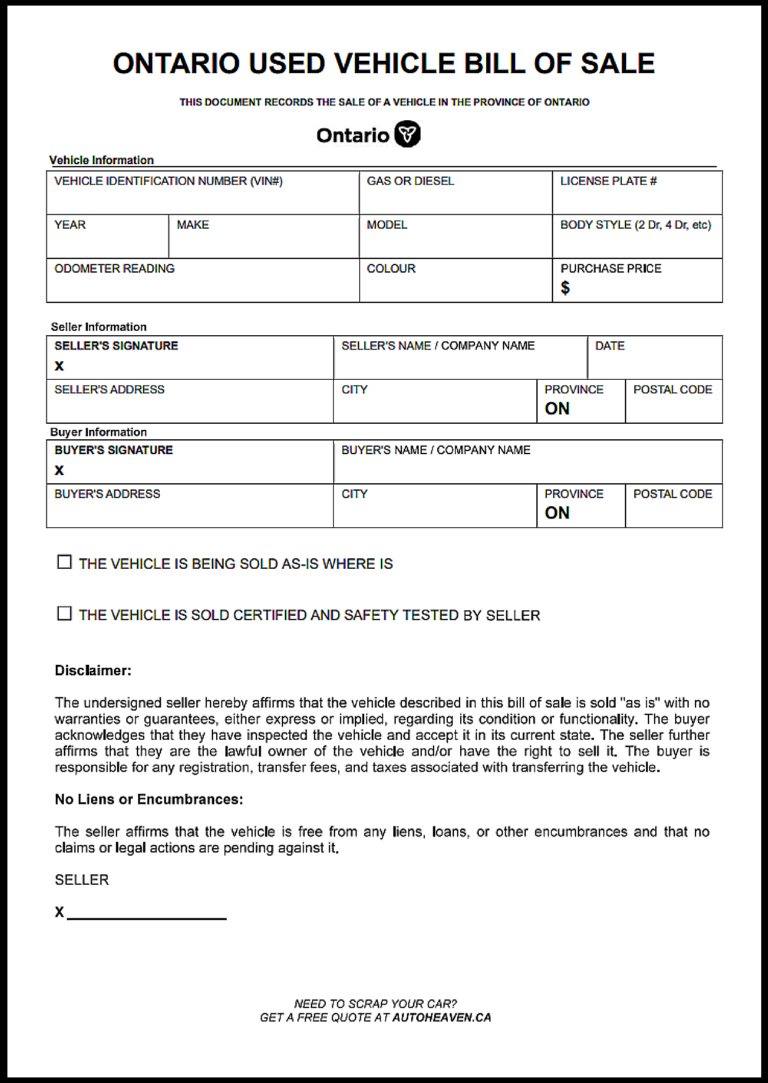
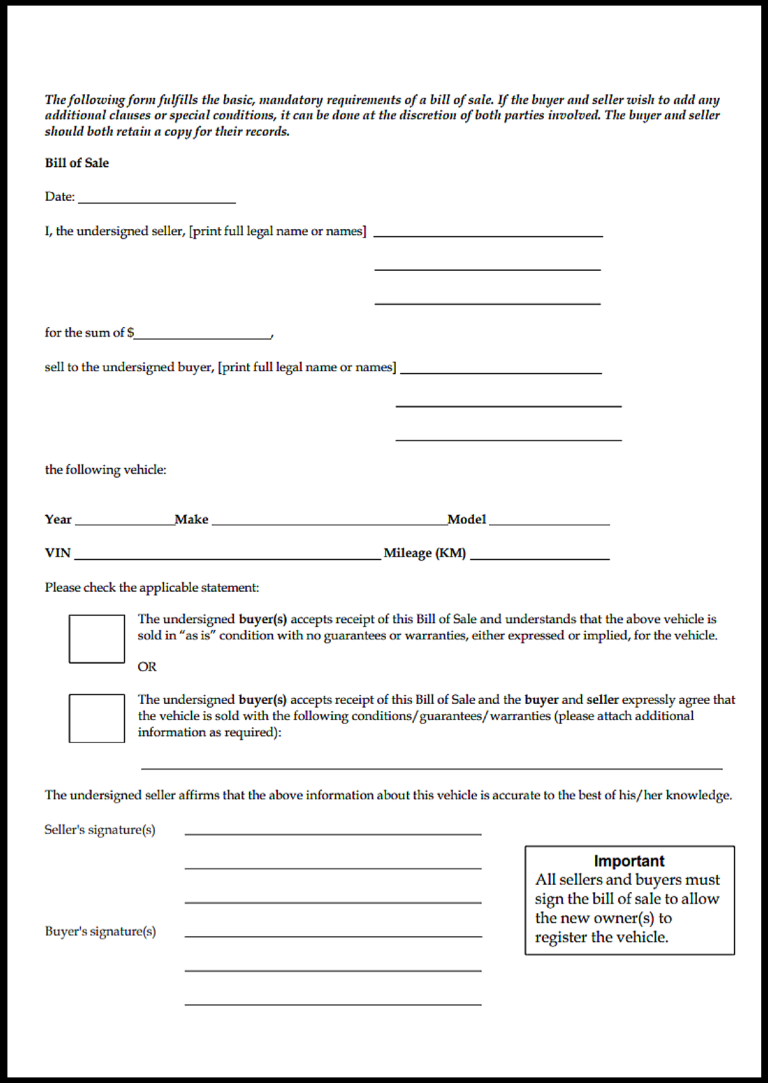
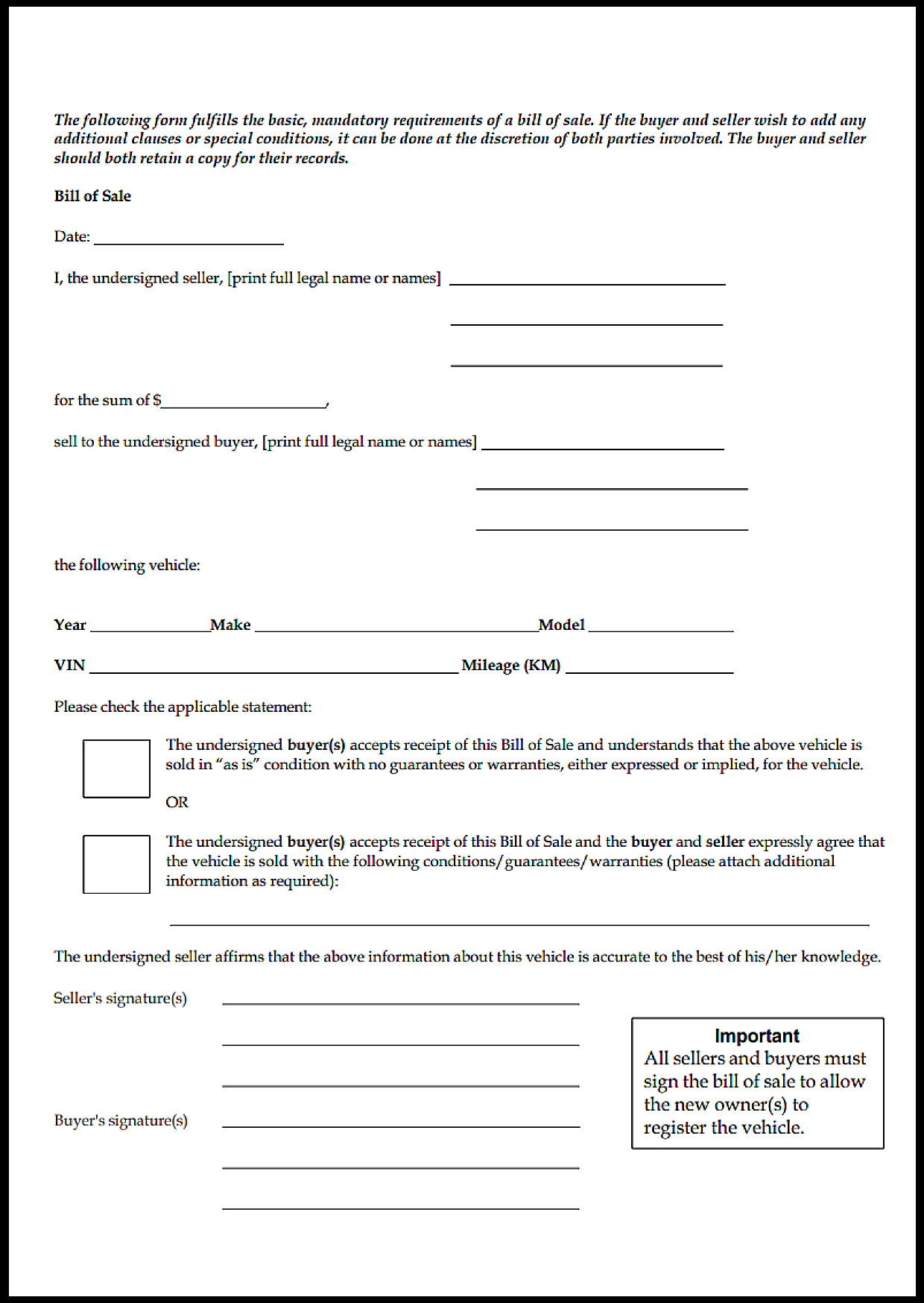
The template below is designed for general private sales in Manitoba. It includes the basic information commonly used in Manitoba private sale requirements and adds important ownership and “As Is” wording.
Manitoba Bill of Sale Legal Requirements, Registration Rules & Ownership Laws
| Topic / Issue | Manitoba Legal Rule | Governing Statute |
|---|---|---|
| Contract of sale rules | The contract of sale and transfer of physical property are governed under Manitoba sale-of-goods law. | The Sale of Goods Act, C.C.S.M. c. S10 |
| Vehicle and trailer registration | Bills of sale used for vehicle and trailer registration are governed by Manitoba registration requirements. | The Drivers and Vehicles Act, C.C.S.M. c. D104 |
| Federal boat transfer compliance | Boat ownership documentation must comply with federal vessel licensing requirements. | Canada Shipping Act, 2001; Small Vessel Regulations (SOR/2010-91) |
| Legal signing authority | For a private vehicle sale, the buyer and seller should complete and sign the bill of sale and the required Transfer of Ownership Document (TOD). If the vehicle has multiple owners or someone is signing on another person’s behalf, confirm the signing requirements with MPI before completing the transfer. | The Sale of Goods Act, C.C.S.M. c. S10; MPI vehicle-sale guidance |
| Witness requirement | An ordinary private bill of sale does not generally need a witness under the routine vehicle-sale process described by MPI. Special transactions or documents may have different requirements, so confirm those separately. | MPI vehicle-sale guidance; special transactions may differ |
| Notarization requirement | A routine private vehicle bill of sale in Manitoba is not generally required to be notarized. If a document is missing or a special transaction requires a sworn declaration, ask MPI or the relevant authority what alternative proof is accepted. | MPI vehicle-sale guidance; confirm any special document requirements |
| Age and legal capacity | Manitoba’s age of majority is 18. A person’s ability to enter into a particular sale agreement can depend on the circumstances and applicable law, so age alone does not resolve every question about contractual capacity. | The Age of Majority Act, C.C.S.M. c. A7, s. 1 |
| Vehicle registration deadline | After a private vehicle purchase, contact MPI or an Autopac agent promptly to confirm the registration, insurance, and any inspection requirements that apply before driving the vehicle. | The Drivers and Vehicles Act, C.C.S.M. c. D104 |
| Pleasure Craft Licence deadline | If the boat already has a Canadian Pleasure Craft Licence, the buyer must transfer the licence into their name within 30 days of the ownership change. This is a federal requirement, not a Manitoba-specific bill of sale deadline. | Transport Canada pleasure craft licensing requirements; Small Vessel Regulations (SOR/2010-91) |
| Required sale date | Bills of sale should contain the exact transaction date. | MPI and Transport Canada processing requirements |
| Purchase price disclosure | The exact purchase price or nature of a gift or trade transaction should be stated clearly. | MPI and Transport Canada processing requirements |
| Vehicle information requirements | For a private vehicle sale, include the vehicle’s identifying details and the information MPI requires on the bill of sale. Check the vehicle’s identifying number against the registration paperwork before signing. | The Drivers and Vehicles Act, C.C.S.M. c. D104 |
| Boat information requirements | For a boat sale, include identifying details such as the hull identification number (HIN), if applicable, and any existing Pleasure Craft Licence number. Check Transport Canada’s current proof-of-ownership requirements for the particular licensing or transfer application. See HIN and Pleasure Craft Licence information. | Canada Shipping Act, 2001; Small Vessel Regulations |
| Party identification requirements | Bills of sale should include full legal names, addresses, and signatures of buyers and sellers. | MPI and Transport Canada processing requirements |
| Trailer registration requirement | Before registering a privately purchased trailer, confirm with MPI or an Autopac agent which ownership documents are required for that trailer. Do not assume that a photocopy or a bill of sale alone will satisfy every registration requirement. See registering trailers and towables. | Manitoba Public Insurance registration process |
| Transfer of Ownership Document (TOD) | For a private vehicle sale, MPI requires the Transfer of Ownership Document (TOD) as well as a written bill of sale. For a trailer, confirm the applicable registration documents with MPI or an Autopac agent. | The Drivers and Vehicles Act, C.C.S.M. c. D104 |
| Retail Sales Tax collection | Retail Sales Tax may be collected through MPI during registration, subject to Manitoba’s tax rules and applicable exemptions. The taxable value may not always be the amount written on the bill of sale. | The Retail Sales Tax Act, C.C.S.M. c. R130 |
| VIN or HIN mismatch | Incorrect identifying numbers can delay registration, licensing, or proof-of-ownership processing. Check the number against the item and relevant documents before signing. | Applicable Manitoba registration rules and federal vessel requirements |
| Missing co-owner signatures | If more than one person has an ownership interest, confirm who must sign the transfer documents with MPI or the relevant authority. Do not assume that one signature is sufficient in every situation. | Applicable contract and registration requirements |
| Altered documents without initials | Material changes to a signed document can create disputes about what the parties agreed to. Both parties should confirm and document any changes rather than relying on an unexplained alteration. | General contract principles |
| Manitoba dual-document rule | For a private vehicle sale, MPI requires a written bill of sale and the TOD. Requirements for trailers can differ, so confirm the documents needed for the particular trailer. | MPI registration process |
| MPI valuation review | For certain motor vehicle and off-road vehicle purchases, Manitoba’s Retail Sales Tax Act provides rules that may use average wholesale price or, in qualifying circumstances, appraised market value to determine taxable value. | The Retail Sales Tax Act, C.C.S.M. c. R130 |
For an ordinary private vehicle sale in Manitoba, MPI asks the buyer and seller to complete two documents: a written bill of sale and the Transfer of Ownership Document (TOD). The TOD is part of the seller’s vehicle registration card. The buyer should check the vehicle’s identifying number against the paperwork and confirm any inspection and registration requirements before driving.
Tax treatment is a separate issue. Under Manitoba’s Retail Sales Tax Act, the taxable value of certain motor vehicles and off-road vehicles may be based on the greater of the purchase price and average wholesale price. A qualifying appraisal may affect the value used where the statutory conditions are met. The rules for boats and trailers can differ, so confirm the documents and tax treatment for the specific item with MPI or Transport Canada before completing the transaction.
What Are the Bill of Sale Requirements in Manitoba?
Manitoba does not have one single universal bill of sale law that applies to every item. The rules depend on the type of property involved.
Under Manitoba law, bills of sale generally fall into three categories:
| Type of Sale | Main Legal Concern |
Common Requirements
|
| General personal property | Proof of sale |
Names, item description, price, signatures
|
| Motor vehicles | Registration and taxes |
VIN, vehicle details, TOD, signatures
|
| Secured transactions | Loans and liens |
A Personal Property Security Act (PPSA) registration may apply
|
For most private sales, Manitoba law does not generally require:
-
Notarization
-
Witness signatures
-
Government filing
Still, written agreements are strongly recommended. A properly written bill of sale creates clear evidence of what was sold, when it was sold, and how much was paid.
When a Bill of Sale Is Legally Important
A written bill of sale is particularly useful when the item has a registration record, a high purchase price, identifying numbers, or a risk of an ownership dispute. For Manitoba vehicle sales, MPI specifically calls for a written bill of sale and a Transfer of Ownership Document (TOD).
A bill of sale becomes especially important in situations involving:
-
Vehicle transfers
-
Expensive private sales
-
Ownership disputes
-
Tax documentation
-
Farm equipment sales
-
Boat transfers
Without written proof, buyers and sellers may struggle to prove ownership or payment later.
When a Simple Receipt May Not Be Enough
A receipt may prove that money changed hands, but it may not identify the property clearly enough to help resolve a later dispute or complete a registration process.
Problems commonly happen when documents are missing:
-
VIN numbers
-
Serial numbers
-
Sale conditions
-
Odometer readings
-
Full buyer and seller names
This can lead to:
-
Registration problems
-
Insurance disputes
-
Hidden lien issues
-
Tax investigations
-
Ownership conflicts
Manitoba Laws That Affect Bills of Sale
For Manitoba sales, the key legal distinction is between the contract itself and any separate registration or secured-interest process. The Sale of Goods Act addresses sale-of-goods contracts, while vehicle registration and security interests are governed by their own legislation and procedures.
The Sale of Goods Act and Buyer Protection
Under Manitoba law, sellers are legally expected to own the property they are selling.
Section 14 of Manitoba’s Sale of Goods Act provides an implied condition that the seller has the right to sell the goods, subject to the Act and the circumstances of the sale. A bill of sale does not make a sale lawful if the seller has no right to transfer the property.
For example, if someone sells a stolen ATV using a bill of sale, the document does not make the sale legal. The buyer may still lose the property.
The Act may also imply terms about quality or fitness in certain transactions. Whether those terms apply, and whether they can be limited, depends on the transaction and the applicable law.
That is why many Manitoba private sales include wording like:
“Sold As Is, Where Is.”
Clear “as is” wording may help define the parties’ agreement and limit certain implied terms where the law allows. Its effect depends on the wording, the transaction, and any applicable statutory protections; it does not automatically excuse fraud or misrepresentation.
Highway Traffic Rules for Vehicle Sales
A private vehicle sale has an additional registration process. MPI instructs the buyer and seller to complete a written bill of sale and the Transfer of Ownership Document (TOD), and the buyer must check any applicable inspection and insurance requirements.
For registration purposes, MPI expects the bill of sale to include:
-
VIN
-
Year, make, and model
-
Purchase price
-
Buyer and seller information
-
Signatures
-
Odometer reading, where applicable
The Transfer of Ownership Document (TOD) must also be completed.
Incorrect vehicle information can delay registration or trigger further checks.
PPSA Rules for Liens and Loans
The Personal Property Security Act (PPSA) deals with secured loans and liens.
A registered security interest may give a creditor rights against the property if the secured debt is not paid. It does not necessarily mean that the creditor owns the item outright.
For example:
-
A financed truck may be subject to a registered security interest in favour of the lender until the debt is discharged.
-
A financed ATV may remain subject to a creditor’s rights even after a private sale if the security interest has not been discharged and the law permits enforcement.
A bill of sale alone does not automatically remove secured debts.
That is why buyers should consider searching the Manitoba Personal Property Registry before buying expensive items.
Vehicle Bill of Sale Requirements in Manitoba
Vehicle sales have specific documentation requirements under Manitoba’s private-sale and registration processes.
Information Required by MPI
For an ordinary private vehicle sale, MPI says the written bill of sale should identify the vehicle’s year, make, model, serial number, and agreed selling price. It should also identify the buyer and seller, and both parties should sign the document. Check the vehicle’s identifying number against the registration paperwork before signing.
A Manitoba vehicle bill of sale should include:
-
Buyer’s full name
-
Seller’s full name
-
Vehicle year
-
Make and model
-
Vehicle identification number (VIN)
-
Sale date
-
Purchase price
-
Odometer reading, where applicable
-
Signatures from both parties
If important information is missing, MPI may be unable to process the transfer until the issue is resolved.
Documents Needed Along With the Bill of Sale
The bill of sale is only one part of the ownership transfer process.
Buyers may also need:
-
Transfer of Ownership Document (TOD)
-
Vehicle registration card or the relevant transfer portion
-
Insurance information
-
Safety or inspection paperwork, if required
The TOD is normally found on the back of the seller’s registration card.
How Vehicle Registration Works After the Sale
For a private vehicle sale, the process generally involves the following steps:
-
Complete the bill of sale.
-
Fill out and sign the TOD.
-
Visit an Autopac or MPI agent.
-
Pay applicable taxes and registration fees.
-
Complete the ownership transfer and arrange insurance as required.
Buyers should avoid driving the vehicle before registration and insurance requirements are properly completed.
What Happens if the VIN or Odometer Is Wrong?
Incorrect information can create serious problems.
Possible consequences include:
-
Registration delays
-
Insurance complications
-
Buyer disputes
-
Further checks or investigations
-
Legal consequences for intentional misrepresentation
Knowingly misrepresenting a vehicle’s mileage can have legal consequences. The applicable rules depend on the conduct and the legislation that governs the transaction.
“As Is” Sales in Manitoba Explained
“As Is” language is common in Manitoba private sales, especially for used vehicles.
However, simply writing “sold as is” on a receipt is not always enough to fully protect a seller. The wording and the circumstances of the sale can affect how the clause is interpreted. If you are selling a used vehicle privately, using a properly structured document that includes condition disclosures can help record the parties’ agreement if a dispute arises later.
What “Sold As Is, Where Is” Means
This phrase usually records that the buyer accepts the item in its current condition. Its legal effect depends on the full agreement and applicable law; it does not automatically eliminate every implied term or protect a seller from fraud or misrepresentation.
This phrase generally means:
-
The buyer accepts the item in its current condition.
-
The seller seeks to limit certain implied terms where the law permits.
-
The buyer acknowledges the item’s existing condition as described in the agreement.
Private vehicle sellers commonly use this wording to reduce future disputes about repairs or condition complaints.
What an As-Is Clause Does NOT Protect
An “As Is” clause does not protect illegal conduct.
A seller still cannot lawfully:
-
Sell stolen property.
-
Commit odometer fraud.
-
Falsely claim ownership.
-
Intentionally conceal material information where disclosure is legally required.
-
Knowingly misrepresent the vehicle.
Under Manitoba law, fraud and dishonest misrepresentation can still create liability even if an “As Is” clause exists.
Best Practices for Buyers Before Signing
Before paying, compare the vehicle’s VIN with its registration documents, ask to see the seller’s ownership paperwork, check for registered security interests, and consider an independent inspection or vehicle history report. Keep copies of the signed bill of sale and transfer documents.
Before paying for a vehicle or expensive item, buyers should:
-
Inspect the property carefully.
-
Check VIN or serial-number history where available.
-
Search for liens or registered security interests.
-
Verify the seller’s identity.
-
Compare identifying numbers on the item and documents.
-
Keep copies of all paperwork.
These steps can help prevent major financial problems later.
Liens, Loans, and Ownership Risks
A bill of sale records the sale, but it does not by itself remove an existing registered security interest. Before buying valuable personal property, search the Manitoba Personal Property Registry and confirm how any identified interest will be discharged.
Why Buyers Should Check for Existing Liens
A registered security interest may allow a creditor to enforce its rights against the property if the debt is unpaid. Buyers should check whether an interest is registered and resolve any concern before completing the purchase.
If buyers purchase property with an active registered security interest, the creditor may have rights against the property depending on the law and circumstances. Potential problems include:
-
The lender may repossess the item.
-
Ownership disputes may arise.
-
Buyers could lose both the property and the money paid.
This issue is common with:
-
Vehicles
-
Trailers
-
Farm equipment
-
Heavy machinery
-
Boats
How the Manitoba Personal Property Registry Helps
The Manitoba Personal Property Registry helps buyers search for registered security interests.
The system operates through Teranet Manitoba.
A search of the Manitoba Personal Property Registry can help identify registered security interests against the property being purchased. Review the search results carefully and obtain advice if an active registration appears to affect the item.
A PPSA search can help determine whether:
-
A lender has a registered claim against the property.
-
The item may have been financed.
-
Security interests are registered.
Searches are especially important for high-value purchases.
Warning Signs of a Problem Sale
Pause the transaction if the seller cannot provide ownership paperwork, the identifying number does not match the documents, or a registry search reveals a security interest that has not been resolved. Confirm the seller’s authority to sell before paying.
Buyers should be cautious if:
-
The seller refuses to show identification.
-
Registration documents are missing.
-
The price seems unrealistically low.
-
The VIN does not match the paperwork.
-
The seller pressures the buyer to make an immediate cash payment.
These are warning signs that deserve further checks before proceeding.
Taxes and Fair Market Value Rules
Taxes are another important part of Manitoba private sale requirements.
Retail Sales Tax (RST) on Private Sales
When a privately purchased vehicle is registered in Manitoba, Retail Sales Tax is generally collected through MPI or its agent. The amount payable may depend on Manitoba’s statutory rules for determining the vehicle’s taxable value.
For private vehicle sales, tax collection commonly happens through MPI during the ownership transfer process.
Even if the buyer already paid the seller, taxes may still apply separately.
Why Manitoba May Ignore a Very Low Sale Price
Reporting an inaccurate sale price can lead to a tax assessment that differs from the amount stated in the bill of sale. Manitoba’s Retail Sales Tax Act contains specific rules for the taxable value of motor vehicles and off-road vehicles, including circumstances where average wholesale price is used.
For certain motor vehicle and off-road vehicle purchases, Manitoba’s Retail Sales Tax Act can require tax to be calculated using average wholesale price rather than the stated purchase price. The Act also provides for appraised market value in qualifying circumstances.
An appraisal may be relevant where the statutory conditions for using market value are met.
For example:
– A vehicle reported as sold for $2,000 when its market value is substantially higher may receive additional valuation scrutiny.
Providing false sale prices can create tax penalties and other legal concerns.
GST Rules for Commercial Sellers
A private sale by an individual who is not making a taxable supply in the course of a commercial activity will generally not attract GST/HST. A sale by a dealer or business may be taxable, depending on the transaction and the federal rules.
GST/HST may apply when a sale is a taxable supply made in the course of a commercial activity. Whether tax is payable depends on the seller, the property, and the transaction under the federal Excise Tax Act.
Examples of transactions that may involve GST/HST include:
-
A dealership selling a vehicle.
-
A registered business selling goods commercially.
-
A seller operating as a commercial dealer.
Commercial transactions may involve both GST/HST and provincial taxes.
Common Mistakes That Make a Manitoba Bill of Sale Problematic
Before signing, compare the bill of sale with the vehicle’s registration documents, confirm the agreed price and condition, and make sure both parties keep signed copies. For a vehicle, complete the TOD and confirm the remaining MPI requirements.
Missing Vehicle Details
Check that the bill of sale accurately describes the vehicle and records the agreed selling price. MPI identifies the vehicle’s year, make, model, serial number, and selling price as key details for a private vehicle bill of sale.
Vehicle paperwork problems commonly involve:
-
Incorrect VIN numbers
-
Missing odometer readings, where applicable
-
Wrong sale dates
-
Missing signatures
Even one incorrect digit in the VIN can delay registration.
No As-Is Language
If the parties intend the buyer to accept the item in its present condition, they should record that agreement clearly and describe any known issues. The legal effect of “as-is” wording depends on the full agreement and applicable law; the phrase is not a substitute for truthful disclosures.
Without clear terms, disputes may arise about the condition of the item or what the seller promised.
Forgetting to Sign the Document
Unsigned paperwork creates major proof problems.
For an ordinary private vehicle sale, MPI says the buyer and seller should sign the written bill of sale and complete the TOD as required.
Missing signatures may lead to:
-
Processing delays
-
Ownership disputes
-
Payment disagreements
Using Verbal Agreements Only
A written bill of sale gives both parties a record of the property, price, and agreed terms. For a private vehicle sale, it also forms part of the paperwork MPI asks the buyer and seller to complete.
Without written records:
-
Buyers may dispute the agreed payment terms.
-
Sellers may dispute what was agreed about the transfer.
-
Proving the terms of the transaction may become more difficult.
Written documentation protects both sides by creating a record of the transaction.
How to Properly Complete a Manitoba Bill of Sale
Start by identifying the buyer and seller, describing the property, recording the price and sale date, and writing down any important condition terms. If you are selling a vehicle, check the identifying number against the registration documents and complete the TOD as well as the bill of sale.
Step-by-Step Instructions
For a general sale, identify the buyer and seller, describe the item, record the agreed price and sale date, include any condition terms, and have the parties sign and keep copies. For a vehicle, also confirm MPI’s required information and complete the TOD.
Follow these steps carefully:
-
Identify the buyer and seller clearly.
-
Describe the item accurately.
-
Add serial numbers or VIN information where applicable.
-
Record the exact purchase price.
-
Include condition disclosures and any agreed “as-is” terms.
-
Sign and date the document.
-
Keep copies for both parties.
For vehicle sales, double-check the VIN before signing.
Tips for Private Buyers and Sellers
Keep signed copies of the bill of sale and any transfer documents, use a payment method that provides a record, and do not complete the transaction until you have checked the seller’s authority to sell and resolved any registration or lien concerns.
Practical safety tips include:
-
Meet in a public place when appropriate.
-
Verify identification carefully.
-
Use traceable payment methods.
-
Take photos during the sale when useful.
-
Avoid rushed transactions.
-
Keep copies of all documents.
Keep the signed sale documents and payment record. For a vehicle purchase, also retain the transfer paperwork and any inspection documents provided during the transaction.
Frequently Asked Questions
Is a bill of sale required in Manitoba?
A bill of sale is useful evidence of the terms of a private sale, but whether it is legally required depends on the property and transaction. For an ordinary private vehicle sale, MPI requires a written bill of sale as part of the registration paperwork. A bill of sale records the transaction; it does not replace every separate registration or ownership-transfer requirement. See how a bill of sale relates to legal title in Manitoba.
Does a Manitoba bill of sale need to be notarized?
A routine private vehicle bill of sale in Manitoba is not generally required to be notarized. A special transaction or a request for alternative proof may have different requirements, so confirm with the relevant authority if a document is missing.
Can I write my own bill of sale?
You can prepare your own bill of sale for many private sales. Clearly identify the parties and property, record the agreed price and date, and have the parties sign it. For a vehicle, make sure it contains the details MPI requires and complete any separate transfer documents.
What if I lost my bill of sale?
Ask the other party for a replacement copy and contact MPI or the relevant licensing authority before attempting a vehicle transfer without the document. Ask what alternative proof, if any, will be accepted for your particular transaction.
Is a handwritten bill of sale legal in Manitoba?
A handwritten bill of sale may be suitable for many private sales if it clearly records the agreement. For a vehicle, make sure it includes the information MPI requires and is accompanied by the necessary transfer paperwork.
Can MPI reject a bill of sale?
MPI may delay or decline to process vehicle-registration paperwork if required information or documents are missing or inconsistent. Confirm the requirements with MPI or an Autopac agent before relying on an incomplete bill of sale.
Do I need a bill of sale for furniture or electronics?
For furniture and electronics, a written bill of sale or receipt is useful evidence of the item, agreed price, and date of sale. Keep one for higher-value purchases or when you may need to prove the transaction later.