Free British Columbia Trailer Bill of Sale Template Guide
British Columbia Trailer Bill of Sale is one of the most important documents when you buy or sell a trailer privately in BC. A simple handshake is not enough under British Columbia law—you need written proof to avoid problems later.
In most private sale situations, this document protects both the buyer and seller. It clearly records ownership transfer, payment details, and the trailer’s condition. In this guide, you’ll learn how it works, what to include, and you’ll also get a ready-to-use template.
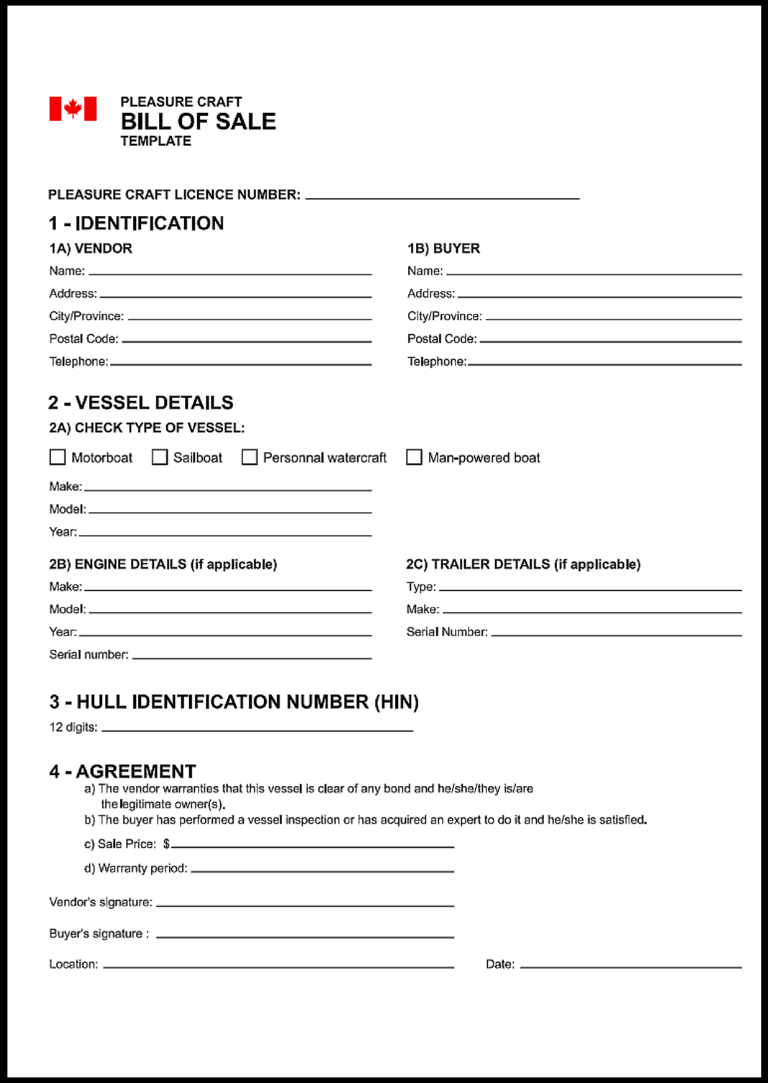
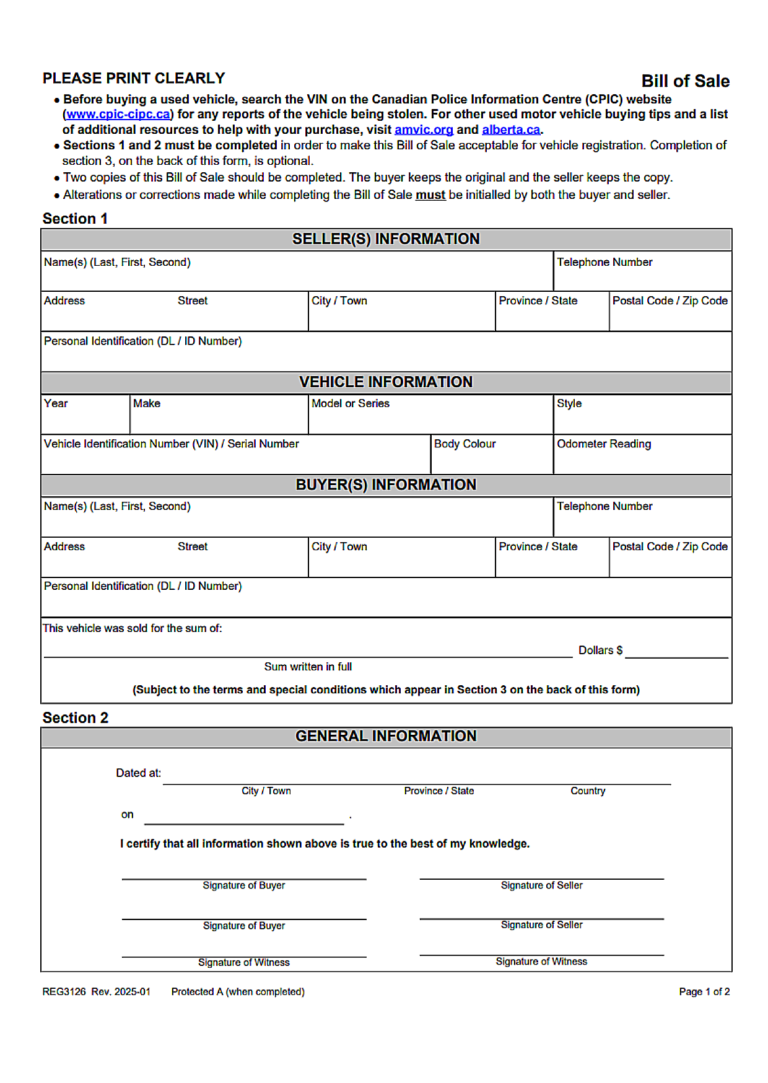
Free British Columbia Trailer Bill of Sale Template
You can copy and use the template below for your private sale. Keep it simple, but make sure all details are filled correctly.
British Columbia Trailer Bill of Sale Laws, ICBC Rules, and PST Requirements
| Topic / Issue | British Columbia Legal Rule | Governing Statute |
|---|---|---|
| Governing legislation for private trailer sales | Private trailer sales are governed mainly by provincial law in British Columbia. | Motor Vehicle Act [RSBC 1996] c. 318; Motor Vehicle Act Regulations; Provincial Sales Tax Act [SBC 2012] c. 35; Personal Property Security Act [RSBC 1996] c. 359 |
| Federal involvement | No federal law directly governs private trailer sales in B.C. | No federal governing statute provided |
| Registered owner requirement | Only the registered owner(s) or authorized agent may sign the transfer documents. | Motor Vehicle Act, s. 17 |
| Witness requirement | No witness is legally required for a private Trailer Bill of Sale in B.C. | Governed by common law principles |
| Notarization requirement | Notarization is not legally required. | Governed by common law principles |
| Age and legal capacity | Parties must be at least 19 years old and mentally capable of contracting. | Age of Majority Act [RSBC 1996] c. 7, s. 1 |
| Transfer deadline | Buyer must register the transfer with ICBC within 10 days of sale. | Motor Vehicle Act, s. 17(1) |
| VIN requirement | The VIN must appear on the Bill of Sale for registration purposes. | Motor Vehicle Act Regulations, B.C. Reg. 26/58 |
| Purchase price disclosure | Purchase price must be clearly stated for PST assessment. | Provincial Sales Tax Act, s. 25 |
| Seller ownership declaration | Sellers commonly state they are the rightful owner and the trailer is free of encumbrances. | Sale of Goods Act [RSBC 1996] c. 410, s. 16 |
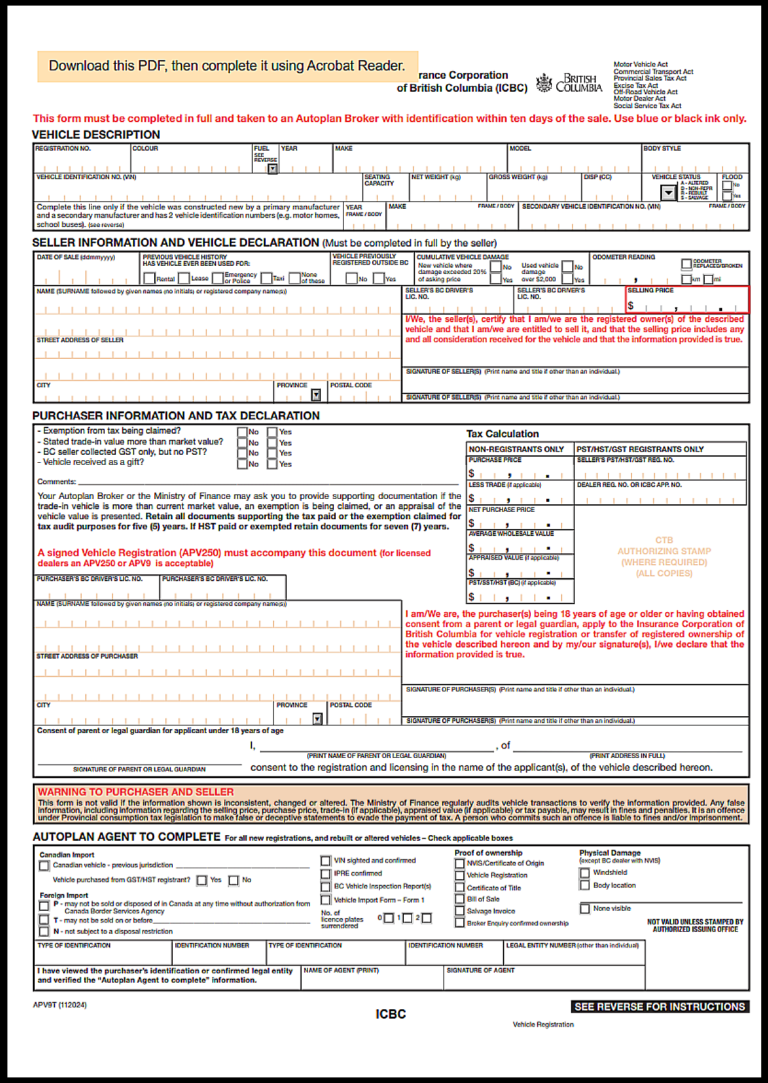
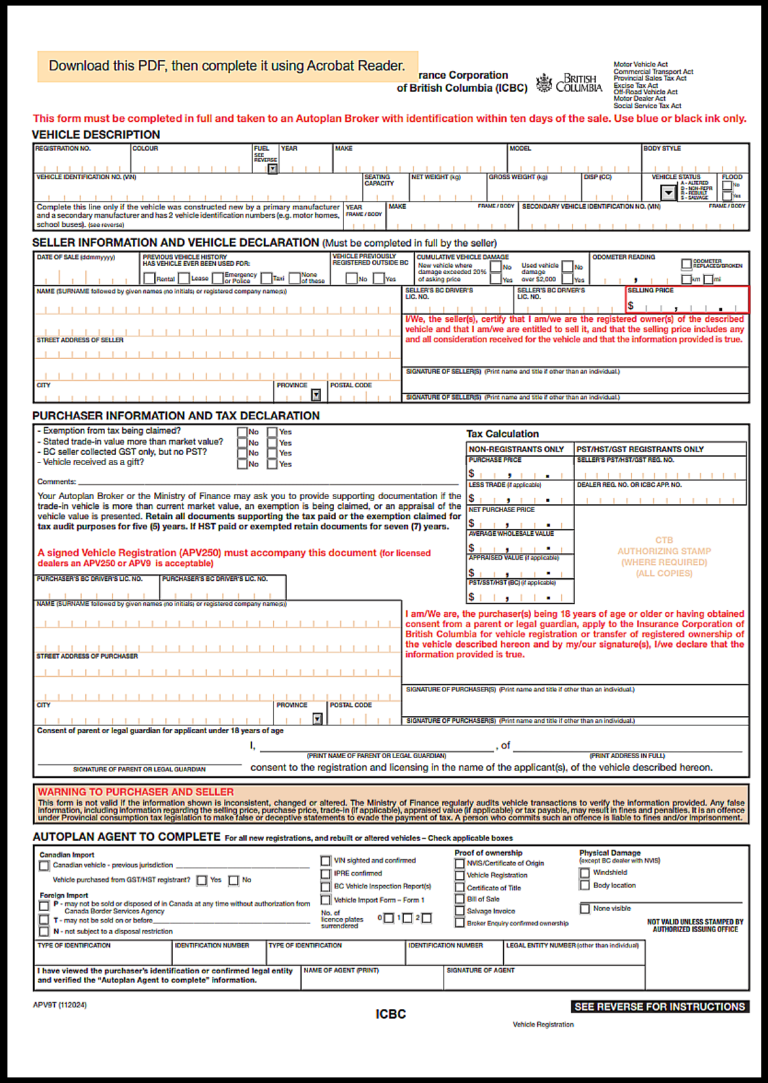
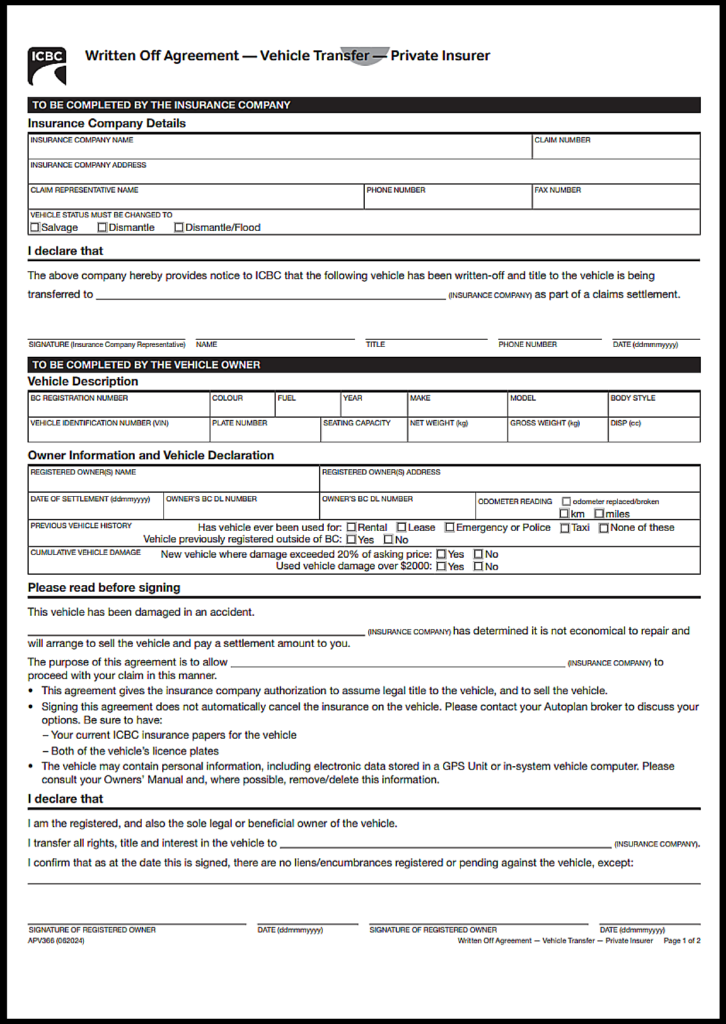
| Registration process | Ownership transfer must be completed through ICBC using Form APV9T. | ICBC administrative requirement tied to Motor Vehicle Act |
| Lien risks | Buyers may lose rights to the trailer if an undisclosed security interest exists against the VIN. | Personal Property Security Act, s. 20 |
| Missing VIN consequences | A missing VIN can make registration impossible and create uncertainty about the trailer being sold. | Motor Vehicle Act, s. 3 |
| Multiple owner signatures | If registration uses “AND,” all registered owners must sign. | Motor Vehicle Act, s. 17 |
| PST on private trailer sales | B.C. applies a 12% PST on many private trailer sales. | Provincial Sales Tax Act, s. 25 |
| Fair market value taxation | ICBC may assess tax using wholesale value instead of the stated purchase price if the amount appears too low. | Provincial Sales Tax Act, s. 25.1 |
| Recent PST amendments | B.C. updated PST valuation rules for used vehicles and trailers, including refinements in June 2025. | B.C. Reg. 64/2025 |
One of the biggest surprises for many buyers in British Columbia is that ICBC may not accept the sale price written on the Bill of Sale for tax purposes. If the amount appears too low, the province can calculate PST using the trailer’s wholesale value instead. This catches many private buyers off guard and can lead to unexpected tax costs during registration.
Another important rule involves liens. Even if a seller hands over the trailer and signs the paperwork, an undisclosed security interest registered against the VIN can still create major problems for the buyer later. In some situations, the buyer could even lose the trailer despite paying for it.
The 10-day ICBC registration deadline also matters more than many people realize. Delays, missing VIN details, or missing signatures from co-owners can slow down registration and create legal headaches. These rules may seem small, but getting them wrong can lead to rejected transfers, tax disputes, or ownership problems. Download the free British Columbia Trailer Bill of Sale template below to help avoid costly mistakes.
A trailer bill of sale helps create a written record of ownership transfer between private parties in British Columbia. For a broader understanding of these legal transfer records, you can review with the guide explaining whether a bill of sale is required in British Columbia.
What Is a Trailer Bill of Sale and Why It Matters
A trailer bill of sale is a legal document that records the transfer of ownership from seller to buyer. Under British Columbia law, especially principles from the Sale of Goods Act, written proof helps confirm that a valid sale took place.
In real life, this document helps you:
- Prove who owns the trailer
- Show how much was paid
- Avoid disputes about condition or payment
- Register the trailer with ICBC
For example, if a buyer later claims the trailer had hidden damage, the “as-is” clause in your bill of sale can protect the seller.
This document is commonly used alongside other transportation-related sale forms depending on the type of asset involved. Vehicle sellers may also need a vehicle bill of sale template, while marine equipment transfers can involve a boat ownership transfer form.
When You Need a Trailer Bill of Sale in British Columbia
In most private sale situations, you should always create a bill of sale. It becomes especially important in these cases:
- Buying or selling a used trailer privately
- Registering the trailer for road use
- Transferring ownership after a gift or trade
- Showing proof for insurance or tax purposes
Even when it’s not legally mandatory, skipping it can cause serious problems later.
Key Details You Must Include (Don’t Skip These)
Accurate Trailer Identification
The VIN is the most important detail. Think of it like a fingerprint for the trailer.
You should include:
- VIN (must match official records)
- Make, model, and year
- Type of trailer (utility, travel, etc.)
If the VIN is wrong or missing, registration can be delayed or rejected.
Buyer and Seller Information
Always use full legal names and correct contact details. This helps if there is any dispute later.
Without this, it becomes difficult to prove who was involved in the sale.
Sale Price and Payment Terms
Clearly write the exact amount paid. Also mention if:
- Payment is full or partial
- Payment method (cash, transfer, etc.)
This is important for tax calculation and legal proof.
Condition and “As-Is” Clause
Most private sales in BC are “as-is.” This means the seller is not responsible for future issues unless they misrepresented the trailer.
Under British Columbia law, sellers are not allowed to lie or hide known defects. But they are not required to provide warranties in private sales.
Before finalizing the transaction, buyers and sellers may also benefit from reviewing the provincial bill of sale requirements to ensure all important ownership details are properly documented.
ICBC and Registration Requirements for Trailers
Trailers must be registered through the Insurance Corporation of British Columbia (ICBC). In most cases, the bill of sale is required as proof of ownership.
Here’s what matters:
- VIN must match all documents
- Buyer must transfer ownership quickly
- Documents must be complete and accurate
If anything is missing, ICBC may refuse registration.
Step-by-Step: How to Transfer Trailer Ownership in BC
Step 1: Complete the Bill of Sale
Fill out all fields clearly. Avoid blanks or unclear writing.
Step 2: Verify VIN and Documents
Check that the trailer matches the paperwork. Even a small mismatch can cause issues.
Step 3: Visit an Autoplan Broker
Submit your documents through an Autoplan broker to register the trailer.
Step 4: Pay Applicable Fees and Taxes
You may need to pay registration fees and Provincial Sales Tax (PST).
Here’s a quick overview:
| Step | What You Do | Why It Matters |
| Fill bill of sale | Record full details | Legal proof |
| Verify VIN | Match trailer & docs | Avoid rejection |
| Visit broker | Register ownership |
Required for road use
|
| Pay taxes | PST and fees |
Legal compliance
|
Taxes on Trailer Sales in British Columbia
In most private sale situations, Provincial Sales Tax (PST) applies.
The tax is usually based on:
- Purchase price, or
- Fair market value (if price seems too low)
Keep your bill of sale safe. It acts as proof of the sale amount and helps avoid tax disputes.
Common Mistakes That Can Cause Problems
Many people make small mistakes that lead to big issues later.
Avoid these:
- Missing or incorrect VIN
- Incomplete buyer or seller details
- Not writing the sale price
- No signatures from both parties
- Relying only on verbal agreements
Even one mistake can delay registration or cause legal trouble.
Legal Risks Without a Proper Bill of Sale
Skipping a bill of sale can create serious risks:
- Ownership disputes
- Liability if the trailer is misused after sale
- Problems registering with ICBC
- Tax penalties or confusion
In simple terms, without this document, you have no strong proof of the transaction.
Buyer vs Seller Responsibilities
Seller Responsibilities
The seller must:
- Provide accurate trailer details
- Disclose known issues honestly
- Sign the document
Buyer Responsibilities
The buyer should:
- Verify the trailer’s condition
- Check VIN carefully
- Complete registration quickly
- Pay required taxes and fees
Here’s a simple comparison:
| Role | Key Responsibility | Risk if Ignored |
| Seller | Honest disclosure | Legal disputes |
| Seller | Correct details |
Invalid document
|
| Buyer | Verify VIN |
Registration issues
|
| Buyer | Pay taxes | Penalties |
Real-Life Example (Simple Scenario)
Imagine you are buying a used utility trailer from a private seller.
The seller gives you a properly filled bill of sale with VIN, price, and “as-is” condition clearly written. After purchase, you register the trailer with ICBC without any issue.
Now compare this to a case where there is no bill of sale. The seller later denies the agreed price, and you cannot prove ownership properly. This leads to delays, stress, and possible financial loss.
This is why proper documentation matters.
Frequently Asked Questions
Is a trailer bill of sale required in BC?
Not always legally required, but strongly recommended in almost all private sales.
Can I write my own bill of sale?
Yes. As long as it includes all key details like VIN, price, and signatures, it is valid.
Does it need to be notarized?
No, notarization is usually not required in British Columbia.
What if the trailer has no VIN?
You may need an inspection or special registration process before ICBC accepts it.
Who keeps the original copy?
Both buyer and seller should keep signed copies for their records.