BC Medical Consent Form (Free PDF & Word Template)
BC Medical Consent Form is a common search for parents, caregivers, and patients preparing for medical treatment who want to understand what documentation may be required before care is provided. In British Columbia, consent to health care is governed by the Health Care (Consent) and Care Facility (Admission) Act, but the province does not prescribe one universal medical consent form for every hospital or clinic.
I’ve seen families arrive for scheduled treatment in Vancouver expecting a generic consent document to be accepted, only to learn the healthcare provider required its own treatment-specific consent form before care could proceed. This page explains how medical consent works in British Columbia, when a consent form may be needed, who can sign it, and the situations where provider-specific forms are required.
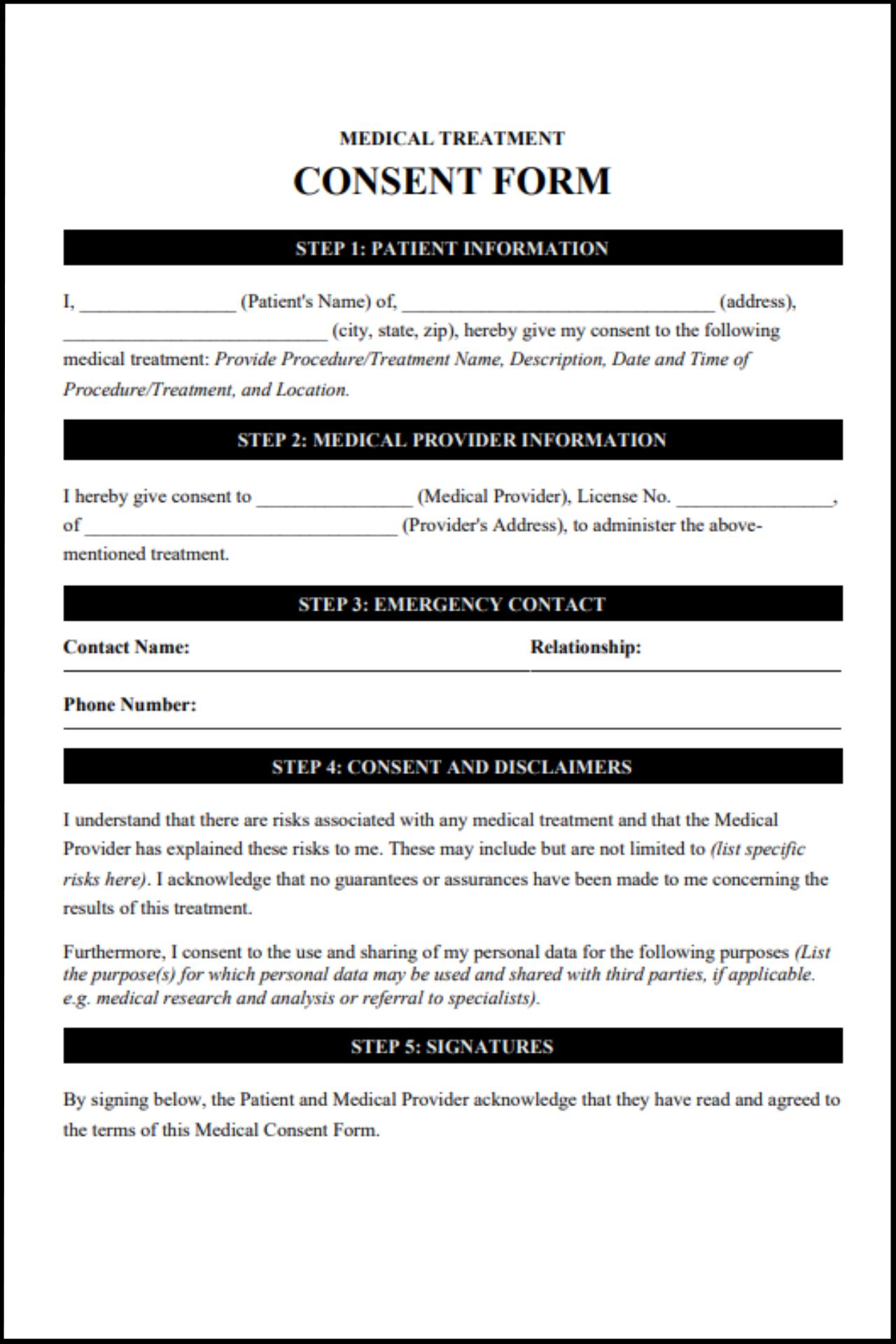
BC Medical Consent Form
Who Can Legally Sign This Form in BC
Under British Columbia law, the person who signs a medical consent form depends on the patient’s age and legal capacity rather than their relationship to the patient. In most situations, a capable adult who understands the nature and consequences of the proposed treatment signs their own consent. If an adult is incapable of making the decision, consent may instead come from a court-appointed Committee of the Person, a Representative appointed under the Representation Agreement Act, or an authorized Temporary Substitute Decision Maker (TSDM) under the Health Care (Consent) and Care Facility (Admission) Act.
British Columbia also has one of Canada’s most distinctive rules for minors. Under section 17 of the Infants Act, there is no fixed age at which a child may consent to medical treatment. Instead, a healthcare provider must determine whether the minor understands the nature, benefits, risks, and consequences of the proposed treatment and whether the treatment is in the minor’s best interests. A capable minor may therefore consent independently, even without a parent’s signature.
For example, a 16-year-old in Kelowna seeking medical treatment may be able to provide their own consent if the healthcare provider determines that the statutory requirements under section 17 of the Infants Act have been met. On the other hand, an unconscious adult in Surrey who has not appointed a Representative may require consent from the appropriate TSDM in the statutory order established by the Act.
Does This Form Need a Witness or Notary?
A standard BC Medical Consent Form does not require a witness or notarization under any British Columbia statute. The validity of consent depends on whether the legal requirements for informed consent have been satisfied rather than whether another person witnessed the signature. As a result, hospitals and clinics generally rely on their own internal procedures for documenting consent instead of requiring a commissioner or notary.
This should not be confused with a Representation Agreement.. If a person appoints someone else to make future healthcare decisions through a Representation Agreement, section 13 of the Representation Agreement Act requires two adult witnesses, or one witness if that witness is a BC lawyer or BC Notary Public. The witnessing rules apply to the Representation Agreement itself, not to an ordinary medical consent form signed before treatment.
A patient attending a clinic in Victoria for a scheduled procedure may therefore be asked to sign the clinic’s consent form immediately before treatment without any witness present. By contrast, someone preparing a Representation Agreement for future healthcare decisions must follow the separate statutory witnessing requirements.
When This Form Is Legally Required
Healthcare providers commonly document consent before treatment involving surgery, invasive procedures, significant risks, or admission to a care facility. Under sections 4–16 of the Health Care (Consent) and Care Facility (Admission) Act, consent must be obtained from the appropriate person before health care is provided unless a statutory exception applies.
A written form is often used because it helps record the discussion between the healthcare provider and the patient. The form itself, however, is only part of the process. Under section 6 of the Act, valid consent requires that:
- The consent relates directly to the proposed health care.
- The patient has received sufficient information about the diagnosis, proposed treatment, material risks, and reasonable alternatives.
- The consent is given voluntarily.
- The patient has had an opportunity to ask questions and receive answers before consenting.
For example, a patient scheduled for surgery in Vancouver may sign a consent form shortly before the procedure. Even with a signed document, the consent may still be ineffective if the patient was never informed of the material risks or given the opportunity to ask questions because the Act requires more than a signature alone.
What Makes This Consent Form Invalid
A BC Medical Consent Form is not valid simply because it has been signed. Under section 6 of the Health Care (Consent) and Care Facility (Admission) Act, consent must satisfy four statutory requirements: it must relate to the proposed health care, be informed, be given voluntarily, and be provided after the patient has had an opportunity to ask questions. A signed form that does not meet those requirements may not amount to valid consent under British Columbia law.
Another common problem occurs when consent is obtained from the wrong substitute decision-maker. If an adult has a valid Representation Agreement or an applicable Advance Directive, a Temporary Substitute Decision Maker (TSDM) cannot override those documents. Relying on substitute consent when a legally effective planning document already exists may invalidate the consent process.
Parents should also be aware that a capable minor’s decision cannot automatically be replaced by a parent’s wishes. Under section 17 of the Infants Act, a healthcare provider may accept consent directly from a mature minor who understands the nature and consequences of the proposed treatment and where the treatment is in the minor’s best interests.
For example, a parent in Surrey may insist on signing a consent form for a 17-year-old receiving treatment. If the healthcare provider determines that the teenager meets the statutory test under the Infants Act, the parent’s signature does not replace the minor’s own decision.
Summary of Applicable Laws
| Topic | Rule | Governing Statute |
|---|---|---|
| Who can consent | Capable adult, mature minor, Representative, or TSDM | Health Care (Consent) and Care Facility (Admission) Act, ss. 4–16; Infants Act, s. 17 |
| Informed consent | Four-part statutory test | Health Care (Consent) and Care Facility (Admission) Act, s. 6 |
| Minor capacity | No fixed minimum age; capacity-based assessment | Infants Act, s. 17 |
| Substitute decision-makers | TSDM hierarchy applies where no valid Representation Agreement exists | Health Care (Consent) and Care Facility (Admission) Act, s. 16 |
| Representation Agreement witnessing | Two witnesses, or one if witnessed by a BC lawyer or BC Notary Public | Representation Agreement Act, s. 13 |
A Mature Minor’s Right to Consent in BC
One feature that makes British Columbia different from many other provinces is that the mature minor doctrine is written directly into legislation rather than relying primarily on common law.
A 16-year-old in Kelowna, for example, may attend a medical appointment without a parent. If the healthcare provider concludes that the teenager understands the treatment, its benefits, risks, and consequences, and believes the treatment is in the young person’s best interests, the teenager may provide valid consent independently under section 17 of the Infants Act.
This differs from several other Canadian jurisdictions where the mature minor principle is based largely on court decisions rather than an explicit statutory provision. British Columbia’s legislation provides clearer guidance for healthcare providers when assessing a minor’s capacity to consent.
Common Mistakes That Invalidate Medical Consent
Many consent problems arise because people focus on completing the paperwork rather than the legal requirements behind it.
Common mistakes include:
- Treating the consent form as a blanket waiver instead of documenting the informed consent discussion required by law.
- Obtaining consent from a Temporary Substitute Decision Maker when a valid Representation Agreement or Advance Directive already governs healthcare decisions.
- Assuming a parent’s signature automatically overrides the decision of a capable mature minor.
- Using a generic consent form without ensuring it reflects the proposed treatment and the healthcare provider’s consent process.
- Assuming every hospital or clinic in British Columbia accepts the same medical consent form.
Frequently Asked Questions
Is verbal consent enough, or do I need this form in writing?
British Columbia law does not require written consent in every situation. However, healthcare providers commonly use written consent forms for treatments involving significant risks or invasive procedures because they help document the informed consent process.
Can my teenager sign their own medical consent form in BC?
Yes. Under section 17 of the Infants Act, a minor who understands the nature, consequences, benefits, and risks of the proposed treatment may provide their own consent if the healthcare provider determines the treatment is in the minor’s best interests.
Who can consent for me if I’m unconscious and have no Representation Agreement?
If you are incapable of consenting and have not appointed a Representative, a Temporary Substitute Decision Maker (TSDM) may provide consent in accordance with the statutory hierarchy under the Health Care (Consent) and Care Facility (Admission) Act.
Does this consent form expire?
There is no statutory expiry period. Consent generally remains effective until it is withdrawn, the treatment changes materially, or the patient’s circumstances require a new consent discussion.
What’s the difference between this and an Advance Directive?
A BC Medical Consent Form authorizes a specific course of medical treatment. An Advance Directive records future healthcare instructions if you later become incapable of making decisions. They serve different purposes under British Columbia law.
Do I need a lawyer to make this form valid?
No. Standard medical consent forms do not require a lawyer, witness, or notarization under British Columbia law. The important requirement is that the consent satisfies the statutory informed consent rules.


