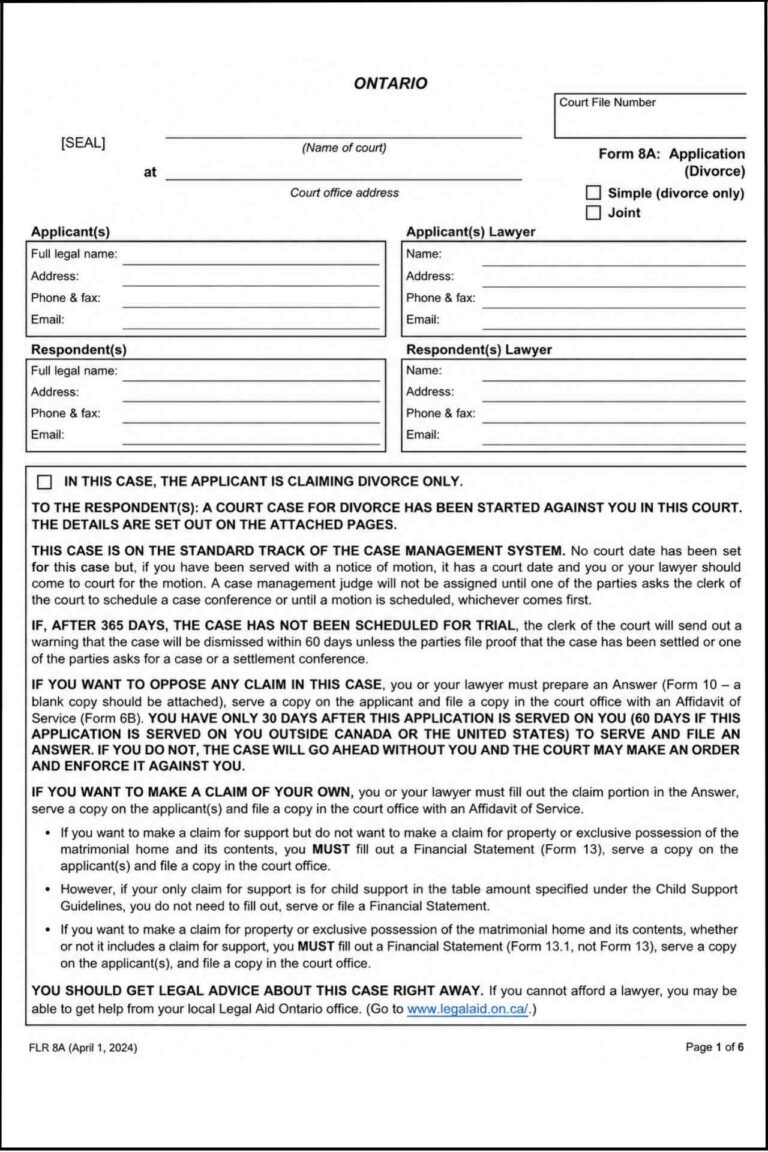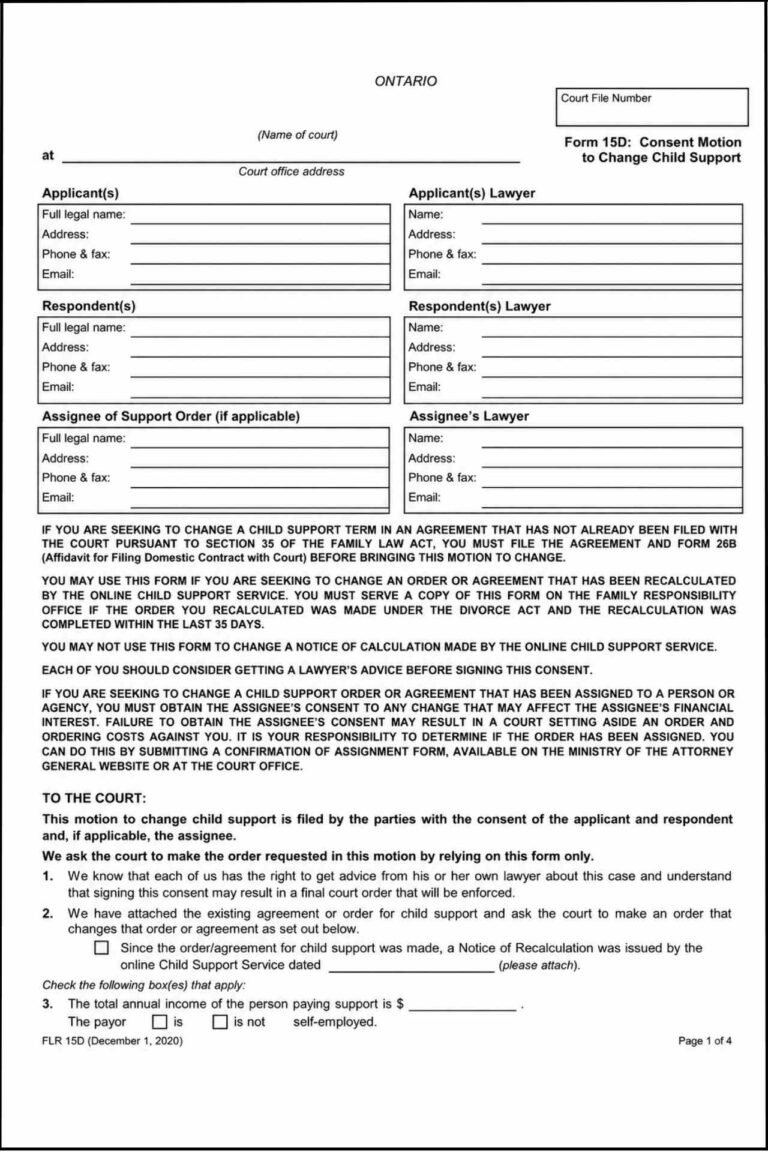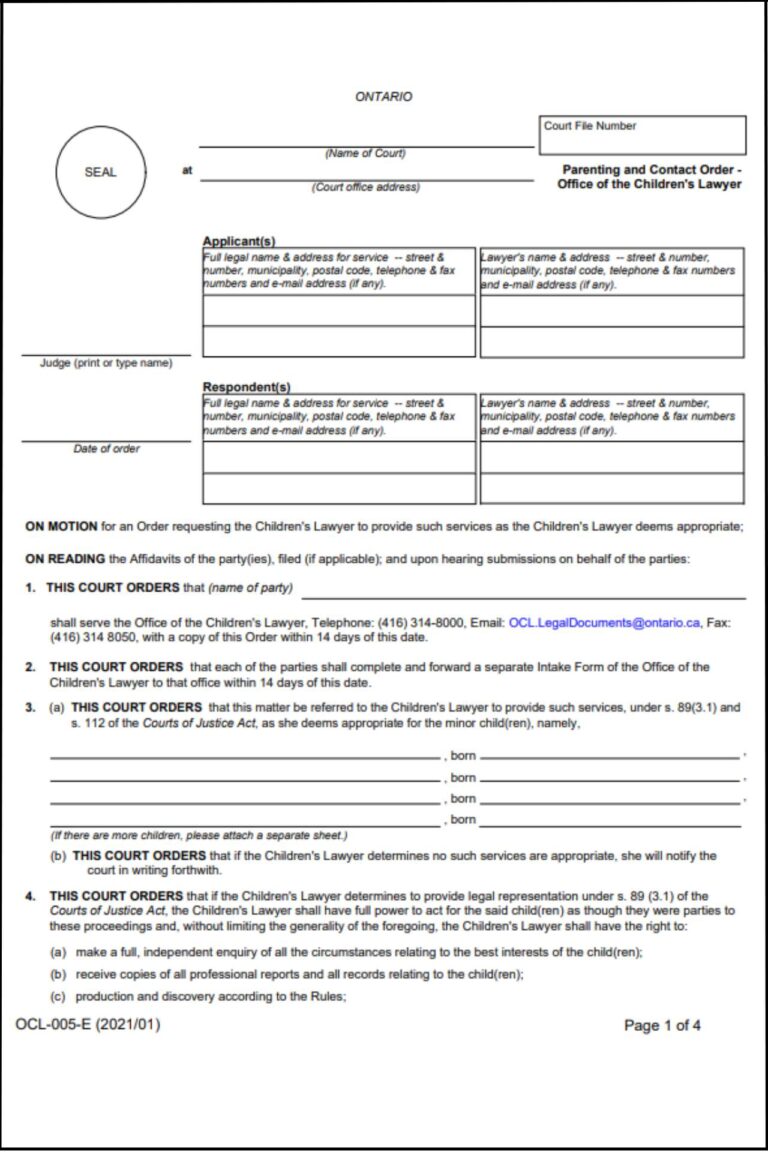
Ontario Child Custody Agreement Template (Editable) | Free PDF
An Ontario Child Custody Agreement can help parents record parenting arrangements after separation, but it’s most useful when it reflects Ontario’s current family law framework and is properly prepared. Since the Children’s Law Reform Act (and the federal Divorce Act) now explicitly utilize the terms “decision-making responsibility” and “parenting time” rather than custody and access, agreements relying on outdated vocabulary or failing to adhere to the Family Law Act’s strict contract execution provisions can cause significant operational friction if a dispute arises.
It’s not unusual to see parents arrive before the Ontario Superior Court of Justice with an informal agreement they assumed would settle future disputes, only to discover the court must determine the parenting issues because the document doesn’t adequately support their position. This page explains what an Ontario child custody agreement should include, how it fits within Ontario’s legal requirements, and the practical steps that can help parents prepare a document that reflects their parenting arrangements.
Table of Contents
ToggleOntario Child Custody Agreement Template
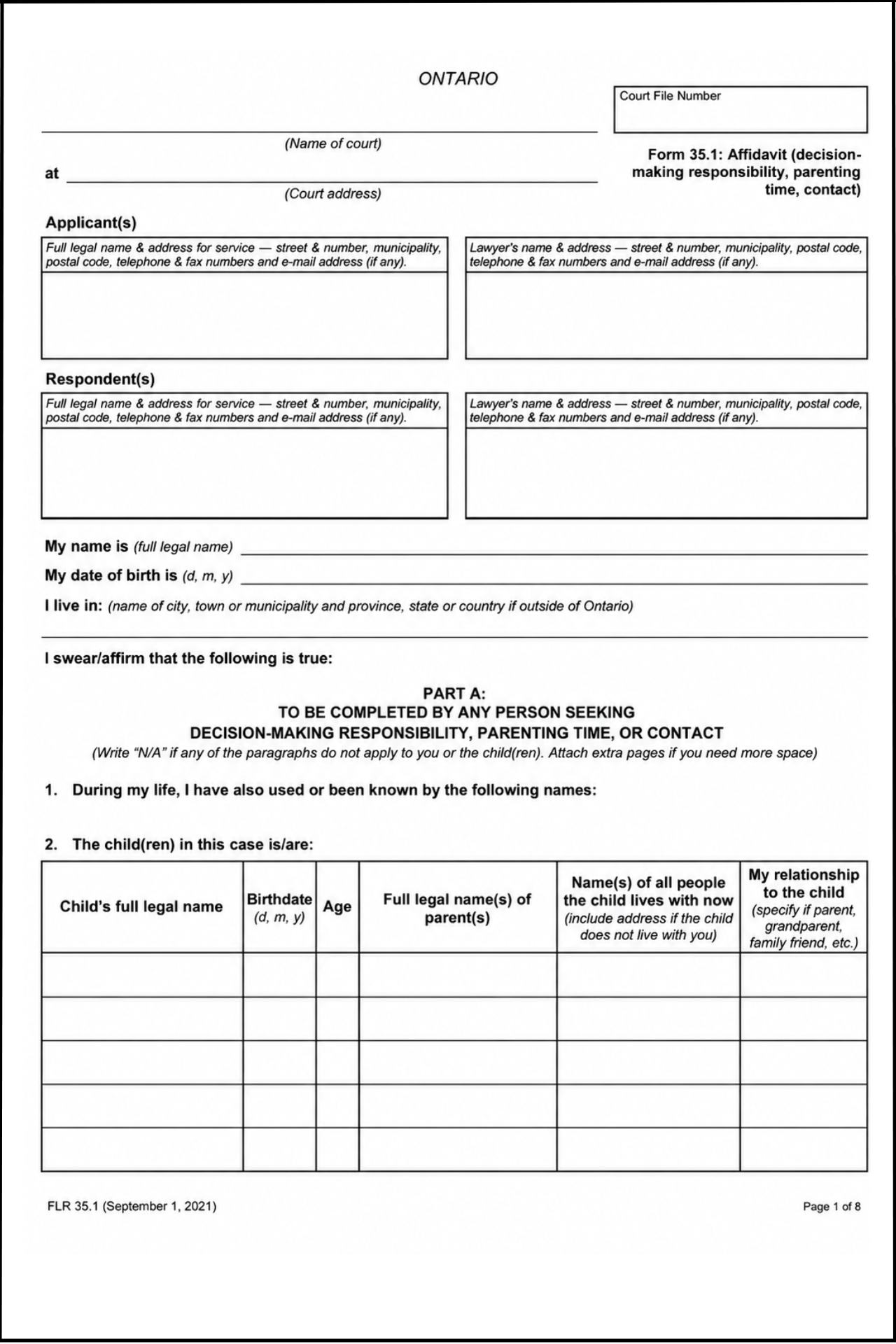
Key Clauses in an Ontario Parenting Agreement
A well-drafted parenting agreement does more than outline where a child lives. It records how parents will make important decisions, share parenting responsibilities, and handle future changes. Under Ontario law, any parenting arrangement must continue to reflect the child’s best interests, so each clause should be practical, specific, and capable of working in everyday life.
Decision-Making Responsibility Clause
Since March 1, 2021, Ontario law no longer uses the term “custody.” Instead, parenting agreements refer to decision-making responsibility, which covers major decisions about a child’s education, health care, religion, and extracurricular activities. These terms are reflected in Ontario’s Children’s Law Reform Act.
For example, separated parents in Ottawa may agree that they will make all major educational and medical decisions together while each parent independently manages routine day-to-day decisions during their parenting time. Recording these responsibilities clearly helps prevent future disagreements.
Under section 20(1) of the Children’s Law Reform Act (CLRA), parents share an equal baseline entitlement to decision-making responsibility. However, a major hidden trap exists under CLRA section 20(4): if parents separate and the child resides primarily with one parent with the other’s implied or explicit consent, the non-residential parent’s right to exercise that decision-making responsibility is automatically suspended by law until a formal separation agreement or court order restores it.
Parenting Time Clause
Parenting time replaces the former legal term “access.” It should clearly explain when the child lives with each parent and how holidays, birthdays, school breaks, and special occasions will be shared.
One of the most common mistakes people make is using vague wording such as “reasonable parenting time.” That often creates uncertainty because each parent may have a different understanding of what is reasonable. A detailed weekly schedule is usually much easier to follow and reduces the likelihood of future disputes.
If the family’s circumstances change significantly, parents can agree to update the schedule or ask the court to determine a new arrangement where necessary.
Relocation Notice Clause
If either parent plans to move with the child, Ontario’s Children’s Law Reform Act includes specific relocation requirements. Parents with decision-making responsibility must generally provide at least 60 days’ written notice in the prescribed form before relocating the child under the Children’s Law Reform Act.
Including a relocation clause in the parenting agreement helps both parents understand what will happen if one parent later accepts employment in another city or decides to move closer to extended family.
Leaving this issue out doesn’t remove the statutory notice requirement. Instead, it often creates unnecessary conflict that may require court intervention before the move can proceed.
Child Support Clause (If Included)
Many parenting agreements also include child support provisions. If child support is addressed, the agreement should clearly identify the payment amount, payment schedule, and any arrangements for special or extraordinary expenses where applicable.
For example, parents in Hamilton may agree that one parent will pay monthly child support while sharing extracurricular expenses separately. Recording these terms reduces misunderstandings later.
If the agreement is eventually filed with the court, child support provisions can be forwarded to the Family Responsibility Office (FRO) for enforcement and collection. Parenting arrangements themselves remain separate from child support obligations, even though both often appear in the same agreement.
What Makes a Parenting Agreement Legally Enforceable in Ontario
Under Ontario law, a parenting agreement is generally valid as a domestic contract when it satisfies the execution requirements found in the Family Law Act, s. 55(1). Simply agreeing verbally is not enough.
To improve enforceability, the agreement should be:
- In writing.
- Signed by each parent.
- Properly witnessed at the time of signing.
Unlike many legal contracts, notarization by a commissioner is not a baseline requirement for the initial document to be valid. However, to file a domestic contract with the Ontario Court of Justice or the Family Court branch of the Superior Court of Justice for enforcement, you must execute and append a commissioned Form 26B (Affidavit for Filing Domestic Contract with Court) rather than a generic affidavit of execution.
Parents sometimes assume downloading a child custody agreement template Ontario is the final step. In practice, execution mistakes are one of the most common reasons agreements become difficult to rely upon later. An unwitnessed agreement, for example, may face unnecessary challenges if one parent later disputes signing it.
Another important limitation is that no agreement can override the child’s best interests. Under Family Law Act, s. 56(1), an Ontario court may set aside any parenting provision that does not adequately protect the child’s welfare, regardless of what the parents originally agreed.
Parents under 18 can also enter into a domestic contract, but under Family Law Act, s. 55(2), court approval is required before the agreement takes effect. This exception does not apply to most parenting agreements but remains an important rule under Ontario family law.
Rights and Obligations of Each Parent Under the Agreement
A parenting agreement gives each parent clear responsibilities while keeping the child’s best interests at the centre of every decision. The agreement should explain who has decision-making responsibility, how parenting time is shared, and how parents will communicate about important issues affecting the child.
Even after signing an agreement, each parent continues to have the right to apply to the court for a parenting order if circumstances change or the existing arrangement no longer works. Parents should also remember that Ontario’s Children’s Law Reform Act specifically allows grandparents to apply for an order respecting decision-making responsibility or parenting time where appropriate.
For example, if grandparents regularly provide childcare and remain closely involved after separation, they may apply to the court if continuing contact is in the child’s best interests. Every case depends on its own facts, and the child’s welfare always takes priority over the parents’ preferences.
What Happens If One Parent Breaches the Agreement
A parenting agreement is initially a private contract between parents. If one parent repeatedly refuses to follow its terms, the agreement does not automatically carry the same enforcement powers as a court order.
Parents can formally file the agreement with the Ontario Court of Justice or the Family Court branch of the Superior Court of Justice using Form 26B. Once filed, support provisions do not automatically migrate to enforcement; the parties must actively complete and submit a separate, formal FRO Registration Package to the Family Responsibility Office to activate administrative collections.
For example, if one parent repeatedly refuses to return the child after scheduled parenting time or stops making agreed child support payments, a court-filed agreement provides stronger enforcement options than relying on a private contract alone.
When You Can Use This Template vs. When You Need a Lawyer
A free parenting agreement template works well for many families who have already reached an agreement and simply want to record it in writing.
You may be able to use this template if:
- Both parents agree on parenting arrangements.
- There are no allegations of family violence.
- The parenting schedule is straightforward.
- Both parents understand their rights and obligations.
- The agreement reflects the child’s best interests.
Professional legal advice is strongly recommended if:
- Parents disagree about decision-making responsibility.
- One parent plans to relocate with the child.
- There are concerns about family violence or coercion.
- Child support or other financial issues are disputed.
- One parent does not fully understand the agreement before signing.
Under Family Law Act, s. 56(4)(b), an Ontario court may set aside a domestic contract if a parent did not understand its nature or consequences or signed under duress. Independent legal advice is not legally required, but it can significantly reduce the risk of future challenges.
Summary of Applicable Laws For Ontario Child Custody
| Topic | Ontario Rule | Governing Statute |
|---|---|---|
| Who can sign | Parents or persons entering a domestic contract relating to parenting matters | Family Law Act, s. 54 |
| Witness requirement | Agreement must be in writing, signed, and witnessed | Family Law Act, s. 55(1) |
| Best interests override | Court may disregard parenting provisions that are not in the child’s best interests | Family Law Act, s. 56(1) |
| Relocation notice | At least 60 days’ written notice in the prescribed form before relocating a child | Children’s Law Reform Act, ss. 39.1–39.4 |
| Agreement set aside | Court may set aside all or part of the agreement for duress or lack of understanding | Family Law Act, s. 56(4)(b) |
Common Mistakes That Get Parenting Agreements Thrown Out
Several common mistakes can create problems if the agreement is later reviewed by an Ontario court.
- Using outdated “custody” and “access” terminology instead of decision-making responsibility and parenting time.
- Preparing only a verbal agreement.
- Failing to have signatures properly witnessed.
- Leaving parenting schedules vague or incomplete.
- Omitting relocation provisions that reflect the Children’s Law Reform Act.
- Signing under pressure or without understanding the agreement’s legal effect.
For instance, parents may prepare an agreement together after separating but never arrange for witnesses. Months later, if disagreements arise, the unwitnessed document may become much more difficult to rely upon in court.
Provincial vs. Federal Rules: Which Law Applies to You
The law that applies depends largely on the parents’ circumstances.
If the parents are unmarried or are married but not seeking a divorce, parenting arrangements are governed by the Children’s Law Reform Act, while the validity of the agreement itself is governed by the Family Law Act.
If married parents are divorcing or already divorced, parenting matters are governed by the Divorce Act, while Ontario’s Family Law Act continues to govern the formal requirements for the domestic contract.
Understanding which legislation applies helps ensure the agreement reflects the correct legal framework before it is signed.
Frequently Asked Questions
Is a child custody agreement legally enforceable in Ontario?
Yes. A properly executed parenting agreement is generally enforceable when it is in writing, signed by both parents, and witnessed in accordance with Family Law Act, s. 55(1). However, a court may set aside any provision that is not in the child’s best interests.
What’s the difference between a parenting agreement and a court order?
A parenting agreement is a private contract between parents. A court order is issued by a judge and carries formal enforcement powers. Parents can later file their agreement with the court if they want additional enforcement options.
Can a parenting agreement be changed later?
Yes. Parents can amend their agreement whenever circumstances change, provided the revised agreement is properly executed. Relocation involving a child must also comply with the notice requirements under the Children’s Law Reform Act.
Do unmarried parents have equal parenting rights in Ontario?
Generally, yes. Under section 20 of the Children’s Law Reform Act, mothers and fathers are equally entitled to decision-making responsibility and parenting time regardless of their marital status.
Can grandparents apply for parenting time?
Yes. Section 21 of the Children’s Law Reform Act specifically allows grandparents to apply to the court for an order respecting decision-making responsibility or parenting time where appropriate.
What can make a parenting agreement invalid in Ontario?
Common reasons include failing to have the agreement properly witnessed, relying on a verbal agreement, signing under duress, or including provisions that conflict with the child’s best interests.