Manitoba Loan Agreement (Free PDF & WORD Template)
A loan between family members, business partners, or even longtime friends often starts with a quick bank transfer and a promise to sort out the paperwork later. That’s usually where the problems begin. I remember meeting with a small contractor in Winnipeg who had advanced money to a supplier on nothing more than text messages and an email saying, “I’ll pay you back soon.” By the time we were involved, neither side agreed on the repayment schedule or whether interest had ever been discussed.
A Manitoba Loan Agreement is commonly used by individuals, private lenders, business owners, and families who want those terms written down before money changes hands. In Manitoba, any court action to recover an unpaid debt is affected by the deadlines set out in The Limitations Act, and waiting too long can leave fewer legal options than people expect. Funny how that catches people off guard.
A repayment dispute can fall apart because the written terms never clearly established when the debt became due, leaving enforcement far more difficult than either side expected. You’re probably lending money because something needs to happen now—a business purchase, a family loan, a renovation, maybe just helping someone out—and there’s not much appetite for drawn-out paperwork.
I handled a file where two siblings argued over a private loan after several years had passed, and one of them ended up absorbing a loss of more than $30,000 because the repayment terms and interest arrangement had never been properly documented. That’s not unusual, actually. Fill in the template with the exact loan amount, repayment schedule, interest terms, and signatures before the funds are advanced.
Free Manitoba Loan Agreement Template
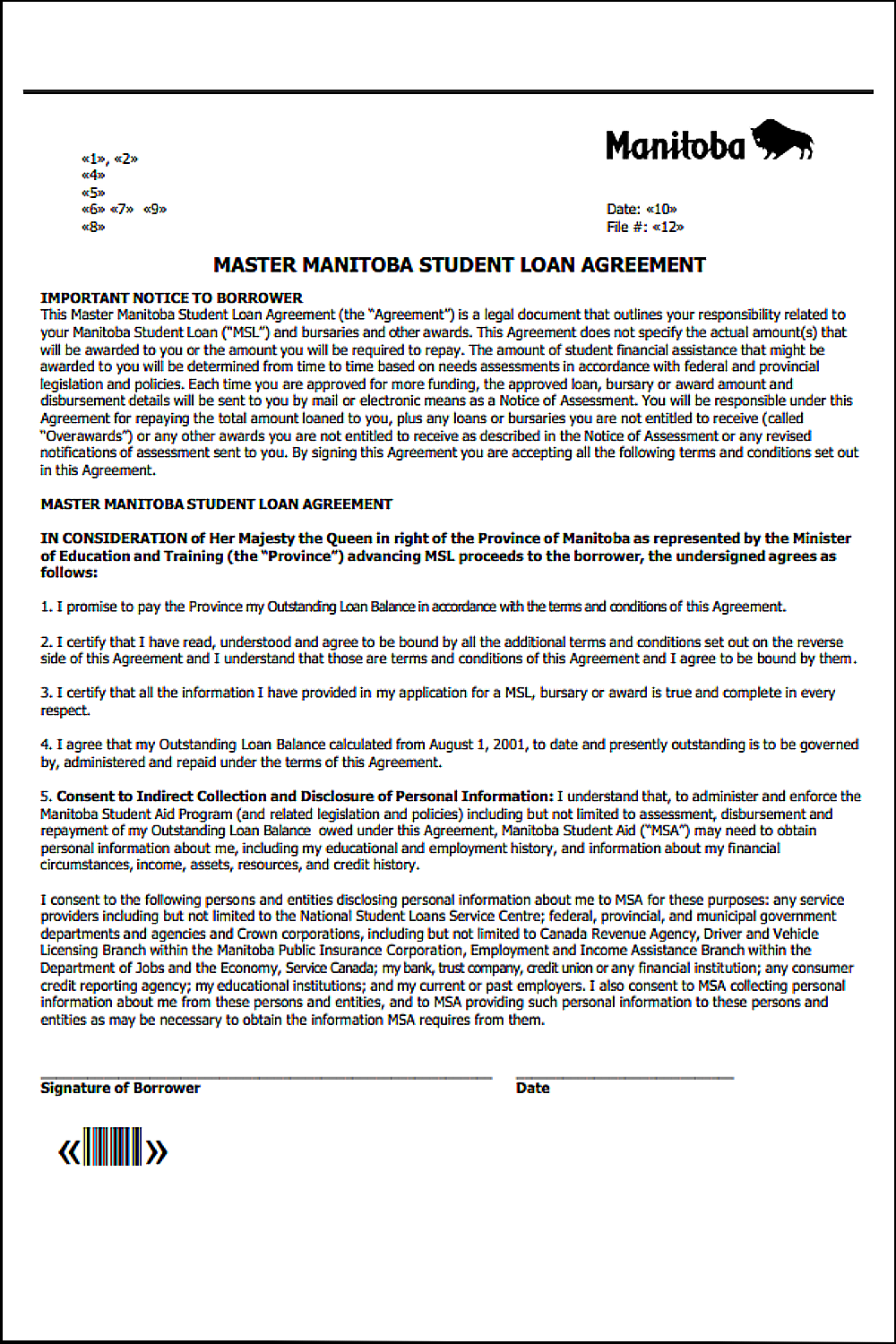
This template is designed for Manitoba private or business lending and can be adapted for secured or unsecured arrangements. Proper drafting matters because unclear or illegal interest clauses may seriously weaken enforcement.
Manitoba Loan Agreement Laws, Interest Rate Limits & PPSA Security Rules
| Topic / Issue | Manitoba Legal Rule | Governing Statute |
|---|---|---|
| Commercial and private loan framework | Manitoba private and commercial loans are governed by common law contract principles and enforcement rules. | Manitoba common law contract principles; The Judgment Act |
| Consumer loan regulation | Personal, family, and household lending transactions are regulated under Manitoba consumer protection law. | The Consumer Protection Act, C.C.S.M. c. C200 |
| Secured personal property loans | Loans secured against personal property are governed by Manitoba PPSA rules. | The Personal Property Security Act, C.C.S.M. c. P35 |
| Interest disclosure requirements | Non-annual interest rates must clearly disclose the equivalent annual rate. | Interest Act, R.S.C. 1985, c. I-15, s. 4 |
| Criminal interest limit | Charging an effective annual interest rate above the federal criminal threshold may violate criminal law. | Criminal Code, R.S.C. 1985, c. C-46, s. 347 |
| Legal signing authority | Individuals with legal capacity and authorized corporate representatives may sign loan agreements. | Manitoba common law principles; The Corporations Act, C.C.S.M. c. C225 |
| Witness requirements | Witnesses are generally not required for unsecured Manitoba loan agreements. | Manitoba common law principles |
| Land-related witness rules | Witnesses may become necessary when loan security involves homestead or land title registration matters. | Manitoba land registration and homestead procedures |
| Notarization requirements | Standard Manitoba loan agreements generally do not require notarization. | Manitoba common law principles |
| Age and legal capacity | ndividuals attain the age of majority at 18 years under Section 1 of The Age of Majority Act, C.C.S.M. c. A7, gaining full legal capacity to sign binding loan agreements and commercial contracts. | The Age of Majority Act, C.C.S.M. c. A7 |
| Lawsuit limitation period | Civil debt collection and loan enforcement claims are restricted to a strict 2-year limitation window starting from the date of discovery under Section 6 of The Limitations Act, S.M. 2021, c. 44. | The Limitations Act, S.M. 2021, c. 44, s. 6 |
| Consumer credit disclosure rules | Consumer loan agreements must clearly disclose APR and total borrowing costs. | The Consumer Protection Act, C.C.S.M. c. C200, s. 4 / s. 34.3 |
| PPSA registration requirements | Lenders securing vehicles, equipment, or inventory should register financing statements through the Manitoba PPR. | The Personal Property Security Act, C.C.S.M. c. P35 |
| Land security registration | Loans secured against land generally require registration through the Manitoba Land Titles Office. | Manitoba Land Titles registration system |
| Illegal interest consequences | Excessive interest charges may invalidate interest provisions or create criminal law exposure. | Criminal Code, R.S.C. 1985, c. C-46, s. 347 |
| Defective APR disclosure consequences | Failure to properly disclose annualized interest may limit recoverable interest to 5% annually. | Interest Act, R.S.C. 1985, c. I-15, s. 4 |
| Consumer disclosure violations | Manitoba courts may reduce or eliminate interest obligations where mandatory consumer disclosures are missing. | The Consumer Protection Act, C.C.S.M. c. C200 |
| Homestead consent requirements | Family-home collateral situations may require separate spousal or common-law partner consent procedures. | The Homesteads Act, C.C.S.M. c. H80 |
One of the most important Manitoba loan agreement rules involves interest disclosure. Many private lenders incorrectly write terms like “3% per month” without converting the rate into an annual percentage. Under federal law, that mistake can severely reduce enforceable interest rights and may even limit recovery to only 5% annually. Manitoba lenders also need to understand the criminal interest rules because charging an effective annual rate above the federal threshold can create major legal and compliance problems.
These rules matter in real life because poorly drafted family loans, private business loans, or secured lending arrangements often lead to disputes years later when memories fade or payments stop. Manitoba’s two-year limitation period also means lenders who wait too long after discovering a default may permanently lose enforcement rights. Secured lenders face additional risks if PPSA registrations are not completed properly, especially when vehicles, equipment, or inventory are used as collateral. Small drafting errors involving APR disclosure, collateral wording, or repayment terms can create expensive enforcement problems later. Download the free Manitoba Loan Agreement template below to help structure your lending agreement correctly.
Why a Written Loan Agreement Matters (Even Between Family or Friends)
Many people assume personal trust is enough when lending money. In practice, that is often where disputes begin.
Verbal loans frequently create confusion over:
- Repayment dates
- Interest expectations
- Whether money was a gift or a loan
- Security rights
- Late payment consequences
Under Manitoba law, written contracts create stronger evidence and clearer enforceability. A proper loan agreement is far more protective than a casual IOU because it addresses legal details courts actually examine.
Common Manitoba Loan Scenarios
Loans often become complicated in situations like:
- Parent-to-child financial support
- Business partner startup funding “e.g.”, When partners are funding a business together, ownership and contribution terms should be set out separately from the loan.
- Contractor equipment purchases
- Emergency personal loans
Clear documentation can protect relationships by reducing uncertainty.
Key Clauses Every Manitoba Loan Agreement Should Include
A strong Manitoba loan contract should clearly define far more than principal alone.
Principal Amount
State the exact amount being loaned.
Interest Rate Disclosure
Federal law creates major risk here. If interest is not properly disclosed annually, enforcement may be limited.
Repayment Schedule
Include:
- Due dates
- Installment amounts
- Lump sum deadlines
- Balloon payments
Default Terms
Businesses should clearly define what happens after missed payments.
Security Clause
If collateral exists, describe it precisely.
Governing Law Clause
State Manitoba jurisdiction clearly.
Interest Rates, APR Rules, and Criminal Limits
Interest mistakes are one of the biggest legal failures in private lending.
Under federal rules active in 2026, the criminal interest ceiling is strictly set at 35% APR for personal loans and small commercial loans up to $10,000, and 48% APR for commercial loans up to $500,000. This metric factors in all administration fees, points, and structural penalties.
Key practical risks:
- Monthly-only interest disclosures without annual equivalents
- Hidden fee structures
- Late penalties pushing effective rates too high
- Vague formulas
Under federal Interest Act rules, failure to properly state annual rates can sometimes reduce enforceable interest dramatically.
Common Interest Mistakes
- “3% monthly” without annual conversion
- Unclear penalty clauses
- Charging fees that effectively create usury risk
Both parties should always understand the true total cost of borrowing.
Secured vs Unsecured Loans (Big Legal Difference)
Not all Manitoba loans carry the same enforcement power.
Unsecured Loans
These are simpler but riskier for lenders because collection often depends on lawsuits or judgments.
Secured Loans
These may involve:
- Vehicles
- Equipment
- Business assets
Under Manitoba law, secured lenders often need proper PPSA registration to protect priority rights.
Real Estate Security
Loans tied to land generally require mortgage or land title processes.
Collateral can strengthen lender rights, but only if documented properly.
Manitoba Consumer Protection Rules
When lending falls into consumer credit territory, Manitoba law may require additional disclosures.
Important issues may include:
- APR disclosure
- Cost of borrowing clarity
- Certain prepayment protections
- Fairness obligations
The rules can differ depending on whether the loan is private, business-related, or part of a lending business.
Default, Enforcement, and Collection Risks
A loan agreement should never assume repayment will always go smoothly.
Common enforcement issues:
- Missed payments
- Demand letters
- Court claims
- Judgment enforcement
- Collateral seizure
Some secured lending situations may also involve seize-or-sue limitations depending on the transaction type.
This is why default language should be practical, lawful, and specific.
Common Loan Agreement Mistakes
Many Manitoba lenders and borrowers create avoidable problems through poor drafting.
Frequent mistakes include:
- Illegal interest rates
- Missing payment schedules
- Vague forgiveness promises
- No collateral details
- No witness
- Weak default clauses
Small drafting problems can create large enforcement problems later.
Family Loans and Informal Lending Risks
Family loans often create the biggest emotional disputes because expectations are rarely documented clearly.
Common family lending problems:
- “I thought it was a gift”
- Estate disputes after death
- Sibling fairness conflicts
- Tax misunderstandings
Recording an outstanding loan and clarifying debts after death helps prevent estate disputes.
A written agreement can protect both financial clarity and personal relationships.
Step-by-Step: How to Fill Out a Manitoba Loan Agreement Properly
- Identify lender and borrower clearly
- State exact principal amount
- Calculate lawful interest properly
- Build a realistic repayment schedule
- Add collateral details if secured
- Include default and dispute terms
- Sign and store copies securely
Payment Disputes, Breach, and Legal Remedies
When payments fail, structure matters.
Manitoba lenders often rely on:
- Demand letters
- Payment renegotiation
- Mediation
- Lawsuits
- Settlements
Borrowers also benefit from clarity because fair written terms can reduce abusive or unclear collection practices.
Practical Loan Clause Comparison
| Clause | Why It Matters |
Common Risk if Missing
|
| Interest Clause | Legal compliance + repayment cost |
Illegal or reduced enforceability
|
| Repayment Schedule | Payment clarity | Date disputes |
| Security Clause | Collateral rights |
Weak lender protection
|
| Default Terms | Enforcement roadmap |
Collection confusion
|
| Witness | Better evidence |
Harder dispute proof
|
FAQ
Is a witness required for a Manitoba loan agreement?
No, not generally by statute, but it is strongly recommended for evidence.
What interest rate is legal in Canada?
Federal criminal law limits excessive effective annual rates.
Can I secure a private loan with a vehicle?
Yes, but proper security registration may be necessary. If the deal also involves transferring ownership of the vehicle, that change should be documented separately.
Are family loans enforceable?
Yes, if properly documented and legally valid.