Fillable Manitoba Boat Bill of Sale Template & Free PDF
A Manitoba Boat Bill of Sale does more than record the purchase price of a vessel—it often becomes the document relied upon to prove ownership when licence or registration records need to be updated. One mistake I see regularly is buyers relying on a generic receipt that doesn’t include the Hull Identification Number, licence details, or a clear description of the boat, leaving them scrambling for additional evidence later.
Because Transport Canada requires satisfactory proof of ownership when a pleasure craft changes hands, missing information can create delays and extra paperwork that could have been avoided from the start. In practice, I’ve seen transactions stall after a used boat sale because the paperwork couldn’t adequately connect the vessel being transferred to the parties named in the document.
Whether you’re selling a fishing boat, personal watercraft, or larger recreational vessel, this page explains the information a Manitoba boat bill of sale should contain, when additional ownership documents may be needed, and how to complete the transfer process with confidence.
Last Updated: October 2026
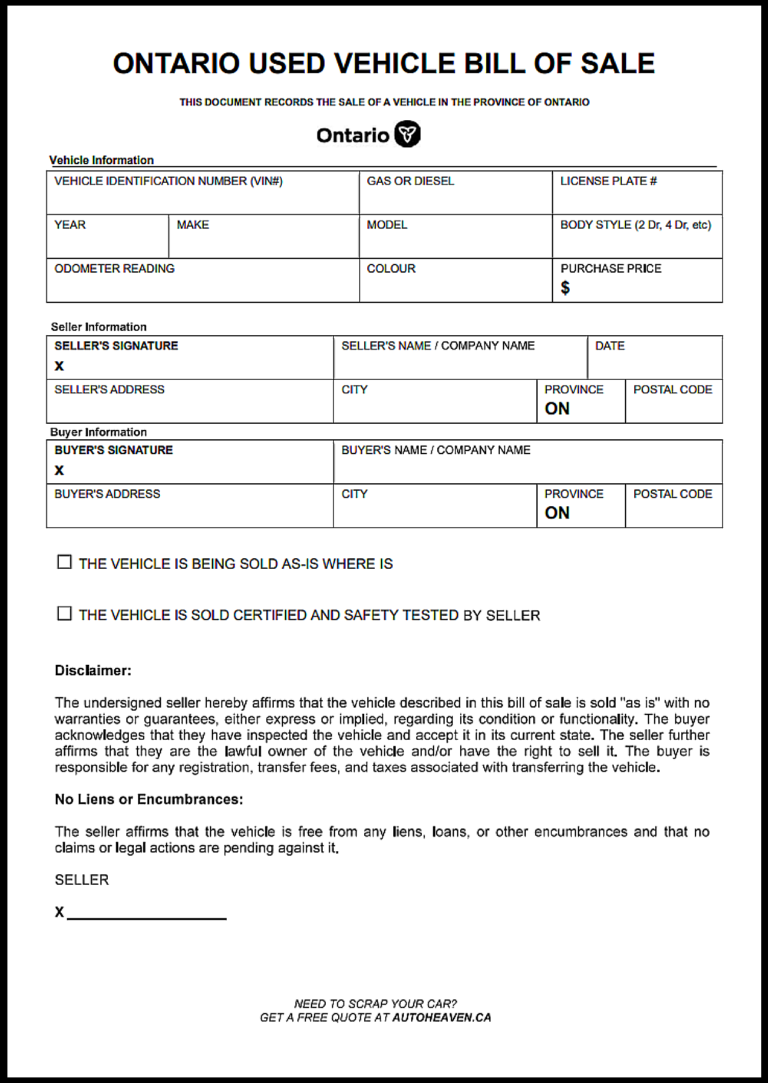
Free Boat Bill of Sale Template (Manitoba)
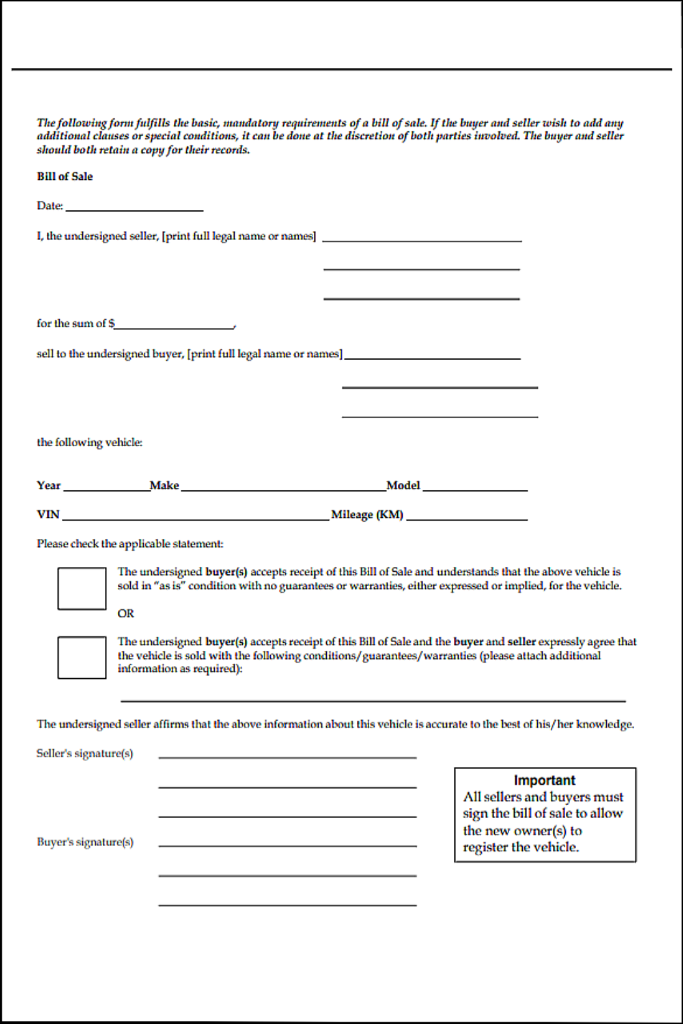
This template is designed for Manitoba private sales and includes key details commonly needed for ownership transfer, licensing, and tax purposes.
Manitoba Boat Bill of Sale Laws, Licensing Rules & Ownership Transfer Requirements
| Topic / Issue | Manitoba Legal Rule | Governing Statute |
|---|---|---|
| Provincial contract law | Private boat sales in Manitoba may be governed by The Sale of Goods Act, together with other applicable contract and consumer-protection rules, depending on the transaction. | The Sale of Goods Act, R.S.M. 1987, c. S10 |
| Consumer dealer transactions | Manitoba consumer-protection rules may apply to a boat purchase from a commercial dealer, depending on the transaction and applicable statutory provisions. | The Consumer Protection Act, C.C.S.M. c. C200 |
| Federal vessel regulation | Federal law governs Pleasure Craft Licensing and Canadian vessel registration. These are separate systems, and a Pleasure Craft Licence is not proof of ownership. | Canada Shipping Act, 2001 and Small Vessel Regulations |
| Pleasure Craft Licence transfer deadline | If you acquire a pleasure craft that already has a Canadian Pleasure Craft Licence, you must transfer the licence into your name within 30 days of the ownership change. | Small Vessel Regulations, s. 103 |
| Legal signing authority | Confirm that the person signing has authority to sell the vessel and transfer the interest being sold. Requirements can depend on the ownership structure and the type of vessel registration. | Applicable federal vessel-registration rules and Manitoba contract law |
| Witness requirements | Do not assume that the same signing requirements apply to every vessel sale, licence transfer, or registered-vessel transaction. Check the requirements for the particular process. | Confirm applicable requirements for the transaction |
| Notarization requirements | A routine bill of sale may be accepted as proof of ownership for a Pleasure Craft Licence application. Transport Canada may require a declaration under oath in specified circumstances; other vessel-registration requirements may differ. | Transport Canada: Before you apply |
| Age and mental capacity | In Manitoba, the age of majority is 18. Contractual capacity depends on the circumstances and applicable law; age alone does not resolve every capacity question. | The Age of Majority Act |
| Required ownership details | For a Pleasure Craft Licence transfer, Transport Canada asks for proof of ownership identifying the seller and buyer, describing the craft, and including the HIN if available and the existing PCL number if applicable. | Transport Canada: Before you apply |
| Federal licensing filing | Submit the required application and proof-of-ownership documents through Transport Canada’s current Pleasure Craft Licence application process. | Transport Canada: How to apply |
| Trailer registration requirements | A trailer included in the sale may require separate registration and ownership documents through Manitoba Public Insurance. Confirm the current requirements for the specific trailer before completing the transaction. | Manitoba Public Insurance |
| Manitoba Retail Sales Tax | Manitoba’s general Retail Sales Tax rate is 7%, but whether RST applies to a private boat or trailer transaction, and how taxable value is determined, must be confirmed under the applicable Manitoba tax rules. | Manitoba Retail Sales Tax |
| Lien search recommendation | Before buying, confirm the appropriate registry and search method for any security interest that may affect the vessel or trailer. If you cannot determine the correct search, obtain advice before completing the purchase. | Manitoba legislation |
| Missing HIN consequences | A missing, damaged, or inconsistent HIN can complicate identification and a Pleasure Craft Licence application. Transport Canada requests the HIN if available; contact the licensing office if the number is missing or cannot be verified. | Transport Canada: Before you apply |
| Missing co-owner signatures | Where a vessel has multiple owners, confirm who owns the interest being sold and which signatures the applicable transfer process requires. Requirements differ according to the type of vessel ownership and registration. | Transport Canada vessel-registration guidance |
| Missing or unclear purchase price | An unclear purchase price or incomplete transaction terms can create disputes. Under section 10 of Manitoba’s Sale of Goods Act, a reasonable price may be payable where the price is not otherwise determined in accordance with the Act. | The Sale of Goods Act |
| Manitoba split registration system | Pleasure Craft Licensing and Canadian vessel registration are federal processes. A trailer may require separate provincial registration through Manitoba Public Insurance, and applicable tax obligations should be confirmed separately. | Canada Shipping Act, 2001 and Manitoba Public Insurance |
| “As-is” clause limitations | An “as-is” clause records the parties’ agreement about the boat’s condition, but its legal effect depends on the contract and applicable law. Do not assume it automatically excludes every claim involving misrepresentation or other legally actionable conduct. | The Sale of Goods Act |
One of the biggest surprises for Manitoba boat buyers is that the boat and trailer are not handled through one simple system. Pleasure Craft Licensing and Canadian vessel registration are federal processes, while a trailer may require separate provincial registration through Manitoba Public Insurance. If the bill of sale includes both items, identify each one separately and record the agreed price allocation where appropriate. Confirm the applicable tax treatment before relying on a calculation.
The Hull Identification Number (HIN), when available, helps identify the vessel. If it is missing or inconsistent, contact Transport Canada about the appropriate next step.
If you buy a pleasure craft that already has a Canadian Pleasure Craft Licence, transfer the licence into your name within 30 days of the ownership change. Keep the signed bill of sale and supporting ownership records together because Transport Canada requires proof of ownership for the application. If there are multiple owners, confirm which signatures the applicable transfer process requires before completing the sale. A bill of sale documents the transaction, but it is not itself a Pleasure Craft Licence or proof that the licence has been transferred.
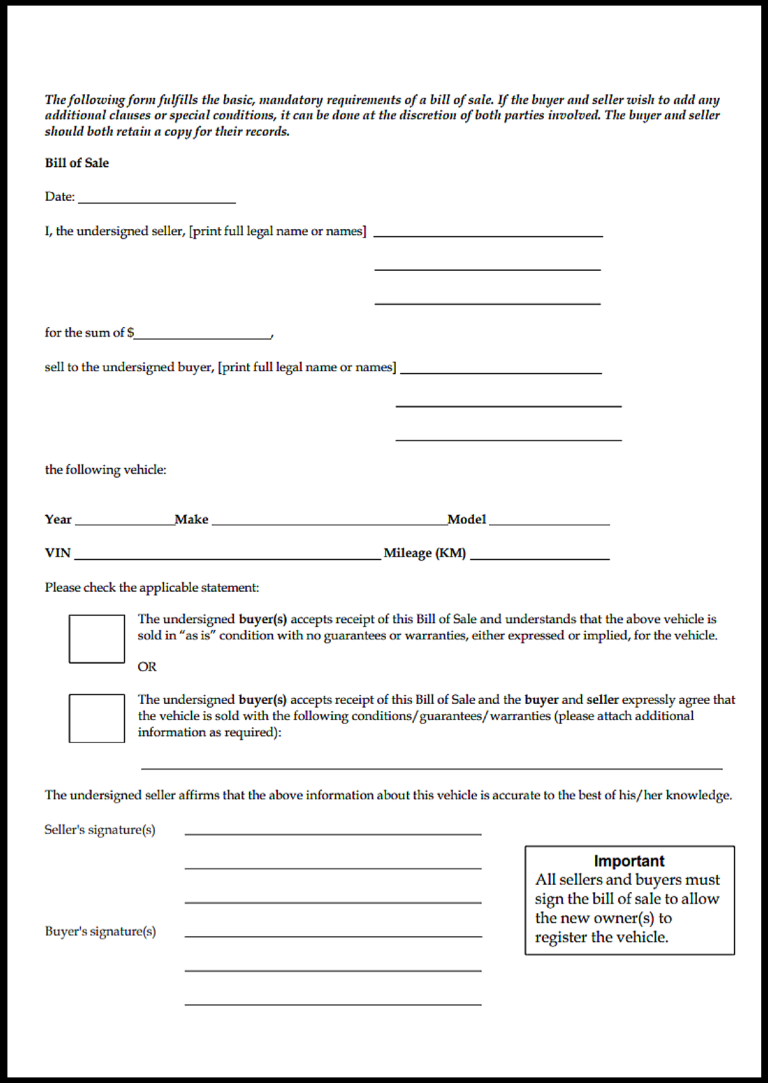
Download the free Manitoba Boat Bill of Sale template below to record the transaction details.
A boat bill of sale helps document ownership transfers involving watercraft and marine equipment in Manitoba. To better understand how these legal records are used during private transactions, you can review the main Canadian bill of sale guide together with the guide explaining how to write a bill of sale in Manitoba.
Why a Boat Bill of Sale Matters More Than a Receipt
A basic receipt may show payment, but it may not describe the vessel or record the full terms of a private boat sale.
For a Manitoba private sale, a written bill of sale records the agreed transaction and can serve as proof of ownership when applying to transfer a Pleasure Craft Licence. Transport Canada asks for the parties’ details, a description of the craft, and the HIN if available. Keep a signed copy with the other purchase records.
Under Manitoba law, this document can help record:
-
Proof of purchase
-
Identity of the vessel
-
Sale terms
-
Condition disclosures
-
Evidence of the transaction for ownership paperwork
In a private sale, keep the bill of sale because it may support a federal licensing application and help document the transaction for tax or registration questions. Confirm the requirements that apply to your particular vessel.
Private Sale vs Dealer Sale
A dealer may provide more formal sales documentation and handle some transaction paperwork. In a private sale, the buyer and seller should agree in writing on the vessel, price, included equipment, and delivery terms, then confirm the applicable licensing, registration, and tax requirements separately.
| Type | Main Difference |
| Dealer Sale |
A dealer may provide formal sales paperwork and may collect applicable taxes where required.
|
| Private Sale |
The buyer and seller should document the terms and confirm the paperwork, tax, and transfer steps that apply.
|
Federal Pleasure Craft Licence Transfer
If you acquire a pleasure craft that already has a Canadian Pleasure Craft Licence, you must transfer the licence into your name within 30 days of the ownership change. Follow Transport Canada’s current application instructions and provide the required proof of ownership.
Without proper documentation:
-
Licensing may be delayed
-
Records may not be updated promptly
-
A later sale or licence update may require additional paperwork
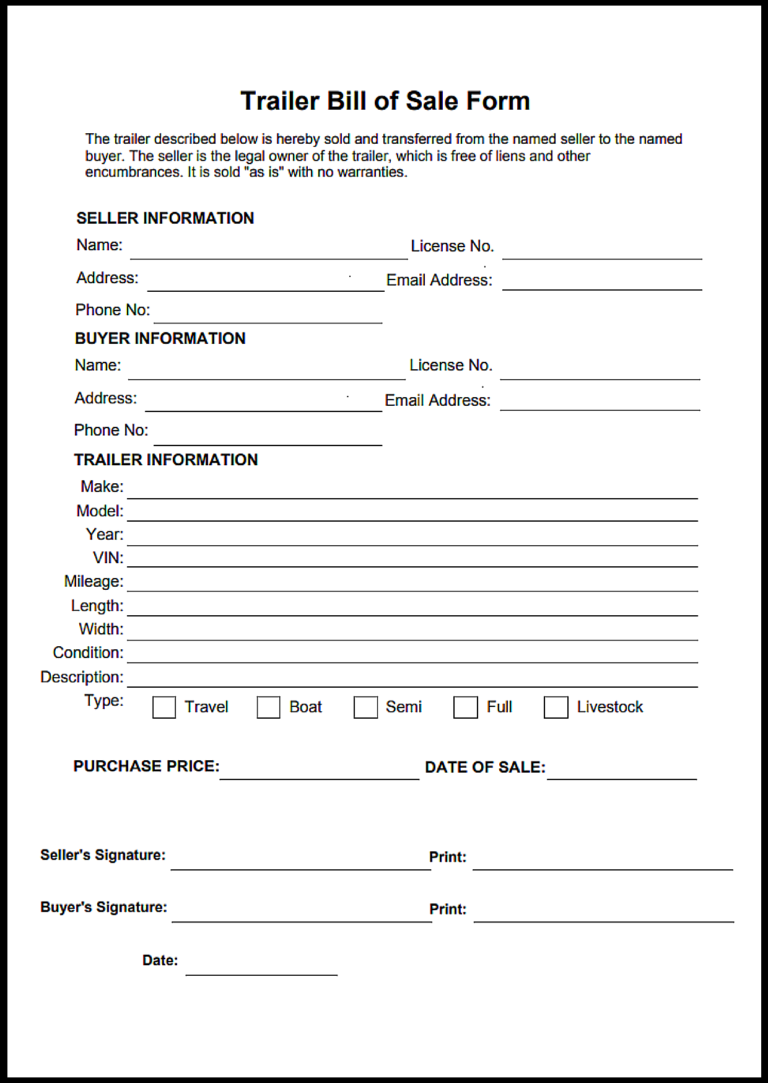
Boat transactions may also involve related transportation paperwork depending on the equipment included in the sale. Trailer transfers may require a trailer bill of sale template, while broader transportation asset sales commonly use a vehicle ownership transfer document.
Key Boat Details You Must Never Leave Out
Check the identifying details carefully before signing. A mismatch between the boat and the available documents can complicate a later licensing application.
Hull Identification Number (HIN)
The HIN, when available, helps identify the vessel. Transport Canada asks for it as part of the proof-of-ownership information for a Pleasure Craft Licence application.
Why it matters:
-
Helps identify the vessel
-
Supports document checks
-
May assist with licensing
-
Can help flag a possible identification discrepancy
If the HIN is missing, altered, damaged, or inconsistent with the documents, do not guess at the number. Ask Transport Canada how to proceed and resolve any discrepancy before relying on the paperwork.
Pleasure Craft Licence (PCL) Number
Include the existing PCL number if the craft has one. The number helps identify the licence record, but a Pleasure Craft Licence is not proof of ownership.
Boat + Motor + Trailer Breakdown
If the sale includes a boat, motor, and trailer, identify each item in the bill of sale. Record separate prices where appropriate so the parties have a clear record of what was included and can confirm the applicable tax and registration treatment.
Separate pricing may help with:
-
Tax questions
-
Trailer registration
-
Clear identification of included property
Seller Ownership Confirmation
Before paying, confirm:
-
Seller identity
-
Available evidence of ownership
-
Whether there may be a security interest affecting the property
When selling used watercraft privately, parties may also use an as-is bill of sale form to record the boat’s described condition and the terms agreed by the parties. The effect of an “as-is” clause depends on the contract and applicable law.
Trailer Included? Manitoba Buyers Often Miss This
If the sale includes a trailer, identify it separately in the bill of sale and record its VIN or other identifying details. Confirm with Manitoba Public Insurance which ownership and registration documents are required for that trailer, and verify any applicable tax before completing the transaction.
A trailer may involve:
-
A separate VIN
-
Separate registration
-
Manitoba Public Insurance paperwork
-
Tax treatment that differs from the vessel
Common Mistake
Combining the boat and trailer price into one number can make it harder to identify what was sold and determine the applicable registration or tax treatment.
This may lead to:
-
Tax questions
-
Registration delays
-
Disputes about the value allocated to each item
List the boat and trailer separately and record the agreed price allocation where appropriate. Confirm tax requirements with the relevant authority.
Taxes, Fees, and Government Filing Steps
Federal Licensing Transfer
If the craft already has a Canadian Pleasure Craft Licence, the buyer must transfer the licence within 30 days of the ownership change. Check Transport Canada’s current application requirements and provide the necessary proof of ownership.
Manitoba Retail Sales Tax
Manitoba’s general Retail Sales Tax rate is 7%, but whether RST applies to a particular private boat or trailer transaction, and how the taxable value is determined, must be confirmed under the applicable Manitoba tax rules. Check with Manitoba Finance before relying on a tax calculation.
Important Warning
Do not deliberately misstate the sale price or provide inaccurate information to a government authority. The tax consequences of a transaction depend on the applicable rules and facts. Confirm the correct reporting requirements with Manitoba Finance rather than assuming that a particular penalty or reassessment will automatically apply.
Trailer Registration
If a trailer is included, its registration may need to be handled separately through Manitoba Public Insurance. Confirm the current requirements for the specific trailer and bring the ownership documents requested by MPI.
Large Vessel Registry
Some vessels may fall under Canadian vessel registration rather than the Pleasure Craft Licence system. These are separate federal processes. Check Transport Canada’s vessel-registration guidance to determine which system applies to the vessel being sold.
“As-Is” Clause Explained (Seller Protection vs Buyer Risk)
“Sold as is, where is” is wording sometimes used in private sales to record that the buyer has considered the property’s condition.
What It Means
An “as-is” clause records the parties’ agreement about the boat’s condition. Its legal effect depends on the wording of the contract and applicable law. Do not assume that it automatically excludes every claim involving misrepresentation or other legally actionable conduct.
Important Legal Limit
Sellers should not:
-
Make false claims about ownership
-
Engage in fraud
-
Misrepresent material facts about the boat
Fraudulent misrepresentation can have legal consequences. If a significant defect or dispute is involved, obtain legal advice rather than relying on a general “as-is” phrase.
Practical Buyer Inspection Tips
Before purchase:
-
Compare the HIN with the available documents, if the number is present
-
Review the existing PCL details, if applicable
-
Inspect the hull
-
Test the motor where practical
-
Verify the trailer VIN if a trailer is included
Common Fraud Risks and Legal Red Flags
Before paying, check that the seller can provide credible ownership evidence and that the boat’s identifying details match the available documents. Investigate altered identification numbers, unexplained ownership gaps, and possible security interests before proceeding. A PCL number alone does not prove ownership.
Common Red Flags:
-
HIN tampering
-
Possible security interests or liens
-
Inconsistent ownership records
-
Missing or altered identification information
-
Inaccurate transaction or tax information
-
Signs that the vessel may be stolen
Fraud Prevention Checklist
-
Confirm the appropriate registry and search method for any security interest that may affect the vessel or trailer. You can begin by reviewing the Teranet Manitoba Personal Property Registry, but make sure the search covers the relevant property and debtor.
-
Compare the HIN with the boat and available documents, if the number is present.
-
Review the PCL details if the craft is licensed.
-
Confirm the seller’s identity.
-
Ask for available maintenance and ownership records.
Buyer vs Seller Responsibilities
Seller Duties
Before completing the sale, the seller should:
-
Provide accurate information about the boat and included equipment
-
Provide available ownership documents
-
Disclose known information about liens or security interests accurately
-
Avoid false or misleading statements
Buyer Duties
Before completing the purchase, the buyer should:
-
Check the available ownership evidence
-
Investigate possible liens or security interests where appropriate
-
Confirm applicable tax obligations
-
Transfer an existing PCL within the required 30-day period
Before signing, both parties should check that the boat description, price, included equipment, transfer date, and party details are correct. Keep a signed copy of the completed bill of sale.
Notarization Myths (Do You Need a Witness?)
A bill of sale is an accepted form of proof of ownership for a Pleasure Craft Licence application. If you lack other proof of ownership, Transport Canada may require a declaration under oath. Check the requirements for your specific application and do not assume that rules for a routine licence transfer also apply to vessel registration.
Why Signatures Still Matter
Signed documents help:
-
Record the parties’ agreement
-
Reduce uncertainty about the terms
-
Support later licensing or ownership paperwork
Confirm any witnessing, commissioning, or notarization requirements that apply to the specific transfer process before signing.
Step-by-Step: How to Complete a Manitoba Boat Bill of Sale Properly
Practical Checklist
| Step | Action |
| 1 |
Gather the available ownership documents.
|
| 2 |
Check the HIN and existing PCL details, if applicable.
|
| 3 |
Identify the boat, motor, and trailer separately and record the agreed price allocation where appropriate.
|
| 4 |
Include an “as-is” clause only if it accurately reflects the parties’ agreement; do not treat it as a substitute for accurate disclosures.
|
| 5 |
Have the parties sign the completed document and keep copies.
|
| 6 |
Confirm the applicable tax, trailer-registration, and federal licensing steps.
|
Before handing over payment, check that the bill of sale is complete and signed, retain copies of the ownership records, and confirm the required Transport Canada application documents. If a trailer is included, verify its separate registration and tax requirements before treating the entire transaction as complete.
Common Mistakes That Cause Problems
Before completing the sale, verify the vessel’s identifying details, the seller’s ownership evidence, the agreed transaction terms, and the applicable licence-transfer deadline.
-
Missing or inconsistent HIN details, where a HIN is available
-
Unclear allocation of the price between the boat and trailer
-
Failure to investigate possible security interests
-
Incorrect assumptions about tax value or tax applicability
-
Failure to transfer an existing PCL within 30 days
-
Vague descriptions of the boat or included equipment
FAQ
Is a boat bill of sale legally required in Manitoba?
A bill of sale is an accepted form of proof of ownership for a Pleasure Craft Licence application. Transport Canada may accept other documents in appropriate circumstances, but buyers should keep a signed bill of sale and supporting ownership records.
Do I need to transfer the Pleasure Craft Licence?
If you acquire a pleasure craft that already has a Canadian Pleasure Craft Licence, you must transfer the licence into your name within 30 days of the ownership change. Follow Transport Canada’s current application instructions.
Is RST payable on private boat sales?
It depends on the transaction and the applicable Manitoba tax rules. Manitoba’s general RST rate is 7%, but confirm whether the tax applies and how the taxable value is determined with Manitoba Finance.
What if the boat has a trailer?
Identify the trailer separately in the bill of sale and record its VIN or other identifying details. Confirm the trailer’s registration requirements with Manitoba Public Insurance and check the applicable tax treatment.
Should I check for liens first?
Yes. Before paying, confirm the appropriate registry and search method for any security interest that may affect the boat or trailer. If you are unsure which search applies, obtain advice before completing the purchase.