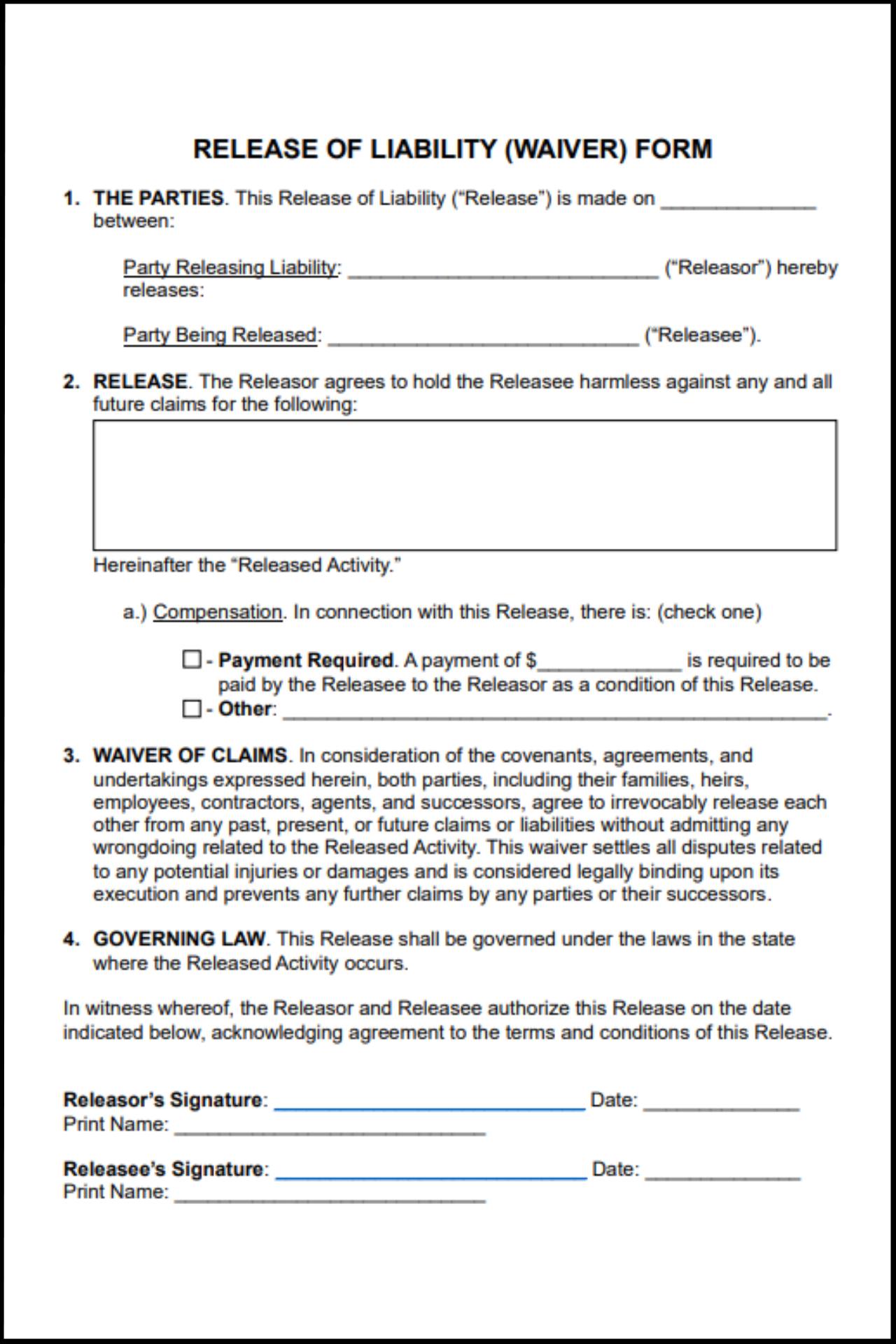
BC Liability Waiver Template (PDF & Word)
BC Liability Waiver Template is often searched by businesses, organisations, and event organisers who want participants to acknowledge the risks of an activity before it begins. In British Columbia, an occupier’s ability to limit liability depends not only on the wording of the waiver but also on whether reasonable steps were taken to bring it to the participant’s attention under the Occupiers Liability Act.
I’ve seen disputes before the Supreme Court of British Columbia where a signed waiver became far less persuasive because participants argued they were never given a fair opportunity to understand what they were signing. This page explains when a liability waiver may be used in British Columbia, what clauses it should include, and the common drafting and execution mistakes that can undermine its effectiveness.
Table of Contents
ToggleBC Liability Waiver Template
Who Can Legally Sign a Liability Waiver in BC
Adults 19 and Over
Under British Columbia law, a liability waiver is generally intended for adults who have reached the age of majority and have the mental capacity to enter into a contract. The Age of Majority Act sets the age of majority at 19, not 18, making British Columbia different from provinces such as Alberta and Ontario. An adult who is 19 or older may sign a liability waiver on their own behalf before participating in an activity, provided they understand what they are agreeing to.
There is no statutory requirement for a witness or notarization. Liability waivers are governed by ordinary contract principles unless a specific statute provides otherwise. A properly drafted waiver should clearly identify the participant, the activity, the risks being assumed, and the release of negligence claims where appropriate.
For example, a mountain biking company in Squamish may ask every adult participant to sign a waiver before the ride begins. If the participant is 20 years old and signs voluntarily after having an opportunity to review the document, the age requirement is satisfied. Whether the waiver is ultimately enforceable will still depend on the wording of the document and how it was presented.
Why Parents Cannot Sign for Minors
One of the biggest misconceptions in British Columbia is that a parent can sign away a child’s future right to sue before an injury occurs. Under section 19 of the Infants Act, pre-injury liability waivers signed on behalf of minors are not enforceable against the child. This means a parent or guardian cannot permanently waive a minor’s negligence claim simply by signing a liability waiver before the activity takes place.
This rule creates a common trap for organisations that use generic Canadian waiver templates. An 18-year-old is still a minor in British Columbia, so a waiver that may appear suitable in another province can produce very different legal consequences in BC.
For instance, a youth sports organisation in Surrey may ask every parent to sign the same waiver before the season starts. Although that paperwork may help explain the risks involved, it does not prevent a minor from bringing a negligence claim if the waiver falls within the prohibition described in the Infants Act.
Does This Waiver Actually Hold Up in Court?
A BC liability waiver is not enforced simply because it contains a signature. Under section 3(4) of the Occupiers Liability Act, an occupier wishing to restrict or exclude their statutory duty of care must take reasonable steps to bring the waiver to the participant’s attention. Courts look beyond the signature and examine how the waiver was presented.
British Columbia courts have also emphasised the importance of clear drafting. According to the verified legal authorities provided for this article, a waiver should expressly refer to “negligence” and clearly explain that the participant is assuming the risks of the activity. Hidden clauses, rushed sign-in procedures, or important exclusions buried in fine print may undermine the waiver’s effectiveness.
A zipline operator in Whistler, for example, may have every participant sign a waiver electronically. If staff rush participants through the process without giving them a meaningful opportunity to review the document, the business may later face arguments that reasonable notice was not provided before the activity began.
When a Liability Waiver Is Commonly Required in BC
A BC Liability Waiver Template is commonly used whenever a business, organisation, or property occupier offers activities that involve an inherent risk of injury. While a waiver cannot eliminate every legal obligation, it can help define the participant’s assumption of risk when properly drafted and presented. Under section 3(4) of the Occupiers Liability Act, businesses that wish to restrict or exclude their statutory duty of care must take reasonable steps to draw those terms to the participant’s attention.
Common situations include:
- Adventure tourism activities such as ziplining, rafting, and rock climbing.
- Fitness centres and personal training programs.
- Ski hills and snowboard resorts.
- Kayak, paddleboard, bicycle, and equipment rentals.
- Youth and adult recreational sports.
- Guided hiking, camping, and outdoor excursions.
For example, a kayak rental company in Kelowna may require every adult customer to sign a waiver before launching onto the lake. Simply collecting signatures, however, is not enough if customers are rushed through the process without a reasonable opportunity to read the document.
What Makes a BC Liability Waiver Invalid
Signed by a Parent on Behalf of a Minor
One of the biggest legal mistakes is relying on a parent’s signature to prevent a child from bringing a future negligence claim. Under section 19 of the Infants Act, contracts attempting to waive a minor’s legal rights are unenforceable against the minor. British Columbia courts have consistently treated pre-injury waivers signed by parents as ineffective in these circumstances.
A youth soccer club in Surrey, for example, may ask parents to sign participation waivers at registration. Even though every parent signs the form, that document may not prevent an injured child from pursuing a negligence claim because the waiver cannot remove the child’s statutory protection.
Failure to Draw Attention to the Waiver
Even where an adult signs the document, the waiver may fail if the business did not take reasonable steps to ensure the participant understood that they were giving up potential negligence claims. Section 3(4) of the Occupiers Liability Act requires more than simply placing legal wording somewhere within a registration package. Important exclusions should be prominent and clearly communicated before participation begins.
Deceptive or Unconscionable Presentation
A liability waiver may also become ineffective if it is presented in a misleading or deceptive manner. The Business Practices and Consumer Protection Act prohibits deceptive and unconscionable practices. Calling the document a simple registration form while hiding liability language inside it can create serious enforceability problems.
Summary of Applicable Laws
| Topic | Rule | Governing Statute |
|---|---|---|
| Who can sign | Adults 19+ only; parents cannot waive a minor’s tort claim | Infants Act, RSBC 1996, c. 223, s. 19 |
| Duty of care exclusion | Occupier must take reasonable steps to draw attention to the waiver | Occupiers Liability Act, RSBC 1996, c. 337, s. 3(4) |
| Age of majority | 19, not 18 | Age of Majority Act, RSBC 1996, c. 7, s. 1 |
| Deceptive practices | Waiver may be ineffective if presented deceptively | Business Practices and Consumer Protection Act, SBC 2004, c. 2, ss. 5 & 9 |
| Limitation period if waiver does not bar the claim | Personal injury action generally must begin within 2 years | Limitation Act, SBC 2012, c. 30, s. 6 |
What Happens If a Minor Is Injured and No Valid Waiver Exists
Imagine a youth mountain biking event in Surrey where every parent signs a participation waiver before the event. During the ride, a child suffers a serious injury allegedly caused by unsafe trail conditions. The organisation may believe the signed waiver protects it from liability, but section 19 of the Infants Act means the parent’s pre-injury waiver cannot remove the child’s right to pursue a negligence claim. That situation has repeatedly been examined by British Columbia courts when considering claims involving injured minors.
This is one reason organisations offering activities for children often combine carefully managed safety procedures with appropriate insurance coverage rather than relying solely on a parent-signed waiver.
BC vs Other Provinces: Why Age 19 Matters
British Columbia differs from many Canadian provinces because the age of majority is 19, not 18. An 18-year-old who signs a liability waiver in Alberta or Ontario may be treated differently than an 18-year-old signing the same document in British Columbia. Using a generic Canadian template without adapting it for BC can therefore create unnecessary legal risk.
British Columbia also has a statutory rule preventing parents from signing away a minor’s future negligence claim under section 19 of the Infants Act. Combined with the notice requirements in section 3(4) of the Occupiers Liability Act, these rules make BC liability waivers different from those used in several other provinces.
Frequently Asked Questions
Is a liability waiver legally binding in BC?
It can be, provided it is properly drafted, clearly presented, and reasonable steps were taken to bring its terms to the participant’s attention as required by the Occupiers Liability Act.
Can a parent sign a waiver for their child in BC?
A parent may sign the document, but section 19 of the Infants Act means a pre-injury waiver generally cannot waive the child’s right to bring a negligence claim.
Does a liability waiver need a witness in BC?
No. There is no statutory requirement for a witness. Witnessing is governed by common law principles rather than legislation.
Can you still sue after signing a waiver in BC?
Possibly. Whether the waiver is enforceable depends on factors such as its wording, whether reasonable notice was provided, and whether it complies with British Columbia law.
Do liability waivers need to be notarized in BC?
No. There is no statutory requirement for notarization.