Manitoba Vehicle Bill of Sale PDF Form (Free Download)
A Manitoba Vehicle Bill of Sale is often prepared when a used vehicle is being sold privately, but many people don’t realise that the paperwork doesn’t end there. In Manitoba, the ownership transfer process relies on the Bill of Sale working together with the Transfer of Ownership Document attached to the vehicle registration, and missing either document can create problems when the buyer tries to register the vehicle through Manitoba Public Insurance.
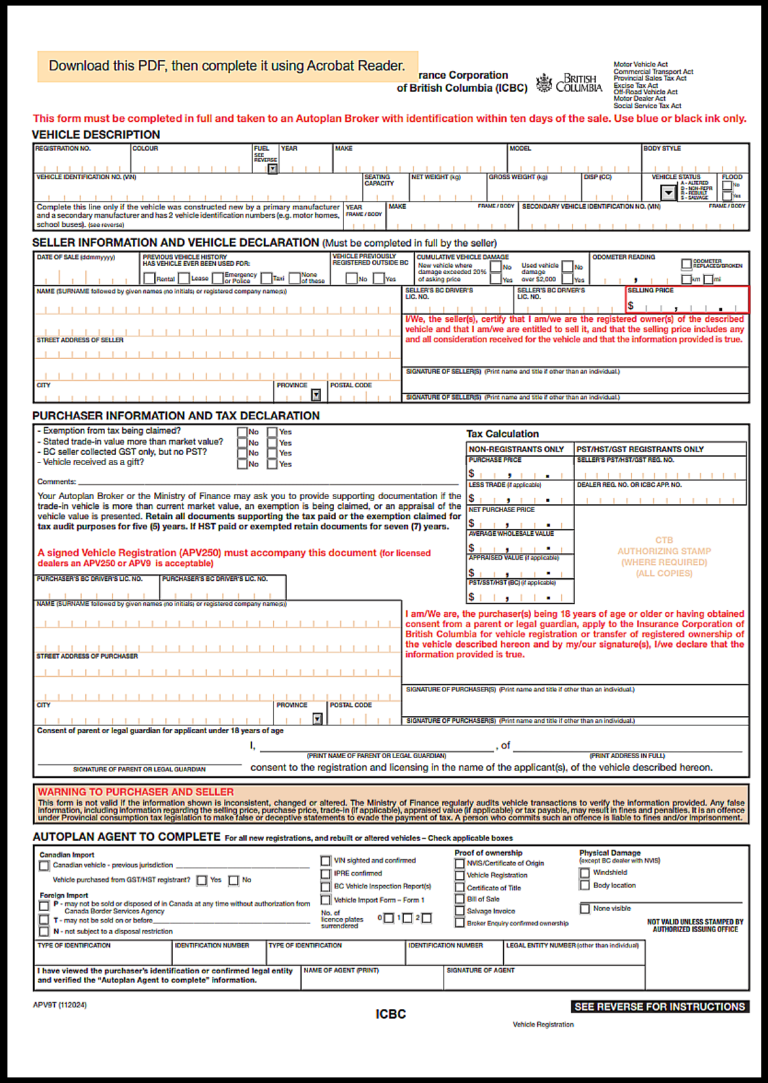
One situation we see regularly is a seller and buyer signing a Bill of Sale, only for the buyer to discover at an MPI service location that the TOD was never completed correctly, delaying the registration process until the paperwork is fixed. That misunderstanding is especially common when someone uses a generic Canadian template that doesn’t reflect Manitoba’s registration requirements.
This page explains what information belongs in a Manitoba Vehicle Bill of Sale, when it should be used, and the supporting documents typically required to complete the transfer properly.
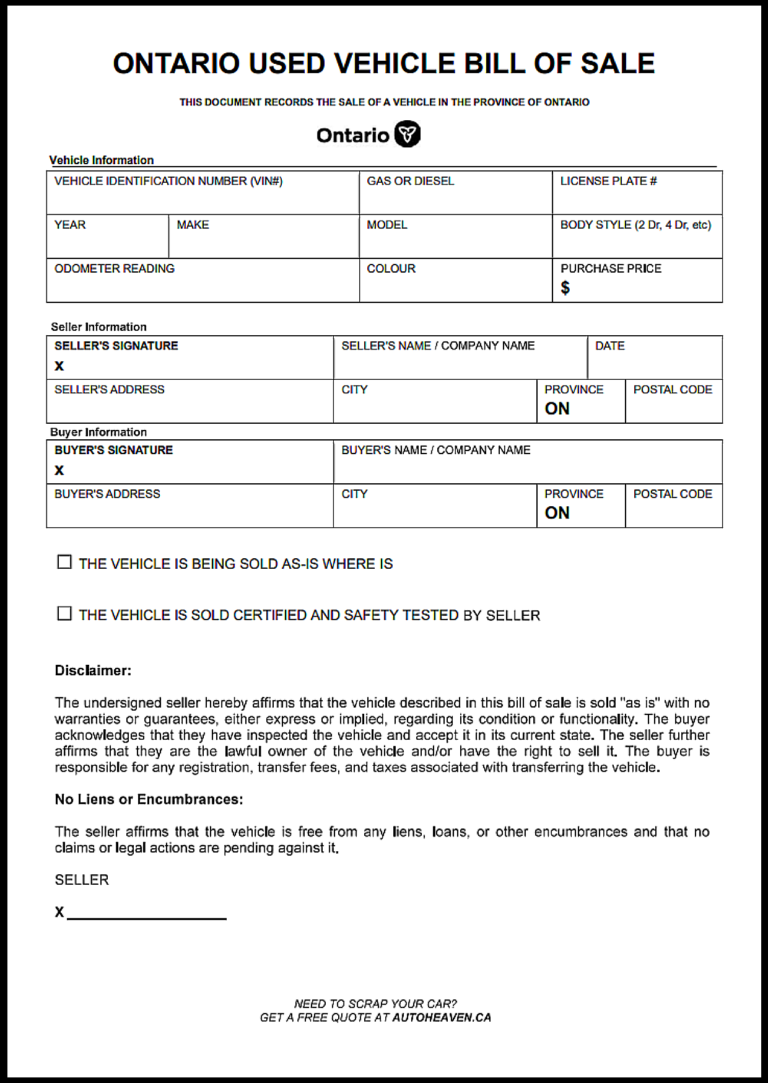
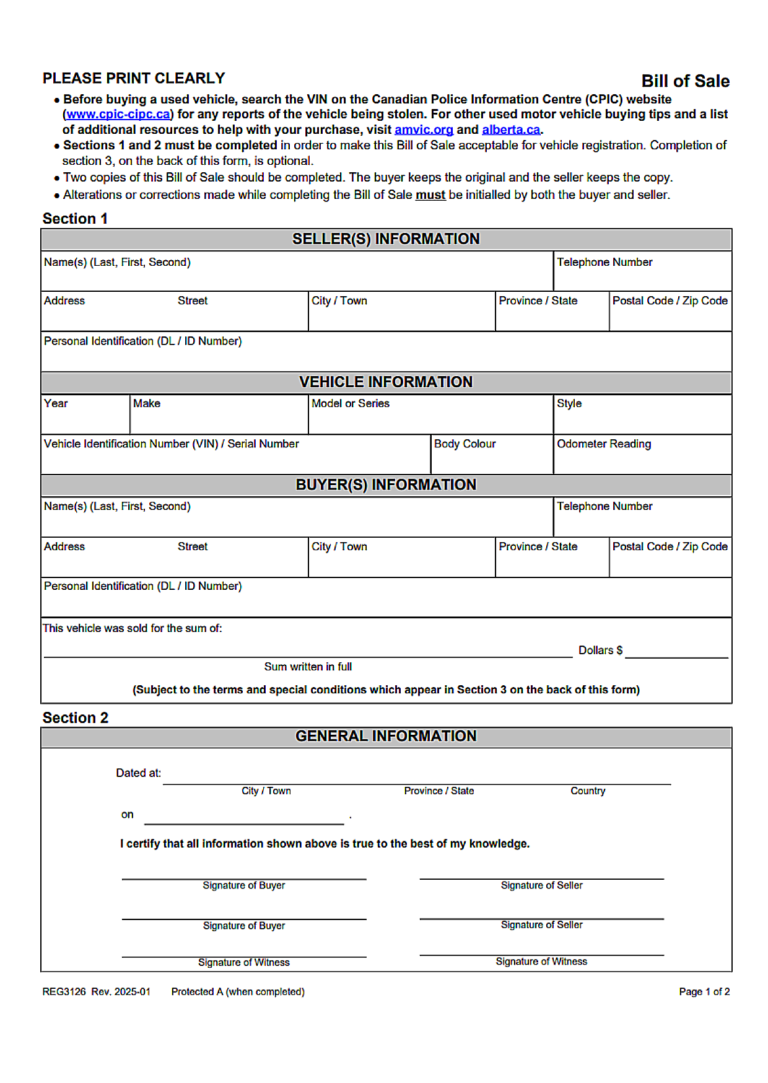
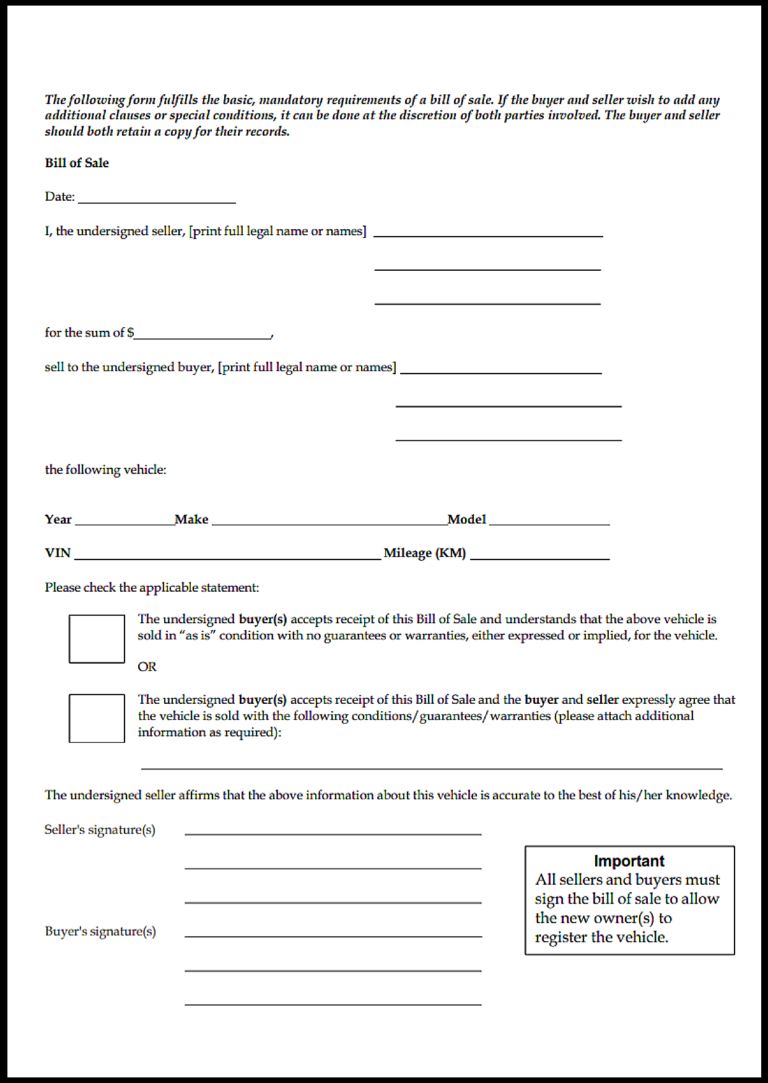
Free Manitoba Vehicle Bill of Sale Template
The template below can be copied and used for most private vehicle sales in Manitoba.
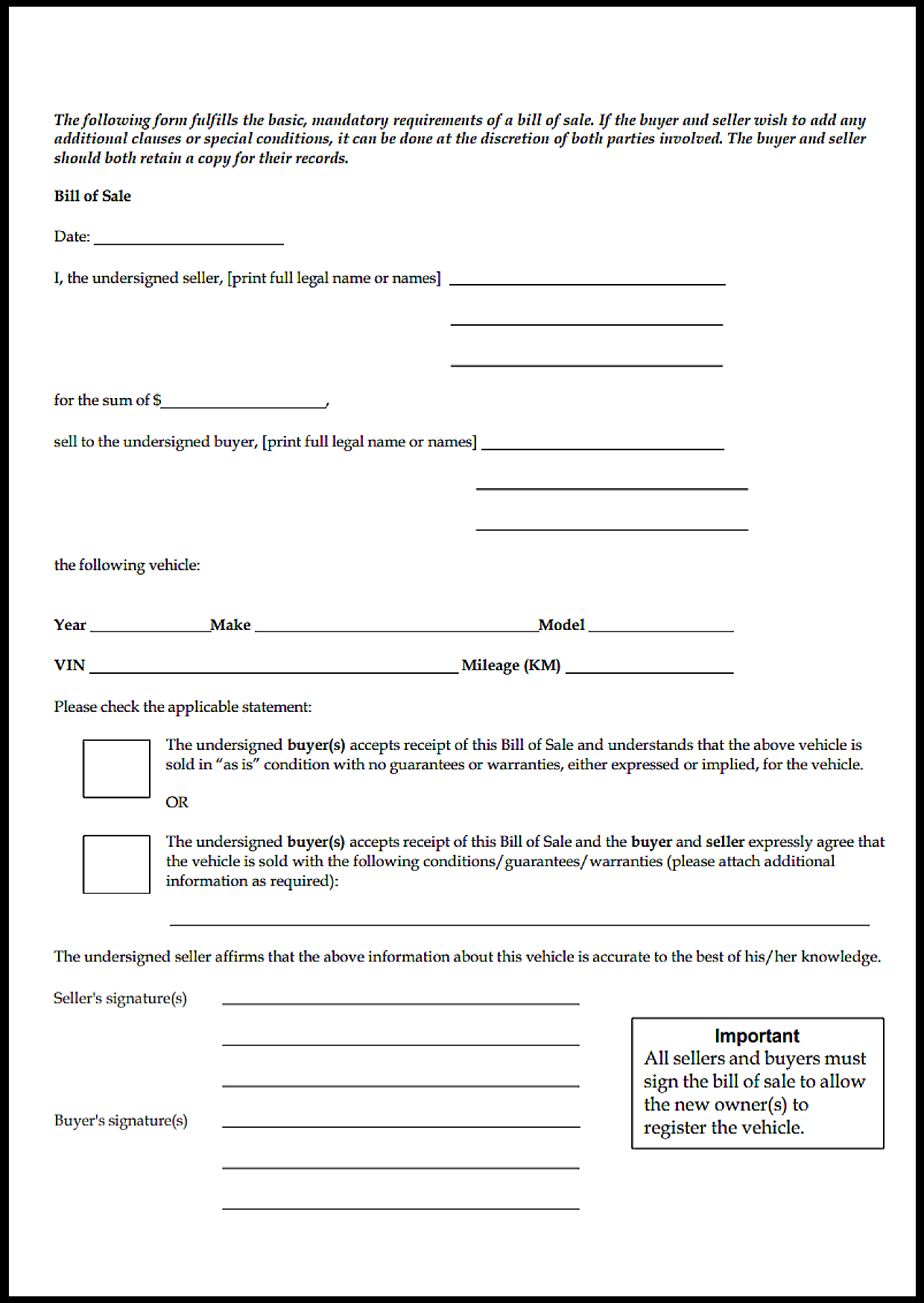
This template is designed for private vehicle sales only. Buyers should still verify ownership records, inspect the vehicle carefully, and confirm whether any liens are attached to the VIN.
Manitoba Vehicle Bill of Sale Rules That Often Cause Registration Problems
| Topic / Issue | MANITOBA Legal Rule | Governing Statute |
|---|---|---|
| Vehicle ownership transfers | Private vehicle transfers are governed through MPI registration rules and ownership documentation requirements. | The Drivers and Vehicles Act, C.C.S.M. c. D104 |
| Contract and sale rules | General contractual rights and obligations for vehicle sales follow provincial sale of goods law. | The Sale of Goods Act, C.C.S.M. c. S10 |
| Vehicle compliance and inspections | Vehicle operation and compliance rules are regulated provincially. | The Highway Traffic Act, C.C.S.M. c. H60 |
| Who can legally sign | The legal owner(s) listed on the vehicle registration and the designated buyer(s) must sign. | The Drivers and Vehicles Act, C.C.S.M. c. D104, s. 4-6 |
| Witness requirements | Manitoba law does not require witnesses for a private vehicle bill of sale. | No statutory requirement — governed by common law principles |
| Notarization requirements | Standard private vehicle bills of sale do not require notarization. | No statutory requirement — governed by common law principles |
| Age requirements | Buyers must generally be at least 16 to independently register a vehicle. Buyers aged 16 or 17 require parental or guardian consent. | The Highway Traffic Act, C.C.S.M. c. H60, s. 168(1) & 168(2) |
| 7-day registration rule | Replacement vehicle buyers may receive a limited 7-day registration and plate transfer grace period. | The Drivers and Vehicles Act, s. 54; The Highway Traffic Act, s. 4(1) |
| Required bill of sale details | Bills of sale used for MPI registration should include names, signatures, VIN, purchase price, and sale conditions. | The Drivers and Vehicles Act |
| Transfer of Ownership Document (TOD) | A vehicle bill of sale alone is not enough to transfer ownership at MPI without the signed TOD. | The Drivers and Vehicles Act |
| Certificate of Inspection (COI) | Vehicle registration may require a valid Manitoba Certificate of Inspection. | The Highway Traffic Act |
| Retail Sales Tax (RST) | MPI collects RST during registration based on the higher of purchase price or fair market value. | The Retail Sales Tax Act |
| Lien and financing issues | Buyers should verify whether financing or legal claims remain attached to the vehicle. | The Sale of Goods Act |
| Odometer disclosure | Sellers must complete odometer information on the TOD during transfer. | Drivers and Vehicles Act Regulations |
| Mismatched seller identity | A seller who does not match the legal owner on MPI registration cannot properly transfer title. | The Drivers and Vehicles Act, s. 4 |
| Missing co-owner signatures | All registered co-owners must sign the sale documents for valid transfer processing. | The Drivers and Vehicles Act |
| “As-Is” sales | Manitoba private vehicle sales commonly use “As-Is” wording to limit future disputes. | The Sale of Goods Act |
| Incorrect VIN information | Incorrect VIN details may delay or prevent registration approval. | The Drivers and Vehicles Act |
| Dealer and private sale differences | Private vehicle sales provide fewer buyer protections than dealer transactions. | The Sale of Goods Act |
| Manitoba TOD system | Manitoba uses a strict two-part transfer system involving both a Bill of Sale and TOD. | The Drivers and Vehicles Act |
One of the biggest surprises for many Manitoba buyers is that a signed Bill of Sale alone does not complete legal vehicle ownership transfer. Manitoba requires the separate Transfer of Ownership Document (TOD) from the seller’s registration card before MPI will process registration. Buyers who overlook this rule often discover too late that they cannot legally register or insure the vehicle. Another important issue involves liens and unpaid loans. Even after a private sale is completed, financing obligations may still remain attached to the vehicle itself. This is why lien searches are strongly recommended before payment is made.
Manitoba also uses strict VIN verification rules, and even a small VIN mistake can delay registration or create fraud concerns. These rules matter because many private vehicle sales happen quickly through online listings, family sales, or informal agreements where paperwork mistakes are common. Missing signatures, incorrect ownership details, or unpaid liens can easily create registration refusals, financial loss, or legal disputes later. Download the free Manitoba Vehicle Bill of Sale template to help complete your private vehicle sale properly.
A vehicle bill of sale helps document ownership transfers between private buyers and sellers in Manitoba. To understand how these transfer records fit within provincial legal requirements, you can review the Canadian bill of sale guide along with the bill of sale requirements in Manitoba before completing the sale.
What Is a Manitoba Vehicle Bill of Sale?
A Manitoba Vehicle Bill of Sale is a private legal agreement showing that ownership of a vehicle has been transferred from one person to another. It records the key details of the transaction and supports the registration process with MPI.
Unlike a casual handwritten receipt, a complete bill of sale contains important information required during registration and ownership transfer.
Why This Document Is Important
A properly completed bill of sale helps both the buyer and seller in several ways:
- Creates written proof of the sale
- Helps avoid payment or ownership disputes
- Supports vehicle registration with MPI
- Verifies the sale price and odometer reading
- Helps calculate Retail Sales Tax (RST)
For example, if a buyer later claims they paid a different amount, the signed bill of sale can help settle the disagreement. Sellers also use it to show the exact date the vehicle left their possession.
Vehicles Commonly Covered
A Manitoba vehicle bill of sale is commonly used for:
- Cars
- Pickup trucks
- SUVs
- Vans
- Motorcycles
- Used commercial vehicles
It may also be used for trailers, campers, recreational vehicles, and similar motor vehicles in private sales.
Vehicle transactions are often connected with other transportation-related ownership documents. Private automobile sales commonly use a car bill of sale template, while motorcycle owners may require a motorcycle transfer document during the registration process.
Manitoba Vehicle Transfer Rules for Private Sales
Private vehicle sales in Manitoba follow several rules under provincial law and MPI registration procedures.
Transfer of Ownership Document (TOD) Requirement
Under Manitoba law, the seller must provide the signed Transfer of Ownership Document (TOD). This document is normally located on the back of the vehicle registration card.
A bill of sale alone does not legally transfer ownership.
This is one of the most common mistakes in Manitoba private vehicle sales. Some buyers receive only a handwritten receipt and later discover they cannot register the vehicle because the TOD was never completed.
Incomplete ownership transfers can create serious problems, including:
- Registration refusal
- Ownership disputes
- Delays with insurance
- Problems proving legal ownership
Registration Through Manitoba Public Insurance (MPI)
After the sale, buyers usually visit an Autopac agent to complete the registration process.
In most cases, buyers should bring:
- Bill of Sale
- Transfer of Ownership Document (TOD)
- Government-issued identification
- Certificate of Inspection (if required)
MPI uses these documents to verify ownership, taxes, inspection status, and vehicle information before registration is completed.
7-Day Plate Transfer Grace Period
Manitoba allows a temporary 7-day grace period for plate transfers in some situations.
This means buyers may temporarily transfer plates from one vehicle to another while arranging permanent registration. During this period, the buyer should carry:
- Bill of Sale
- Signed TOD
- Existing registration documents
Keeping these documents inside the vehicle can help avoid issues during traffic stops or insurance checks.
For used vehicles sold without guarantees, parties may also include an as-is bill of sale agreement to clarify the condition of the asset and reduce future disputes.
Information Required in a Manitoba Vehicle Bill of Sale
A vehicle bill of sale should always contain complete and accurate information.
Buyer and Seller Details
The document should include:
- Full legal names
- Residential addresses
- Phone numbers or contact details
Using nicknames or incomplete information can create registration problems later.
Vehicle Identification Information
Vehicle details must match the registration records exactly.
Important information includes:
- VIN or serial number
- Year
- Make
- Model
- Colour
- Odometer reading
The VIN is especially important because even one incorrect digit may cause registration delays.
Sale and Payment Details
The agreement should clearly record:
- Purchase price
- Date of sale
- Deposit amount
- Payment method
If partial payments are involved, both parties should keep copies showing payment arrangements.
Signatures and Final Agreement
Both parties should sign and date the document.
Although witnesses are not legally required in Manitoba, having a witness signature can still be a useful best practice if disputes arise later.
Accurate dates are also important because they help determine:
- Ownership transfer timing
- Insurance responsibility
- Tax obligations
Certificate of Inspection (COI) Rules in Manitoba
Vehicle inspections are an important part of Manitoba’s registration process.
When a Safety Inspection Is Required
In most situations, a valid Certificate of Inspection (COI) is required before the vehicle can be registered.
However, the sale itself can still happen before the inspection is completed.
Many buyers purchase used vehicles first and then arrange inspection repairs afterward.
Vehicles That May Not Pass Inspection
Some vehicles may fail inspection because of serious safety concerns, including:
- Brake problems
- Structural rust damage
- Unsafe tires or steering
- Major collision damage
- Irreparable vehicle status
Vehicles marked as “Irreparable” under Manitoba’s monitoring programs generally cannot be registered again for road use.
Risks of Buying Without Inspection
Buying a vehicle before inspection can create several risks.
Common problems include:
- Expensive repair bills
- Delayed registration
- Insurance complications
- Unexpected safety issues
Many experienced buyers arrange a mechanic inspection before finalizing payment.
Vehicle Liens and Unpaid Loans
Liens are one of the most overlooked risks in private vehicle sales.
Why Buyers Should Check for Liens
A lien usually means money is still owed on the vehicle through financing or a loan.
In some situations, the lien remains attached to the vehicle even after the sale. This can create major problems for the new owner.
For example, if a financed vehicle is sold without paying off the lender, the lender may still have legal rights connected to the vehicle.
Manitoba Personal Property Registry Searches
Buyers can search for liens through the Manitoba Personal Property Registry operated through Teranet Manitoba.
These searches are usually completed using the VIN.
A lien search helps buyers check whether:
- Financing exists
- A lender has a legal claim
- The vehicle may have unpaid debt attached
Seller Disclosure Responsibilities
Under The Sale of Goods Act, sellers are generally expected to disclose known encumbrances or unpaid loans attached to the vehicle.
If a seller hides an existing lien, legal disputes may follow after the sale.
Buyers should never assume a vehicle is debt-free without checking records themselves.
“As Is” Vehicle Sales in Manitoba
Most private vehicle sales in Manitoba are completed on an “as is” basis.
Meaning of an “As Is” Sale
An “as is” sale means the buyer accepts the vehicle in its current condition.
The seller is generally not promising that the vehicle is free from defects or future repair problems.
This is common with older used vehicles where wear and tear already exists.
Recommended “As Is” Clause
The following wording is commonly recommended in Manitoba private sales:
“The vehicle is sold in ‘as is’ condition without any warranties, express or implied.”
This clause helps limit disputes about mechanical problems discovered after the sale.
Common Problems After Private Vehicle Sales
Disputes often happen because buyers and sellers fail to document important details properly.
Common issues include:
- Hidden mechanical defects
- Odometer disagreements
- Verbal promises not written down
- Missing ownership documents
- Unpaid liens discovered later
Written records usually provide the strongest protection for both parties.
Retail Sales Tax (RST) on Vehicle Purchases
Buyers should understand how Manitoba taxes private vehicle sales.
How RST Is Calculated
Manitoba generally charges 7% Retail Sales Tax (RST) on vehicle purchases.
The tax is usually based on:
- Purchase price, or
- Fair market value determined by MPI
MPI may use the greater amount when calculating tax.
Low-Value Vehicle Tax Exemption
Certain used vehicle sales valued at $5,000 or less may qualify for an RST exemption.
However, buyers should still confirm eligibility rules directly with MPI because exemptions may depend on the type of transaction and supporting documents.
When Buyers Pay the Tax
RST is normally paid during vehicle registration through MPI or an Autopac agent.
The tax must usually be paid before registration can be completed.
|
Vehicle Sale Situation
|
RST Usually Applies? | Notes |
| Standard used vehicle purchase | Yes | Usually 7% |
| Vehicle sold for $5,000 or less | Possible exemption |
Conditions may apply
|
| Family transfer | Sometimes exempt |
Supporting proof may be required
|
| Registration through MPI | Tax collected at registration |
Based on price or market value
|
Common Mistakes Buyers and Sellers Should Avoid
Even simple vehicle sales can create problems if documents are incomplete.
Incorrect VIN or Odometer Information
Incorrect VIN numbers are one of the biggest causes of registration delays.
Buyers should compare the VIN on:
- Registration papers
- Dashboard VIN plate
- Bill of Sale
Missing Signatures
Unsigned documents may create ownership disputes later.
Both parties should sign and keep copies immediately after the sale.
Buying Without a TOD
Without the TOD, buyers may not legally complete the ownership transfer.
Never finalize a purchase without receiving the signed TOD.
Forgetting to Check for Liens
Many buyers skip lien searches to save time.
This mistake can lead to financing disputes or legal claims after the purchase.
Using Handwritten or Incomplete Documents
Messy or incomplete paperwork can create confusion during registration.
Typed or clearly written forms are easier for MPI agents to review.
How to Complete a Manitoba Vehicle Bill of Sale
Step 1 – Gather Vehicle Information
Collect the vehicle details directly from the registration documents and VIN plate.
Double-check all numbers carefully.
Step 2 – Verify Ownership Documents
Make sure the seller provides:
- Signed TOD
- Registration documents
- Inspection information if available
Buyers should confirm the seller actually owns the vehicle before payment is made.
Step 3 – Record the Sale Price and Odometer Reading
Write the exact purchase amount and current odometer reading clearly.
Avoid leaving blank spaces on the form.
Step 4 – Sign the Bill of Sale
Both parties should sign and date the document at the time of sale.
Each person should keep a copy for their records.
Step 5 – Complete Registration With MPI
The buyer should visit an Autopac agent with all required documents to complete registration, insurance, and tax payments.
Is a Manitoba Vehicle Bill of Sale Legally Valid?
Yes. Under Manitoba law, a properly completed vehicle bill of sale is legally valid when it contains accurate information and signatures from both parties.
Signature Requirements
Both the buyer and seller should sign the document.
Manitoba law does not normally require notarization for a standard private vehicle sale.
However, witnesses may still help strengthen proof of the agreement if disagreements happen later.
Age Requirements for Vehicle Registration
In Manitoba, a person generally must be at least 16 years old to register a vehicle.
Buyers under 18 may need written consent from a parent or guardian.
Frequently Asked Questions
Does Manitoba require a Bill of Sale for a vehicle?
Yes. A bill of sale is commonly required during private vehicle registration and ownership transfer with MPI.
Can I sell a vehicle without a safety inspection?
Yes. The sale itself can happen without inspection, but registration may still require a valid Certificate of Inspection.
Is notarization required in Manitoba?
No. Manitoba does not normally require notarization for private vehicle bills of sale.
What happens if the TOD is missing?
Without the TOD, the buyer may not be able to legally transfer ownership or complete registration.
Can I register a vehicle with unpaid liens?
A vehicle may still have active liens attached even after a sale. Buyers should complete a lien search before purchase.
How much tax is charged on used vehicle sales?
Manitoba generally charges 7% RST on used vehicle purchases, although some low-value sales may qualify for exemptions.