Free Alberta Loan Agreement Template Guide
An Alberta Loan Agreement is a simple written contract between a lender and a borrower that explains how money will be given and repaid. In plain English, it protects both sides by clearly setting expectations—so there are no misunderstandings later.
Under Alberta law, this type of agreement is legally enforceable if it includes basic contract elements like offer, acceptance, and consideration (money exchanged). That’s why even informal loans between friends or family should be written down.
I’ve seen Alberta lenders run into serious problems because they relied on text messages or verbal promises, only to realize later there was no clear proof about repayment terms or interest. When people are already stressed about money or helping family, a properly written loan agreement usually prevents the misunderstandings that end up damaging relationships or leading to court disputes.
This guide is useful for people who are lending money personally, running a small business, or even helping a friend financially. On this page, you’ll get a free template, understand different loan types, learn legal basics, and know how to choose the right format for your situation.
Free Alberta Loan Agreement Template
If your loan is simple, you don’t need a complex legal document. A basic template can cover everything important while keeping things clear and easy to use.
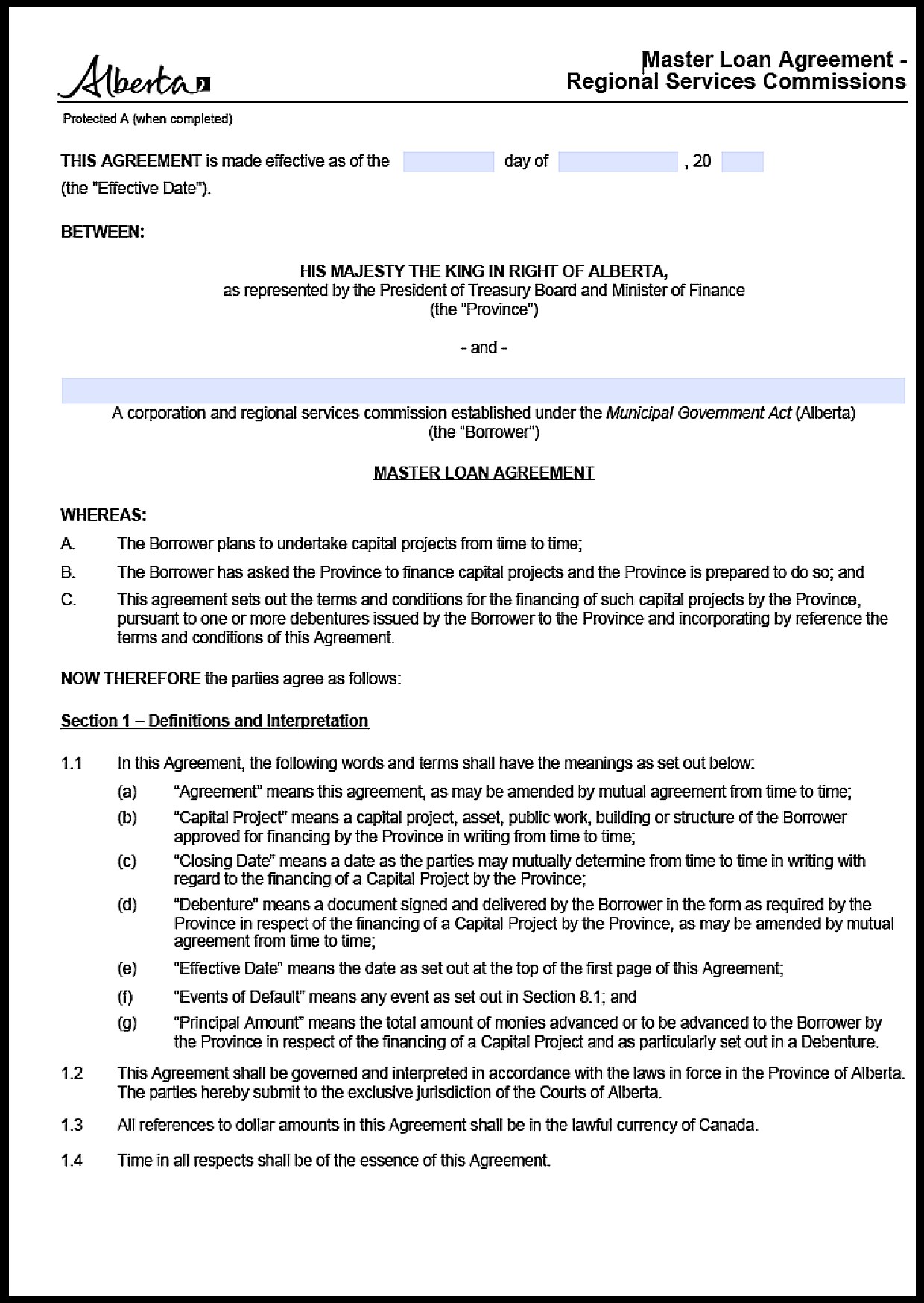
Get PDF
Note: Open pdf into Adobe Acrobat
Alberta Loan Agreement Rules Borrowers and Lenders Often Miss
| Topic / Issue | Alberta Legal Rule | Governing Statute |
|---|---|---|
| Federal interest regulation | Canadian federal law governs how loan interest must be calculated and disclosed. | Interest Act, R.S.C. 1985, c. I-15 |
| Consumer loan protections | Alberta consumer loan transactions are regulated under provincial consumer protection law. | Consumer Protection Act, R.S.A. 2000, c. C-26 |
| Legal signing authority | Any individual or corporation with legal capacity may sign a loan agreement. | Governed by common law principles |
| Witness requirements | Witnesses are commonly used but are generally not legally required for validity. | Governed by common law principles |
| Notarization requirement | Standard loan agreements usually do not require notarization unless tied to mortgages or guarantees. | Governed by common law principles |
| Age requirement | Alberta’s age of majority for contracts is 18 years old. | Age of Majority Act, R.S.A. 2000, c. A-6, s. 1 |
| Mental capacity | Parties must understand the nature and consequences of the agreement. | Adult Guardianship and Trusteeship Act, S.A. 2008, c. A-4.2 |
| Debt claim deadline | Most debt collection claims must begin within 2 years after discovery. | Limitations Act, R.S.A. 2000, c. L-12, s. 3(1) |
| Consumer loan disclosure | Consumer lenders must provide written disclosure of APR, borrowing costs, and fees before lending. | Consumer Protection Act, s. 68 |
| High-cost credit warnings | Loans above 32% interest require special warning notices on the first page. | High-Cost Credit Systems Regulation, Alta Reg 125/2018 |
| Annual interest disclosure | If interest is quoted monthly or otherwise below annual terms, the yearly equivalent must be stated. | Interest Act, s. 4 |
| Private contract filing | Standard unsecured loan agreements are private and generally do not require registration. | Alberta contract practice |
| Secured personal property loans | Lenders should register security interests in the Personal Property Registry to protect priority rights. | Personal Property Security Act (PPSA) |
| Real estate secured loans | Mortgages secured by land must be registered with Alberta Land Titles. | Alberta Land Titles system |
| Criminal interest rates | Interest above the criminal rate is illegal and unenforceable. | Criminal Code, R.S.C. 1985, c. C-46, s. 347 |
| Unconscionable lending | Alberta courts may set aside loans that unfairly exploit borrowers. | Consumer Protection Act, s. 7 |
| Missing annual rate disclosure | Failure to properly disclose annual rates may limit collectible interest to 5%. | Interest Act, s. 4 |
| Personal guarantee requirements | Alberta requires lawyer-certified guarantees for personal guarantors. | Guarantees Acknowledgment Act |
| Seize or sue restrictions | Some Alberta secured consumer loans limit lenders from both seizing collateral and suing for remaining debt. | Law of Property Act, R.S.A. 2000, c. L-7 |
One of the most surprising Alberta loan rules involves interest disclosure. Many lenders casually write terms like “1% per month” without stating the equivalent annual rate. Under federal law, that mistake can reduce collectible interest to only 5% per year, even if both parties originally agreed to more.
Another major Alberta-specific rule involves personal guarantees. Alberta is stricter than most provinces because anyone personally guaranteeing a loan must appear before a lawyer and sign a formal acknowledgment certificate. Without that certificate, the guarantee may be completely unenforceable.
The “seize or sue” rule is also very important for secured loans. In some Alberta consumer lending situations, a lender who seizes collateral may lose the right to sue for the remaining unpaid balance afterward. This can significantly affect recovery options if the borrower defaults.
These rules matter in real life because unclear loan terms, invalid guarantees, or improper disclosures can quickly turn a simple loan into a costly legal dispute. Download the free Alberta Loan Agreement template to create a clearer and legally stronger lending contract.
Types of Loan Agreements in Alberta
Different situations require different types of loan agreements. Choosing the right one helps avoid legal problems and ensures clarity for both parties.
Personal Loan Agreement
This is used between individuals, such as friends or family members. Even though these loans are often informal, writing them down avoids future disputes and keeps things professional.
Business Loan Agreement
This type is used when money is lent to or from a business. It usually includes stricter repayment terms, interest clauses, and detailed conditions.
Secured Loan Agreement
A secured loan is backed by an asset like a car or property. If the borrower fails to repay, the lender has the right to claim that asset. This reduces risk for the lender.
Unsecured Loan Agreement
In this case, no collateral is involved. Because of higher risk, lenders often include higher interest or stricter repayment terms.
Promissory Note (Simplified Loan Format)
A promissory note is a short and simple written promise to repay money. It is commonly used for small or quick loans where detailed terms are not needed.
Demand Loan Agreement
This type allows the lender to ask for repayment at any time. While flexible, it can be risky for the borrower since repayment timing is uncertain.
Installment Loan Agreement
This agreement sets fixed payments over time, such as monthly or quarterly installments. It is commonly used for structured repayment plans.
While financial in nature, loan agreements may still require confidentiality clauses discussed in the Free Alberta NDA Template Guide. Legal enforceability is explained in the binding contract guide.
Real-Life Use Cases (When You Need a Loan Agreement)
Loan agreements are useful in many everyday situations. Without one, even small misunderstandings can turn into serious disputes.
For example, if you lend money to a friend without any written terms, they might remember the repayment date differently. A written agreement removes confusion.
Some common use cases include:
- Lending money to friends or relatives
- Funding a startup or small business
- Borrowing money with clear repayment terms
- Securing a loan using personal assets
- Avoiding disputes in informal agreements
Loan agreements are often connected with a partnership agreement or a service agreement in business transactions.
Key Elements of a Valid Loan Agreement
For a loan agreement to be legally valid in Alberta, it must include certain essential elements. Missing these can make the agreement weak or difficult to enforce.
Important Elements
| Parties |
Full legal names of lender and borrower
|
| Loan Amount |
Exact amount given
|
| Repayment Terms |
Schedule and method of repayment
|
| Interest Rate |
Must follow Canadian legal limits
|
| Collateral |
Asset details if loan is secured
|
| Signatures |
Required for enforceability
|
Each of these parts plays a role in making the agreement clear and legally strong.
How to Create or Complete This Document
Creating a loan agreement is not complicated if you follow a structured approach. The goal is to keep everything clear and easy to understand.
Start by choosing the correct loan type based on your situation. Then add full details of both parties, including names and addresses. Clearly define how the money will be repaid—whether in a lump sum or installments.
You should also include interest (if applicable) and mention any conditions like late fees or penalties. If the loan is secured, describe the collateral properly. Finally, both parties must review and sign the document.
Legal Overview in Alberta
In Alberta, loan agreements are governed by general contract law principles. This means the agreement must show a clear offer, acceptance, and exchange of value.
Written agreements are always recommended because they are easier to enforce. While verbal agreements can be valid, they are difficult to prove in court and often lead to disputes.
Key Legal Points
- Interest must not exceed the criminal rate under Canadian law
- Written contracts are safer than verbal agreements
- Both parties must agree voluntarily
- Terms must be clear and not misleading
Common Mistakes to Avoid
Many people overlook important details when creating loan agreements, especially in informal situations.
Some of the most common mistakes include:
- Not writing the agreement at all
- Missing repayment schedules
- Ignoring interest rules
- Not defining default consequences
- Using the wrong type of agreement
- Forgetting signatures
Avoiding these mistakes can save time, money, and legal trouble.
Choosing the Right Loan Agreement (Decision Guide)
Choosing the correct agreement depends on your situation. The wrong choice can create confusion or risk.
Each of these parts plays a role in making the agreement clear and legally strong.
How to Create or Complete This Document
Creating a loan agreement is not complicated if you follow a structured approach. The goal is to keep everything clear and easy to understand.
Start by choosing the correct loan type based on your situation. Then add full details of both parties, including names and addresses. Clearly define how the money will be repaid—whether in a lump sum or installments.
You should also include interest (if applicable) and mention any conditions like late fees or penalties. If the loan is secured, describe the collateral properly. Finally, both parties must review and sign the document.
Legal Overview in Alberta
In Alberta, loan agreements are governed by general contract law principles. This means the agreement must show a clear offer, acceptance, and exchange of value.
Written agreements are always recommended because they are easier to enforce. While verbal agreements can be valid, they are difficult to prove in court and often lead to disputes.
Key Legal Points
- Interest must not exceed the criminal rate under Canadian law
- Written contracts are safer than verbal agreements
- Both parties must agree voluntarily
- Terms must be clear and not misleading
Common Mistakes to Avoid
Many people overlook important details when creating loan agreements, especially in informal situations.
Some of the most common mistakes include:
- Not writing the agreement at all
- Missing repayment schedules
- Ignoring interest rules
- Not defining default consequences
- Using the wrong type of agreement
- Forgetting signatures
Avoiding these mistakes can save time, money, and legal trouble.
Choosing the Right Loan Agreement (Decision Guide)
Choosing the correct agreement depends on your situation. The wrong choice can create confusion or risk.
| Situation |
Recommended Agreement
|
| Lending to a friend |
Personal Loan Agreement
|
| Lending to a business |
Business Loan Agreement
|
| Want security |
Secured Loan Agreement
|
| No collateral |
Unsecured Loan Agreement
|
| Simple short loan |
Promissory Note
|
| Fixed repayments |
Installment Agreement
|
| Flexible repayment |
Demand Loan Agreement
|
This quick guide helps you make the right decision without overthinking.
FAQs
Is a loan agreement legally binding in Alberta?
Yes, as long as it is properly written and signed, it is enforceable.
Can I lend money without charging interest?
Yes, charging interest is optional.
What happens if the borrower doesn’t repay?
The lender can take legal action based on the agreement terms.
Do I need a lawyer to create a loan agreement?
Not required, but helpful for complex or high-value loans.
What’s the difference between a loan agreement and a promissory note?
A loan agreement is detailed, while a promissory note is shorter and simpler.