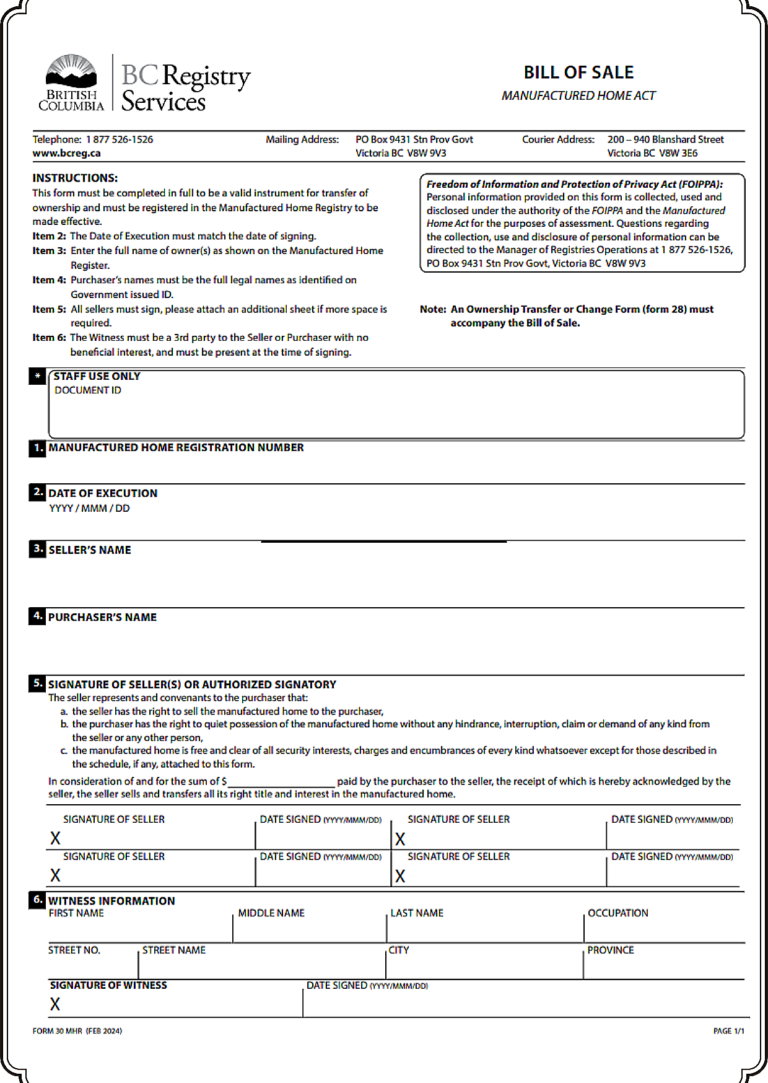
Free British Columbia Car Bill of Sale Template Guide
British Columbia Car Bill of Sale is a simple document that proves a car was sold from one person to another. In very basic terms, it is like a receipt for a vehicle sale. It shows who sold the car, who bought it, and for how much.
In British Columbia, this document is important because it helps prove ownership transfer. I’ve seen private vehicle sales in British Columbia turn into stressful disputes because the buyer or seller relied on a verbal agreement and later could not prove the exact terms of the deal. I always tell first-time buyers and sellers that a proper bill of sale can save a lot of problems if questions come up later about ownership, payment, or the condition of the vehicle.
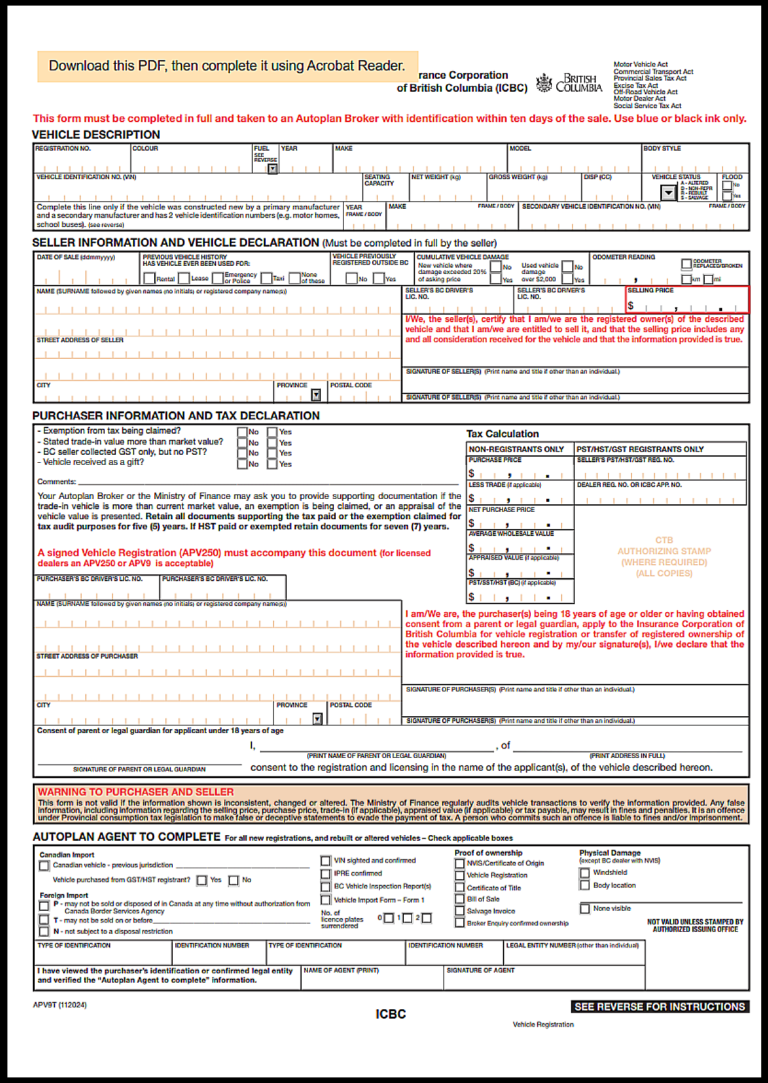
However, it is usually used together with forms from Insurance Corporation of British Columbia (ICBC), which handles vehicle registration and insurance in the province.
Last Updated: August 2026
This is especially useful if you are:
- Buying or selling a used car privately
- Doing a transaction without a dealer
- A first-time vehicle owner
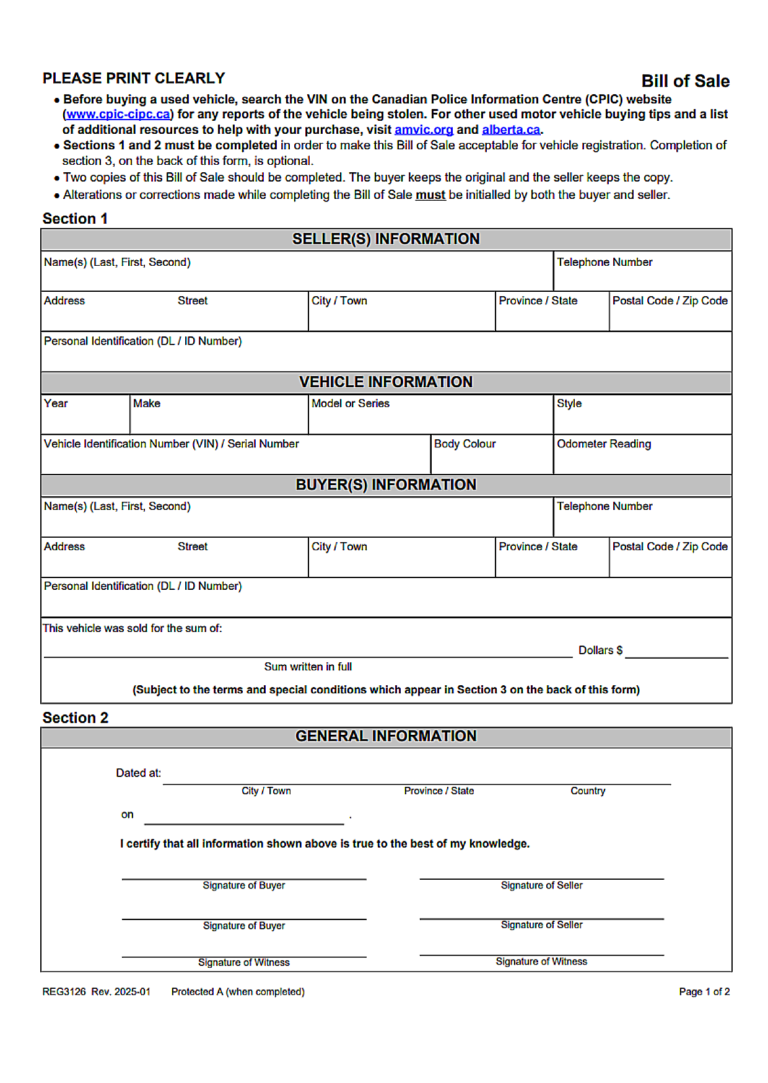
Free British Columbia Car Bill of Sale Template
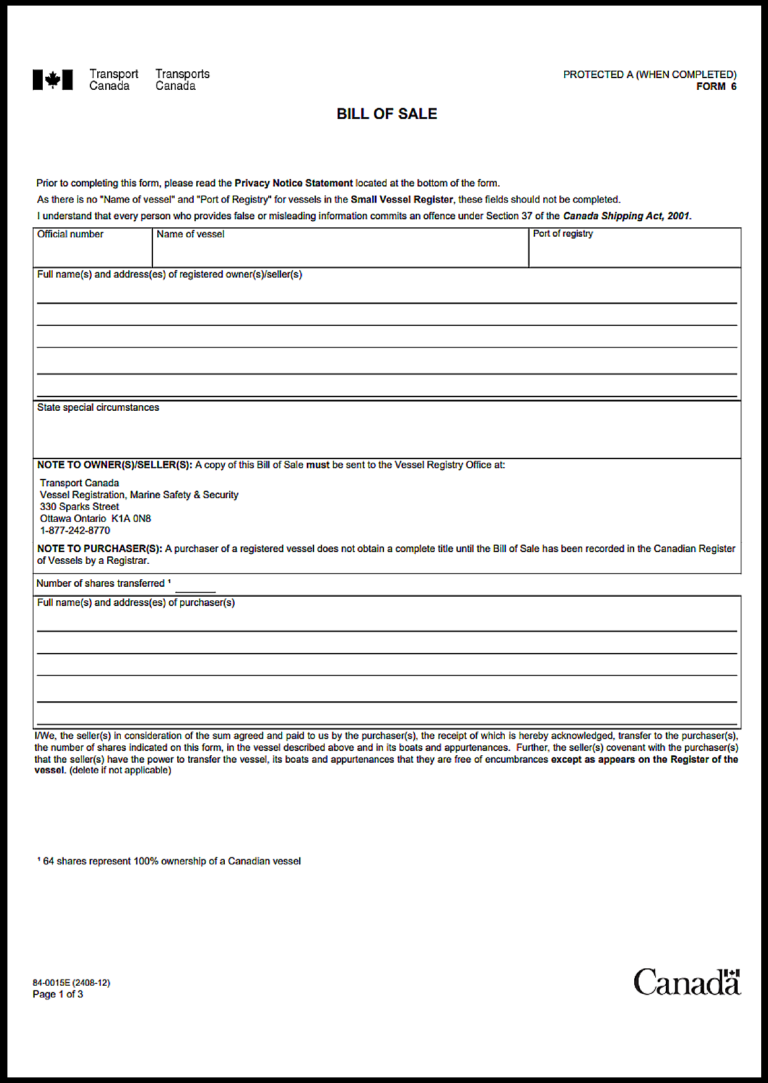
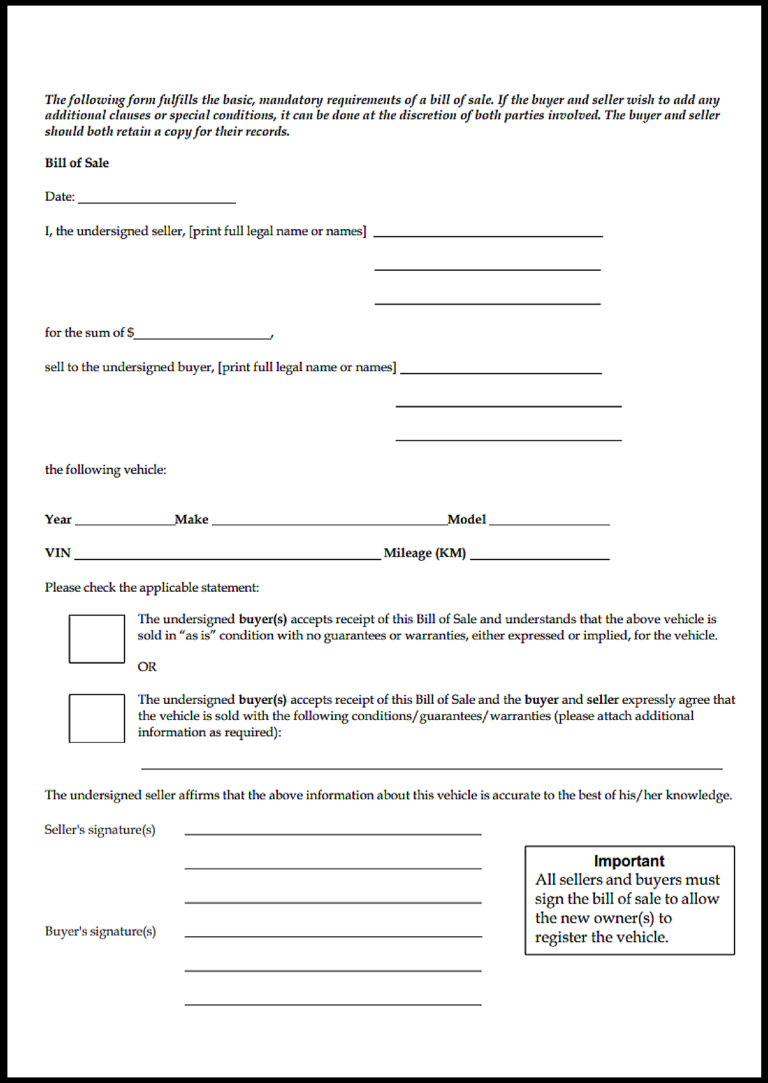
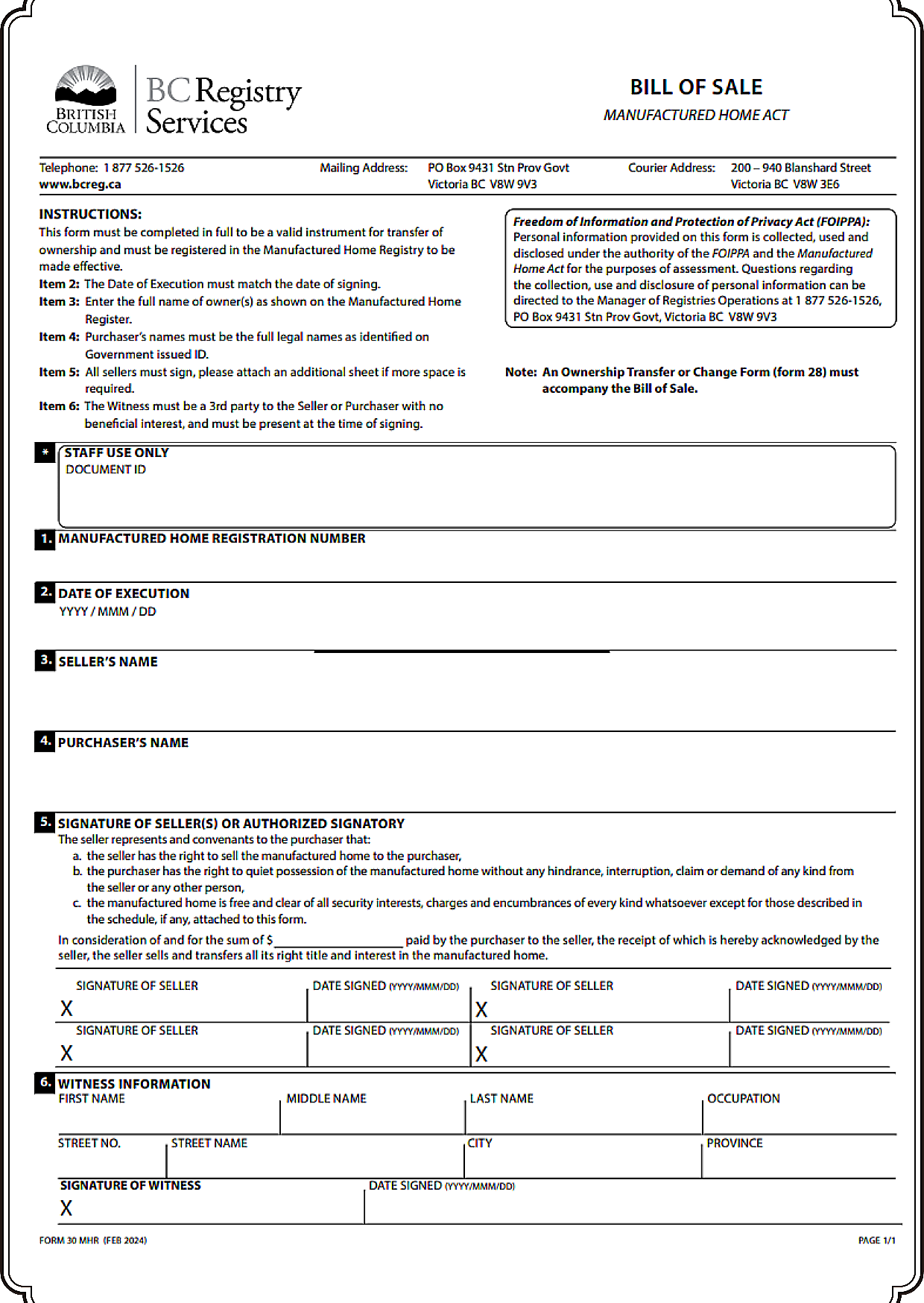
Below is a simple, general-purpose template that works for most private car sales in British Columbia.
Important British Columbia Car Bill of Sale Laws and Transfer Rules
| Topic / Issue | British Columbia Legal Rule | Governing Statute |
|---|---|---|
| Governing legislation | Registered vehicle transfers in British Columbia are governed primarily by the Motor Vehicle Act and related regulations, while contractual sale issues can also be governed by the Sale of Goods Act. | Motor Vehicle Act, [RSBC 1996] c. 318; Sale of Goods Act, [RSBC 1996] c. 410 |
| Federal criminal law | Certain fraud and identity offences can be governed by federal criminal law. | Criminal Code, RSC 1985, c. C-46 |
| 2022 tax amendment | Since October 1, 2022, BC’s PST rules for many private vehicle purchases use the applicable average wholesale value where it exceeds the designated purchase price, subject to statutory appraisal rules and exceptions. | Provincial Sales Tax Act amendments |
| Who can sign | The transferor and transferee must sign the prescribed transfer notice, and the seller must certify the applicable ownership information on the transfer form. | Motor Vehicle Act, s. 17 |
| Witness requirements | The Motor Vehicle Act and ICBC’s standard transfer process do not prescribe a general witness-signature requirement for an ordinary vehicle bill of sale. | Motor Vehicle Act / ICBC |
| Notarization | Notarization is not generally required for an ordinary private vehicle transaction. | ICBC / Motor Vehicle Act |
| Age requirement | British Columbia’s general age of majority is 19, while contractual capacity is governed by the applicable law and circumstances. | Age of Majority Act, s. 1 |
| Mental capacity | The parties should have the legal capacity required to enter into the transaction. | Applicable contract and capacity law |
| Filing deadline | The transferee must deliver the prescribed transfer notice to ICBC within 10 days from the day of the transfer. | Motor Vehicle Act, s. 17(1) |
| “As Is, Where Is” wording | A private vehicle agreement may include an “as-is” term, but its legal effect depends on the wording and applicable law and does not automatically exclude every statutory or contractual obligation. | Sale of Goods Act |
| Tax declaration | The actual purchase price should be recorded accurately on the APV9T because it is relevant to the vehicle transfer and PST process. | Provincial Sales Tax Act |
| Filing requirements | A bill of sale is a private supporting document; the required ICBC transfer paperwork must be completed separately. | ICBC transfer process |
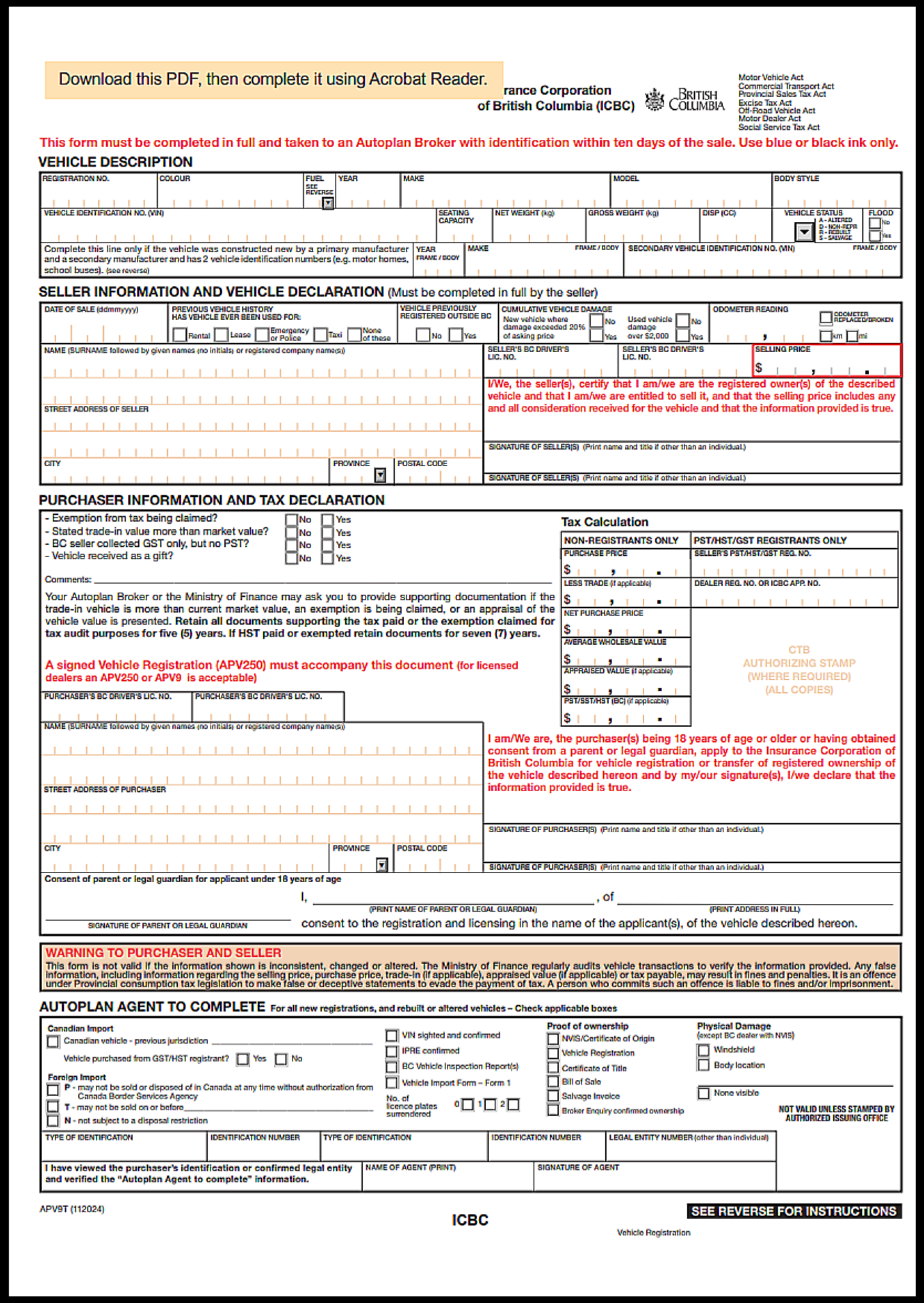
| Required transfer forms | The ICBC transfer process requires the prescribed APV9T and the seller’s signed original vehicle registration (APV250). | ICBC / Motor Vehicle Act process |
| Missing owner signatures | For a voluntary transfer, the required owner signatures must be provided; a court order can authorize a transfer without one or more signatures in specified circumstances. | Motor Vehicle Act, s. 17 |
| Incorrect VIN | A VIN error or mismatch can prevent the transfer from being processed correctly and should be corrected before registration. | Motor Vehicle Act / ICBC |
| Undisclosed liens | A buyer should check for registered security interests or other encumbrances because they can affect the buyer’s rights depending on the circumstances and applicable law. | Sale of Goods Act / Personal Property Security Act |
| BC PST “Black Book” rule | For many private vehicle purchases, PST is determined under the purchase-price and applicable average-wholesale-value rules, subject to statutory exceptions and appraisal rules. | Provincial Sales Tax Act |
| APV9T requirement | A private bill of sale alone does not replace the required ICBC transfer documentation. | ICBC transfer requirements |
| Plate retention rule | Sellers should remove their licence plates before transferring the vehicle, in accordance with ICBC requirements. | ICBC vehicle-transfer guidance |
The 10-day transfer deadline matters because the Motor Vehicle Act requires the transferee to deliver the prescribed transfer notice to ICBC within 10 days. Buyers should not assume they can wait several weeks to complete the transfer.
The VIN should be checked against the vehicle and registration records before the transfer is submitted. A mismatch can delay processing, so it is better to correct the information before visiting the Autoplan broker.
BC’s private-vehicle PST rules do not always use only the amount written on the bill of sale. For many private purchases, the applicable average wholesale value is used when it exceeds the designated purchase price, subject to the statutory rules and appraisal process.
The transfer documents should be completed consistently with the registration record. For a voluntary transfer, the required transferor signatures must be provided, although the Motor Vehicle Act also contains exceptions for transfers authorized by court order.
Download the free British Columbia Car Bill of Sale template to help record the transaction clearly and keep the important sale details together.
Before completing a private vehicle transaction, it helps to understand how the bill of sale fits with the required ICBC transfer documents. Buyers may also want to understand the bill of sale requirements in British Columbia before finalizing the purchase.
Types of Car Bill of Sale in British Columbia
Choose a document that matches the type of transaction and the vehicle being transferred. Different situations may require different supporting documents.
Standard Private Sale Bill of Sale
This is the most common type in BC.
Used when:
- A private seller sells a used car to another individual
- No dealership is involved
This format can be useful for documenting a private sale, but the separate ICBC transfer requirements still apply.
As-Is (No Warranty) Bill of Sale
Used when:
- The seller does not promise anything about the car’s condition
This is common for older cars.
A private vehicle agreement can include an “as-is” term, but its legal effect depends on the wording and applicable law. It does not automatically exclude fraud, misrepresentation, or every statutory or contractual obligation.
Gifted Vehicle Bill of Sale
Used when:
- The car is given for free (family or friends)
Even if no money is exchanged, a written record can still be useful for documenting the gift and keeping the transfer details together:
- Tax purposes
- Ownership records
This is usually combined with ICBC transfer forms.
Dealership Bill of Sale
Used when:
- Buying from a licensed dealer
This document is more detailed and includes:
- Taxes
- Dealer information
- Additional fees
Dealers may have additional disclosure and consumer-law obligations compared with private sellers.
Conditional Bill of Sale (With Payment Terms)
Used when:
- Buyer pays in installments
This type includes:
- Payment schedule
- Conditions for ownership transfer
The parties can agree on payment conditions, including when ownership is intended to pass, subject to the agreement and applicable law.
Many vehicle transactions also involve related paperwork depending on the type of automobile being sold. Sellers handling broader transportation assets may use a vehicle bill of sale template, while motorcycle owners often require a motorcycle transfer document for private sales.
Real-Life Use Cases
Here are some real situations where a bill of sale is used:
- You buy a used car from someone on Facebook Marketplace
- You sell your car before moving out of British Columbia
- You gift your old car to your sibling or child
- You sell a car “as-is”
- You buy a car from a dealer vs a private seller
Each situation may require a slightly different version of the document.
Key Elements of a Valid Car Bill of Sale
A useful vehicle bill of sale should include enough information to identify the parties, vehicle, price, date, and other important terms of the transaction.
Buyer and Seller Information
You should include:
- Full legal names
- Addresses
- Contact details
This helps identify both parties clearly.
Vehicle Identification Details
The VIN is an important identifying detail and should be recorded accurately.
Include:
- VIN (Vehicle Identification Number)
- Make, model, year
- Odometer reading
A VIN error or mismatch can delay processing, so it should be checked carefully before registration.
Sale Price and Payment Details
Clearly mention:
- Exact amount paid
- Payment method (cash, bank transfer, installments)
Avoid vague wording like “paid in full” without an amount.
Date of Sale and Transfer
This is important because:
- It records when the transaction took place
- It provides a clear timeline for the parties’ records
Signatures of Both Parties
Both buyer and seller should sign the written bill of sale so there is a clear record of the agreed terms.
Summary of Required Elements
| Element | Why It Matters |
| Buyer/Seller Info |
Identifies both parties
|
| Vehicle Details |
Confirms exact vehicle
|
| Sale Price |
Records the transaction amount
|
| Date |
Records the transaction timeline
|
| Signatures |
Records the agreed transaction
|
Before registering the vehicle, buyers may also want to review the difference between a bill of sale and ownership records in British Columbia to understand how each document is used during the transfer process.
How to Create or Complete This Document
You can prepare a clear bill of sale by recording the transaction details in a consistent order:
Step 1: Gather all details
Collect vehicle info, VIN, and personal details.
Step 2: Fill out the template
Complete the relevant fields accurately.
Step 3: Verify VIN and ownership
Check documents carefully before signing.
Step 4: Review everything
Both parties should read the document fully.
Step 5: Sign and keep copies
Each person should keep a signed copy.
Legal Overview in British Columbia
Private vehicle sales involve both contract-law principles and the BC vehicle-registration framework. The Sale of Goods Act can apply to contractual aspects of a sale, while the Motor Vehicle Act governs the transfer of a registered vehicle.
Here is what you should know:
- A bill of sale is proof of agreement between buyer and seller
- It shows terms of the sale clearly
- It helps establish the transaction details if a dispute happens
However, very important:
You must still:
- Register the vehicle with ICBC
- Transfer ownership officially
The buyer should complete the required ICBC registration and transfer process so the vehicle is registered in the buyer’s name.
Common Mistakes to Avoid
Common problems include missing or inconsistent vehicle and transaction information.
Avoid these:
- Incorrect or missing VIN
- Not writing clear condition terms
- Leaving price blank or unclear
- Forgetting signatures
- Not keeping a copy
- Thinking bill of sale = full ownership
Quick Mistakes Checklist
| Mistake | Result |
|---|---|
| Wrong VIN | Registration delay |
| No signature | Weaker written evidence of the transaction |
| Missing price | Legal confusion |
| No copy kept | No proof later |
| No “as-is” note | Less certainty about the agreed condition terms |
Choosing the Right Car Bill of Sale
Use this simple guide:
- Selling privately → Standard Private Sale
- Selling without guarantee → As-Is Bill of Sale
- Giving car to family → Gifted Bill of Sale
- Buying from dealer → Dealership Bill of Sale
- Payment in parts → Conditional Bill of Sale
Choosing a document that fits the transaction can make the vehicle details and agreed terms easier to record.
FAQs
Is a car bill of sale required in British Columbia?
A separate bill of sale is not required for every vehicle transaction, but it is strongly recommended because it creates a written record of the sale. The required ICBC transfer documentation must still be completed.
Do I need to notarize a bill of sale in BC?
No. Notarization is not generally required for an ordinary private vehicle sale.
Can I write my own bill of sale?
Yes. You can prepare your own bill of sale. It should accurately identify the buyer, seller, vehicle, price, date, payment terms, and any important conditions.
What happens if I lose my bill of sale?
You may have more difficulty proving the agreed price or other transaction details if other records are unavailable. Keep a paper or digital copy.
Is a handwritten bill of sale valid?
Yes. A handwritten bill of sale can be used as a written record of the transaction, provided it accurately records the sale and does not conflict with applicable legal or ICBC requirements.
Does ICBC provide a bill of sale form?
ICBC provides the required transfer forms. A separate bill of sale can still be useful as supporting evidence of the transaction.
Legal Disclaimer
This guide is for informational purposes only. It is not legal advice. Laws in British Columbia may change over time. For official guidance, consult a qualified legal professional or contact ICBC.