Ontario Rent Increase Notice (Rules, Requirements & Legal Guidelines)
Ontario Rent Increase Notice is a legal document landlords must use when increasing rent. In Ontario, you cannot just raise rent anytime—you must follow strict rules under the Residential Tenancies Act.
If you’re a landlord or property manager, this article will help you stay compliant. If you’re a tenant, it will help you understand your rights before accepting any rent increase.
A rent increase notice tells a tenant that their rent will go up on a future date. Under Ontario law, landlords must follow clear rules before doing this. I’ve seen Ontario landlords lose weeks of time and money because they used the wrong notice form or increased rent before they were legally allowed to. Most people dealing with rent increases are already stressed, and even small mistakes under Ontario’s rules can quickly turn into disputes at the Landlord and Tenant Board.
This article includes a free template, legal rules, and step-by-step instructions so you can do it correctly.
Last Updated: September 2026
Table of Contents
ToggleFree Ontario Rent Increase Notice Template
You can use this sample as a basic draft. It is helpful for understanding what information is required.
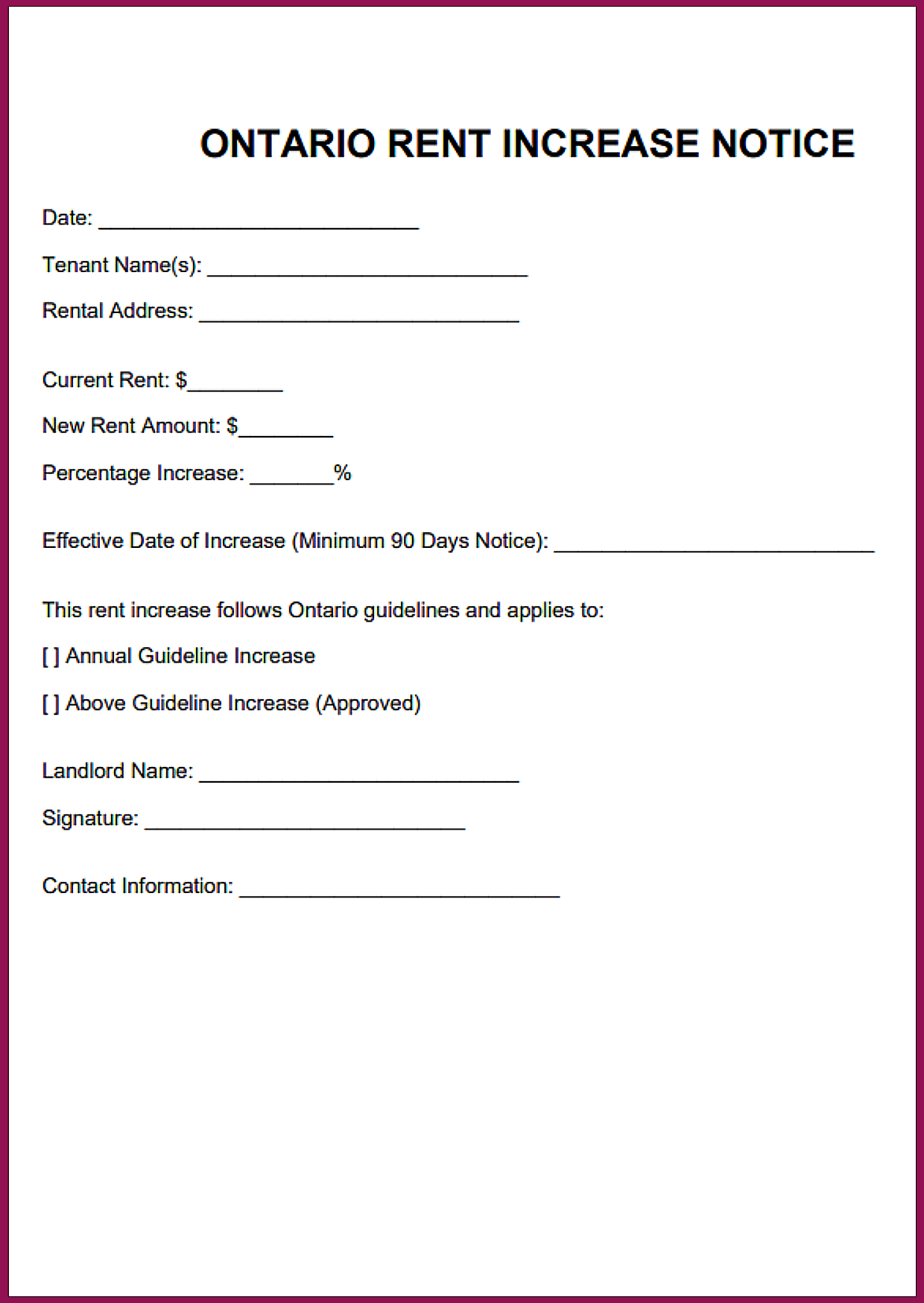
Tip: Use this template to understand the structure. For legal compliance, always use official Ontario forms when required.
Ontario Rent Increase Notice Legal Requirements and Compliance Rules
| Topic / Issue | Ontario Legal Rule | Governing Statute |
|---|---|---|
| Governing Legislation | Residential rent increase rules are governed by provincial law under the Residential Tenancies Act, 2006. | Residential Tenancies Act, 2006 |
| Recent Amendments | Bill 60 amended parts of the RTA, but the core 90-day notice and 12-month timing rules remain in place. | Residential Tenancies Act, 2006 |
| Who Can Legally Sign | The landlord or an authorized person acting for the landlord can give the notice. | RTA, s. 116 |
| Witness Requirements | There is no general statutory witness requirement for an ordinary rent increase notice. | N/A |
| Notarization / Commissioner | A rent increase notice does not generally have to be notarized or commissioned. | N/A |
| Age & Mental Capacity | The RTA does not establish a separate age or mental-capacity witnessing requirement for an ordinary rent increase notice. | N/A |
| Notice Deadline | Landlords generally must give at least 90 days’ written notice before the rent increase takes effect. | RTA, s. 116(1) |
| Frequency Limit | Rent generally cannot be increased more than once every 12 months, measured from the last rent increase or, where applicable, the start of the tenancy. | RTA, s. 119(1) |
| Effective Date Rule | The effective date must comply with the RTA and the applicable LTB notice requirements, including the required notice period and rental-period rules. | RTA, s. 116 |
| Mandatory Forms | The required Board-approved form depends on the situation. N1 is generally used for guideline increases, N2 for certain units exempt from the guideline, and N3 for care homes. Other procedures, such as an N10 agreement, may apply in specific circumstances. | RTA, s. 116; LTB forms |
| Required Guideline | For rent increases taking effect in 2026, the annual guideline is 2.1% for most rent-controlled units. | Ontario rent increase guideline |
| Filing Requirement | A standard guideline increase generally does not require an application to the LTB. | Landlord and Tenant Board |
| Above Guideline Increase (AGI) | A landlord seeking an above-guideline increase may need to apply to the LTB using Form L5, unless another statutory procedure or valid agreement applies. | RTA, ss. 120–126 |
| Invalid Notice — Insufficient Notice | If the required notice is not given, the increase is void under the RTA and a new notice may be required. | RTA, s. 116(4) |
| Invalid Notice — Wrong Form | Section 116(3) requires the notice to be in a Board-approved form when that section applies. A letter, text message, or homemade document should not be used instead of the required form. | RTA, s. 116(3) |
| Invalid Notice — 12-Month Violation | A landlord generally cannot increase rent unless the 12-month requirement has been satisfied. | RTA, s. 119(1) |
| Post-2018 Exemption | Certain newer buildings, additions, and qualifying units first occupied after November 15, 2018 may be exempt from the annual guideline. The exemption has specific statutory conditions. | RTA, s. 6.1 |
| Annual Guideline Cap | The annual guideline is calculated under the RTA using Ontario CPI and is subject to a 2.5% maximum. For increases taking effect in 2026, the guideline is 2.1%. | RTA, s. 120(2) |
Ontario has specific rules for rent increases that landlords need to follow. In most situations covered by section 116 of the RTA, the landlord must use the appropriate Landlord and Tenant Board form rather than relying on a homemade notice. The correct form depends on the type of increase and the rental unit.
Another important rule is the combination of the 90-day notice requirement and the 12-month timing rule. A landlord generally cannot increase rent simply because the tenancy is month-to-month. Both timing requirements must be satisfied.
The post-2018 exemption is also important because certain qualifying newer rental units are exempt from the annual rent increase guideline. However, those units can still be subject to notice and other RTA requirements.
To make the process easier, you can use the free Ontario Rent Increase Notice template below as a reference. For a legally required notice, use the applicable official LTB form.
What Is a Rent Increase Notice in Ontario?
A rent increase notice is a written notice from a landlord telling a tenant that rent will increase on a specified future date.
It is important to understand this:
- The notice tells the tenant about the proposed increase.
- It does not eliminate the landlord’s obligation to follow the RTA.
- The increase must comply with the applicable amount, timing, notice, and form requirements.
Under Ontario law:
- Written notice is required where the RTA requires notice.
- The landlord generally must provide at least 90 days’ notice.
- The increase generally cannot occur more than once every 12 months.
- The appropriate Board-approved form must be used when required.
Ontario Rent Increase Rules You Must Follow
This is the most important part. If you do not follow the applicable rules, the rent increase may not take effect as intended.
90-Day Notice Rule
Landlords generally must provide at least 90 days’ written notice before a rent increase takes effect. Section 116(1) of the Residential Tenancies Act requires this notice period. The applicable LTB form also provides instructions about the effective date and service of the notice.
The 90-day requirement should not be described as a separate “clear days” formula under the Legislation Act. Instead, landlords should carefully calculate the effective date using the RTA and the applicable LTB form and service rules.
Service can also affect when a document is legally considered served. The LTB rules contain deemed-service provisions for methods such as mail, courier, fax, email where permitted, and personal service.
Once Per 12 Months Rule
You can only increase rent:
- Once every 12 months, and
- Generally only when at least 12 months have passed since the last rent increase or since the tenant began the tenancy, as applicable.
The LTB’s N1 instructions also recognize specific circumstances involving assignments.
Even if the tenant is on a month-to-month tenancy, the 12-month rule still applies.
Government Rent Increase Guideline
Ontario has an annual Rent Increase Guideline for most rent-controlled residential units. For a rent increase taking effect between January 1, 2026, and December 31, 2026, the guideline is 2.1%.
The guideline does not apply to every rental unit. For example, certain qualifying buildings and units first occupied after November 15, 2018 are exempt, as are certain other categories identified by Ontario law.
For a rent-controlled unit, an increase above the guideline generally requires LTB approval or another legally available exception or agreement. It is not accurate to say that every increase above 2.1% automatically constitutes an administrative offence or that every such increase requires Form L5.
Approved Above-Guideline Increases
In some cases, landlords can increase rent by more than the annual guideline.
Depending on the circumstances, this may involve:
- Applying to the Landlord and Tenant Board for an above-guideline increase
- Obtaining LTB approval
- Entering into a valid agreement with the tenant where the RTA permits one
An L5 application is used for certain above-guideline increase applications. The RTA also provides specific procedures for certain agreements, including N10 agreements.
Common grounds for an AGI application can include eligible capital expenditures and certain increases in municipal taxes and charges or operating costs, subject to the statutory requirements.
Official Forms vs Custom Templates
This is where many landlords make mistakes.
| Type | Purpose | Legal Status |
| Custom Template | Understanding / drafting |
Useful as a reference but not a substitute where an official form is required
|
| N1 | Standard rent increase for most guideline-controlled units |
Board-approved notice form
|
| N2 | Rent increase for certain units exempt from the guideline |
Board-approved notice form
|
| N3 | Rent increase for care homes |
Board-approved notice form
|
| N10 | Certain agreed increases above the guideline |
Agreement form used in qualifying circumstances
|
Under Ontario law:
- You must use the applicable Board-approved form when section 116 requires one.
- N1 is generally used for ordinary guideline increases.
- N2 is used for certain units that are exempt from the guideline.
- N3 applies to care-home rent increases.
- An N10 may be used for certain above-guideline increases agreed to by the landlord and tenant.
A custom template alone should therefore not be treated as a replacement for the official LTB form.
Risk of using the wrong format:
- The notice may be defective.
- The landlord may have to serve a proper notice again.
- The effective date of the increase may be delayed.
When Can a Landlord Increase Rent?
After Lease Completion
When a fixed-term lease ends:
- The tenancy does not necessarily require a new lease to continue.
- If the tenant remains and the statutory conditions are met, the tenancy may continue on a month-to-month basis.
- Rent can generally be increased only when the RTA’s timing, notice, amount, and form requirements are satisfied.
Month-to-Month Tenancies
Even in month-to-month tenancies:
- The 90-day notice requirement generally still applies.
- The 12-month rule still applies.
- The applicable rent-control or exemption rules still apply.
New Tenants vs Existing Tenants
This is a key rule many people misunderstand.
- Existing tenants: The RTA’s rent increase rules apply, subject to exemptions and special provisions.
- New tenants: When a unit is vacant and a new tenancy is being established, the landlord and new tenant generally negotiate the starting rent, subject to applicable legal restrictions and exemptions.
This means:
- When a unit becomes vacant, the landlord can generally set the starting rent for the new tenancy.
- Once the new tenancy begins, future rent increases must comply with the RTA and any applicable rent-control rules.
Key Elements of a Valid Rent Increase Notice
A proper notice must include the information required by the applicable LTB form.
Tenant and Property Details
- Full tenant names
- Correct rental address
Current and New Rent Amount
- Clearly show the current rent
- Clearly show the new rent
Percentage Increase Calculation
- The amount must comply with the applicable guideline, exemption, approved AGI, or other lawful basis.
Effective Date (90-day gap)
- The effective date must comply with the required notice period and applicable rental-period rules.
Compliance Statement
- Where relevant, identify the guideline increase, exemption, approved increase, or other applicable basis.
How to Fill Out the Rent Increase Notice (Step-by-Step)
Step 1 – Check Guideline Percentage
Look up the Ontario rent increase guideline for the year in which the increase will take effect.
For increases taking effect in 2026, the guideline is 2.1% for most rent-controlled units.
Step 2 – Calculate New Rent
Example:
- Current rent = $1,000
- Increase = 2.1%
- New rent = $1,021
The calculation is:
$1,000 × 2.1% = $21
$1,000 + $21 = $1,021
This example assumes the unit is subject to the 2026 guideline and no other legal exception applies.
Step 3 – Set Correct Notice Period
Choose an effective date that satisfies the required notice period.
For an ordinary rent increase under section 116, the landlord generally needs to give at least 90 days’ written notice.
Step 4 – Complete Tenant Details
Ensure:
- Names are correct
- Address is accurate
- The rent amounts and effective date match the applicable requirements
Careless errors can create disputes or require the landlord to correct and re-serve the notice.
Step 5 – Deliver Notice Properly
This step is critical (explained below).
How to Deliver the Notice to Tenants
You must serve the notice using a method permitted by the applicable RTA and LTB rules.
Accepted methods can include:
- In person
- By mail
- By leaving the document in the tenant’s mailbox or mail slot where permitted
- By courier
- By fax where permitted
- By email where the applicable rules permit electronic service and the required written consent exists
Important:
- Always keep proof of service.
- Keep a copy of the notice.
- Keep any receipt, confirmation, or other evidence showing how and when the notice was served.
Common Mistakes That Make a Rent Increase Invalid
Avoid these common errors:
Giving Less Than 90 Days Notice
This is one of the most common mistakes.
If the required notice period is not provided, the increase may be void under section 116(4), and the landlord may need to serve a new notice.
Increasing Rent Too Soon
If the applicable 12-month period has not passed, the increase generally cannot take effect.
Exceeding Guideline Without Approval
For a rent-controlled unit, a landlord generally needs LTB approval or another lawful statutory route before imposing an increase above the guideline.
Using Wrong Form or Missing Details
Using a homemade notice instead of the applicable Board-approved form can create a legal problem where section 116 requires an approved form.
Verbal Notice Only (Not Allowed)
Written notice is required for a rent increase governed by section 116. A verbal conversation alone does not replace the required written notice.
What Happens If a Rent Increase Is Illegal?
If the notice or increase does not comply with Ontario law:
- The tenant may dispute the increased amount.
- The tenant can bring the issue before the Landlord and Tenant Board where appropriate.
- The landlord may have to return or credit an amount that was unlawfully charged.
- The landlord may have to serve a new notice before a lawful increase can take effect.
Important:
Landlords should not pressure tenants into accepting an increase that does not comply with the RTA.
Tenants should also avoid simply withholding rent without understanding their legal position. If a tenant believes an increase is unlawful, they can continue paying the lawful rent and use the appropriate LTB process to dispute the issue.
Real-Life Example
Legal Rent Increase
- Rent: $1,200
- Increase: 2.1%
- Notice: Given at least 90 days in advance
- Result: Assuming the unit is rent-controlled, the 12-month requirement is satisfied, and the applicable form and service rules are followed, the increase can be valid.
The calculation would be:
$1,200 × 2.1% = $25.20
New rent = $1,225.20
Invalid Rent Increase
- Rent: $1,200 → $1,400
- No applicable AGI approval or other lawful basis
- Only 30 days notice
Result: If the unit is rent-controlled and no exemption or other lawful exception applies, the proposed increase does not comply with the required notice period and applicable rent rules. The tenant can dispute the increase and continue paying the lawful rent while the issue is resolved.
Rent Increase vs Rent Review
| Feature | Rent Increase |
Above-Guideline Increase
|
| Purpose | Increase rent under the applicable RTA rules |
Increase rent above the annual guideline where legally permitted
|
| Frequency | Generally once every 12 months |
Subject to the applicable statutory process
|
| Approval | Usually not required for a standard guideline increase |
LTB approval may be required, unless another lawful procedure or agreement applies
|
| Legal Process | Follow notice, timing, amount, form, and service rules |
May involve an L5 application or an N10 agreement, depending on the circumstances
|
FAQs
Can a landlord increase rent every year?
Yes, a landlord can generally increase rent once every 12 months, provided the applicable requirements are met. The landlord must also give the required written notice and use the proper form where required.
Can tenants refuse a rent increase?
If the increase is unlawful, a tenant can dispute it and may continue paying the lawful rent while using the appropriate LTB process. However, a tenant generally cannot simply refuse a lawful rent increase that complies with the RTA.
What is the maximum rent increase in Ontario?
For rent increases taking effect in 2026, the guideline is 2.1% for most rent-controlled units. The guideline does not apply to every rental unit, and certain qualifying units are exempt.
Do I need to sign a new lease after increase?
No. A tenant generally does not need to sign a new lease simply because a lawful rent increase takes effect. A valid rent increase can change the rent payable under the existing tenancy.
Can rent be increased during a fixed lease?
Usually, rent cannot be increased during a fixed-term tenancy unless the RTA or the tenancy agreement provides a lawful basis for doing so. In many ordinary fixed-term tenancies, the landlord must wait until the applicable timing requirements are satisfied before increasing rent.