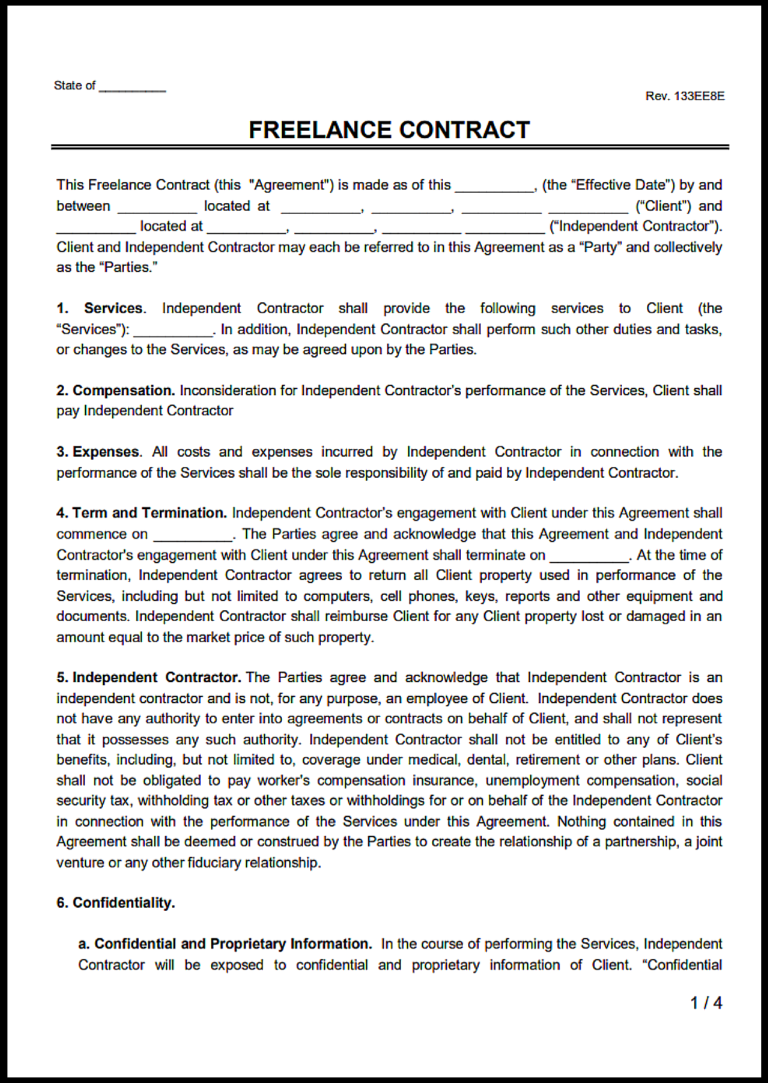
Ontario NDA Agreement Template | Free Legal Form Canada
Ontario NDA agreements are one of the simplest ways to protect your business ideas, data, and sensitive information. If you’re sharing anything confidential—whether with an employee, freelancer, or partner—you need this in place.
I’ve seen Ontario businesses lose the ability to stop former employees or contractors from sharing sensitive information simply because the NDA was too vague or signed too late. When clients come to me after a confidentiality dispute has already started, it’s usually far more expensive and stressful to fix than it would have been to set the agreement up properly from the beginning.
Last Updated: September 2026
What Is an Ontario NDA?
An NDA (Non-Disclosure Agreement) is a legal contract where one or more people agree not to share confidential information.
In simple terms, it’s a promise:
“I won’t share your private business information with anyone else.”
Under Ontario law, NDAs are enforceable contracts when they meet basic rules like offer, acceptance, and consideration (something of value exchanged).
Why Businesses in Ontario Use NDAs
Businesses in Ontario use NDAs to protect important and sensitive information that gives them an advantage. This can include business ideas, startup concepts, client lists, financial data, trade secrets, internal processes, and even marketing or product strategies. Without an NDA, there is always a risk that this information could be shared or misused.
Who Typically Uses NDAs?
NDAs are commonly used in many real-life situations. Employers use them when hiring staff to protect company data, startups rely on them when working with developers or pitching to investors, freelancers often sign them when handling confidential projects, and business partners use them while discussing potential deals or collaborations.
What This Page Includes
On this page, you’ll find everything you need to understand and use an Ontario NDA properly. This includes a free NDA template, an explanation of different types of NDAs, key legal rules that apply in Ontario, and practical tips to help you avoid common mistakes.
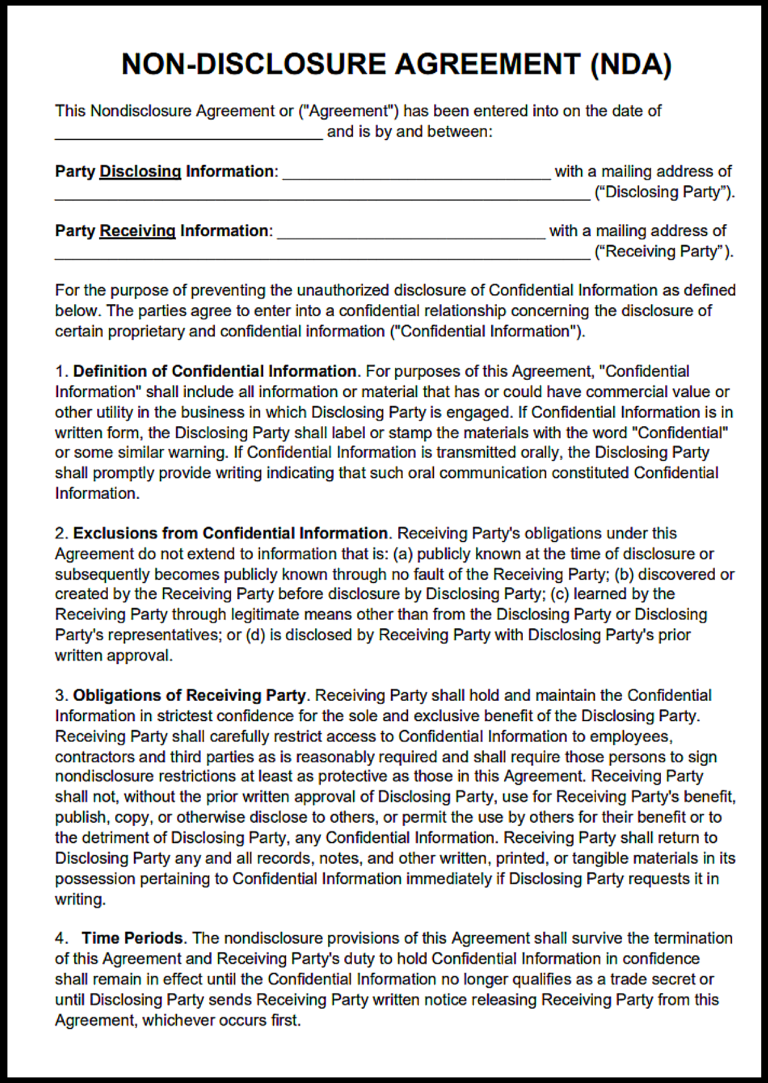
Free Ontario NDA Template (Non-Disclosure Agreement)
Below is a simple, general-purpose NDA suitable for most business situations in Ontario.
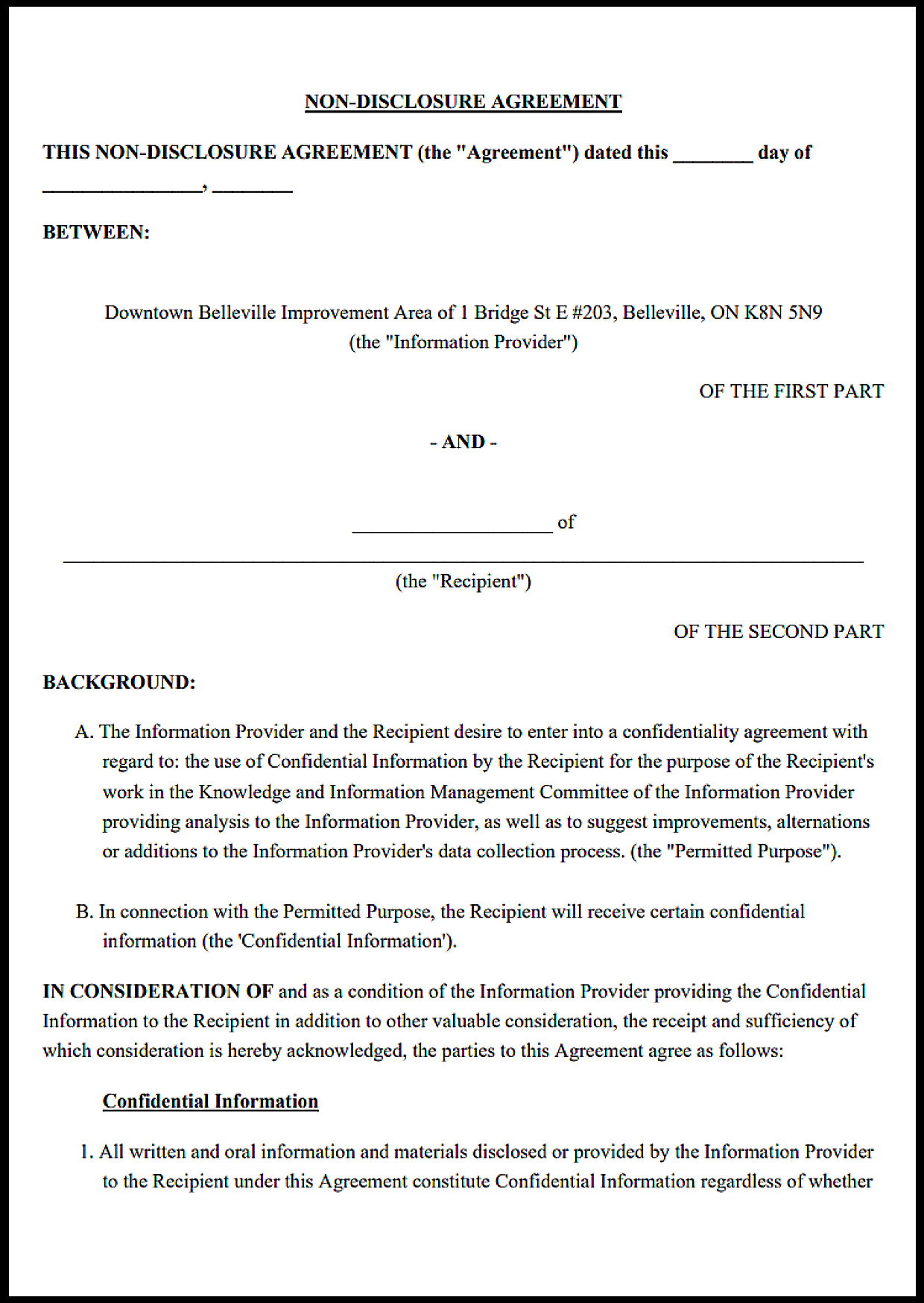
To understand how confidentiality agreements work under provincial law, this page serves as a central resource for creating a legally valid NDA. You can also explore the basic rules of NDAs in Ontario to learn when these agreements are enforceable and how they are commonly used in business settings.
Ontario NDA Laws and Legal Limits Businesses Should Understand
| Topic / Issue | Ontario Legal Rule | Governing Statute |
|---|---|---|
| Primary governance of NDAs | Standard business, commercial, and employment NDAs are primarily governed by contract and common-law principles. Additional legislation may apply depending on the parties, information involved, and purpose of the agreement. | Employment Standards Act, 2000, S.O. 2000, c. 41 |
| Public-sector confidentiality | For Ontario public institutions, privacy and access obligations may arise under FIPPA and other applicable legislation; an NDA does not replace those statutory obligations. | Freedom of Information and Protection of Privacy Act (FIPPA), R.S.O. 1990, c. F.31 |
| Federal privacy application | PIPEDA may apply when an Ontario business is subject to federal privacy law, including federally regulated activities or certain interprovincial or international commercial information flows. | Personal Information Protection and Electronic Documents Act (PIPEDA) |
| Recent restrictions on NDAs | Ontario does not have a general statutory ban on commercial NDAs. However, specific legislation restricts certain confidentiality terms involving sexual-misconduct allegations at covered post-secondary institutions and career colleges. | Ministry of Training, Colleges and Universities Act and applicable amendments |
| Who can legally sign | A person with legal capacity or an authorized representative of a corporation may enter into an NDA, subject to the applicable contract and corporate rules. | Common-law contract principles |
| Witness requirement | A witness is not generally required for an ordinary NDA, although particular transactions or execution requirements may call for additional formalities. | Common-law contract principles |
| Notarization requirement | An ordinary NDA does not generally need to be notarized merely to be enforceable. | Common-law contract principles |
| Minimum age and mental capacity | Ontario’s age of majority is 18, and Ontario law presumes a person who is 18 or older to be capable of entering into a contract, subject to applicable rules and exceptions. | Age of Majority and Accountability Act, R.S.O. 1990, c. A.7; Substitute Decisions Act, 1992 |
| Time limit for legal action | The basic limitation period for a claim is generally two years from when the claim is discovered under the Limitations Act, 2002, subject to the Act’s exceptions and other applicable limitation rules. | Limitations Act, 2002, S.O. 2002, c. 24, Sched. B |
| Whistleblower protection | An NDA should not be drafted as though it overrides statutory reporting, regulatory, law-enforcement, or other legally protected disclosures that apply to the particular situation. | Applicable legislation and public-policy principles |
| Sexual misconduct settlement restrictions | Ontario law restricts certain agreements by covered post-secondary institutions that prohibit disclosure of allegations or complaints of employee sexual misconduct toward students, subject to a statutory exception where the student requests confidentiality and the required conditions are met. | Ministry of Training, Colleges and Universities Act |
| Permitted disclosure clause | An NDA should identify appropriate exceptions for disclosures required or permitted by law and other agreed purposes. | Contract and applicable statutory principles |
| Filing requirements | Ordinary private NDAs generally do not require government filing or registration, although separate filing or disclosure rules may apply if the agreement becomes part of a court or regulatory proceeding. | Applicable Ontario law and procedure |
| Contract effectiveness | An NDA is generally assessed under ordinary contract principles, including formation, consideration where required, certainty, and enforceability of its terms. | Common-law contract principles |
| Lack of consideration | When an NDA is introduced after an employment or commercial relationship has already begun, enforceability can depend on the circumstances and the consideration supporting the new obligation. Ontario case law does not establish a blanket rule that continued employment can never constitute consideration. | Common-law principles (Techform Products Ltd. v. Wolda, 2001 CanLII 8604 (ON CA)) |
| Public policy violations | An NDA should not attempt to prevent disclosures or complaints that cannot lawfully be restricted under applicable legislation or public policy. | Applicable Ontario legislation and common-law principles |
| Overbroad confidentiality scope | An NDA should clearly identify genuine confidential information and should not purport to restrict information that is already public or otherwise outside the legitimate scope of confidentiality protection. | Common-law principles |
| Ontario’s stricter NDA approach | Ontario has targeted statutory restrictions concerning certain sexual-misconduct confidentiality agreements at covered post-secondary institutions and career colleges. These restrictions should not be described as a general ban on commercial NDAs. | Applicable Ontario legislation |
| Trade secret protection approach | Ontario generally protects confidential business information and trade secrets through contract, common-law principles, and other applicable legislation rather than a standalone general Trade Secrets Act. | Common-law principles |
| Restrictive covenant scrutiny | Ontario courts scrutinize restrictive covenants such as non-solicitation clauses for clarity and reasonableness, and an unreasonable covenant may be unenforceable. | Common-law principles |
One of the most important things businesses should understand about Ontario NDAs is that there is no single “NDA law.” Instead, these agreements are affected by contract law, employment legislation, privacy laws where applicable, and court decisions. This matters because downloading a generic NDA template does not automatically make every restriction enforceable.
Ontario also places specific statutory limits on employment non-compete agreements. A confidentiality clause is not automatically a non-compete simply because it protects confidential information. The agreement should identify genuine confidential information and avoid unnecessarily restricting a person’s ability to work or use ordinary skills and experience.
The consideration rule is another real-world issue businesses should understand. If an NDA is introduced after an employment or commercial relationship has already started, the enforceability analysis depends on the circumstances and the consideration supporting the new obligation. Ontario case law does not establish a blanket rule that continued employment can never constitute consideration. Businesses should therefore avoid assuming that a signing bonus or promotion is always legally required.
Types of NDAs in Ontario (Choose the Right One)
Not all NDAs are the same. The right structure depends on who is sharing information, the relationship between the parties, and what the information will be used for.
Unilateral NDA (One-Way NDA)
Only one party shares confidential information.
Used when:
- Hiring employees
- Sharing ideas with contractors
Example: A startup hires a developer and shares its app concept.
Mutual NDA (Two-Way NDA)
Both parties share sensitive information.
Used in:
- Partnerships
- Joint ventures
- Business negotiations
Example: Two companies exploring a collaboration.
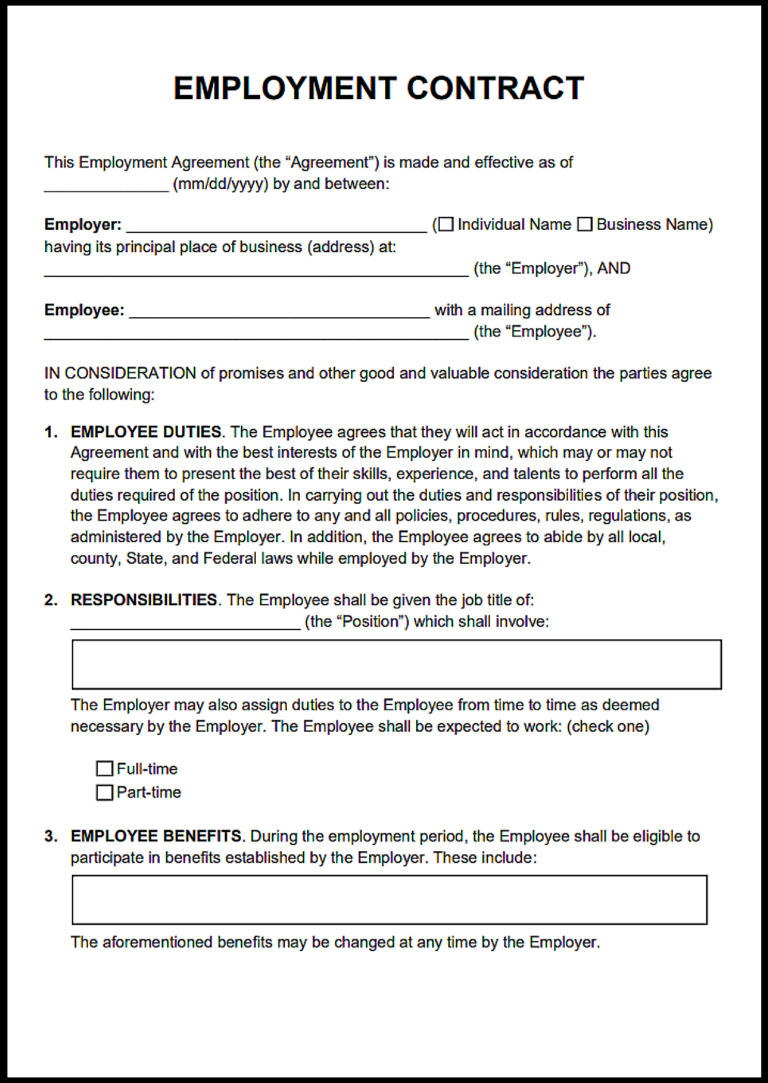
Employee NDA (Confidentiality Clause for Staff)
Protects employer information when hiring staff.
Often included in an employment contract.
Used when:
- Hiring full-time or part-time employees
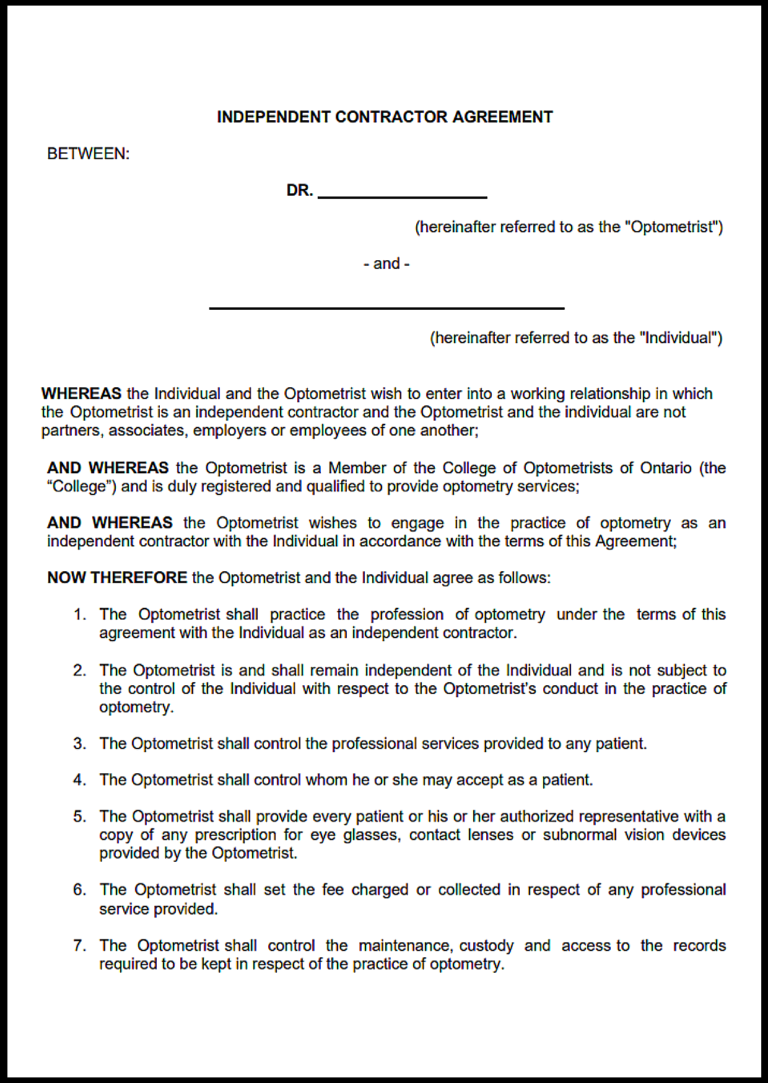
Independent Contractor NDA
Used for freelancers or consultants.
Common in:
- Marketing services
- IT and software projects
Business Sale NDA (Due Diligence NDA)
Used before buying or selling a business.
Protects:
- Financial records
- Customer data
- Internal operations
Often paired with a business purchase agreement or bill of sale.
NDAs are often used alongside other business agreements such as a consulting agreement format or a service agreement structure, especially when confidential information is shared during professional work.
Startup / Investor NDA
Used when pitching to investors or partners.
Protects:
- Business ideas
- Financial projections
- Product plans
Also consider a shareholder agreement for long-term business arrangements.
Real-Life Use Cases of an Ontario NDA
Here’s how NDAs work in real business situations:
- A startup founder shares an app idea with a freelance developer
- A company hires a freelancer for a confidential marketing campaign
- Two businesses explore a partnership deal and exchange strategies
- A business owner shares financial records before selling the company
- An employee gets access to sensitive client data
In each case, the NDA can establish contractual restrictions on how confidential information may be used or disclosed.
Key Elements of a Valid Ontario NDA
A strong NDA focuses on clarity—not complex legal language.
Definition of Confidential Information
Clearly list what is protected:
- Client data
- Trade secrets
- Financial information
The definition should identify genuine confidential information rather than simply describing every piece of information connected with the business as confidential.
Obligations of Receiving Party
Explain what the person can and cannot do:
- Can use info only for agreed purpose
- Cannot share or copy it
Duration of Confidentiality
Set a clear timeframe:
- Fixed term (e.g., 2–5 years)
- Or ongoing for information that remains confidential, where appropriate
The appropriate duration depends on the type of information and the agreement’s circumstances. A fixed period should not be presented as a universal Ontario legal requirement.
Permitted Disclosures
Include legal exceptions:
- Court orders
- Legal requirements
The agreement can also address disclosures to professional advisers or other recipients where appropriate.
Consequences of Breach
State what happens if the NDA is broken:
- Legal action
- Financial damages
- Court injunctions
The actual remedy depends on the circumstances, the agreement, and applicable law. An NDA should not guarantee that a particular remedy will automatically be awarded.
Governing Law Clause (Ontario)
This identifies Ontario as the governing law of the agreement where the parties choose Ontario law and the clause is legally appropriate.
Important for determining which law the parties intend to govern the agreement.
How to Create or Complete an Ontario NDA
Follow these simple steps:
Step 1: Identify parties involved
Use full legal names and addresses.
Step 2: Define confidential information clearly
Avoid vague terms like “all information.”
Step 3: Choose the correct NDA type
Unilateral vs mutual matters.
Step 4: Set duration and obligations
Be reasonable and specific.
Step 5: Review and sign
Both parties should sign the agreement according to its execution terms.
In many cases, businesses also combine NDAs with documents like an independent contractor agreement or a standard employment contract to clearly define both confidentiality and working relationships.
Legal Overview of NDAs in Ontario
Under Ontario law, NDAs are generally assessed under ordinary contract principles. Formation, consideration where required, certainty of the terms, legality, and the circumstances surrounding the agreement can all affect enforceability.
Important Legal Considerations
There are some key legal points to keep in mind when creating or using an NDA in Ontario. The agreement should clearly define what counts as confidential information and should be limited to legitimate confidentiality interests. Employment-related restrictions can also be affected by the Employment Standards Act, 2000 and common-law rules governing restrictive covenants.
When Courts May Reject an NDA:
Ontario courts may refuse to enforce particular NDA terms when they are uncertain, unreasonable, contrary to legislation, or otherwise unenforceable under contract or public-policy principles. The wording and circumstances matter.
Why Clarity Matters More Than Complexity:
An NDA should make the important boundaries obvious: what information is protected, why it may be used, who may receive it, what disclosures are permitted, and how long the obligation lasts.
Common Mistakes When Using an NDA in Ontario
Avoid these common errors:
- Using overly broad or vague language
- Not defining “confidential information” properly
- Choosing the wrong type of NDA
- Missing duration or termination terms
- Assuming an NDA replaces other contracts
- Reusing the same NDA for every situation
Tip: Always adjust your NDA based on the specific business scenario.
Choosing the Right NDA
| Situation | Best NDA Type |
| Only one party shares info | Unilateral NDA |
| Both parties share info | Mutual NDA |
| Hiring employees | Employee NDA |
| Working with freelancers | Contractor NDA |
| Selling a business |
Business Sale NDA
|
| Pitching to investors | Startup NDA |
FAQs About Ontario NDAs
Are NDAs legally enforceable in Ontario?
An NDA can be enforceable in Ontario when it is properly formed and its terms are legally enforceable. Whether a particular clause will be enforced depends on the wording, circumstances, and applicable law.
How long does an NDA last in Canada?
There is no universal Canadian NDA duration. The duration depends on the agreement and the type of information being protected. Some agreements use a fixed confidentiality period, while obligations concerning information that remains confidential may continue longer where legally appropriate.
Can an NDA protect business ideas?
An NDA can protect confidential business information, including certain business ideas, when the information is genuinely confidential and the agreement clearly defines the parties’ obligations. An NDA does not automatically give exclusive ownership of an idea or protect information that is already public.
Do I need a lawyer to create an NDA?
Not always. A simple NDA can be prepared using a suitable template. However, legal advice can be useful when the agreement involves employees, restrictive covenants, valuable trade secrets, a business sale, significant personal information, or a complicated commercial relationship.
What happens if someone breaks an NDA?
If someone breaches an NDA, the affected party may have contractual or other legal remedies depending on the circumstances. These can potentially include a claim for damages or an application for an injunction, but no particular remedy is guaranteed.
Is a verbal NDA valid in Ontario?
An oral confidentiality agreement may create contractual obligations depending on the circumstances, but proving the agreed terms can be much harder. A written NDA provides a clearer record of what information was protected and what restrictions were accepted.
Can NDAs be used with employees and freelancers?
Yes. NDAs are commonly used with employees, freelancers, contractors, and consultants to establish contractual rules concerning confidential business information. Employment-related confidentiality terms should still comply with applicable Ontario legislation and common-law principles.