Ontario As Is Bill of Sale Form | Free PDF Template
Ontario As Is Bill of Sale is one of the most common documents used in private sales—but many people don’t fully understand what it actually protects (and what it doesn’t).
Buying or selling something “as is” in Ontario can become risky if the terms are not clear. This is especially true for used items like cars, bikes, electronics, or furniture.
I’ve seen Ontario buyers assume an “as is” deal means they have no rights at all, only to discover later that missing details or vague wording created disputes neither side expected. In my experience, a properly written bill of sale often becomes the only thing protecting people when memories change or problems show up after the sale.
This article gives you a free Ontario As Is Bill of Sale template, along with simple legal explanations and practical steps to protect yourself. You’ll also learn what “as is” really means under Ontario law.
Last Updated: September 2026
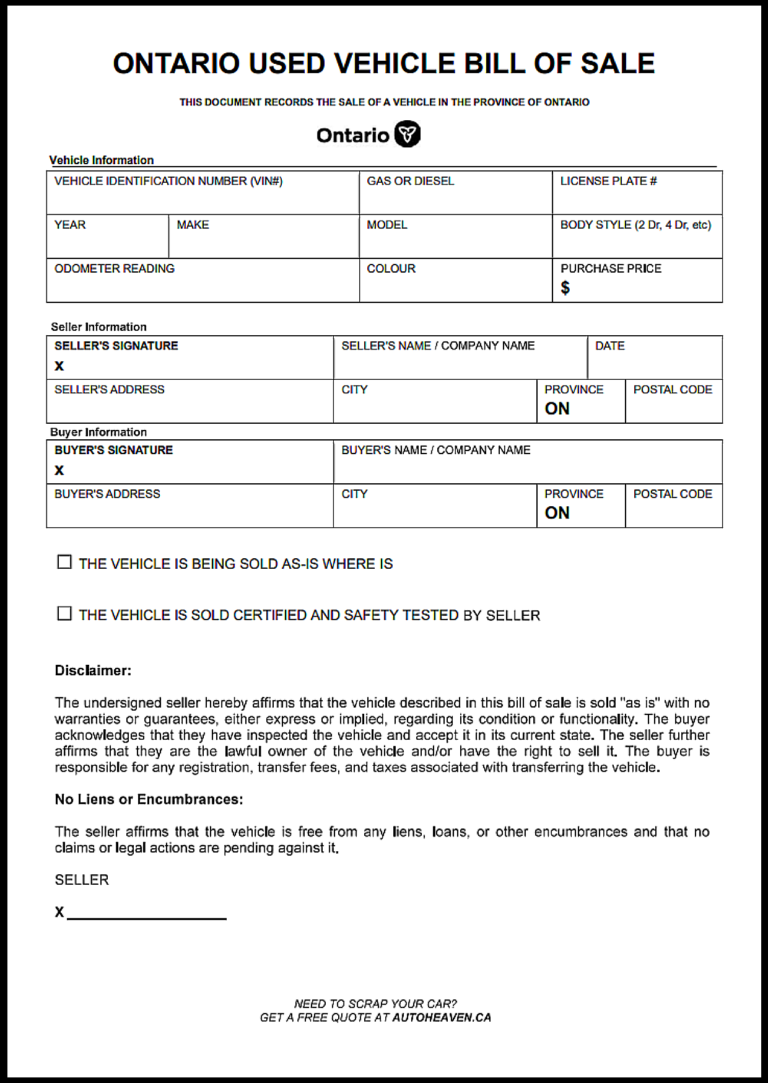
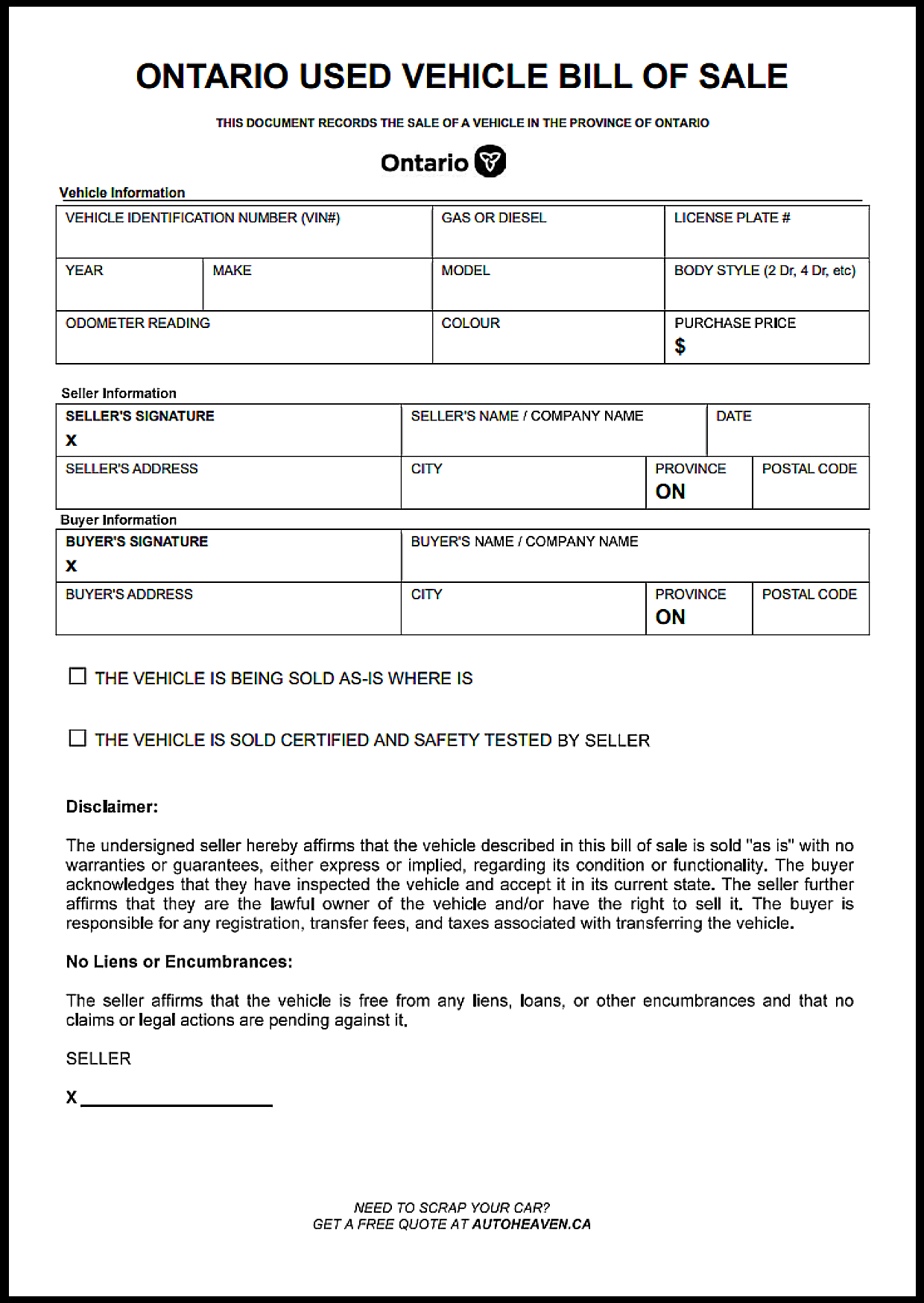
Free Ontario As Is Bill of Sale Template
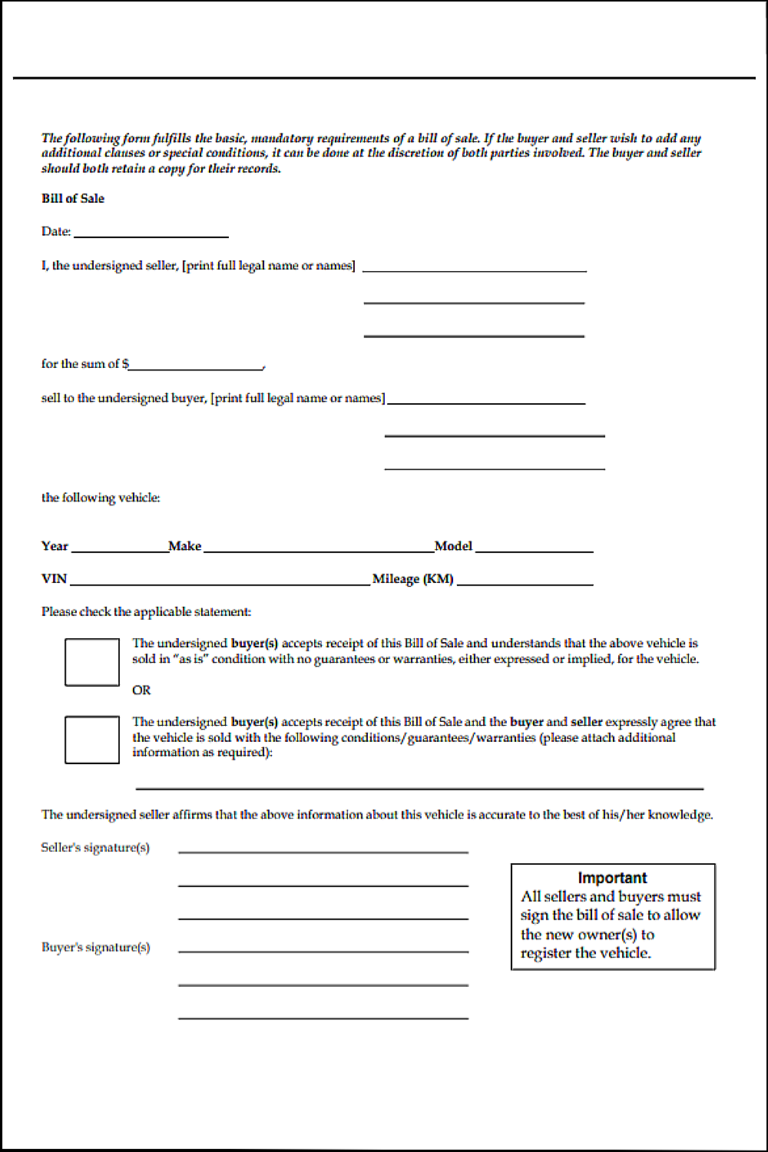
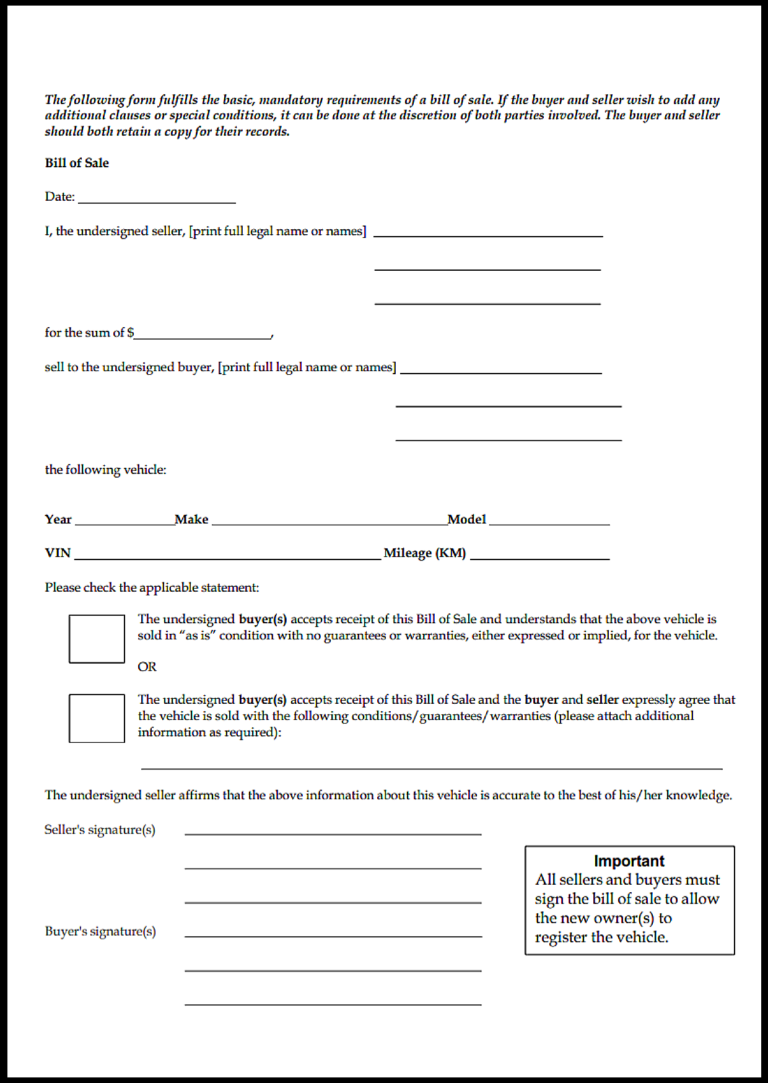
Copy, download, or adapt this template:
Ontario “As Is” Bill of Sale Laws Most Buyers and Sellers Ignore
| Topic / Issue | Ontario Legal Rule | Governing Statute |
|---|---|---|
| Governing legislation | Private sales of goods in Ontario are generally governed by the Sale of Goods Act and common-law contract principles, with other Ontario laws applying depending on the type of transaction. | Sale of Goods Act, R.S.O. 1990, c. S.1 |
| Vehicle sale legislation | Vehicle transfers and registration requirements are governed separately under Ontario’s Highway Traffic Act and related requirements. | Highway Traffic Act, R.S.O. 1990, c. H.8 |
| Federal legislation | No single federal statute generally governs every private “as is” sale of goods. Federal laws may apply to particular goods or transactions. | Federal law may apply depending on the transaction |
| Recent legal updates | The Consumer Protection Act, 2023 applies to consumer transactions that fall within its statutory definitions. A genuinely private sale between individuals will generally fall outside the Act’s supplier-consumer framework, but the facts of the transaction should be considered before concluding that the Act does not apply. | Consumer Protection Act, 2023, S.O. 2023, c. 23, Sch. 1 |
| Who can sign | The parties should have legal capacity to enter the transaction, and a corporation or other organization should sign through a person with appropriate authority. | Sale of Goods Act; general Ontario contract law |
| Witness requirement | An ordinary private bill of sale does not generally require a witness to be valid, although a witness may provide additional evidence about the signing. | Common law principles |
| Notarization | Notarization is generally not required for an ordinary private bill of sale. | Common law principles |
| Age and legal capacity | Contractual capacity is governed by Ontario’s general law, and the Sale of Goods Act specifically provides rules for sales of necessaries to minors. | Sale of Goods Act, s. 3 |
| Vehicle registration deadline | A purchaser of a motor vehicle or trailer for which a permit has been issued must apply for a new permit within six days after becoming the owner. | Highway Traffic Act, s. 11(2) |
| “As is” protection limits | An express “as is” term can affect contractual rights and implied terms, but its effect depends on the wording, the applicable law and the circumstances of the sale. | Sale of Goods Act |
| Mandatory vehicle wording | The prescribed “as-is” disclosure wording in O. Reg. 333/08 applies to registered motor vehicle dealers. Ontario does not prescribe the same “as-is” script for an ordinary private individual sale, although clear contractual wording can be important when the parties intend to vary rights that can legally be varied. | Sale of Goods Act, R.S.O. 1990, c. S.1, s. 53 |
| Vehicle information package requirement | A person who sells, offers for sale or transfers a used motor vehicle generally must provide a valid Used Vehicle Information Package (UVIP) and deliver it to the purchaser or transferee at the time of sale or transfer, subject to applicable exemptions. | Highway Traffic Act, s. 11.1 |
| Registration requirement for general goods | An ordinary private bill of sale generally does not need to be filed or registered with the Ontario government. | Private contract principles |
| Vehicle ownership transfer | Vehicle purchasers must complete the applicable ownership and registration requirements through ServiceOntario. | Highway Traffic Act |
| Boat registration | Pleasure craft licensing is handled federally through Transport Canada. | Pleasure Craft Electronic Licensing System (PCELS) |
| Missing VIN | An incorrect or missing VIN can create problems with vehicle identification and the ownership-transfer process. | Highway Traffic Act |
| Consideration requirement | A sale normally involves an exchange of value, such as money or another form of consideration, although the enforceability of a particular transaction depends on the applicable contract rules and circumstances. | Sale of Goods Act / Ontario common law |
| Undisclosed liens | The Sale of Goods Act implies a warranty that goods will be free from charges or encumbrances in favour of third parties that were not declared or known to the buyer when the contract was made, unless the circumstances show a different intention. | Sale of Goods Act, s. 13 |
| Ontario UVIP difference | Ontario requires a UVIP for covered private used-vehicle sales and transfers, subject to applicable exemptions. | Highway Traffic Act, s. 11.1 |
| Retail Sales Tax on private vehicle sales | Ontario charges 13% Retail Sales Tax (RST) on specified vehicles purchased privately, subject to applicable exemptions. For an automobile, van or truck with an empty weight of 2,200 kg or less, the tax base is generally the greater of the purchase price or the applicable Canadian Red Book value. RST does not generally apply to ordinary private sales of household goods such as furniture or electronics under the specified-vehicle RST rules. | Retail Sales Tax Act, R.S.O. 1990, c. R.31 |
| Family gift exemption rules | A qualifying family gift of a used vehicle requires the prescribed sworn statement, signed before a Commissioner of Oaths or Commissioner for Taking Affidavits. | Form 1157E requirements |
Ontario has some surprisingly important rules for private “as is” sales, especially when vehicles are involved. Many sellers wrongly assume writing “sold as is” automatically protects them from every future dispute. In reality, the effect of an “as is” clause depends on the agreement and the circumstances of the transaction. Vehicle sellers also need to pay attention to accurate identification and ownership paperwork. One of the biggest Ontario-specific requirements is the Used Vehicle Information Package (UVIP), which generally must be provided in covered used-vehicle sales.
The six-day vehicle registration rule also matters more than many buyers realize. A purchaser must apply for a new permit within six days after becoming the owner. Another issue is undisclosed liens or other third-party charges. The Sale of Goods Act contains an implied warranty concerning undisclosed third-party charges or encumbrances, subject to the statutory rules and circumstances of the transaction.
These rules matter because small mistakes in a bill of sale can quickly turn into expensive disputes, rejected transfers, or legal claims involving misrepresentation or other issues. To document the transaction clearly, use the free Ontario As Is Bill of Sale template before completing the sale and customize it to the goods and circumstances involved.
What Does “As Is” Mean in Ontario Sales?
In simple terms, an “as is” sale means the buyer agrees to accept the goods in their existing condition under the agreed terms. The legal effect of that wording depends on the agreement, the type of goods and the circumstances of the sale.
An “as is” clause can place substantial condition risk on the buyer. However, Ontario’s Sale of Goods Act contains implied conditions and warranties that may apply unless the circumstances or an express agreement legally vary them. An “as is” clause does not automatically eliminate every possible legal claim or remedy. Misrepresentation, fraud and other legally actionable conduct can create separate issues depending on the facts.
Even if the document says “as is”:
- A seller should not make false or misleading statements about the item
- A seller should not deliberately conceal material information where the law imposes a duty not to do so
If a dispute arises, the buyer’s available remedies will depend on the facts, the contract wording and the applicable law.
An as-is bill of sale is used when the buyer accepts the item subject to the agreed condition and warranty terms. To understand how this differs from standard formats, review the complete bill of sale guide and examples like the car sale agreement.
When Should You Use an As Is Bill of Sale?
You should use this document in most private, informal sales where the buyer and seller want a written record of the item, price, condition and agreed “as is” terms.
Common situations include:
- Selling items on Kijiji or Facebook Marketplace
- Selling second-hand goods (furniture, appliances)
- Selling used vehicles without warranty
- Quick transactions between individuals
Real-life examples:
- Selling a used bike with worn brakes → the agreement can record that the buyer accepts the bike in its existing condition
- Buying a second-hand sofa → the bill of sale can record visible stains, wear or other disclosed condition issues
If you’re dealing with vehicles, you may also want to check our Ontario Vehicle Bill of Sale template for more detailed requirements.
Is an As Is Bill of Sale Legally Valid in Ontario?
A private bill of sale can be a valid contract when the parties have reached an enforceable agreement and the terms are sufficiently clear.
Under Ontario contract principles and the Sale of Goods Act:
A written bill of sale should clearly identify the transaction and the terms the parties have agreed to.
- Agreement between buyer and seller
- Clear terms, including any “as is” provision
- Signatures are strongly recommended as evidence of the agreement
If these elements are present, the document can provide useful evidence of the transaction. However, a signature is not an absolute requirement for every contract of sale because Ontario law recognizes contracts that may be made orally, in writing, partly orally and in writing, or by conduct.
Important legal point:
Misrepresentation can create liability despite “as is” wording
If a seller lies about:
- Condition
- History
- Major defects
The buyer may still have a legal claim depending on the nature of the statement, the seller’s conduct, the contract wording and the available evidence.
Key Elements That Make Your Document Strong
Clear Identification of Buyer and Seller
Always include:
- Full legal names
- Complete addresses
This helps avoid identity disputes later.
Detailed Description of the Item
Avoid vague wording like:
- “Used item”
- “Old product”
Instead, include:
- Make and model
- Condition
- Known issues
The more accurately you describe the goods and disclosed defects, the clearer the record of the transaction becomes.
Strong “As Is” Clause
Your clause should clearly explain the condition and warranty terms the parties have agreed to, such as:
- No express warranties, if that is what the parties intend
- No guarantees beyond those expressly included in the agreement
Avoid confusing or incomplete wording. An “as is” clause should not be treated as an automatic waiver of every statutory right or legal remedy.
Sale Price and Payment Details
Include:
- Exact amount paid
- Payment method (cash, e-transfer, etc.)
This helps prevent disputes about money later.
Signatures and Date
A signed bill of sale provides useful evidence of the parties’ agreement.
Always include:
- Both signatures
- Date of sale
How to Fill Out the Template (Step-by-Step)
Step 1 – Enter Personal Details
Write full legal names and addresses for both parties.
Step 2 – Describe the Item Honestly
Be clear and honest about:
- Condition
- Defects
- Usage
This step helps create a clear record of what the buyer was told and what was being sold.
Step 3 – Add the Sale Price
Include:
- Final agreed amount
- Payment type
Step 4 – Confirm the “As Is” Agreement
Make sure both parties understand:
- What warranties, if any, are excluded
- That the buyer is accepting the goods subject to the agreed “as is” terms
Do not use wording that suggests the buyer has automatically waived every future legal claim.
Step 5 – Sign and Keep Copies
Both parties should:
- Sign the document
- Keep a copy (digital + printed)
Tip: Always store a photo or PDF version.
This type of agreement is often used in private sales and should align with Ontario legal requirements. You can also compare it with ownership concepts in the bill of sale vs ownership explanation.
For official consumer protection and sales laws in Ontario, you can refer to Government of Ontario resources.
Legal Risks of “As Is” Sales (Very Important)
An “as is” clause can reduce the buyer’s contractual protections, but it is not a universal shield against every dispute.
Hidden Defects Can Still Cause Problems
If a seller knew about a material defect and their conduct gives rise to a legally actionable claim:
- They may still face legal action
Whether the buyer has a remedy depends on the facts and applicable law.
Fraud Overrides “As Is” Protection
If a seller lies:
- The buyer may still have a claim based on the seller’s conduct
An “as is” clause should not be treated as permission to make fraudulent or misleading statements.
Buyer Has Limited Protection
Buyers should understand:
- An “as is” agreement may significantly limit contractual warranty protection
- There is not necessarily a general right to a refund simply because the buyer later regrets the purchase or discovers an ordinary condition issue
Real scenario:
A seller hides a serious engine issue in a car.
Even with “as is” wording, the buyer may still have a claim if the facts establish actionable misrepresentation, fraud or another legal basis for relief.
As Is vs Regular Bill of Sale
| Feature | As Is Sale | Regular Sale |
| Warranty | May exclude or limit express/implied warranties to the extent legally permitted |
May include express warranties or other protections
|
| Risk Level | More condition risk may fall on buyer |
May provide greater contractual protection for buyer
|
| Disclosure | Sellers should accurately describe the goods and avoid misleading statements |
Sellers should accurately describe the goods and comply with applicable legal obligations
|
| Contract Terms | Buyer accepts the agreed “as is” terms |
Terms may provide broader warranties or remedies
|
If you want stronger buyer protection, consider using a standard Ontario Bill of Sale template instead.
Special Case: Vehicles Sold “As Is” in Ontario
This is very common in used vehicle sales.
You’ll often see terms like:
- “Not certified”
- “Not roadworthy”
Important Rules
- Buyers should understand the vehicle’s condition and may need to address safety or certification requirements before registration where applicable
- Sellers must not make false or misleading statements about the vehicle
For covered private used-vehicle transactions, Ontario also requires a Used Vehicle Information Package (UVIP), and the purchaser must complete the applicable vehicle permit and registration requirements.
Required Documents (Vehicle Sales)
For vehicle transactions, you typically need:
- Bill of Sale
- Used Vehicle Information Package (UVIP), where required
- Ownership transfer documents
If you’re selling a bike or trailer, check:
- Ontario Motorcycle Bill of Sale
- Ontario Trailer Bill of Sale
These include more specific legal details.
Common Mistakes to Avoid
Many disputes happen because of simple mistakes:
- Not clearly writing the intended “as is” terms
- Making verbal promises that contradict or create uncertainty about the written terms
- Missing signatures
- Poor item description
- Not keeping a copy
Always treat even small sales seriously.
Frequently Asked Questions
Can I sell anything “as is” in Ontario?
Private parties can generally agree to an “as is” sale where the transaction is lawful, but the wording and circumstances matter. The buyer may accept substantial condition risk, while statutory rights and other legal remedies may still need to be considered.
Can a buyer return an “as is” item?
There is not generally an automatic right to return an item simply because it was sold “as is.” However, a buyer may have legal rights depending on the agreement and circumstances, including where there was actionable misrepresentation, fraud or another legal basis for a remedy.
Is a handwritten bill of sale valid?
A handwritten bill of sale can provide evidence of a sale if it clearly records the parties, goods, price and agreed terms. Ontario contract law does not make a particular printed form mandatory for an ordinary private sale.
Do I need a witness?
No, a witness is not generally legally required for an ordinary private bill of sale. Still, having one can provide additional evidence about the signing if a dispute later arises.
Does “as is” protect me completely?
No. Selling “as is” does not give full protection against every possible claim. The clause may affect contractual warranties and implied terms to the extent permitted by law, but it does not automatically eliminate claims arising from fraud, misrepresentation or other legally actionable conduct.