Ontario As Is Bill of Sale Form | Free PDF Template
Ontario As Is Bill of Sale is one of the most common documents used in private sales—but many people don’t fully understand what it actually protects (and what it doesn’t).
Buying or selling something “as is” in Ontario can become risky if the terms are not clear. This is especially true for used items like cars, bikes, electronics, or furniture.
I’ve seen Ontario buyers assume an “as is” deal means they have no rights at all, only to discover later that missing details or vague wording created disputes neither side expected. In my experience, a properly written bill of sale often becomes the only thing protecting people when memories change or problems show up after the sale.
This article gives you a free Ontario As Is Bill of Sale template, along with simple legal explanations and practical steps to protect yourself. You’ll also learn what “as is” really means under Ontario law.
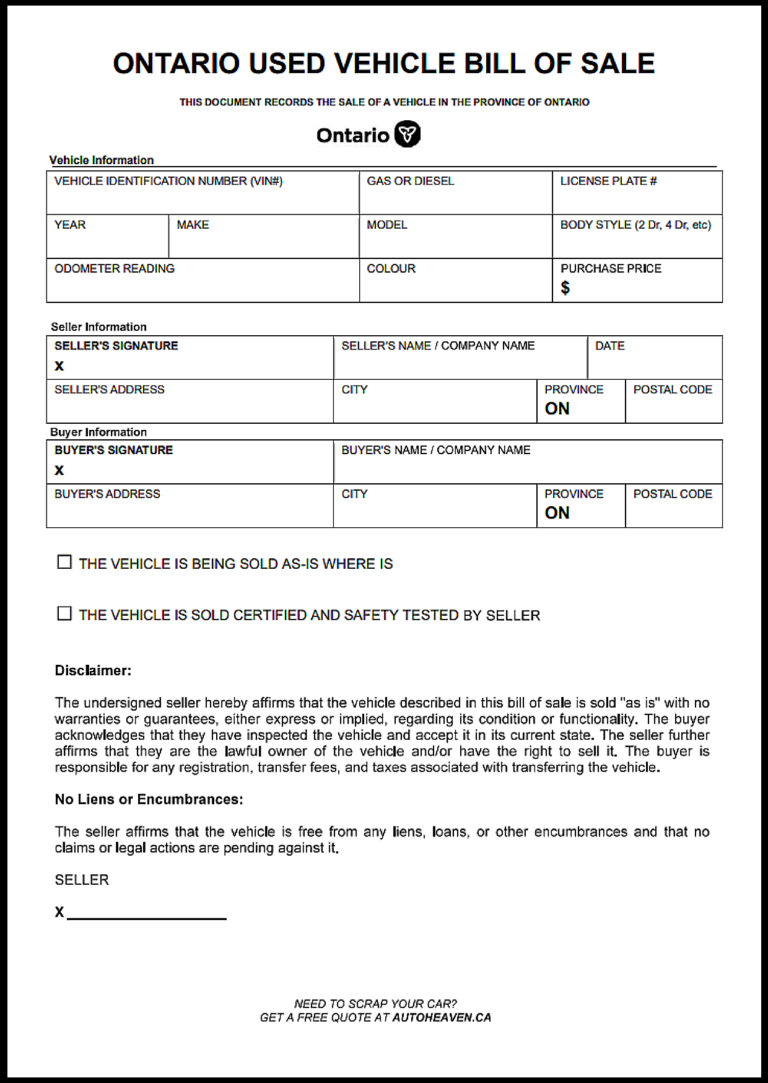
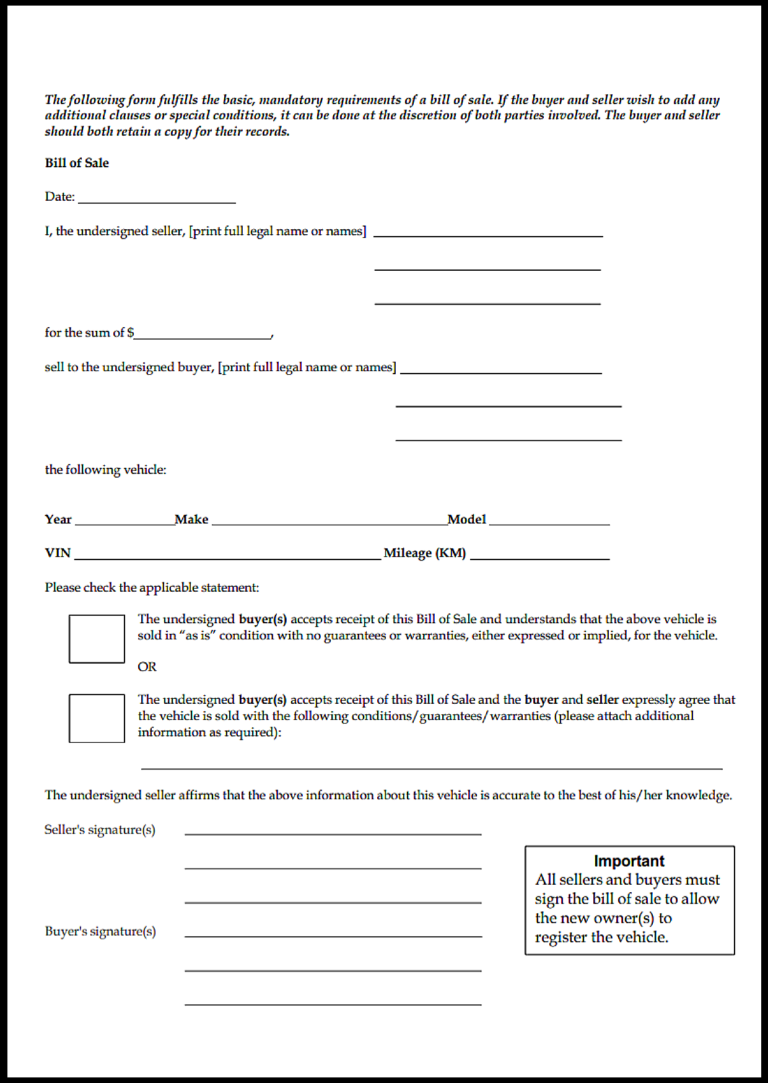
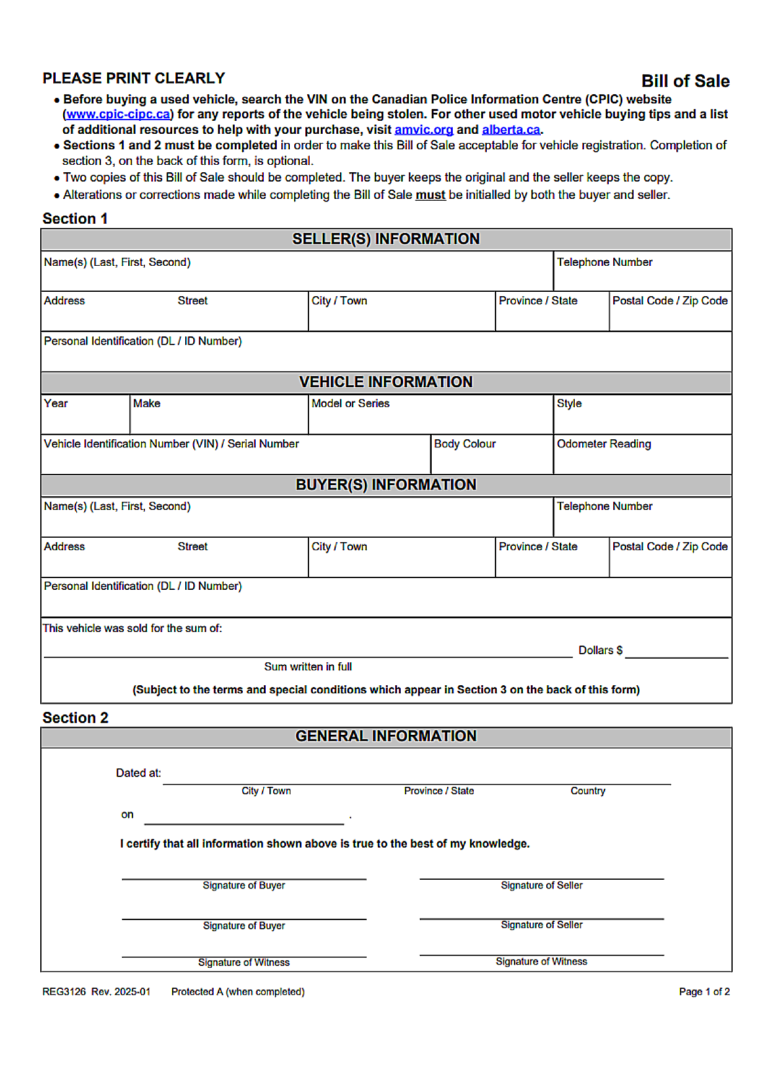
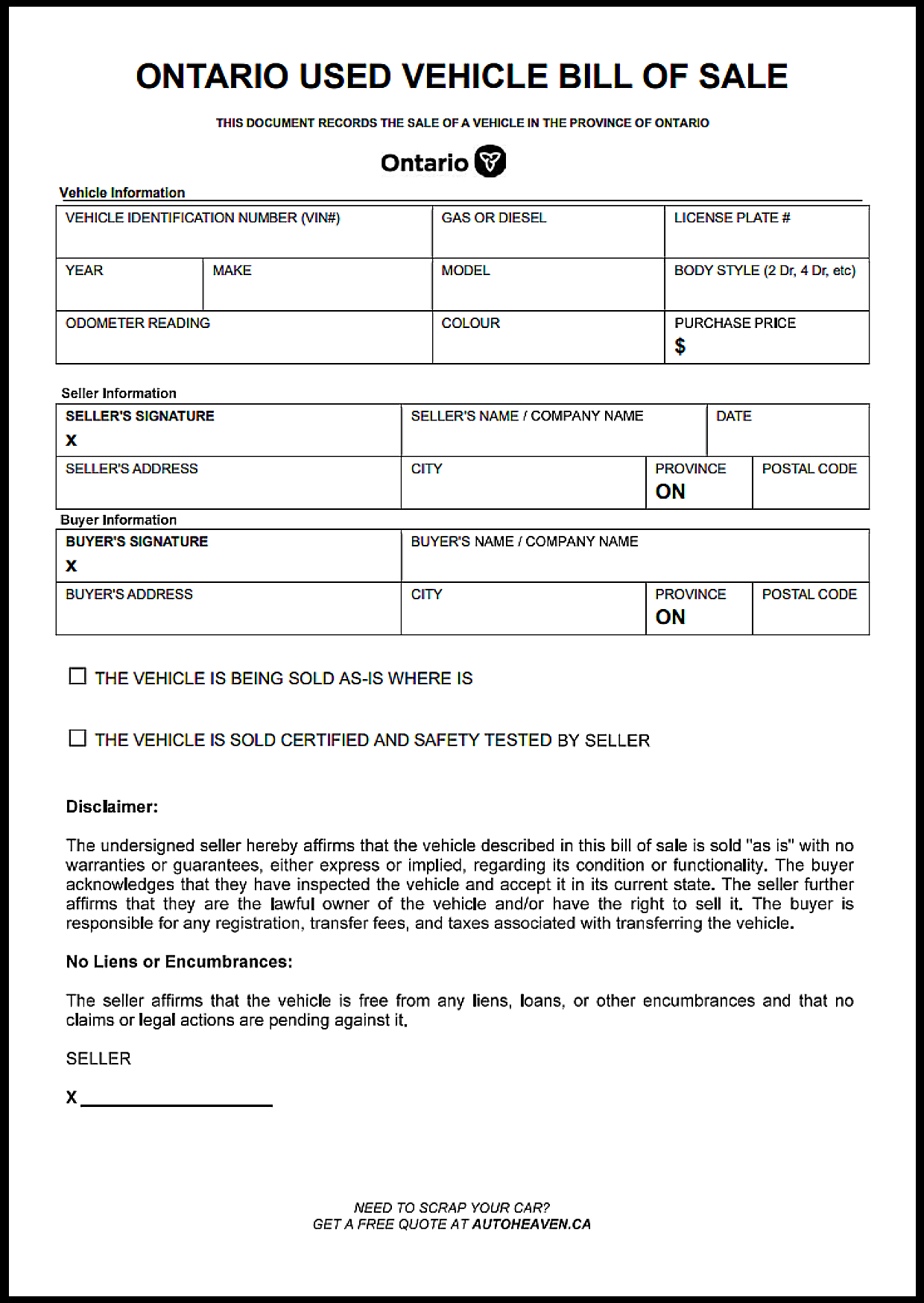
Free Ontario As Is Bill of Sale Template
Copy, download, or adapt this template:
Ontario “As Is” Bill of Sale Laws Most Buyers and Sellers Ignore
| Topic / Issue | Ontario Legal Rule | Governing Statute |
|---|---|---|
| Governing legislation | Private “as is” sales in Ontario are primarily governed at the provincial level. | Sale of Goods Act, R.S.O. 1990, c. S.1 |
| Vehicle sale legislation | Vehicle transfers and registration requirements are governed separately. | Highway Traffic Act, R.S.O. 1990, c. H.8 |
| Federal legislation | No federal statute governs private “as is” sales of goods. | None |
| Recent legal updates | The Consumer Protection Act, 2023 (S.O. 2023, c. 23, Sch. 1) applies strictly to transactions between a commercial supplier and an individual consumer. It has zero application to private peer-to-peer (P2P) sales, which remain governed exclusively by the Sale of Goods Act and common law contract principles. | None (Not applicable to private sales) |
| Who can sign | Any individual or corporation with legal ownership of the goods may sign the bill of sale. | Sale of Goods Act, s. 2 |
| Witness requirement | Ontario law does not require witnesses for a valid private bill of sale. | Common law principles |
| Notarization | Notarization is generally not required for private sales documents. | Common law principles |
| Age and legal capacity | Minors may have limited ability to enter binding contracts except for necessaries. | Sale of Goods Act, s. 3 |
| Vehicle registration deadline | Buyers must register a purchased vehicle within 6 days of sale. | Highway Traffic Act, s. 11(2) |
| “As is” protection limits | Sellers must clearly disclaim warranties to reduce future liability. | Sale of Goods Act |
| Mandatory vehicle wording | OMVIC’s mandatory ‘as is’ disclosure statements apply strictly to registered motor vehicle dealers under the Motor Vehicle Dealers Act, 2002. No specific ‘as is’ script is statutorily mandated for private individual agreements, though explicit language is required to contract out of the Sale of Goods Act. | Sale of Goods Act, R.S.O. 1990, c. S.1, s. 53 |
| Vehicle information package requirement | Sellers must provide a Used Vehicle Information Package (UVIP) during private vehicle sales. | Highway Traffic Act, s. 11.1 |
| Registration requirement for general goods | Bills of sale for ordinary goods do not need government registration. | Private contract principles |
| Vehicle ownership transfer | Vehicle buyers must present transfer documents to ServiceOntario. | Highway Traffic Act |
| Boat registration | Pleasure craft licensing is handled federally through Transport Canada. | Pleasure Craft Electronic Licensing System (PCELS) |
| Missing VIN | An incorrect or missing VIN can prevent a valid vehicle transfer. | Highway Traffic Act |
| Consideration requirement | A bill of sale normally requires payment or other consideration to remain enforceable. | Sale of Goods Act / Ontario common law |
| Undisclosed liens | Sellers are expected to transfer goods free of undisclosed liens or encumbrances. | Sale of Goods Act, s. 13 |
| Ontario UVIP difference | Ontario uniquely requires a UVIP for private used vehicle sales. | Highway Traffic Act, s. 11.1 |
| Retail Sales Tax on private vehicle sales | Buyers must pay 13% Retail Sales Tax (RST) on private used vehicle transfers based on the greater of the purchase price or the Canadian Red Book wholesale value. Private peer-to-peer sales of general consumer goods (furniture, electronics, tools) are completely exempt from tax. | Retail Sales Tax Act, R.S.O. 1990, c. R.31 |
| Family gift exemption rules | Tax-exempt family transfers require a sworn statement commissioned by a Notary or Commissioner of Oaths. | Form 1157E requirements |
Ontario has some surprisingly strict rules for private “as is” sales, especially when vehicles are involved. Many sellers wrongly assume writing “sold as is” automatically protects them from every future dispute. In reality, Ontario law still expects honest disclosure, accurate VIN details, and proper ownership paperwork. One of the biggest surprises for many people is the mandatory Used Vehicle Information Package (UVIP). Unlike provinces such as Alberta or British Columbia, Ontario legally requires this document during most private vehicle sales.
The six-day vehicle registration deadline also matters more than many buyers realize. Missing it can delay ownership transfer and create registration problems with ServiceOntario. Another major issue is undisclosed liens. If money is still owed against a vehicle or item, the buyer could face serious financial headaches later.
These rules matter because small mistakes in a bill of sale can quickly turn into expensive disputes, rejected transfers, or even legal claims over fraud or misrepresentation. To protect yourself properly, download and use the free Ontario As Is Bill of Sale template before completing any private sale.
What Does “As Is” Mean in Ontario Sales?
In simple terms, “as is” means the buyer accepts the item in its current condition.
Under Ontario common law, the principle of caveat emptor (buyer beware) shifts the risk of patent defects (visible upon reasonable inspection) to the buyer. While a seller can explicitly exclude statutory implied conditions of quality and fitness under section 53 of the Sale of Goods Act, R.S.O. 1990, c. S.1, an ‘as is’ clause is legally voided if the seller commits fraudulent misrepresentation or actively conceals a latent defect—a hidden, non-discoverable fault that renders the item hazardous or structurally useless.
Even if the document says “as is”:
- A seller cannot misrepresent the item
- A seller cannot hide known defects
If they do, the buyer may still take legal action.
An as-is bill of sale is used when the buyer accepts the item without warranties. To understand how this differs from standard formats, review the complete bill of sale guide and examples like the car sale agreement.
When Should You Use an As Is Bill of Sale?
You should use this document in most private, informal sales.
Common situations include:
- Selling items on Kijiji or Facebook Marketplace
- Selling second-hand goods (furniture, appliances)
- Selling used vehicles without warranty
- Quick transactions between individuals
Real-life examples:
- Selling a used bike with worn brakes → “as is” protects the seller from complaints later
- Buying a second-hand sofa → buyer accepts stains or wear upfront
If you’re dealing with vehicles, you may also want to check our Ontario Vehicle Bill of Sale template for more detailed requirements.
Is an As Is Bill of Sale Legally Valid in Ontario?
Yes—in most private sale situations, it is legally valid.
Under Ontario contract principles (and similar rules found in the Sale of Goods Act):
A valid bill of sale must include:
- Agreement between buyer and seller
- Clear terms (including “as is”)
- Signatures
If these elements are present, the document is generally enforceable.
Important legal point:
Misrepresentation overrides “as is”
If a seller lies about:
- Condition
- History
- Major defects
Then courts may ignore the “as is” clause.
Key Elements That Make Your Document Strong
Clear Identification of Buyer and Seller
Always include:
- Full legal names
- Complete addresses
This helps avoid identity disputes later.
Detailed Description of the Item
Avoid vague wording like:
- “Used item”
- “Old product”
Instead, include:
- Make and model
- Condition
- Known issues
The more detail you add, the stronger your protection.
Strong “As Is” Clause
Your clause must clearly say:
- No warranties
- No guarantees
Avoid confusing or incomplete wording.
Sale Price and Payment Details
Include:
- Exact amount paid
- Payment method (cash, e-transfer, etc.)
This helps prevent disputes about money later.
Signatures and Date
Without signatures:
- The document may not be enforceable
Always include:
- Both signatures
- Date of sale
How to Fill Out the Template (Step-by-Step)
Step 1 – Enter Personal Details
Write full legal names and addresses for both parties.
Step 2 – Describe the Item Honestly
Be clear and honest about:
- Condition
- Defects
- Usage
This step protects both sides.
Step 3 – Add the Sale Price
Include:
- Final agreed amount
- Payment type
Step 4 – Confirm the “As Is” Agreement
Make sure both parties understand:
- No warranty
- No future claims (except fraud cases)
Step 5 – Sign and Keep Copies
Both parties should:
- Sign the document
- Keep a copy (digital + printed)
Tip: Always store a photo or PDF version.
This type of agreement is often used in private sales and should align with Ontario legal requirements. You can also compare it with ownership concepts in the bill of sale vs ownership explanation.
For official consumer protection and sales laws in Ontario, you can refer to Government of Ontario resources.
Legal Risks of “As Is” Sales (Very Important)
“As is” reduces risk—but it does NOT remove it completely.
Hidden Defects Can Still Cause Problems
If a seller knew about a defect and did not disclose it:
- They can still face legal action
Fraud Overrides “As Is” Protection
If a seller lies:
- The clause becomes weak or useless
Buyer Has Limited Protection
Buyers should understand:
- No refunds in most cases
- No warranty coverage
Real scenario:
A seller hides a serious engine issue in a car.
Even with “as is,” the buyer may still sue for misrepresentation.
As Is vs Regular Bill of Sale
| Feature | As Is Sale | Regular Sale |
| Warranty | None | May exist |
| Risk Level | Higher for buyer | More balanced |
| Disclosure | Still required | Required |
| Legal Protection | Limited | Stronger |
If you want stronger buyer protection, consider using a standard Ontario Bill of Sale template instead.
Special Case: Vehicles Sold “As Is” in Ontario
This is very common in used vehicle sales.
You’ll often see terms like:
- “Not certified”
- “Not roadworthy”
Important Rules
- Buyers may need an inspection before registration
- Sellers must not mislead about condition
Required Documents (Vehicle Sales)
For vehicle transactions, you typically need:
- Bill of Sale
- Used Vehicle Information Package (UVIP)
- Ownership transfer
If you’re selling a bike or trailer, check:
- Ontario Motorcycle Bill of Sale
- Ontario Trailer Bill of Sale
These include more specific legal details.
Common Mistakes to Avoid
Many disputes happen because of simple mistakes:
- Not clearly writing “as is”
- Making verbal promises (these can override the document)
- Missing signatures
- Poor item description
- Not keeping a copy
Always treat even small sales seriously.
Frequently Asked Questions
Can I sell anything “as is” in Ontario?
Yes, you can sell items “as is” in Ontario as long as the item itself is legal. The buyer accepts the item in its current condition without guarantees.
Can a buyer return an “as is” item?
Usually, a buyer cannot return an “as is” item. However, they may have rights if there was fraud, hidden defects, or false information provided.
Is a handwritten bill of sale valid?
Yes, a handwritten bill of sale is valid if it clearly includes all key details like names, item description, price, and signatures.
Do I need a witness?
No, a witness is not legally required. Still, having one can be helpful if there is a dispute later.
Does “as is” protect me completely?
No, selling “as is” does not give full protection. It does not cover cases of dishonesty, fraud, or intentional misrepresentation.