Ontario Car Bill of Sale | Free Form & Guide
Ontario Car Bill of Sale is one of the most important documents when buying or selling a car privately in Ontario. It acts as written proof of the deal and protects both the buyer and seller.
In most private sale situations, this document records the price, vehicle details, and ownership transfer. While Ontario law does not always strictly require it, it is practically essential for registration, tax purposes, and avoiding disputes.
I’ve seen private car sales in Ontario turn into expensive disputes simply because the bill of sale was missing key details or signed incorrectly. When buyers come to me after registration problems or unpaid parking tickets tied to the old owner, it’s usually because they thought a simple handwritten note was enough.
Before we get into the form itself, here is what this page covers. You will find a free Ontario car bill of sale template you can download and fill out today. We also walk through the Ontario-specific rules that make this document actually hold up — what needs to be on it, what the province requires for a private sale, and the mistakes that trip people up at the ServiceOntario counter.
Last Updated: September 2026
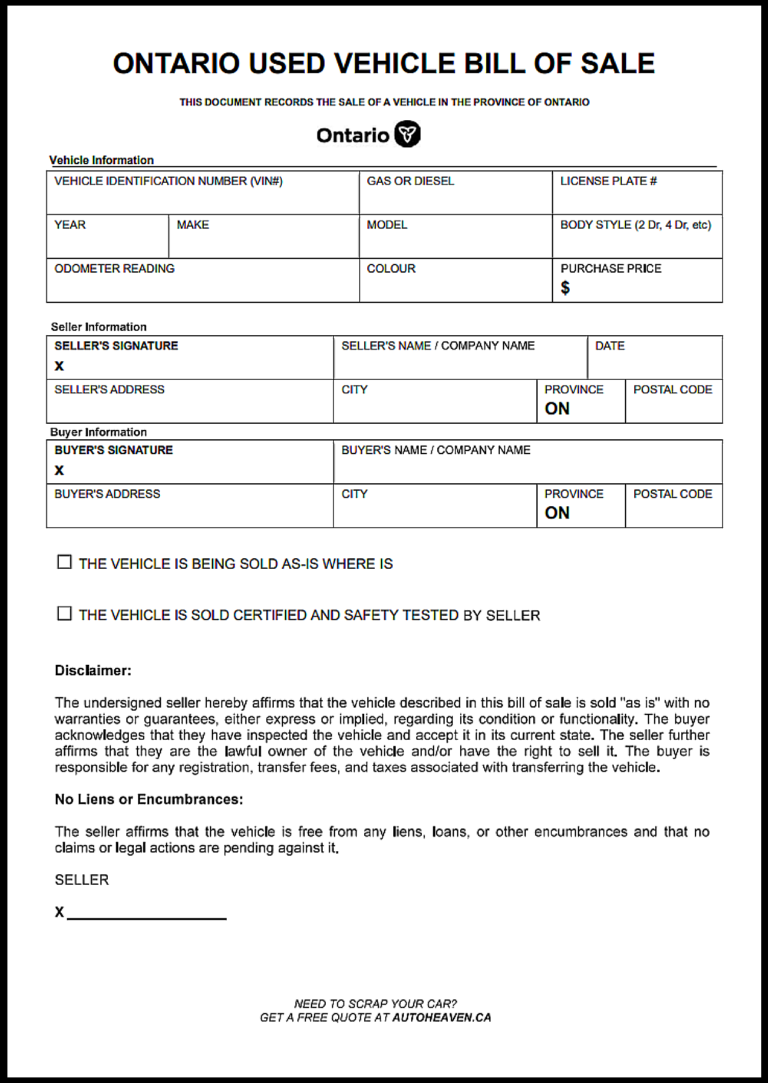
Free Ontario Car Bill of Sale Template
Use this simple and clean template for private car sales in Ontario.
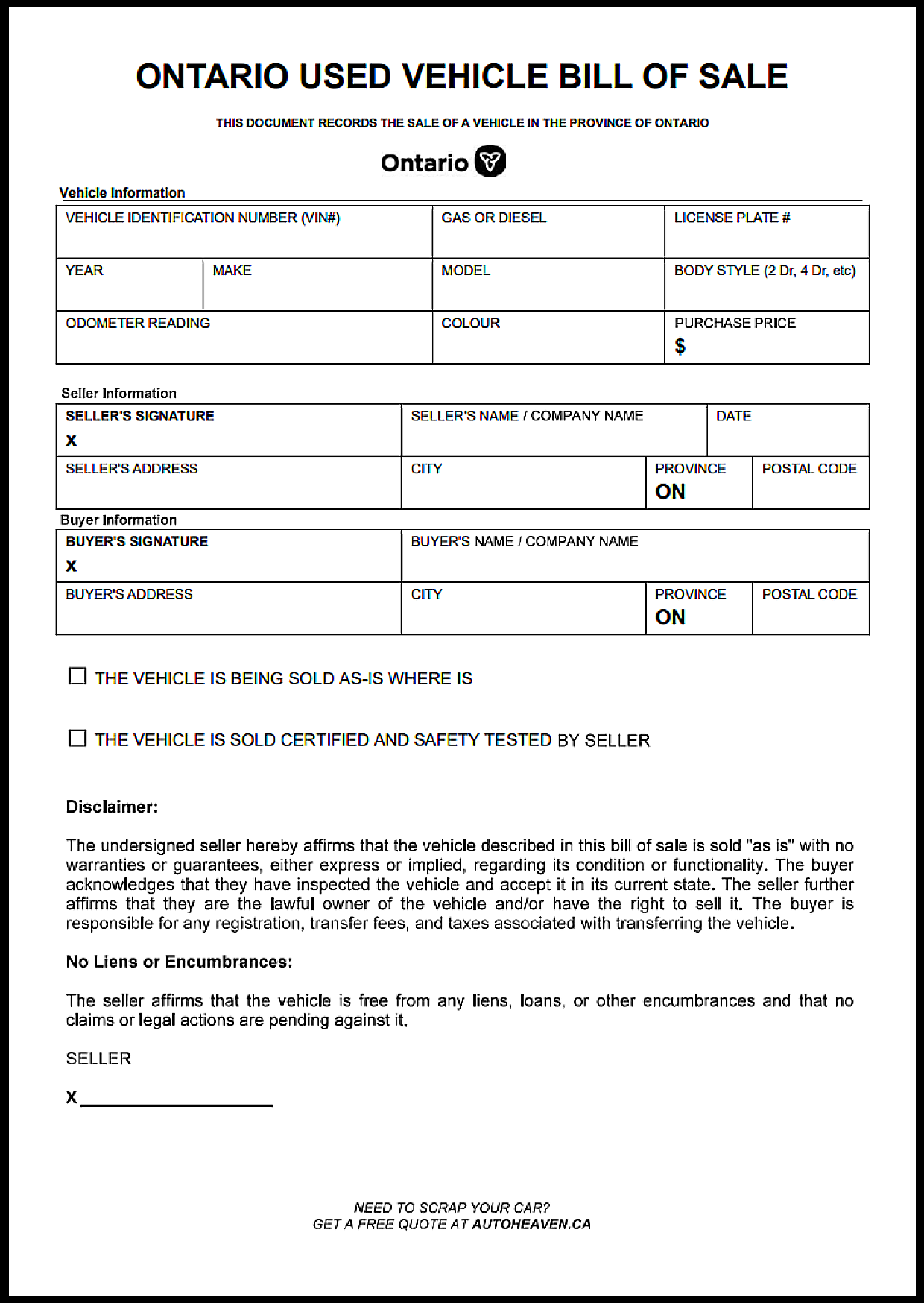
Tip: Fill it carefully and keep one signed copy for both buyer and seller.
Ontario Car Bill of Sale Legal Rules That Can Affect Registration
| Topic / Issue | Ontario Legal Rule | Governing Statute |
|---|---|---|
| Primary governing law | Private vehicle transfers and registration in Ontario are governed primarily by the Highway Traffic Act and related Ontario regulations and government procedures. | Highway Traffic Act, R.S.O. 1990, c. H.8 |
| Supporting vehicle inspection rules | Vehicle safety and inspection requirements are governed by Ontario’s Highway Traffic Act and related regulations. | O. Reg. 601/93 (Motor Vehicle Inspection) |
| Tax collection during transfer | For a taxable private vehicle purchase in Ontario, 13% Retail Sales Tax (RST) is generally collected when the vehicle is registered and transferred. | Retail Sales Tax Act, R.S.O. 1990, c. R.31 |
| Federal involvement | Vehicle registration and the provincial ownership-transfer process are governed primarily by Ontario law, although federal law can apply to particular vehicle-related issues. | Ontario and applicable federal law |
| Who can sign | For an Ontario vehicle sale, the seller completes and signs the Application for Transfer on the back of the vehicle permit, and the Bill of Sale must be signed and dated by both the buyer and seller. | Highway Traffic Act, R.S.O. 1990, c. H.8; Ontario vehicle-transfer requirements |
| Witness requirement | A witness is not required for an ordinary Ontario vehicle Bill of Sale. | N/A |
| Notarization requirement | Notarization is not generally required for an ordinary vehicle Bill of Sale. A qualifying family-gift transfer may require a sworn statement completed before a Commissioner of Oaths or Commissioner for Taking Affidavits. | Ontario vehicle-transfer and family-gift requirements |
| Age and legal capacity | Ontario’s age of majority is 18. Contractual capacity to buy and sell goods is governed by the general law, as recognized by section 3 of the Sale of Goods Act. | Age of Majority and Accountability Act, R.S.O. 1990, c. A.7, s. 1; Sale of Goods Act, R.S.O. 1990, c. S.1, s. 3 |
| Registration deadline | The purchaser must apply to ServiceOntario for a new vehicle permit within 6 days after becoming the owner of the motor vehicle. | Highway Traffic Act, R.S.O. 1990, c. H.8, s. 11(4) |
| UVIP requirement | For a private sale of a used motor vehicle in Ontario, the seller must provide a valid Used Vehicle Information Package (UVIP) to the buyer. | Highway Traffic Act, s. 11.1(1) |
| Required Bill of Sale details | For an Ontario vehicle Bill of Sale, include the VIN; make, year and power source; body type, colour and model if available; purchase price; seller’s name, address and signature; buyer’s name and address; and the sale or purchase date. | Ontario used-vehicle transfer requirements |
| “As-Is” clause | An “as-is” clause should clearly state the agreed condition of the vehicle and any warranty exclusions. Under section 53 of the Sale of Goods Act, rights, duties or liabilities arising by implication of law may be negatived or varied by express agreement, subject to the Act. An “as-is” clause does not automatically eliminate every possible claim. | Sale of Goods Act, R.S.O. 1990, c. S.1, s. 53 |
| Registration process | For registration, the buyer generally needs the UVIP, Bill of Sale or other proof of purchase, the original vehicle permit with the completed transfer portion, proof of insurance and any other documents applicable to the vehicle. | Highway Traffic Act / ServiceOntario process |
| Failure to provide UVIP | Failure to provide the required UVIP means the seller has not complied with the Ontario requirement to provide the package to the buyer. | Highway Traffic Act, s. 11.1(1) |
| Missing or incorrect VIN | The VIN on the vehicle and ownership documents should be checked carefully before registration. Knowingly making a false statement in an application, declaration or other paper writing required by the Highway Traffic Act or regulations can constitute an offence under section 9(1), while section 5.3 separately addresses incorrect information appearing on a permit or licence. | Highway Traffic Act, R.S.O. 1990, c. H.8, ss. 5.3 & 9(1) |
| Signature mismatch | The buyer and seller should make sure the signatures and vehicle-transfer information are completed accurately and consistently with the ownership documents. | Highway Traffic Act / ServiceOntario process |
| Ontario-specific UVIP system | Ontario requires sellers to provide a government-issued UVIP during private sales. | Highway Traffic Act |
| Ontario tax calculation rule | For an automobile, van or truck with an empty weight of 2,200 kg or less, Ontario generally calculates 13% RST using the greater of the purchase price or the applicable Canadian Red Book value. If the vehicle qualifies for an appraisal, the appraisal may affect the taxable value. | Retail Sales Tax Act, R.S.O. 1990, c. R.31; applicable regulations |
The UVIP is one of the documents I would not skip in an Ontario private sale. The seller must provide it to the buyer, and it can reveal whether money is owing on the vehicle. Before signing, compare the VIN on the vehicle with the permit and review the UVIP for lien and vehicle-history information.
I would check the VIN before anything is signed. It should match the vehicle and the ownership documents. The buyer also has only six days after becoming the owner to apply for the new vehicle permit, so registration should not be left until the last minute.
Ontario also uses a specific RST calculation for many privately purchased vehicles. Depending on the vehicle, tax may be based on the greater of the purchase price and the applicable Canadian Red Book value. Check the current Ontario rules before registration so the amount written on the Bill of Sale and the amount used for tax purposes are not confused. Download the free Ontario Car Bill of Sale template below to avoid costly mistakes and complete your sale correctly.
Understanding Ontario Car Bill of Sale Rules
What Is a Car Bill of Sale in Ontario?
Under Ontario law, a car bill of sale is a written record showing that a vehicle was sold from one person to another.
It works as:
- Proof of transaction
- Evidence of payment
- Supporting document for registration
- Protection in case of disputes
In real life, if a disagreement happens later (for example about payment or condition), this document becomes very important.
When Do You Need It?
For an Ontario private vehicle sale, use the Bill of Sale as part of the transfer paperwork. It records the buyer, seller, vehicle and purchase terms, and Ontario’s current government guidance requires a signed Bill of Sale containing specified information. Keep a signed copy after the transaction.
A car bill of sale is one of the most commonly used ownership transfer documents in Ontario. To understand its role in broader legal documentation, review the main bill of sale guide and related formats like the general vehicle bill of sale.
Ontario Vehicle Sale Rules You Must Know
Used Vehicle Information Package (UVIP)
In Ontario, sellers are required to provide a Used Vehicle Information Package (UVIP) for private car sales.
It includes:
- Vehicle history
- Lien (loan) information
- Previous ownership details
Without the required UVIP, the seller has not complied with the Ontario requirement to provide the package to the buyer.
Ownership Transfer Deadline
The buyer must register the vehicle within 6 days of purchase.
If delayed:
- Registration may be delayed
- Other registration issues can arise
Always complete registration as soon as possible.
Safety Standards Certificate (SSC)
A Safety Standards Certificate is generally required when transferring a used vehicle to a new owner and is required to put plates on the vehicle, subject to Ontario’s exemptions.
Important points:
- It is not required simply to complete every private sale
- It is generally required for the used-vehicle transfer and for putting plates on the vehicle, subject to applicable exemptions
What Details Must Be Included?
Buyer and Seller Information
- Full legal names
- Addresses
- Seller’s signature
- Buyer’s name and address
Make sure the information is accurate and consistent with the identification and ownership documents.
Vehicle Identification
- VIN
- Make, model and year
- Power source
- Body type and colour, where applicable
The VIN should be copied carefully from the vehicle permit and checked against the vehicle itself.
Payment Information
- Exact sale price
- Payment method (cash, bank transfer, etc.)
Avoid writing unclear or approximate amounts.
Vehicle Condition
- State whether the vehicle is being sold as-is or with an express warranty
- Identify any specific warranty or condition terms agreed by the parties
An “as-is” clause should describe the parties’ agreement clearly; it does not automatically eliminate every possible legal claim.
Signatures
For an Ontario vehicle Bill of Sale used in the transfer process, both the buyer and seller should sign and date the document.
A signed Bill of Sale provides clearer evidence of the agreed transaction, so both parties should sign and keep a copy.
You may also come across situations where additional clauses are needed, such as in an as-is bill of sale format. For legal clarity, it’s helpful to understand the requirements under Ontario law.
How to Fill Out the Ontario Car Bill of Sale
Follow these simple steps:
Step 1: Enter correct personal details
Step 2: Copy VIN carefully from ownership document
Step 3: Write exact sale price (no confusion)
Step 4: State whether the vehicle is being sold as-is or with any warranty
Step 5: Sign and date the document
Important Tip:
Always create 2 copies (one for buyer, one for seller).
Common Mistakes to Avoid
Many people make small mistakes that later cause big issues:
- Incorrect or missing VIN
- Not obtaining the required UVIP
- Forgetting signatures
- Writing unclear price
- Not keeping a copy
These mistakes can delay registration or create legal disputes.
Legal Risks in Private Car Sales
The paperwork cannot guarantee that a private sale will be trouble-free. It can, however, make the transaction much easier to prove. In Ontario, compare the VIN with the permit, review the UVIP, confirm the seller is the registered owner, record the exact purchase price, and keep the signed Bill of Sale.
Common risks include:
- Disputes over payment
- Hidden vehicle defects
- Ownership conflicts
- Fraud or stolen vehicles
A properly written bill of sale helps create a clear record of what the buyer and seller agreed to.
Does a Car Bill of Sale Need to Be Notarized in Ontario?
No, notarization is not generally required for an ordinary vehicle Bill of Sale in Ontario.
However:
- Both parties should sign and date the Bill of Sale
- A witness is not generally required, although the parties may choose to have one
Car Bill of Sale vs Ownership Transfer Document
| Feature | Bill of Sale |
Ownership (Green Slip)
|
| Proof of payment | Yes | No |
| Required for registration | Part of the transfer paperwork | Yes |
| Provided by seller | Yes | Yes |
| Legal ownership transfer | Records the sale and agreed terms |
Used for the official vehicle-permit transfer
|
Both documents work together — one records the sale and payment terms, while the vehicle permit is used for the official ownership-transfer process.
Real-Life Example
- John sells his used car to Alex. They prepare and sign a Bill of Sale, cross-reference the VIN against the vehicle permit, and John provides the required UVIP.
- Alex registers the vehicle within 6 days at ServiceOntario and pays the applicable RST. If a monetary contractual dispute arises later, Ontario Small Claims Court generally handles claims up to $50,000, while larger claims fall within the Superior Court of Justice.
Frequently Asked Questions (FAQs)
Is a bill of sale mandatory in Ontario?
For an Ontario used-vehicle sale, the seller must provide a signed Bill of Sale containing the required information. The Bill of Sale is an important part of the ownership-transfer process.
Who keeps the original copy?
Both the buyer and seller should keep signed copies of the Bill of Sale. This ensures that each party has proper proof of the transaction.
Can I write my own bill of sale?
Yes. Ontario’s current vehicle-transfer guidance allows a Bill of Sale to be handwritten or prepared in another format, provided it contains the required information and is properly signed.
What if I lose my bill of sale?
If you lose your Bill of Sale, proving the terms of the transaction can become more difficult. Keep your signed copy with the other vehicle and payment records whenever possible.