Ontario Bill of Sale Form | Free Template & Legal Guide
Ontario Bill of Sale is a simple legal document used to record the sale and transfer of ownership of goods between a buyer and seller. It protects both parties by clearly stating what was sold, for how much, and under what terms.
In most private sale situations in Ontario, a bill of sale is not legally required—but it is strongly recommended. It acts as proof of the transaction and can help avoid disputes later.
I’ve seen private sales in Ontario turn into expensive disputes simply because the parties relied on text messages or verbal promises instead of a proper bill of sale. When someone comes to me after the deal has gone wrong, the biggest problem is usually proving exactly what was agreed to and when ownership actually changed hands.
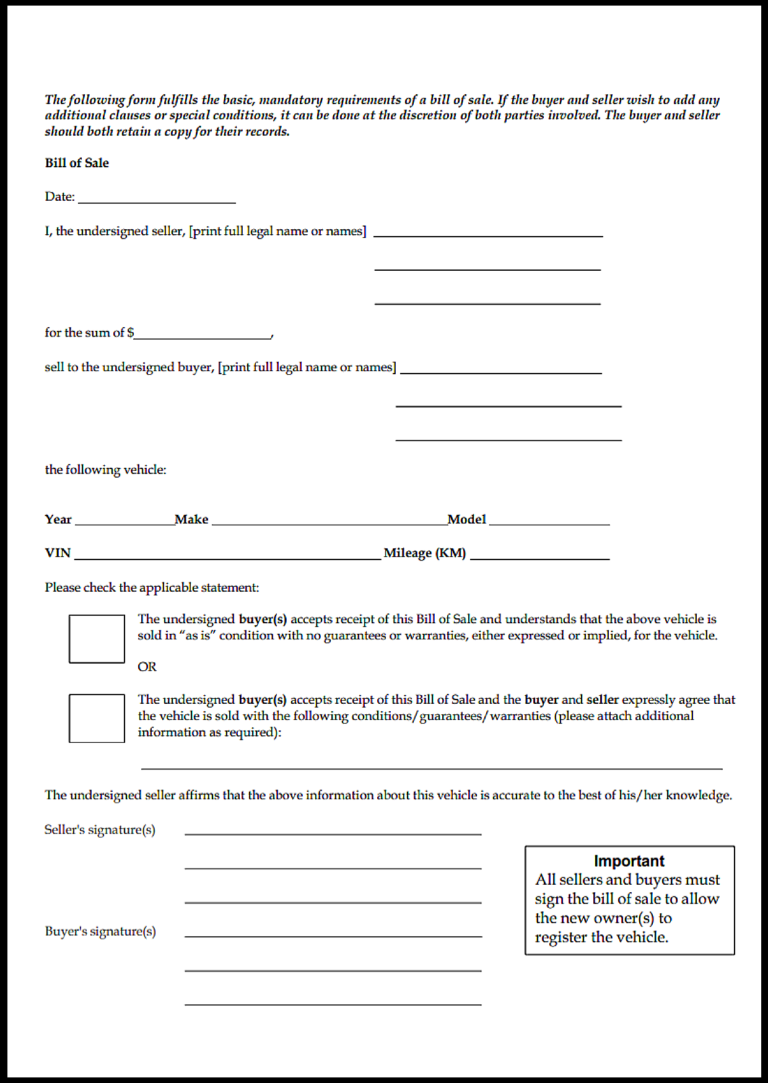
Free Ontario Bill of Sale Template
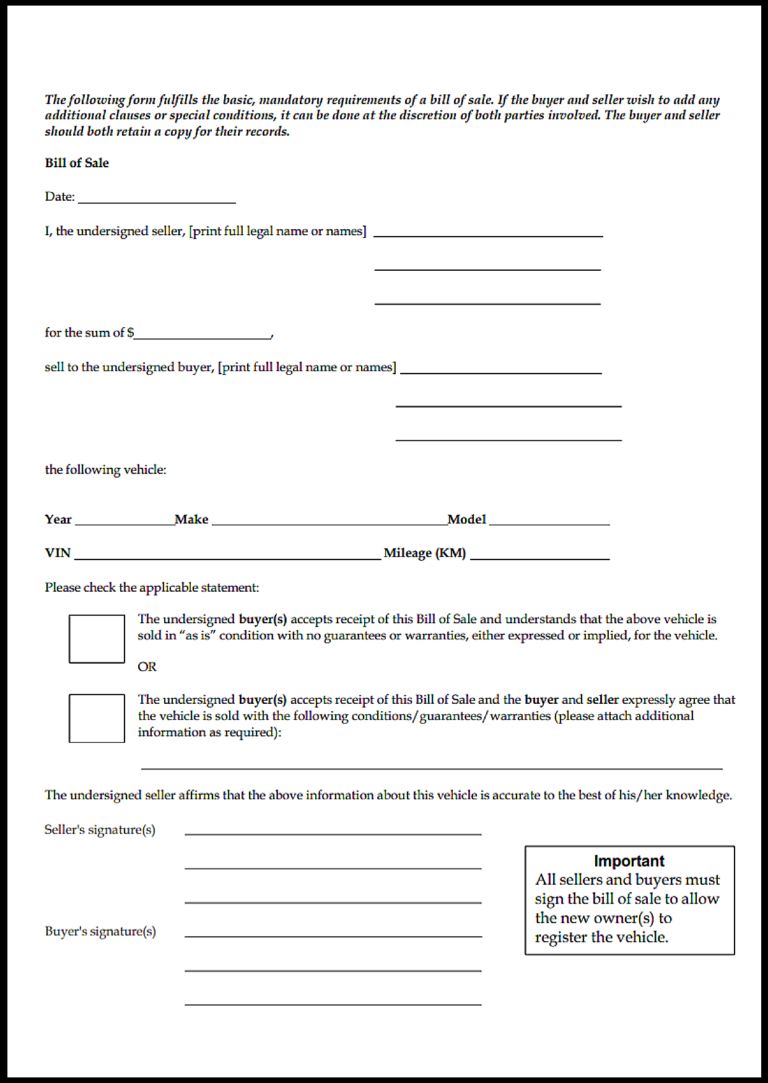
Below is a general-purpose Ontario bill of sale template. It works for most personal transactions like selling furniture, electronics, or small equipment.
Ontario Bill of Sale Laws and Registration Rules You Should Know
| Topic / Issue | Ontario Legal Rule | Governing Statute |
|---|---|---|
| Governing law for sale of goods | The sale of tangible personal property in Ontario is primarily governed by provincial sale of goods legislation. | Sale of Goods Act, R.S.O. 1990, c. S.1 |
| Vehicle transfer requirements | Motor vehicle ownership transfers and registration requirements are governed separately under Ontario vehicle law. | Highway Traffic Act, R.S.O. 1990, c. H.8 |
| Consumer transactions | Consumer protection legislation applies exclusively if the seller is a ‘supplier’ acting in the course of business. Purely private, peer-to-peer transactions are exempt from these statutory regimes, which are transitioning to the updated frameworks under the Consumer Protection Act, 2023, S.O. 2023, c. 23, Sched. 1. | Consumer Protection Act, 2023, S.O. 2023, c. 23, Sched. 1″ |
| Federal jurisdiction | No specific federal act governs a standard Ontario Bill of Sale. | Purely provincial jurisdiction |
| Recent legislative update | The Consumer Protection Act, 2023 was passed to replace the 2002 Act but is largely awaiting proclamation of regulations. | Consumer Protection Act, 2023 |
| Who can sign | The legal owner (seller) and buyer must sign. Corporations require an authorized signing officer. | Sale of Goods Act, s. 3 |
| Witness requirement | No witness is legally required for validity. | N/A |
| Notarization | Notarization is not legally required for validity in Ontario. | N/A |
| Age and legal capacity | Minors under 18 have limited contractual capacity and some contracts may be voidable. | Age of Majority and Accountability Act, s. 1 |
| Vehicle registration deadline | Buyers must register a transferred vehicle within 6 days of purchase. | Highway Traffic Act, s. 11(4) |
| Mandatory “As Is” disclosure | Unfit vehicles sold “as is” require specific warning language regarding roadworthiness and repairs. | Motor Vehicle Dealers Act, 2002, O. Reg. 333/08, s. 61 |
| Filing requirement for general goods | Private sales of general goods do not require government filing. | N/A |
| Vehicle registration filing | Vehicle Bills of Sale must be presented to ServiceOntario for ownership transfer. | Highway Traffic Act requirements |
| Security interest registration | Seller financing interests must be registered to protect against third parties. | Personal Property Security Act (PPSA) |
| Missing VIN | A vehicle Bill of Sale without the correct 17-digit VIN is insufficient for registration. | Highway Traffic Act Reg. 628 |
| UVIP requirement | Private vehicle sellers must provide a Used Vehicle Information Package (UVIP). | Highway Traffic Act, s. 11.1 |
| Undisclosed liens | Ontario law implies goods are free from undisclosed charges or encumbrances. | Sale of Goods Act, s. 13 |
| Ontario-specific vehicle rule | Ontario uniquely requires a UVIP for private vehicle sales. | Highway Traffic Act, s. 11.1 |
| Retail Sales Tax on private vehicle sales | Specified Vehicle Tax of 13% RST is calculated on the greater of the purchase price or the Canadian Red Book wholesale value. If the purchase price is lower due to vehicle condition, a mandatory appraisal (via Ministry of Finance Form 1157) must be executed to pay tax on the actual sale price. | Retail Sales Tax Act, R.S.O. 1990, c. R.31; R.R.O. 1990, Reg. 1012″ |
Ontario has some very specific Bill of Sale rules that many buyers and sellers do not realize until a problem happens. One of the biggest surprises is the Used Vehicle Information Package (UVIP) requirement for private vehicle sales. Unlike many other provinces, Ontario requires the seller to provide this package before the buyer can properly register the vehicle. Another important rule is the 6-day registration deadline under the Highway Traffic Act. Missing this deadline can delay ownership transfer and create unnecessary complications with registration.
The VIN requirement is also extremely important. If the Bill of Sale contains the wrong 17-digit VIN or leaves it out completely, ServiceOntario may reject the transfer. Sellers should also pay close attention to undisclosed liens because Ontario law assumes the item is free from hidden debts or claims. If that turns out to be false, the buyer may have legal grounds to cancel the transaction.
These rules matter because even small paperwork mistakes can create registration delays, ownership disputes, or unexpected financial liability. Download the free Ontario Bill of Sale template to help complete your transaction correctly.
Types of Bill of Sale in Ontario
Not all sales are the same. Under Ontario law, some items require extra details or documents.
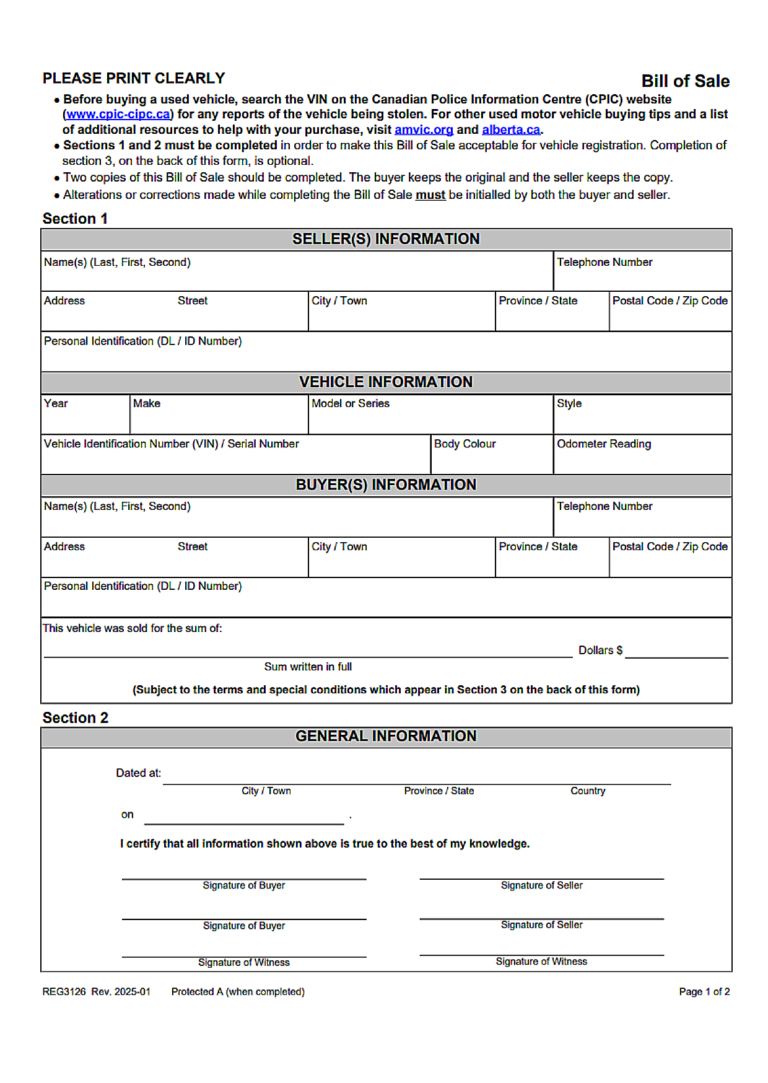
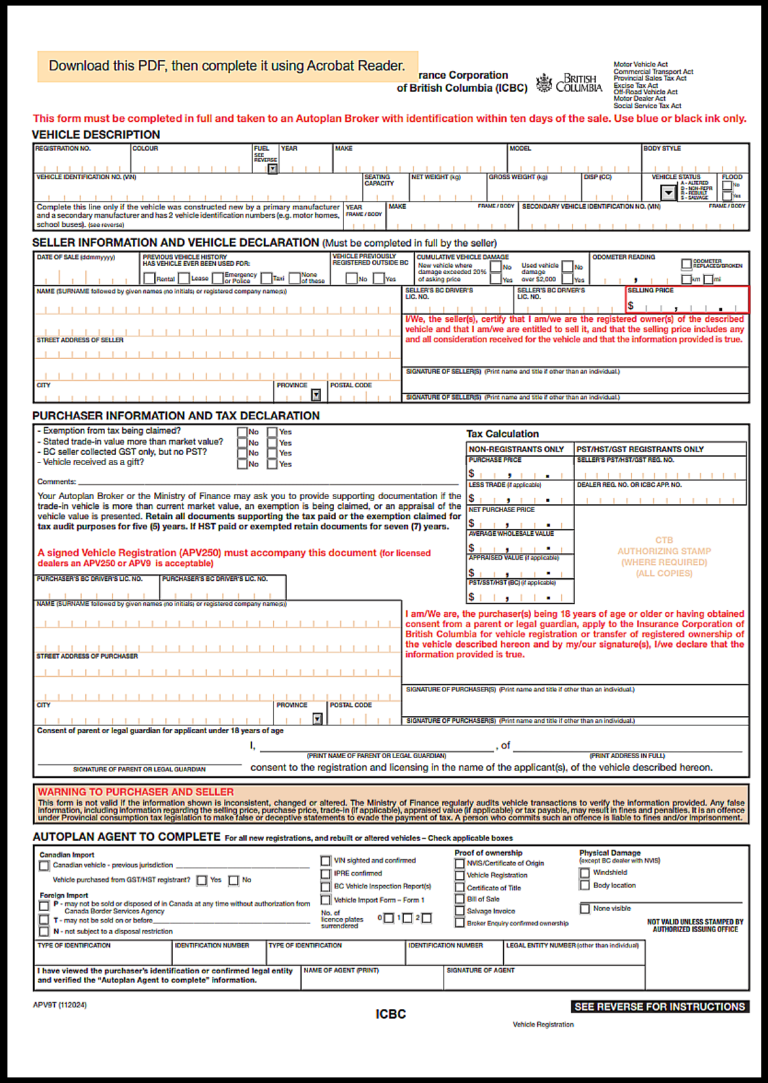
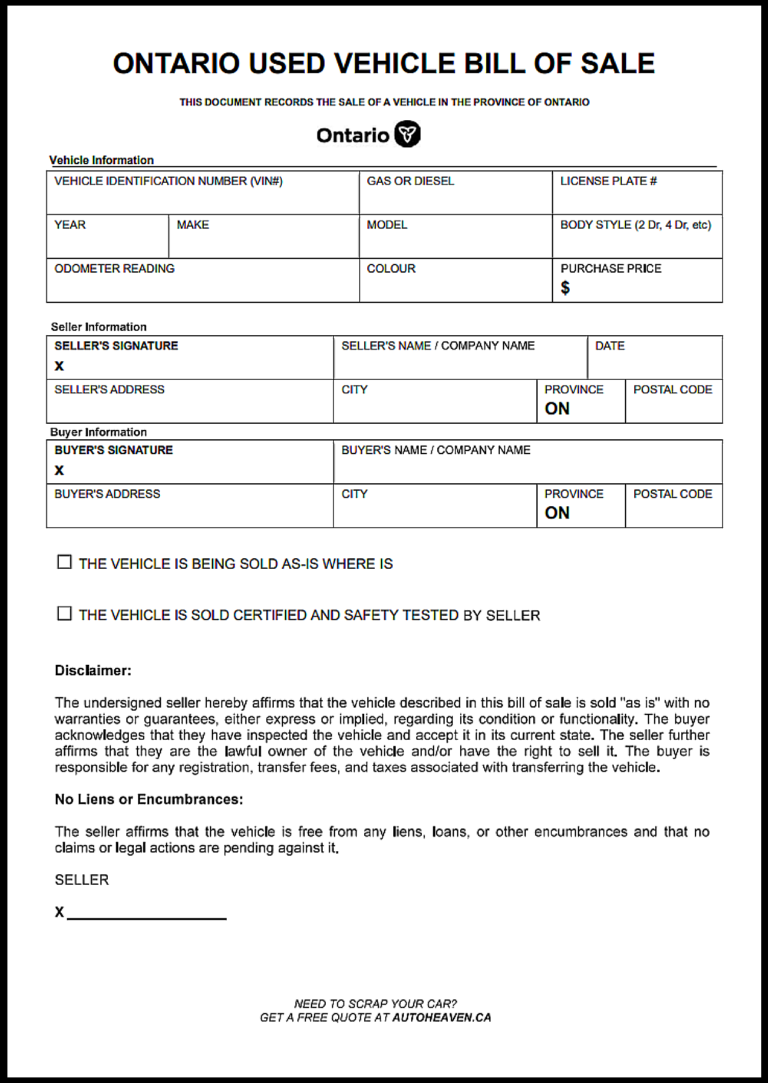
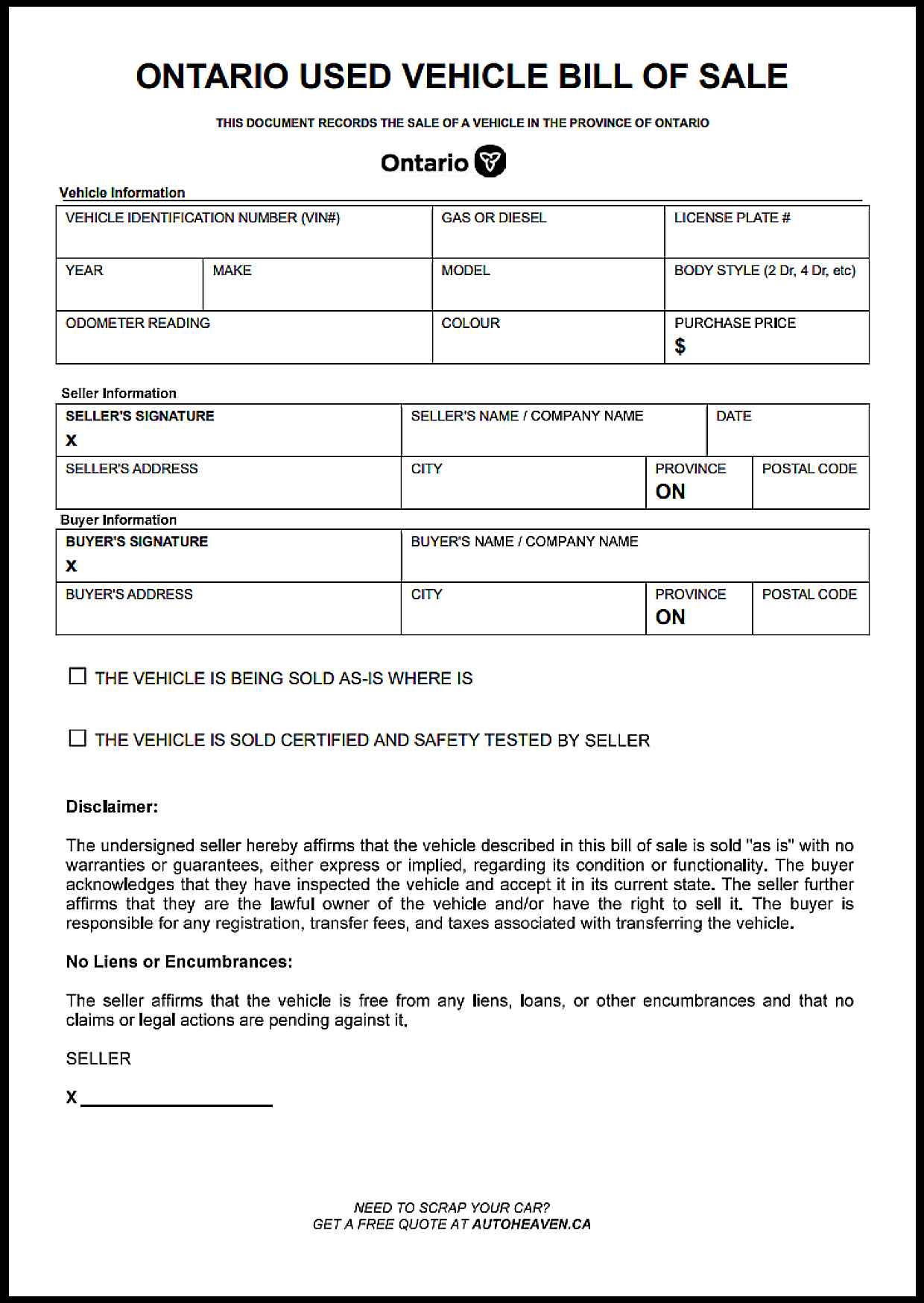
Vehicle Bill of Sale (Car / Motorcycle / Truck)
In Ontario, vehicle transfers usually also require a Used Vehicle Information Package (UVIP). You can verify official requirements through ServiceOntario.
Used when selling a vehicle privately.
Must include:
- VIN (Vehicle Identification Number)
- Make, model, year
- Mileage
- Sale price
In Ontario, vehicle transfers usually also require a Used Vehicle Information Package (UVIP).
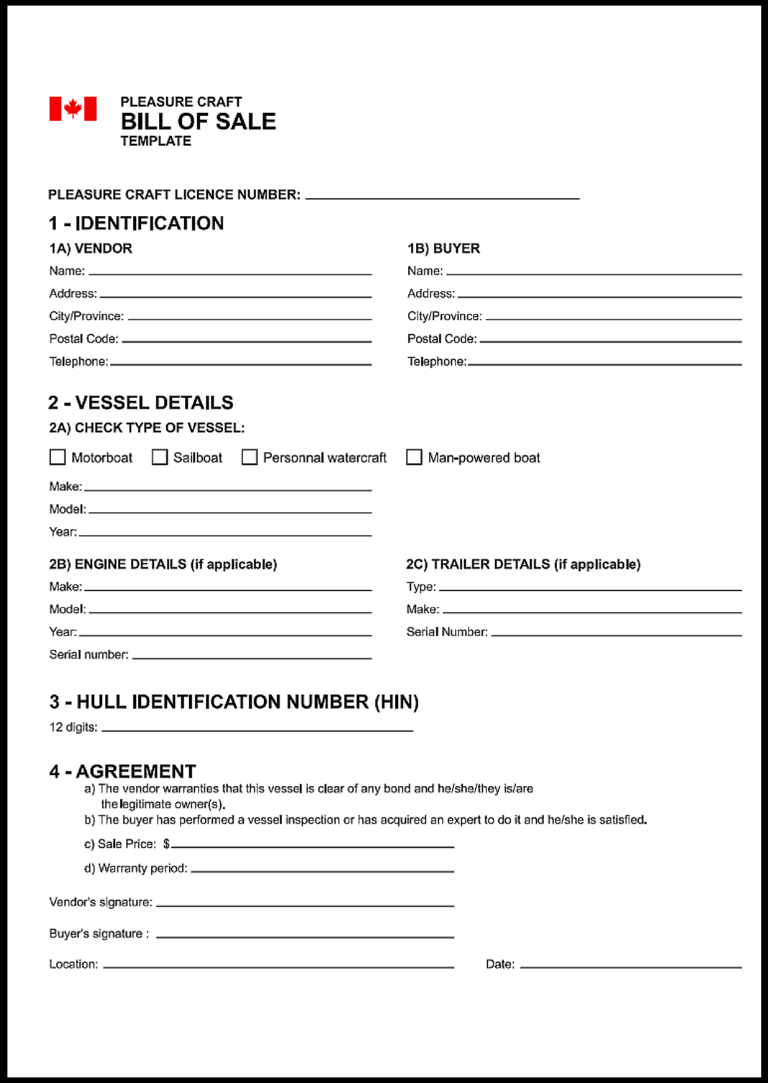
Boat (Vessel) Bill of Sale
Used for boats and watercraft.
Includes:
- Hull Identification Number (HIN)
- Engine details
- Registration info
Important for:
- Ownership proof
- Insurance
- Future resale
When dealing with ownership transfer in Ontario, this article helps you understand how a bill of sale works as a legally recognized proof of transaction. Whether you’re handling a vehicle or personal asset, documents like the vehicle bill of sale template in Ontario and the car sale agreement format are commonly used to record key transaction details.
Firearm Transfer Restrictions (Federal Preemption)
- A private bill of sale cannot legally execute a firearm transfer in Canada. Under federal law, private sales of handguns are subject to a national freeze. For non-restricted firearms, the seller must verify the transferee’s Possession and Acquisition License (PAL) with the Registrar of Firearms to secure a mandatory Reference Number before physical transfer. Violation constitutes an offense under the Criminal Code.
- Firearms Act, S.C. 1995, c. 39; Criminal Code, R.S.C. 1985, c. C-46
Trailer Bill of Sale
Used for trailers, campers, or utility units.
Includes:
- VIN (if available)
- Weight and type
- Condition
Sometimes required for registration in Ontario.
Equipment / Personal Property Bill of Sale
Used for:
- Furniture
- Electronics
- Tools
- Machinery
Flexible and simple format.
Business Asset Bill of Sale
Used when selling business-related items.
Includes:
- Inventory
- Equipment
- Tools
Often part of a larger agreement.
Depending on the type of asset, you may need more specific formats such as a boat bill of sale document or a trailer ownership transfer form. For a broader understanding of legal compliance, it’s also helpful to review the bill of sale requirements in Ontario.
Real-Life Use Cases (When You Need a Bill of Sale)
Here are common situations where a bill of sale is very useful:
- Selling a used car privately in Ontario
- Buying a second-hand boat from an individual
- Selling equipment like generators or tools
- Selling items on platforms like Facebook Marketplace
- Keeping proof for tax or legal records
Example & Adjudicative Forum:
If a dispute arises regarding contract terms, undisclosed liens, or vehicle defects, the Bill of Sale serves as primary documentary evidence. For claims valued up to $35,000 CAD, the proper forum for dispute resolution is the Ontario Small Claims Court. For claims exceeding $35,000 CAD, actions must be commenced in the Ontario Superior Court of Justice.
Key Elements of a Valid Ontario Bill of Sale
To be legally useful, your document must include the following:
Buyer and Seller Information
- Full legal names
- Contact details
Description of the Item
- Clear and detailed
- Include serial numbers (if available)
Purchase Price and Payment Terms
- Exact amount
- Payment method
Date of Sale
- When ownership changes
Signatures of Both Parties
- Makes the document valid proof
-
As-Is” and Statutory Waiver Clause (Critical for Seller Liability) In private transactions, a generic ‘as-is’ statement is legally insufficient to eliminate the implied conditions of merchantable quality and fitness for purpose under the Sale of Goods Act. To successfully shield the seller from post-sale liability, the clause must explicitly state:
-
The buyer accepts the item in its current state and condition, ‘as is, where is,’ with all faults.
-
The parties expressly contract out of and waive all statutory implied conditions, warranties, and remedies under sections 13, 14, and 15 of the Sale of Goods Act, R.S.O. 1990, c. S.1.”
How to Create or Complete a Bill of Sale in Ontario
Follow these simple steps:
Step 1: Identify the type of item
Is it a vehicle, boat, or general item?
Step 2: Use the correct template
Avoid using a general template for regulated items.
Step 3: Fill in accurate details
Double-check numbers, names, and price.
Step 4: Review terms
Especially the “as-is” clause.
Step 5: Sign and keep copies
Both parties should keep a signed copy.
Legal Overview in Ontario
If you’re unsure whether this document is mandatory in your situation, you can explore when a bill of sale is required in Ontario or compare it with other ownership documents like in this bill of sale vs ownership guide.
Avoid these common errors:
- Using a generic template for a vehicle sale
- Missing key details (VIN, serial numbers)
- Not including an “as-is” clause
- Forgetting signatures
- Not keeping a copy
Tip: Small mistakes can cause big problems later—especially in vehicle sales.
Choosing the Right Bill of Sale
| Situation |
Which Bill of Sale to Use
|
| Selling a vehicle |
Vehicle Bill of Sale
|
| Selling a boat | Boat Bill of Sale |
| Selling firearms |
Legally compliant Firearm Bill of Sale
|
| Selling everyday items |
General Bill of Sale
|
| Selling business assets |
Business Bill of Sale
|
FAQs
Is a bill of sale legally required in Ontario?
No, a bill of sale is not legally required in most cases. However, it is strongly recommended because it protects both the buyer and seller and works as proof of the transaction.
Can I write my own bill of sale?
Yes, you can create your own bill of sale. It is valid as long as it includes important details like names, item description, price, and signatures of both parties.
Does a bill of sale need to be notarized?
No, notarization is not required in most situations in Ontario. A properly signed document is usually enough to make it valid.
What is the difference between a bill of sale and a receipt?
A bill of sale is a legal document that shows ownership transfer, while a receipt only proves that payment was made. Both are useful, but they serve different purposes.
Can a bill of sale be used as proof of ownership?
Yes, a bill of sale is commonly used as proof of ownership. It is especially helpful in case of disputes or when confirming ownership details.
What happens if I don’t use one?
If you don’t use a bill of sale, you may face problems later. This can include disputes over price or condition, difficulty proving ownership, and possible legal issues.
Legal Disclaimer
This content is for general information only and is not legal advice. Laws may change or vary depending on your situation. Always verify details with official Ontario government sources or consult a qualified legal professional.