Affidavit format Canada: Download Free PDF & Word Template
Affidavit format Canada is one of the most searched legal topics because people often need a simple, correct format they can actually use. In this guide, I’ll show you exactly how affidavits work in Ontario, give you a ready-to-use template, and explain the legal rules in plain English. If you’re a student, applying for immigration, filing something in court, or just need a sworn statement—this guide is written for you.
One important thing to know: format matters a lot. I’ve seen people in Ontario have affidavits rejected simply because they signed them before meeting a commissioner or used the wrong format for the court or agency involved. When someone is already stressed about immigration, family matters, or court deadlines, that small mistake can create delays they never expected.
Even if your information is correct, a badly formatted affidavit can be rejected or treated as invalid. The good news? Once you understand the structure, it’s actually very simple.
Free Affidavit Template Ontario
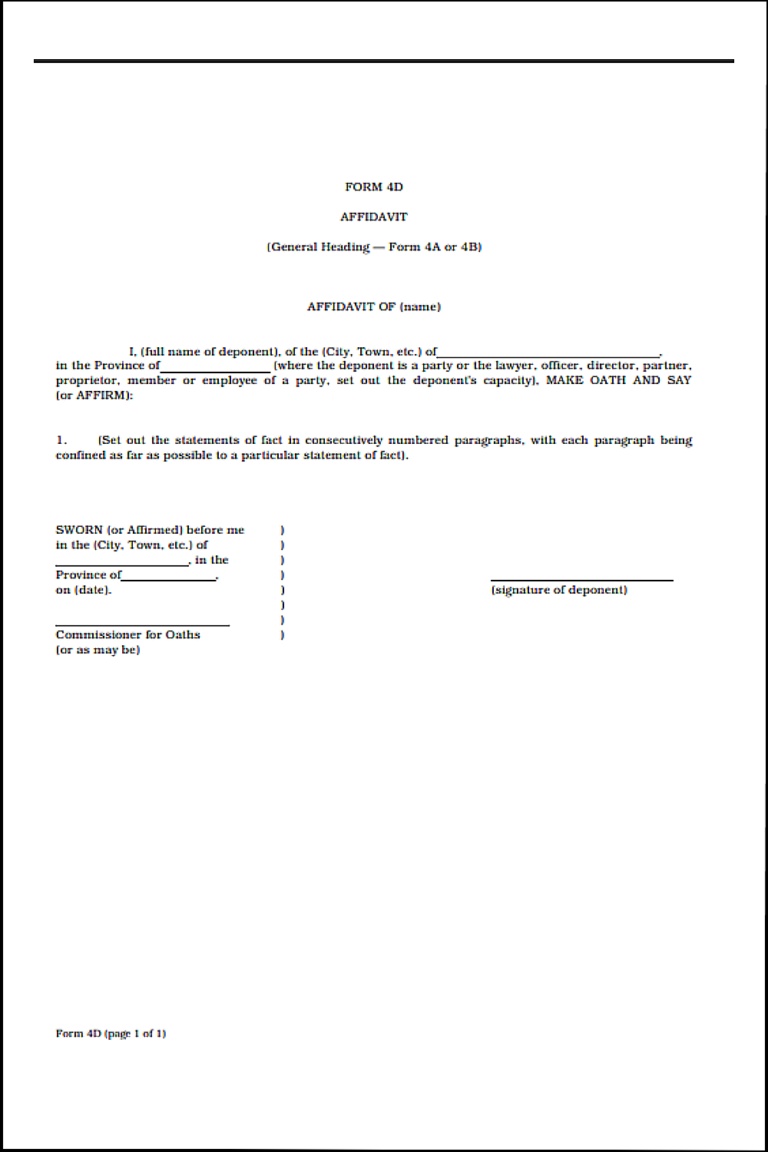
Below is a clean, standard affidavit format used in Ontario. You can copy, edit, and use it.
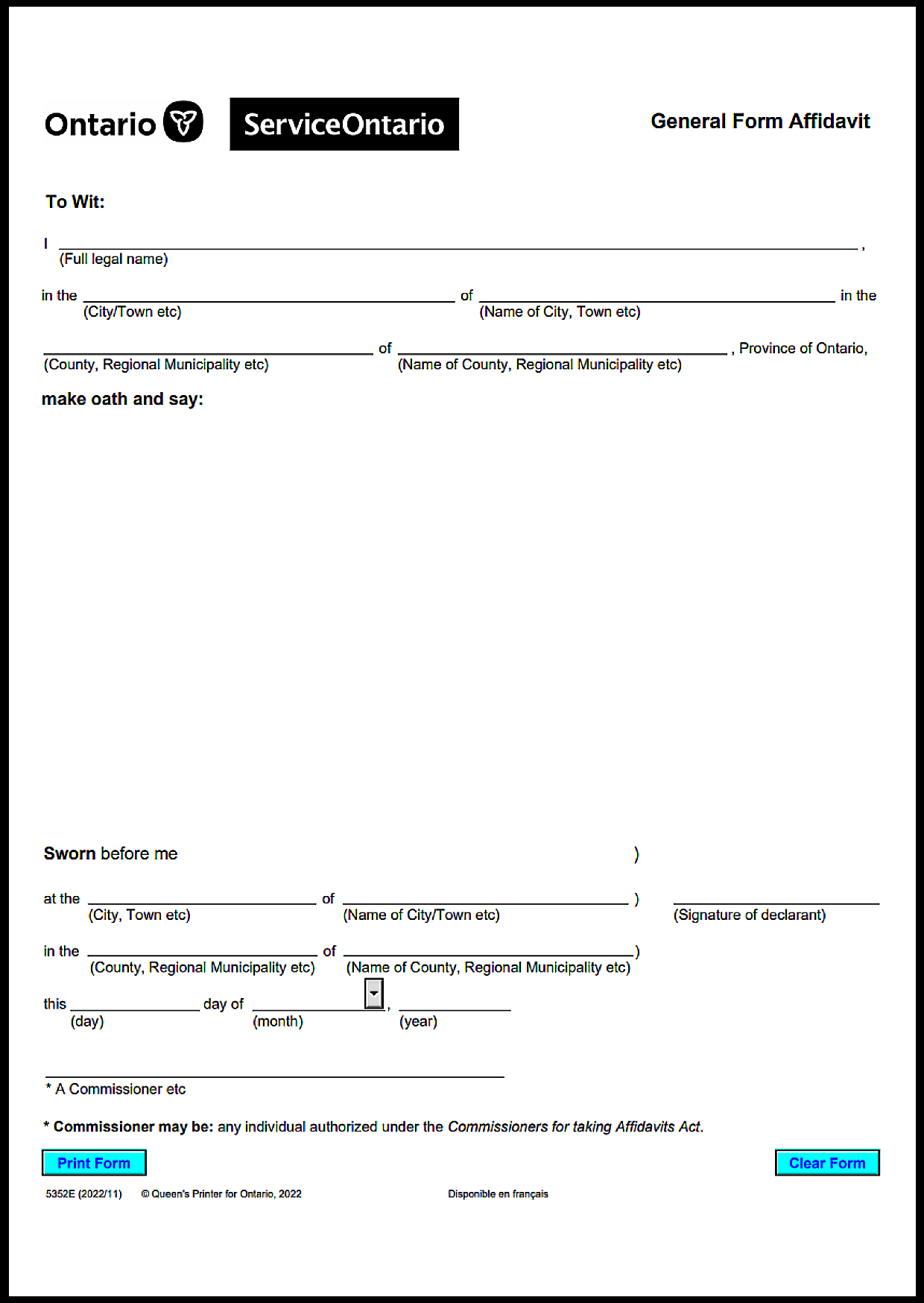
You can use “Sworn” if you follow a religious oath, or “Affirmed” if not.
Always remember:
- Do not sign before meeting the commissioner
- Signature must be done in front of an authorized person
Ontario Affidavit Format Rules, Court Filing Standards & Legal Requirements
| Topic / Issue | Ontario Legal Rule | Governing Statute |
|---|---|---|
| Provincial affidavit laws | Ontario affidavit formatting and court procedures are governed by provincial affidavit and evidence laws. | Rules of Civil Procedure, R.R.O. 1990, Reg. 194 |
| Evidence rules | Ontario evidence law governs affidavits and oath requirements. | Evidence Act, R.S.O. 1990, c. E.23 |
| Commissioner rules | Ontario law governs who can commission and witness affidavits. | Commissioners for Taking Affidavits Act, R.S.O. 1990, c. C.17 |
| Federal affidavit use | Federal evidence law applies when the affidavit is used for immigration or federal court matters. | Canada Evidence Act, R.S.C. 1985, c. E-10 |
| Virtual commissioning | Remote affidavit commissioning is permanently lawful via synchronous, real-time audiovisual communication. The commissioner must verify the deponent’s identity, ensure comprehension, and utilize a modified remote jurat explicitly naming the physical city/province location of both the commissioner and the deponent during the link. | Commissioners for Taking Affidavits Act, R.S.O. 1990, c. C.17; O. Reg. 431/20. |
| Electronic filing | Ontario permits electronic filing and issuance of court documents. | Rules of Civil Procedure, Rule 4.05.1 |
| Who can sign | A deponent must have personal knowledge of the facts or information and belief. | Rules of Civil Procedure, Rule 4.06(1)(b) |
| Witness requirement | The affidavit must be sworn or affirmed before a Commissioner. | Commissioners for Taking Affidavits Act, s. 9 |
| Notarization/commissioning | Affidavits must be signed before a Commissioner for Taking Affidavits or Notary Public. | Commissioners for Taking Affidavits Act, s. 1 |
| Age and mental capacity | The deponent must understand the nature of an oath or affirmation. | Evidence Act, s. 18(1) |
| Motion deadlines | A moving party must serve and file the notice of motion and supporting affidavits at least 7 clear days before the motion hearing date. Under provincial time computation rules, the day of service and the day of the hearing are entirely excluded from the calculation. | Rules of Civil Procedure, R.R.O. 1990, Reg. 194, Rule 37.07(1) and Rule 3.01(1)(a). |
| Mandatory Ontario court format | Civil litigation affidavits in the Superior Court of Justice must strictly use Form 4D. Affidavits filed in the Small Claims Court must strictly utilize Form 15A, while administrative tribunals utilize specialized statutory declaration modules or simplified evidence portals. | Rules of Civil Procedure, Form 4D; Rules of the Small Claims Court, O. Reg. 258/98, Form 15A. |
| Mandatory jurat wording | The affidavit jurat must specify where and when the oath was taken. | Ontario affidavit procedure requirements |
| Virtual commissioning wording | Remotely commissioned affidavits must contain the prescribed remote commissioning statement. | O. Reg. 431/20 |
| Information and belief statements | Affidavits based on information and belief must identify the source of the information. | Rules of Civil Procedure, Rule 39.01(4) |
| Court filing requirement | Litigation affidavits must be filed with the Ontario court clerk handling the case. | Superior Court of Justice / Ontario Court of Justice procedures |
| Electronic court filing | Many Ontario civil affidavits are filed through Justice Services Online. | Justice Services Online procedures |
| Non-litigation affidavits | Private affidavits are generally not filed with the government unless connected to a registered interest. | Land Titles Act filing procedures |
| Presence requirement | The commissioner and deponent must be in each other’s physical or virtual presence. | Commissioners for Taking Affidavits Act, s. 9 |
| Trial affidavit knowledge rule | Trial affidavits must generally be based on personal knowledge rather than information and belief. | Rules of Civil Procedure, Rule 4.06(2) |
| Exhibit marking requirement | Every exhibit attached to the affidavit must be properly marked and signed by the commissioner. | Rules of Civil Procedure, Rule 4.06(3) |
| Ontario remote commissioning system | Ontario permanently adopted remote video commissioning with strict procedural safeguards. | O. Reg. 431/20 |
| Ontario standardized forms | Ontario requires strict affidavit formatting through mandatory Form 4D usage. | Rules of Civil Procedure |
| Expert affidavit requirement | Expert affidavits require a signed Acknowledgment of Expert’s Duty form. | Rule 53.03 |
One of the most important Ontario affidavit rules is that formatting matters just as much as the information itself. Even if the facts are completely true, courts can reject an affidavit that does not follow Ontario’s required Form 4D structure or proper jurat wording. Ontario also applies strict exhibit rules. If documents are attached but not officially marked and signed by the commissioner, those exhibits may become inadmissible in court.
Another major Ontario-specific rule involves virtual commissioning. Ontario permanently legalized remote affidavit signing, but only if the affidavit includes the exact remote commissioning wording required under O. Reg. 431/20. Missing this statement can create serious filing problems.
These rules matter in real life because affidavits are commonly used for court proceedings, immigration matters, identity verification, and property issues. Small technical mistakes can delay hearings, weaken evidence, or cause an affidavit to be rejected entirely. Download the free Ontario affidavit template below to create a properly formatted affidavit that follows Ontario legal requirements.
Understanding Affidavit Format in Canada
An affidavit is a written statement where you promise that everything is true.
But many people confuse two things:
- What to write (content)
- How to write (format)
Simple explanation
- Content = your facts
- Format = structure of the document
In Canada, affidavits follow a fixed structure so courts and officials can easily read them. Ontario follows this structure strictly, but other provinces are very similar.
Understanding the correct affidavit format is essential for ensuring your document is legally valid across Canada. For Ontario-specific applications, you can refer to the affidavit template hub, which provides province-focused guidance.
When Do You Need an Affidavit?
Affidavits are used in many real-life situations. You don’t need to be a lawyer to use one.
Common situations include:
- Court matters (family disputes, civil cases)
- Immigration applications
- Identity verification
- Business or legal documents
For example, if you need to prove your address, you may need an affidavit of residence Ontario.
Sometimes, people also use it for identity proof—see affidavit of identity Canada for that.
Key Parts of a Valid Affidavit (Ontario)
Let’s break it down in a simple way. Every affidavit must have these parts.
Title Section
This is very basic. The document must clearly say “AFFIDAVIT” at the top.
Deponent Information
This means your details. Write:
- Full legal name
- City and province
- Sometimes occupation
Statement of Facts
This is the main part. Write your facts like this:
- Use numbers (1, 2, 3…)
- Keep sentences short
- Only write what is true
Avoid things like opinions or feelings.
Oath or Affirmation
This confirms that:
- You are telling the truth
- You understand it is a legal document
Signature Section
This is where most mistakes happen.
- You sign
- Commissioner signs
- Date and place must be written
A commissioner for oaths must see you sign.
This format applies to multiple document types, including an Ontario sworn affidavit and specialized forms like an affidavit of identity. You can also compare usage differences in the affidavit vs statutory declaration guide.
Ontario Legal Rules
Under Ontario law, affidavits must follow certain rules.
Instead of making it complicated, here’s a simple breakdown:
- Must be signed in front of:
- Commissioner of Oaths
- Notary Public
- Must be:
- Voluntary
- Truthful
- False information can lead to:
- Legal penalty
- Case rejection
In simple words: Never lie in an affidavit.
How to Fill an Affidavit (Step-by-Step)
If you’re doing it for the first time, follow this simple process.
Step 1: Add your details
Write your full name and city properly.
Step 2: Write your facts
Keep it clear and simple:
- One point per line
- Use numbers
- No extra story
Step 3: Avoid emotional language
Do not write:
- “I feel…”
- “I think…”
Only write facts.
Step 4: Keep signature blank
Do not sign at home.
Step 5: Visit a commissioner
They will:
- Check your ID
- Watch you sign
- Stamp your document
You can read more in how to get affidavit Ontario.
Affidavit vs Statutory Declaration
Many beginners get confused here, so this table will help:
| Feature | Affidavit |
Statutory Declaration
|
| Oath Required | Yes | No |
| Used For | Court cases |
General/legal use
|
| Signed Before | Commissioner/Notary |
Authorized official
|
| Legal Strength | Strong (court evidence) | Slightly less |
If your case is not for court, you can also use statutory declaration Canada.
Common Mistakes to Avoid
Some mistakes can make your affidavit invalid. These are very common:
- Signing before meeting the commissioner
- Writing false or exaggerated facts
- Using unclear language
- Missing date or location
- Not following proper format
Tip: Always check your document once before signing.
Do You Need Notary or Commissioner?
Yes, in most cases.
Instead of long explanation, here is a quick comparison:
| Role | Commissioner of Oaths | Notary Public |
| Work | Witness affidavits |
Wider legal powers
|
| Cost | Low or free | Usually higher |
| Use | Basic affidavits |
Advanced/legal documents
|
Can You Use Same Format Across Canada?
Yes, mostly.
The structure stays the same, but small changes may happen like:
- Province name
- Minor wording
For example:
- Ontario → “Province of Ontario”
- Alberta → “Province of Alberta”
So always adjust based on where you are submitting it.
FAQs About Affidavit Format Canada
Is handwritten affidavit valid?
Yes, a handwritten affidavit is valid if it is clear, properly written, and signed in front of a commissioner or notary.
Can I make my own format?
No, not for litigation. If your affidavit is intended for an Ontario court proceeding, the court registrar will summarily reject the document if it fails to comply with the mandatory format of Form 4D (Superior Court of Justice) or Form 15A (Small Claims Court). These require an exact style of cause, sequential numbered paragraphs in the first person, and an unalterable provincial jurat block.
Is notary required in Ontario?
No for domestic use; yes for international use. A Commissioner for Taking Affidavits is legally sufficient for documents staying within Canada. However, under the Hague Apostille Convention (which entered into force for Canada on January 11, 2024), if an Ontario affidavit is being sent outside the country, it must be sworn before an appointed Notary Public and formally apostilled to achieve legal validity abroad.
Can affidavit be used for immigration?
Yes, affidavits are very commonly used as supporting documents in immigration processes.
What if affidavit is false?
If an affidavit contains false information, you may face serious legal action, including fines or other penalties.
Final Thoughts
Affidavit format may look difficult at first, but it’s actually simple.
Just remember:
- Follow the correct structure
- Write only true facts
- Sign in front of a commissioner
If you follow these steps, your affidavit will be valid.